No, I am not confusing here vitamin A and vitamin D as done in the early days of vitamin research. This post is really about vitamin A (but with similar nomenclature problem as with vitamin D). Retinol is ingested in a precursor form; animal sources like liver (–>cod liver oil) contain retinyl esters, whereas plants like carrots contain carotenoids. Wikipedia has the formulas
Hydrolysis of retinyl esters results in retinol while pro-vitamin A carotenoids can be cleaved to produce retinal. Retinal, also known as retinaldehyde, can be reversibly reduced to produce retinol or it can be irreversibly oxidized to produce retinoic acid.
I am primarily interested in retinoic acid as – in analogy to cholecalciferol – this substance has now well documented immunological effects. Just visit JEM for a recent editorial and several original papers. The editorial demystifies oral tolerance. Provitamin A is transformed into retinoic acid by gut-associated DCs and enhances the conversion of T cells into FoxP3+ T reg cells by a TGF-ß-dependent mechanism.
So certainly, a good time to ask if excess consumption (or deficit) of vitamin A may be related to allergy. Here are few snippets what’s being already known about vitamin A and allergy – and my interpretation of the vitamin A effect
- Retinyl palmitate, a retinol ester, can lead to contact dermatitis link
- Vitamin A levels in children with asthma were found to be lower than in controls link1 + link2
- Vitamin A deficiency promotes bronchial hyperreactivity in rats link
- an European Community Respiratory Health Survey (ECRHS) meta-analysis showed reduced sensitization risks for vitamin A intake link
- Retinol concentration in young infants is inversely associated with the subsequent development of allergic symptoms link
- Increased intake of retinol reduced the risk of atopic dermatitis link
- lower alpha-carotene intake in asthmatics link1+link2
- Vitamin A treated mice were less capable of resolving the inflammatory response elicited during sensitization link
Somewhat confusing low exposure/low levels bringing up an allergy risk – contrary to the general opinion but may be assumed from some model experiments.
Addendum
16 Oct 2007 Found the abstract #318 in JACI Jan 2002; S114

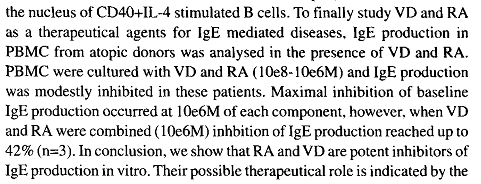
Addendum
Vitamin A content in cod liver oil may be enormous: 5 ml may contain 1,000 ug/3,300 IU vitamin A which is now gradually reduced.
Addendum
Injection of liposomal retinoic acid increases OVA induced IgE – agonistic effect to vitamin D.
Retinoic acid imprints gut homing specificity of T cells – clearly antagonistic.