I recently came across the European Journal of Translational Myology publishing papers outside the scope of the journal and outside the expertise of the editorial board.
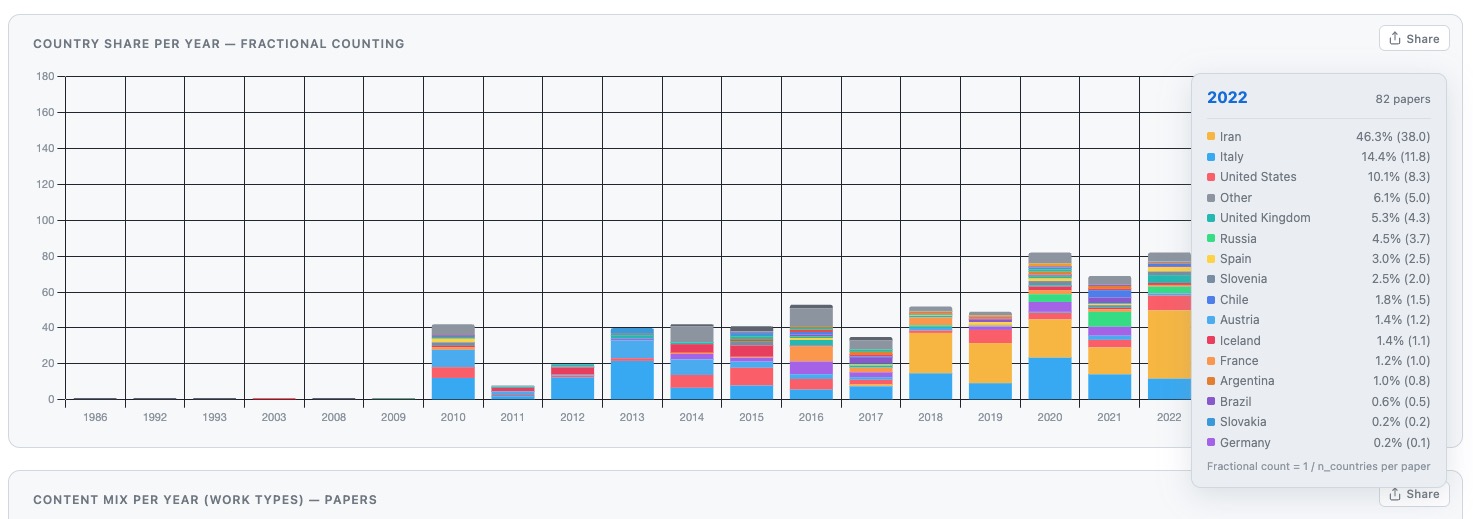
Editor-in-Chief Ugo Carraro (*1943, former University of Padua researcher) supported EJTM’s broadening from muscle physiology into general medicine, proposing a rename to “Myology, Mobility, Medicine”. The journal subsequently started to publish Iranian clinical papers across orthopedics, dentistry, psychiatry, COVID-19, and urology – not related to myology. In 2022, an Iranian author even published in EJTM a bibliometric study of Iranian output in EJTM itself – a self-referential feedback loop that normalizes the journal as a legitimate Iranian venue inviting further submissions.
The Cegolon bridge
Luca Cegolon (University of Trieste) is the structural intermediary between Baqiyatallah University of Medical Sciences (BMSU) and Italian academia. He holds at least six joint publications with Einollahi and Javanbakht spanning COVID-19, plasma exchange, ozone therapy, and kidney injury – all on Iranian data. Cegolon completed his PhD at Padua University Medical School, the same institution as Carraro. The Tehran-Trieste-Padua route therefore carries manuscripts from a sanctioned IRGC institution to a Pavia open-access publisher with no regulatory friction.
Javanbakht as serial off-topic submitter
Javanbakht’s EJTM papers cover kidney transplantation pharmacology (Suprotac tacrolimus), male fertility / varicocelectomy, and wrist tendon transfer surgery – none touching myology. The pattern is deliberate: EJTM is Scopus-indexed, open-access and has demonstrated tolerance for off-topic Iranian clinical submissions. The Suprotac APC was almost certainly paid by NanoAlvand Company, the product’s manufacturer, paying a trivially small marketing cost for a PubMed-citable Phase IV label.
The sanctions geography
From March 2013, OFAC regulations prohibited US-owned journals from handling manuscripts authored by Iranian government employees. Elsevier instructed its US editors to reject such manuscripts outright. OFAC sanctions also generated misunderstanding among editors in other countries, who rejected Iranian manuscripts for political rather than scientific reasons, further narrowing the accessible publishing landscape.
The primary exchange is probably not financial but metric. For Cegolon, co-authorship with a high-volume Iranian clinical group accelerates publication output at a career stage where Italian Abilitazione Scientifica Nazionale metrics directly determine promotion. For BMSU and NanoAlvand, the European co-author provides editorial access, institutional legitimacy, and a sanctions-circumventing pathway to Scopus. The APC is the transaction cost; mutual bibliometric benefit is the structural incentive - legal, common, and largely misaligned with quality control.
Reactions
15/6/26 I received an email from Ugo Carraro that basically confirms that <EJTM3 has opened up since 2018 to publish any “Medicine” work>. Interestingly he adds that all
Ejtm papers end with the Disclaimer: All statements expressed in this article are solely those of the authors and do not necessarily represent those of their affiliated organizations, nor those of the publisher, editors, or reviewers. Any product reviewed in this article or claims made by its manufacturer are not guaranteed or endorsed by the publisher.
So he distances from the content – a strange move. Sure, as a liability device, it is a standard, boilerplate non-endorsement clause found across many journals. Under ICMJE and COPE norms, editors retain responsibility for what they accept, including registration requirements, scope fit, and conflict-of-interest handling. A publisher cannot contract out of that responsibility after the fact via a footer. The disclaimer does not address why a prospectively-unregistered, manufacturer-funded bioequivalence study was accepted in a myology journal. The authors responded with some AI generated appeasement while the publisher response is still missing.