Tag Archives: insufficiency

Withstand the threshold

I called the Endocrine Society’s 2024 reversal the biggest shift I’d probably eveer seen. Vitamin D insufficiency gone, thresholds meaningless, stop testing healthy people. And now, Frontiers runs Christie et al., Vitamin D in the UK: an urgent call to redefine the threshold for deficiency. The ask is one number: move the UK deficiency line from <25 to <50 nmol/L.

Notice it never argues with the Society. It can’t – the RCTs are the RCTs. So it just moves the fight somewhere else. The Society shut the door on the low-normal band. This reopens it by calling that same band “deficiency.” The new “deficient” line sits exactly on the floor of the old “insufficiency” band the Society just threw out. Everyone below 50 gets relabelled. In UK Biobank, isn’t that more than half of adults?

The first pages are all rickets, seizures, osteomalacia. Sure, those are real, and I have never said otherwise. But that’s the trick – they open with mis-treated toddlers in Glasgow and close with a cutoff for sixty million people who feel fine.

They half-admit it themselves near the end: efficacy depended on VDR genotype, and “we will need to move away from using serum 25(OH)D thresholds as the only target.” Fine - so why demand a new one?

And then read who’s asking – Frontiers prints it in full:”

SC: Over the last 3 years received consultant fees from the Council for Responsible Nutrition UK CRN UK. ACT NOW Vitamin D's inception meeting was supported by CRN UK, including room hire, subsistence and travel expenses. TH: Over the last 5 years, received consultant fees from Noble Foods and an honorarium from Danone. TH's institution currently receives a sponsored PhD studentship from The Lakes Free Range Egg co. Currently instructed as an expert witness by a professional services firm in a tribunal matter concerning a nutritional supplement company. Trustee of the Nutrition Society charity. CR: Received consultancy fees during 2025 from the European Fruit Juice Association, Yoplait, General Mills, the UK Tea & Infusions Association, Tate & Lyle, Holland & Barrett, the Proprietary Association of GB, BBC Radio Scotland, the British Egg Industry Consortium, INRAE and the University of Reading. She also serves as a board member of Quality Meat Scotland, a public body. MH: Co-holder of two patents on the therapeutic use of vitamin D binding protein; honorarium and royalties as Editor-in-Chief of Feldman and Pike's Vitamin D. The remaining author(s) declared that this work was conducted in the absence of any commercial or financial relationships that could be construed as a potential conflict of interest.

The inception meeting paid for by the supplement trade body. Two patents on vitamin D binding protein. Royalties on a textbook.

I’m not saying the rickets isn’t real. But do you understand the urgency? I can only speculate. The ground moved – an earthquake – and an establishment defending its liturgy. Fresh scary NDNS numbers, a government that still hasn’t answered its own 2022 call for evidence, and SACN sitting at 25 as the world’s outlier.

If you are a MD: please treat vitamin D deficiency where you find it, the child kept indoors, the elderly housebound or dark skin in a Northern winter. But don’t turn half the country into patients three weeks after the biggest society on earth said stop that.

Yea, yea. Nay, nay. The rest cometh of the trade associations.
 

CC-BY-NC Science Surf , accessed 05.08.2026

The biggest turning point in medical science that I have ever encountered

Vitamin D insufficiency? Gone!

I can’t even remember how many vitamin D studies we did, explaining how this prohormone has been discovered and how stupid guidelines came on to the scene.

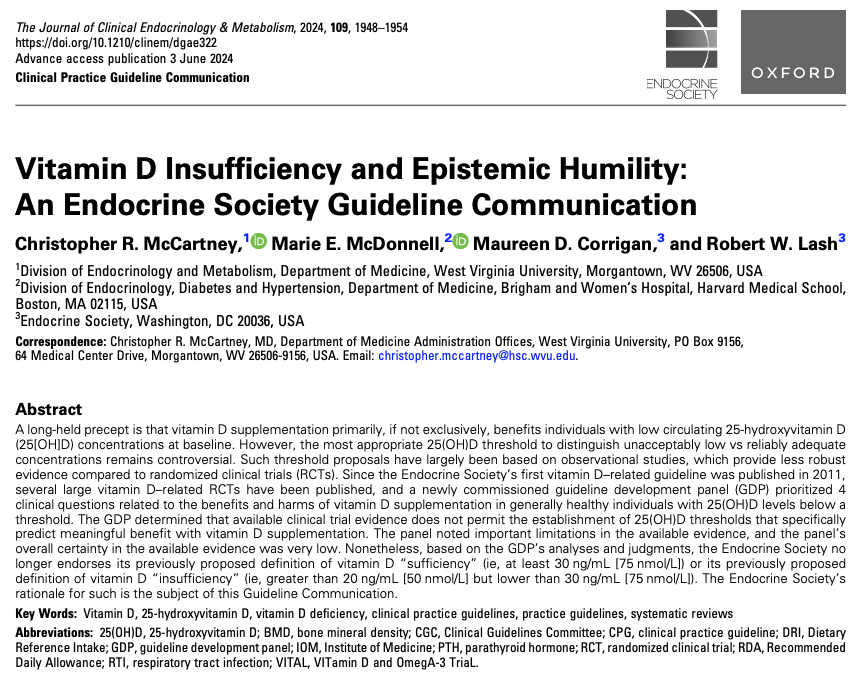
https://academic.oup.com/jcem/article/109/8/1948/7685309

And it didn't happen quietly. It wasn't a minor tweak, a footnote, or an incremental update. It was a full reversal of a doctrine that has dominated labs, clinics, public-health brochures, and countless biomarker panels for decades. A classical paper even claimed that 50% of the world population is vitamin D insufficient. For years, we had to live with the tidy triplet:

<20 ng/mL = deficiency
20-30 ng/mL = insufficiency
≥30 ng/mL = sufficiency

That middle category "insufficiency" became a diagnosis in itself. It justified mass screening. It justified supplementation campaigns. It justified entire clinical cultures built around chasing numbers. And then 2024 arrived.

Because after reviewing all high-quality randomized trials, the Endocrine Society concluded something truly astonishing:

there is no reliable evidence that people with 25(OH)D levels between 20 and 30 ng/mL derive any clinically meaningful benefit from raising those levels

In fact, the guideline panel found that even below 20-24 ng/mL, evidence for clear benefit is surprisingly weak or uncertain - except perhaps in the very elderly, and even there the benefit didn't map neatly to a threshold. Vitamin D physiology makes the whole "insufficiency" concept biologically dubious, because serum 25(OH)D is only an external storage marker of an intracellular prohormone system - a tank that appears "empty" only in true deficiency like rickets. Let me put that differently: The category of "vitamin D insufficiency," introduced in 2011 and used worldwide, is now considered *scientifically unsupported*. The Society explicitly withdraws it.

That is not merely unusual. In the world of clinical guidelines, this is as close as you get to a scientific earthquake. Why did they withdraw it? Because the evidence never really showed what everyone assumed.

The new communication explains the problem with striking clarity:

1. Observational associations misled us.
Many early threshold claims came from correlations - low vitamin D and higher PTH, low vitamin D and lower bone density, etc. But none of this proved causality, and much of it turned out to be non-informative once RCTs were performed.

2. Surrogate markers were overinterpreted.
Calcium absorption, PTH suppression, even bone mineral density - these are *indirect* signals. They don't automatically translate into fewer fractures, fewer falls, fewer infections, or longer life. And when RCTs finally tested real outcomes, the expected clinical benefits simply weren't there.

3. Large RCTs showed no special benefit in "low-normal" ranges.
VITAL - one of the biggest vitamin D trials ever - found no difference in fractures even in participants below 24 ng/mL, and even those below 12 ng/mL did not exhibit the dramatic benefit everyone predicted (though the subgroup was very small).

4. Across thousands of participants aged 50-74, supplementation beyond the RDA made essentially no difference - including in those below the supposed thresholds.
The forest plots in the guideline communication make this visually obvious: the <20-24 ng/mL subgroups almost never differ from the overall population in any meaningful direction. (See page 5 of the document: identical risk-change estimates for falls, fractures, cancer, CVD, etc.)

We rarely see a major medical society openly dismantle one of its own most influential guidelines - not because of scandal, not because of politics, but because the evidence finally matured and said: we were wrong. And they didn't hedge. They didn't massage the language. They called the new stance what it is: epistemic humility.

Still not convinced? For key readings go for the approx 10 vitamin D “umbrella reviews” and the 20 studies that show “vitamin D as a marker of inflammation“.


CC-BY-NC Science Surf , accessed 05.08.2026