Category Archives: AI supported

A bookmarklet that highlights AI generated prose

As AI models are trained on vast amounts of text, including published, polished prose that uses professional typesetting, which is why they default to these more precise characters although they cannot be simply reached by a keyboard. Some examples are

— Em Dash U+2014 Two hyphens (–) or special key commands Used to set off a phrase for emphasis or a sharp break in thought—like this.

– En Dash U+2013 Hyphen (-) Used for ranges of numbers or dates (e.g., 1990–2000) or to join two names in a phrase.

“ ” Curly Quotes U+201C, U+201D Straight quotes (“) Typographically correct quotation marks used in formal writing.

‘ ’ Curly Apostrophe U+2018, U+2019 Straight apostrophe (‘) Typographically correct apostrophe.

… Ellipsis U+2026 Three periods (…) A single character for an ellipsis.

A forensic caveat: these are heuristics, not proof. Smart-punctuation in any word processor produces identical glyphs from human input, and a model can be told to emit ASCII. The presence raises the prior; it does not establish AI provenance.

javascript:(function(){var ID='glyphHL',ex=document.querySelectorAll('mark.'+ID);if(ex.length){ex.forEach(function(m){m.replaceWith(document.createTextNode(m.dataset.c))});document.body.normalize();['_'+ID+'s','_'+ID+'b'].forEach(function(i){var e=document.getElementById(i);if(e)e.remove()});return}var G={'\u2014':['em dash','U+2014','dash'],'\u2013':['en dash','U+2013','dash'],'\u2212':['minus','U+2212','dash'],'\u2010':['hyphen','U+2010','dash'],'\u2012':['figure dash','U+2012','dash'],'\u2015':['horizontal bar','U+2015','dash'],'\u201C':['left double quote','U+201C','quote'],'\u201D':['right double quote','U+201D','quote'],'\u2018':['left single quote','U+2018','quote'],'\u2019':['apostrophe / right single','U+2019','quote'],'\u2032':['prime','U+2032','quote'],'\u2033':['double prime','U+2033','quote'],'\u2026':['ellipsis','U+2026','ell'],'\u00A0':['no-break space','U+00A0','space','NB'],'\u2009':['thin space','U+2009','space','TH'],'\u202F':['narrow nbsp','U+202F','space','NNB'],'\u200C':['zero-width non-joiner','U+200C','space','ZWNJ'],'\u200D':['zero-width joiner','U+200D','space','ZWJ'],'\uFEFF':['BOM / zwnbsp','U+FEFF','space','BOM']};var cls='[\\u2014\\u2013\\u2212\\u2010\\u2012\\u2015\\u201C\\u201D\\u2018\\u2019\\u2032\\u2033\\u2026\\u00A0\\u2009\\u202F\\u200C\\u200D\\uFEFF]';var has=new RegExp(cls),rx=new RegExp(cls,'g');var s=document.createElement('style');s.id='_'+ID+'s';s.textContent='mark.'+ID+'{border-radius:2px;padding:0 1px;color:inherit;box-shadow:0 0 0 1px rgba(0,0,0,.2)}mark.'+ID+'.dash{background:#bcd0ff}mark.'+ID+'.quote{background:#ecc9ff}mark.'+ID+'.ell{background:#b8efe2}mark.'+ID+'.space{background:#ffd0c4;outline:1px dashed #b23b2e;display:inline-block;min-width:.5em;text-align:center}mark.'+ID+'.space::after{content:attr(data-x);font:9px/1 monospace;color:#b23b2e;vertical-align:super;margin-left:1px}';document.head.appendChild(s);var c={dash:0,quote:0,ell:0,space:0},nodes=[],w=document.createTreeWalker(document.body,NodeFilter.SHOW_TEXT,{acceptNode:function(n){if(!n.nodeValue||!has.test(n.nodeValue))return 3;var p=n.parentNode,t=p&&p.nodeName;if(t=='SCRIPT'||t=='STYLE'||t=='NOSCRIPT'||t=='TEXTAREA')return 3;if(p&&p.isContentEditable)return 3;return 1}});while(w.nextNode())nodes.push(w.currentNode);nodes.forEach(function(n){var f=document.createDocumentFragment(),v=n.nodeValue,last=0,m;rx.lastIndex=0;while((m=rx.exec(v))){var ch=m[0],i=m.index,g=G[ch];if(i>last)f.appendChild(document.createTextNode(v.slice(last,i)));var mk=document.createElement('mark');mk.className=ID+' '+g[2];mk.dataset.c=ch;mk.title=g[0]+' '+g[1];if(g[2]=='space')mk.dataset.x=g[3];mk.textContent=ch;f.appendChild(mk);c[g[2]]++;last=i+ch.length}if(last<v.length)f.appendChild(document.createTextNode(v.slice(last)));n.parentNode.replaceChild(f,n)});var tot=c.dash+c.quote+c.ell+c.space,b=document.createElement('div');b.id='_'+ID+'b';b.style.cssText='position:fixed;z-index:2147483647;right:12px;bottom:12px;background:#14161a;color:#fff;font:12px/1.5 system-ui,sans-serif;padding:8px 12px;border-radius:6px;box-shadow:0 2px 10px rgba(0,0,0,.3);max-width:240px';b.innerHTML='<b>'+tot+'</b> typeset glyphs<br>'+c.dash+' dash &middot; '+c.quote+' quote &middot; '+c.ell+' ellipsis &middot; '+c.space+' space/hidden<br><span style="opacity:.7">click the bookmarklet again to clear</span>';document.body.appendChild(b)})();

/* glyph-highlighter bookmarklet — readable source
 *
 * Highlights typeset Unicode glyphs that a plain keyboard does not produce.
 * Run once to highlight; run again on the same page to remove.
 *
 * Categories (CSS class + colour):
 *   dash   blue          em/en/minus/hyphen/figure dash/horizontal bar
 *   quote  purple        curly quotes, curly apostrophe, prime, double prime
 *   ell    teal          ellipsis
 *   space  red, dashed   no-break/thin/narrow spaces + zero-width chars (ZWJ/ZWNJ/BOM)
 *
 * Invisible characters carry a small superscript tag (NB, TH, ZWJ, ...) via ::after,
 * because they have no visible shape of their own.
 *
 * To install: minify to a single line and prefix with "javascript:" as a bookmark URL,
 * or use the one-liner already provided.
 */
(function () {
  var ID = 'glyphHL';

  // --- toggle off: if marks exist, unwrap them and remove injected nodes ---
  var existing = document.querySelectorAll('mark.' + ID);
  if (existing.length) {
    existing.forEach(function (m) {
      m.replaceWith(document.createTextNode(m.dataset.c)); // restore original char
    });
    document.body.normalize(); // merge split text nodes back together
    ['_' + ID + 's', '_' + ID + 'b'].forEach(function (id) {
      var el = document.getElementById(id);
      if (el) el.remove();
    });
    return;
  }

  // --- glyph table: char -> [name, codepoint, category, shortTag?] ---
  var G = {
    '\u2014': ['em dash', 'U+2014', 'dash'],
    '\u2013': ['en dash', 'U+2013', 'dash'],
    '\u2212': ['minus', 'U+2212', 'dash'],
    '\u2010': ['hyphen', 'U+2010', 'dash'],
    '\u2012': ['figure dash', 'U+2012', 'dash'],
    '\u2015': ['horizontal bar', 'U+2015', 'dash'],
    '\u201C': ['left double quote', 'U+201C', 'quote'],
    '\u201D': ['right double quote', 'U+201D', 'quote'],
    '\u2018': ['left single quote', 'U+2018', 'quote'],
    '\u2019': ['apostrophe / right single', 'U+2019', 'quote'],
    '\u2032': ['prime', 'U+2032', 'quote'],
    '\u2033': ['double prime', 'U+2033', 'quote'],
    '\u2026': ['ellipsis', 'U+2026', 'ell'],
    '\u00A0': ['no-break space', 'U+00A0', 'space', 'NB'],
    '\u2009': ['thin space', 'U+2009', 'space', 'TH'],
    '\u202F': ['narrow no-break space', 'U+202F', 'space', 'NNB'],
    '\u200C': ['zero-width non-joiner', 'U+200C', 'space', 'ZWNJ'],
    '\u200D': ['zero-width joiner', 'U+200D', 'space', 'ZWJ'],
    '\uFEFF': ['BOM / zero-width no-break space', 'U+FEFF', 'space', 'BOM']
  };

  // character class covering every key above
  var cls = '[\\u2014\\u2013\\u2212\\u2010\\u2012\\u2015\\u201C\\u201D\\u2018\\u2019' +
            '\\u2032\\u2033\\u2026\\u00A0\\u2009\\u202F\\u200C\\u200D\\uFEFF]';
  var has = new RegExp(cls);        // non-global: safe for .test()
  var rx  = new RegExp(cls, 'g');   // global: used to scan/split text

  // --- injected stylesheet ---
  var style = document.createElement('style');
  style.id = '_' + ID + 's';
  style.textContent =
    'mark.' + ID + '{border-radius:2px;padding:0 1px;color:inherit;box-shadow:0 0 0 1px rgba(0,0,0,.2)}' +
    'mark.' + ID + '.dash{background:#bcd0ff}' +
    'mark.' + ID + '.quote{background:#ecc9ff}' +
    'mark.' + ID + '.ell{background:#b8efe2}' +
    'mark.' + ID + '.space{background:#ffd0c4;outline:1px dashed #b23b2e;display:inline-block;min-width:.5em;text-align:center}' +
    'mark.' + ID + '.space::after{content:attr(data-x);font:9px/1 monospace;color:#b23b2e;vertical-align:super;margin-left:1px}';
  document.head.appendChild(style);

  // --- collect candidate text nodes ---
  var counts = { dash: 0, quote: 0, ell: 0, space: 0 };
  var nodes = [];
  var walker = document.createTreeWalker(document.body, NodeFilter.SHOW_TEXT, {
    acceptNode: function (n) {
      if (!n.nodeValue || !has.test(n.nodeValue)) return NodeFilter.FILTER_REJECT;
      var p = n.parentNode, t = p && p.nodeName;
      if (t === 'SCRIPT' || t === 'STYLE' || t === 'NOSCRIPT' || t === 'TEXTAREA') return NodeFilter.FILTER_REJECT;
      if (p && p.isContentEditable) return NodeFilter.FILTER_REJECT;
      return NodeFilter.FILTER_ACCEPT;
    }
  });
  while (walker.nextNode()) nodes.push(walker.currentNode);

  // --- wrap each matched glyph ---
  nodes.forEach(function (n) {
    var frag = document.createDocumentFragment();
    var v = n.nodeValue, last = 0, m;
    rx.lastIndex = 0;
    while ((m = rx.exec(v))) {
      var ch = m[0], i = m.index, g = G[ch];
      if (i > last) frag.appendChild(document.createTextNode(v.slice(last, i)));
      var mk = document.createElement('mark');
      mk.className = ID + ' ' + g[2];
      mk.dataset.c = ch;                 // original char, for clean restore
      mk.title = g[0] + ' ' + g[1];      // hover tooltip: name + codepoint
      if (g[2] === 'space') mk.dataset.x = g[3];
      mk.textContent = ch;
      frag.appendChild(mk);
      counts[g[2]]++;
      last = i + ch.length;
    }
    if (last < v.length) frag.appendChild(document.createTextNode(v.slice(last)));
    n.parentNode.replaceChild(frag, n);
  });

  // --- count badge ---
  var total = counts.dash + counts.quote + counts.ell + counts.space;
  var badge = document.createElement('div');
  badge.id = '_' + ID + 'b';
  badge.style.cssText =
    'position:fixed;z-index:2147483647;right:12px;bottom:12px;background:#14161a;color:#fff;' +
    'font:12px/1.5 system-ui,sans-serif;padding:8px 12px;border-radius:6px;' +
    'box-shadow:0 2px 10px rgba(0,0,0,.3);max-width:240px';
  badge.innerHTML =
    '<b>' + total + '</b> typeset glyphs<br>' +
    counts.dash + ' dash \u00B7 ' + counts.quote + ' quote \u00B7 ' +
    counts.ell + ' ellipsis \u00B7 ' + counts.space + ' space/hidden<br>' +
    '<span style="opacity:.7">click the bookmarklet again to clear</span>';
  document.body.appendChild(badge);
})();


CC-BY-NC Science Surf , accessed 13.06.2026

Südhof reloaded

Following the Lindau elogy there is a new Südhof paper in  Neuroscience.

The biggest issue? Undisclosed self-interest.  Südhof opens by admitting his own lab is under PubPeer scrutiny, then analyzes PubPeer as if providing neutral commentary. This is never adequately acknowledged as the primary driver of the piece. His attack on PubPeer commentors for income-dependent bias applies with greater force to himself.

The “income” claim misrepresents PubPeer’s structureThe assertion that PubPeer’s key proponents base their livelihood on comment success conflates a handful of individuals with the platform as a whole. PubPeer is a registered non-profit. The overwhelming majority of commentors are anonymous volunteers – I know only of a few exceptions Bik/Patreon, David/Dana Farber or Oransky/service fees. The characterization implies a structural commercial incentive that does not exist institutionally. Verdict – clearly wrong.

The Occam’s razor argument is logically invalid. He argues: if you wanted to fake a Western blot, you’d just load fake samples rather than manipulate images – therefore image manipulation is less likely. This is not my empirical experience: Image manipulation happens to rescue weak signals, fix failed loading controls, save time. The existence of an allegedly simpler path to fraud does not preclude the actual path taken. Applied consistently, this reasoning exculpates most detected fraud by construction.

“Minor issues with no bearing on main findings” is asserted without evidence.  He repeats the Lindau argument as if established. The opposite is frequently documented: duplicated Western blots in result-critical panels, reused patient data across trials presented as independent cohorts, fabricated dose-response curves. No data are provided on PubPeer’s false positive rate, proportion of retractions later shown unjustified, or what fraction of flagged issues were peripheral vs. central to conclusions. Verdict – not a scientific argument

The proposed alternatives?  Just a return control to the same failed system?  eLife comments, Nature “Matters Arising”, and BioRxiv comments require formal authorship and pass through editorial gatekeeping by the same journals that sat on integrity concerns for years before PubPeer forced action. The history of that institutional failure is the reason PubPeer exists, and it goes entirely unaddressed.

Where Südhof is right. The description of the author-journal power imbalance is accurate and underappreciated. Journals recruit reviewers for free, make unilateral acceptance and retraction decisions, collect open-access fees, and provide authors no due process. A paper can be retracted without the authors having any formal right of appeal. COPE guidelines nominally govern this process but confer authority on journals, not authors.

(with AI support)


CC-BY-NC Science Surf , accessed 13.06.2026

The EMA on Zandoriah

This story started by end of March 2026 – see also my arXiv preprint – with an email to the European Medical Association after examining some Iranian RCTs.

One of these was a teriparatide biosimilar that  is under scrutinity by the EMA.

ASK-292796 – EMA Zandoriah / teriparatide received on 01/04/2026
Thank you for your message and your interest in the European Medicines Agency. Your request has been given the reference number ASK-292796.

Unfortunately there was no further response however.

So I repeated my email 6 weeks later

ASK-294576 – Zandoriah CHMP opinion received on 15/05/2026
Thank you for your message and your interest in the European Medicines Agency. Your request has been given the reference number ASK-294576.
We will reply to you as soon as we can. For complex queries, it may take longer to answer. In any case we will write back to you within 2 months from the date of receipt.
Please do not reply to this email, this is an automated response to confirm that we have received your request. If you need to contact us again about the same matter, please use the form on our website and mention the reference number.

Another 2 weeks later an EMA official (or an EMA bot) answered

The European Medicines Agency does not routinely request or receive individual patient-level datasets as part of its marketing authorisation applications. The Agency’s evaluation is primarily based on the analyses and summaries provided by applicants, in line with the established regulatory framework. Please be informed that the European Public Assessment Report for this product will be published on the EMA website soon, it will contain the details of the assessment, including specific studies and types of data which served as the grounds for the CHMP Opinion.
With regards to your concerns raised, please note that we have a whistleblowing policy in place. Please check https://www.ema.europa.eu/en/about-us/how-we-work/external-whistleblowing-policy for further reference.
If you consider your concerns well-founded, you are welcome to submit full supporting and detailed evidence via the email reporting@ema.europa.eu so it can be properly assessed and acted upon as appropriate.

So I sent email number 3 to the reporting hotline.

Funnily, on the the next day, instead of a response, the EMA published numerous related Zandoriah documents including the anticipated market authorisation.

I am not an expert in reading these kind of official documents. Asking Claude for interpretation it says

A PK/PD comparability study was published but contains errors

The RMP (Module SII and SIII) names EudraCT 2019-004477-82 explicitly: an open-label, randomised, two-sequence, two-period crossover bioequivalence study in 60 healthy female subjects, comparing P044 20 µg vs Forsteo 20 µg single dose subcutaneous. This study has now been identified as Raykova et al. 2021 (Expert Opinion on Biological Therapy 22:2, 235–243) by CinnaGen employees and their contracted CRO in Bulgaria. The paper states that the study “was approved by independent ethical committee ” naming neither the committee nor its approval number or date, contrary to ICMJE requirements. For a study conducted in Sofia, Bulgaria by a CRO contracted by an Iranian sponsor, and submitted to EMA as part of a marketing authorisation dossier, the absence of independently verifiable ethics oversight documentation is a material reporting deficit.

The EMA report states 60 subjects; the published paper reports 66 enrolled, 56 completers, 48 PK-evaluable. The figure 60 probably corresponds to the P044 safety population (Table 5, N=60), suggesting the RMP cited the treatment-specific safety denominator rather than the enrolled N. The sample size section states CV=25%, 80% power, alpha=5% → n=56 required; standard TOST calculation for those inputs yields only n=16, not 56. Reverse engineering shows n=56 corresponds to an intrasubject CV of approximately 49%. Either the stated CV or the stated sample size is wrong.

Eight of 56 completers (14%) were excluded post-hoc from PK analysis for pre-dose concentrations exceeding 5% of Cmax. With a teriparatide half-life of approximately 1 hour and a 3-day washout, pharmacokinetic carryover is impossible. The paper investigated all plausible causes and found none. This cluster of unexplained pre-dose signals is almost certainly what the EMA’s provisional negative opinion referred to in September 2021 when it cited “uncertainties about the way results from the study on distribution in the body had been analysed.” The first EMA application (Teriparatide Cinnagen) was withdrawn on 9 September 2021, two weeks after this paper appeared online. The second application (Zandoriah) received a positive initial opinion in March 2026 although the arithmetic mean of t½ for P044 (0.95h, SD 1.80h) has SD exceeding mean, which is inconsistent with a normal distribution for a strictly positive variable and indicates severe right-skew or extreme outliers in the population.

If teriparatide PK differs between sexes (there is published evidence that it does as body weight, renal function, and volume of distribution differ systematically), then the bioequivalence demonstrated in healthy young women (mean age 33, mean BMI 24) may not extend to the male patients or older postmenopausal women who are the actual clinical population. This is a limitation of the design and would normally appear in the discussion. It does not.

The serum calcium PD endpoint used in this study reflects transient PTH receptor activation in kidney and gut, not the osteoblast stimulation and bone matrix formation that defines teriparatide’s clinical value, which operates over months and is measurable only through bone turnover markers or BMD.

Structural comparability data — peptide mapping, circular dichroism, receptor binding, cell-based bioassay — are absent from the published paper and the EPAR assessment report that would contain them remains unavailable. Eight of 56 completers (14.3%) had pharmacokinetically impossible pre-dose elevations despite a 72-half-life washout, most plausibly explained by ELISA cross-reactivity with endogenous PTH(1-84), which would mean the measured PK curves partially reflect endogenous hormone rather than the biosimilar. If assay specificity for P044 differs even slightly from that for Forsteo — due to differences in aggregation state or degradation profile — the apparent bioequivalence is an assay artefact,

The only clinical efficacy data in the entire dossier is the Tabatabaei-Malazy 2018 RCT that I identified in my paper.

The CinnoPar RCT (Tabatabaei-Malazy 2018) remains formally part of the dossier

The RMP Module SIII states it explicitly: 104 patients randomised, 94 analysed, 6-month follow-up. This is the study with documented impossible CVs, cross-variable mean duplicates, a CONSORT flow claiming zero exclusions despite extensive exclusion criteria, and a Table 1 denominator inconsistency (counts consistent with N=43, percentages consistent with N=44). EMA accepted this study as contributing to the clinical comparability claim. None of the documents address the data integrity issues documented on PubPeer.

The safety exposure is thin and the risk assessment is anomalous. Table 15 of the RMP states 52 patients exposed to CinnoPar across the entire clinical trial programme. The RMP then lists Important Identified Risks: None; Important Potential Risks: None; Missing Information: None. This triple “None” against a 52-patient safety database is a regulatory anomaly. The Forsteo originator dossier covered over 2,800 patients.

So EMA authorised Zandoriah on a dossier that includes: (1) a published bioequivalence study with unclear ethical provenance and a sample size calculation that is arithmetically irreconcilable with its stated inputs; (2) a clinical RCT with documented forensic anomalies that remain unaddressed in the regulatory record. (3)  There is also currently no publicly verifiable basis for assessing whether P044/CinnoPar/Zandoriah is structurally and functionally comparable to Forsteo at the molecular level.


CC-BY-NC Science Surf , accessed 13.06.2026

There is no average patient

I am collecting material for an article questioning EBM (evidence based medicine) while coming across an interesting preprint by Zach Shahn “Trust me, I’m a doctor”.

Suppose that outcomes under usual care, e.g., collected from hospital health records, outperform the outcomes in both arms of a randomized experiment conducted in the same population. A textbook example concerning lung cancer patients comes from Hernan and Robins [2024], see also Sarvet and Stensrud [2025]. Then, Deaton and Cartwright’s argument that one should trust their physician over a trial is validated. In this case, a next step is to find the criteria that physicians are using to make personalized decisions.

He continues to examine study settings in which a randomized trial is nested within an observational cohort, so that outcomes are observed under treatment, control, and usual care while I am following up here his reference to Sarveed & Stensrud  Unfortunately the abstract of this paper is poor – it should have explained the two definitions of “harm” in personalized medicine. So I try it on my own.

Counterfactual harm – a patient is harmed if they received a treatment whose outcome is worse than what would have happened under the alternative – requires knowing unobservable potential outcomes / principal strata. The interventionist harm (the authors’ preference): a patient is harmed if their expected outcome under the assigned treatment is worse than under the alternative, conditional on their measured features which requires only experimentally identifiable quantities. The counterfactual approach is practically problematic because principal strata are metaphysical objects that can never be verified, require non-experimental data and partial identification. The interventionist approach is transparent, observable, and doesn’t coerce commitment to unverifiable metaphysics.

The paper does not explain how to do this in practice – I think this could be just a well-designed RCT with pre-specified effect modification analysis. The workflow would be; pre-register → stratified randomization → interaction-term analysis or causal forest → decision rule by argmax of expected outcome. You never need to ask “what would have happened to this patient under the other treatment” — you only ask “what does the evidence say about patients like this one.”


CC-BY-NC Science Surf , accessed 13.06.2026

US demands on African countries in exchange for health aid

After dismantling USAID in January 2025, the Trump administration has been negotiating bilateral health agreements with over 30 countries, predominantly in Africa, under its “America First Global Health Strategy.” The deals tie what was previously humanitarian assistance to a bundle of strategic demands:

1. Personal health and genomic data

Ghana walked away from a $109 million deal after Washington demanded access to personal health data (Ärzteblatt, April 2026). In Zambia, the US demanded 10 years of access to national health and genomic data in exchange for only 5 years of funding, with no guarantee that Zambia would benefit from any vaccines or drugs developed from that data (IBTimes UK).

2. Mining concessions for US companies

A leaked State Department memo proposed explicitly using HIV aid for Zambia’s 1.3 million PEPFAR-dependent patients as leverage to extract access to copper, cobalt, lithium, and rare earth minerals (FPRI, March 2026). In the DRC, after demanding 20-year corporate tax exemptions, windfall tax waivers, and duty-free treatment for US imports, Washington secured a deal giving US firms right-of-first-offer on certain mining sites (Capital & Main, April 2026).

3. Recipient country co-financing

Zambia’s proposed deal required the country itself to contribute roughly $340 million in domestic health spending alongside the US offer of $1 billion over five years, sharply reducing the net benefit (Observer Research Foundation, March 2026).

4. Regulatory reforms favoring US investment

Several agreements include clauses requiring recipient governments to create favorable regulatory environments for US direct investment in mining and pharmaceuticals (Al Jazeera, April 2026).

So the strategic goal is to redirect African critical minerals — cobalt, copper, lithium, rare earths — into US supply chains and counter China’s dominance in African mining.

PEPFAR, long regarded as one of America’s most successful humanitarian programs (credited with saving over 26 million lives globally), is now being openly wielded as a negotiating tool. Zimbabwe, Zambia, and Ghana have rejected or walked out of talks; Kenya, Nigeria, Ethiopia, and over a dozen others have signed agreements. Malawi’s Kayelekera uranium mine  restarted and now shipping to the US.

Critics, including former USAID officials, have called the approach “coercion dressed in the language of strategy.”


CC-BY-NC Science Surf , accessed 13.06.2026

The Padua pipeline – how a sanctioned Iranian university publishes clinical data in an off topic Italian open access journal

I recently came across the European Journal of Translational Myology publishing papers outside the scope of the journal and outside the expertise of the editorial board.

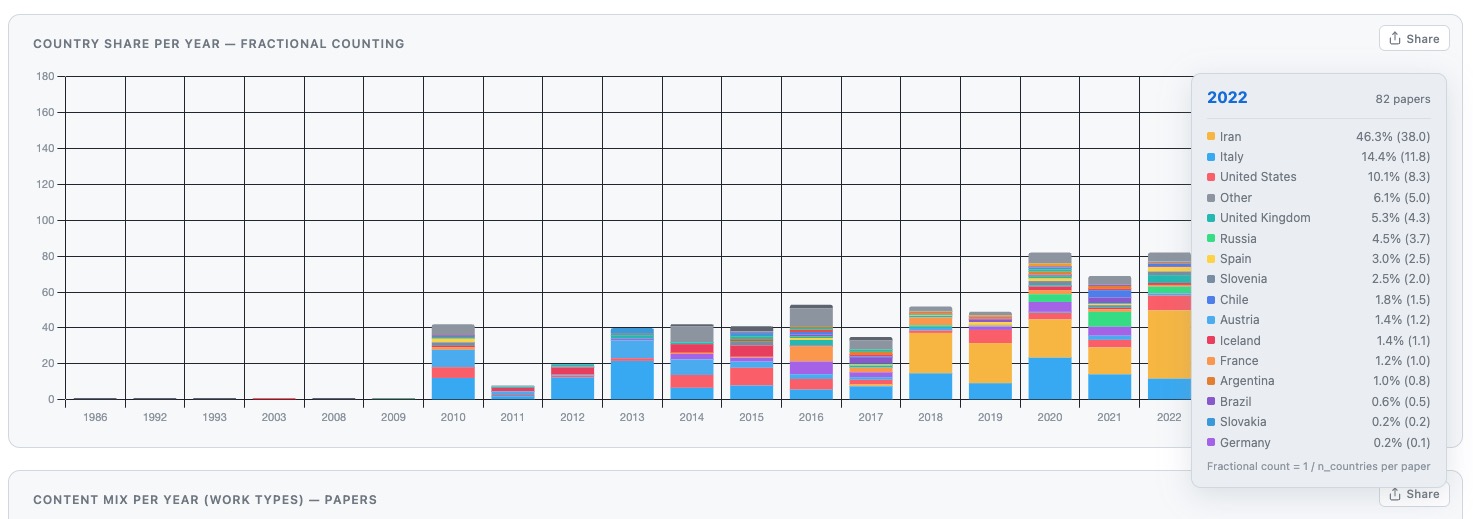
Screenshot 12/6/26 in 2022 Iran is the most frequent country of origin according to https://journaltrends.com/

Editor-in-Chief Ugo Carraro (*1943, former University of Padua researcher) supported EJTM’s broadening from muscle physiology into general medicine, proposing a rename to “Myology, Mobility, Medicine”. The journal subsequently started to publish Iranian clinical papers across orthopedics, dentistry, psychiatry, COVID-19, and urology – not related to myology. In 2022, an Iranian author even published in EJTM a bibliometric study of Iranian output in EJTM itself –  a self-referential feedback loop that normalizes the journal as a legitimate Iranian venue inviting further submissions.

The Cegolon bridge

Luca Cegolon (University of Trieste) is the structural intermediary between Baqiyatallah University of Medical Sciences (BMSU) and Italian academia. He holds at least six joint publications with Einollahi and Javanbakht spanning COVID-19, plasma exchange, ozone therapy, and kidney injury — all on Iranian data. Cegolon completed his PhD at Padua University Medical School,  the same institution as Carraro. The Tehran–Trieste–Padua route therefore carries manuscripts from a sanctioned IRGC institution to a Pavia open-access publisher with no regulatory friction.

Javanbakht as serial off-topic submitter

Javanbakht’s EJTM papers cover kidney transplantation pharmacology (Suprotac tacrolimus)male fertility / varicocelectomy, and wrist tendon transfer surgery – none touching myology. The pattern is deliberate: EJTM is Scopus-indexed, open-access and has demonstrated tolerance for off-topic Iranian clinical submissions. The Suprotac APC was almost certainly paid by NanoAlvand Company, the product’s manufacturer, paying a trivially small marketing cost for a PubMed-citable Phase IV label.

The sanctions geography

From March 2013, OFAC regulations prohibited US-owned journals from handling manuscripts authored by Iranian government employees. Elsevier instructed its US editors to reject such manuscripts outright. OFAC sanctions also generated misunderstanding among editors in other countries, who rejected Iranian manuscripts for political rather than scientific reasons, further narrowing the accessible publishing landscape.

PAGEPress has no US ownership and no OFAC exposure. It accepts APC payments via Italian bank transfer (Banca Popolare di Sondrio), routable through European exchange offices without triggering US sanctions. It fills a structural niche created by the sanctions geography.
Baqiyatallah University of Medical Sciences   (BMSU) was founded in 1994 as the primary medical institution operated by the Islamic Revolutionary Guard Corps IRGC. The US Treasury designated it on under Executive Order 13382 (WMD proliferation) and again in 2017 under Executive Order 13224 (terrorism support). Foreign parties facilitating transactions for the entity are subject to US sanctions. Einollahi, Javanbakht, and their BMSU co-authors are employees of this designated institution.
Interpretation

The primary exchange is probably not financial but metric. For Cegolon, co-authorship with a high-volume Iranian clinical group accelerates publication output at a career stage where Italian Abilitazione Scientifica Nazionale metrics directly determine promotion. For BMSU and NanoAlvand, the European co-author provides editorial access, institutional legitimacy, and a sanctions-circumventing pathway to Scopus. The APC is the transaction cost; mutual bibliometric benefit is the structural incentive — legal, common, and largely misaligned with quality control.


CC-BY-NC Science Surf , accessed 13.06.2026

Epithelial barrier hypothesis now confirmed

Akdis and colleagues at the Swiss Institute of Allergy and Asthma Research, SIAF have developed what is often called the epithelial barrier hypothesis EBH or epithelial damage theory, most systematically articulated around 2020-2021 in a series of papers. The core idea is that a wide range of modern environmental exposures (detergents, surfactants, emulsifiers, cleaning products, microplastics, particulate matter, tobacco smoke, certain dietary additives) damage the epithelial barriers of the skin, gut, and airway. The theory gives as an explanation for the modern epidemic of allergic disease, autoimmunity, and certain inflammatory conditions – arguing that the hygiene hypothesis and biodiversity hypothesis are partially correct but incomplete, because the primary driver is not simply reduced microbial exposure but active epithelial damage by novel chemicals of the industrial era. Cezmin Akdis published a landmark review 2021 titled something like “Does the epithelial barrier hypothesis explain the increase in allergy, autoimmunity and other chronic conditions?” that laid out the full framework.

An upcoming congress is now dedicated to EBH.


12th Swiss Congress on Environmental Allergology and Epithelial Medicine

“Barriers Under Siege: Modern Threats to Human Interface Biology”

Date: September 14-17, 2026
Location: Congress Center Basel, Switzerland
Host: Swiss Society of Immune Speculation (SSIS)
Co-sponsors: European Academy of Allergic Overreaction (EAAOR)
Global Confederation of Airborne Anxiety (GCAA)

Keynote Speakers:
Prof. M. Sidka (FIAS), University of Zurich) – “Epithelial Damage Theory: 5 Years Later”

Prof. Alexandra Steinberg (ETH Zurich) – “The 2.4 GHz Epidemic: Evidence and Implications”
Dr. Rachel Thornfield (St. Bartholomew’s Hospital) – “Microplastic Perforation Syndrome: A New Clinical Entity”

Abstract Submission Deadline:  Feb 15, 2026
Registration: www.swiss-environmental-allergy2026.ch


Three new studies from the online  abstracts to confirm the hypothesis.

Abstract 1: Epithelial Barrier Disruption by Household Detergents Predicts Allergic Sensitization: A Prospective Birth Cohort Analysis

Marta K. Lindström¹, Javier Hernández-Cortés², Elena V. Petrov³, Thomas Müller-Bern¹, Sarah J. Whitfield⁴, Andreas Koller⁵, Fatima Al-Rashid⁶, Dimitri Papadopoulos⁷, Lisa Chen⁸, Marco Antonelli⁹, Ingrid Svensson¹⁰, Robert MacLeod¹¹

¹Swiss Institute of Asthma (FIASC), University of Zurich, Switzerland ²Department of Pediatric Allergology, Hospital Infantil La Paz, Madrid, Spain ³Institute for Environmental Health, Karolinska Institute, Stockholm, Sweden ⁴Centre for Barrier Biology, University of Edinburgh, UK ⁵Department of Dermatology, Medical University of Vienna, Austria ⁶Environmental Toxicology Unit, King Saud University, Riyadh, Saudi Arabia ⁷European Centre for Allergy Research Foundation, Athens, Greece ⁸Division of Immunology, Boston Children’s Hospital, Harvard Medical School, USA ⁹Department of Molecular Medicine, University of Padova, Italy ¹⁰Scandinavian Epithelial Research Consortium, University of Bergen, Norway ¹¹Department of Public Health, University of Glasgow, UK

Background: The epithelial damage theory proposes that modern chemical exposures compromise barrier integrity, promoting type 2 immunity. We tested whether early-life detergent exposure predicts subsequent allergic sensitization.
Methods: We recruited 847 newborns from three European cities (2019-2021) and measured transepidermal water loss (TEWL) at 6 weeks using standardized methodology. Parents completed detailed questionnaires on household cleaning product use, including specific brand names and frequencies. Serum samples at 24 months were analyzed for specific IgE to 15 common allergens using ImmunoCAP. Primary outcome was ≥1 positive sensitization (≥0.35 kU/L). Secondary analyses examined TSLP, IL-33, and tight junction protein expression in nasal epithelial brushings.
Results: Complete data were available for 739 children. Median TEWL was 12.4 g/m²/h (IQR 9.1-16.8). Children with high TEWL (>90th percentile, n=74) had significantly elevated sensitization rates compared to low TEWL (<10th percentile, n=73): 48.6% vs 12.3% (adjusted OR 4.7, 95% CI 2.1-10.4, p<0.001). Unexpectedly, this association was entirely driven by households using premium fabric softeners containing quaternary ammonium compounds ≥3 times weekly (interaction p=0.003). Among high-detergent-use families, TEWL >15 g/m²/h predicted sensitization with 94% specificity and 61% sensitivity. Nasal epithelial TSLP expression correlated strongly with TEWL (r=0.72, p<0.001) and was 3.8-fold higher in the high-TEWL group.
Conclusions: Infant epithelial barrier dysfunction, as measured by TEWL, powerfully predicts allergic sensitization at 24 months. The unexpected concentration of risk among users of premium fabric softeners suggests specific quaternary ammonium formulations may be particularly damaging to developing epithelial barriers.


Abstract 2: Microplastic-Induced Epithelial Perforation Syndrome: Evidence from Emergency Department Skin Biopsies

Dr. Rachel M. Thornfield¹, Prof. Klaus Weber-Hoffmann², Yuki Tanaka³, Maria Fernanda Santos⁴, Erik J. Lindqvist⁵, Priya Sharma⁶, Jean-Claude Dubois⁷, Dr. Anastasia Volkov⁸, Prof. Giovanni Benedetti⁹, Dr. Amira Hassan¹⁰, Dr. James O’Sullivan¹¹, Dr. Nina Petersen¹², Prof. Rajesh Mehta¹³, Dr. Sophie Laurent¹⁴

¹Emergency Medicine Research Unit, St. Bartholomew’s Hospital, London, UK ²Institute for Microplastic Pathology, Technical University of Munich, Germany ³Department of Environmental Dermatology, Tokyo Medical University, Japan ⁴Brazilian Centre for Plastic Pollution Health Effects, University of São Paulo, Brazil ⁵Nordic Institute for Particle Toxicology, University of Copenhagen, Denmark ⁶Centre for Urban Environmental Health, All India Institute of Medical Sciences, New Delhi, India ⁷Laboratory of Environmental Pathophysiology, INSERM, Lyon, France ⁸Department of Cellular Ultrastructure, Moscow State University, Russia ⁹Institute of Advanced Microscopy, University of Florence, Italy ¹⁰Environmental Health Department, Cairo University, Egypt ¹¹Trinity Centre for Environmental Health, Trinity College Dublin, Ireland ¹²Scandinavian Environmental Medicine Institute, University of Oslo, Norway ¹³Department of Occupational Health, Tata Institute, Mumbai, India ¹⁴Centre de Recherche Environnementale, University of Geneva, Switzerland

Background: Microplastics are ubiquitous environmental contaminants, but their direct pathological effects remain unclear. We investigated an unexpected clustering of acute dermatitis cases presenting to our emergency department.
Methods: Between March-August 2025, we observed 23 patients (ages 4-67) presenting with sudden-onset vesicular eruptions and intense pruritus, all within 15km of a municipal recycling facility. Standard patch testing was negative. We performed 4mm punch biopsies and analyzed tissue samples using scanning electron microscopy (SEM) and energy-dispersive X-ray spectroscopy. Household dust samples were collected from all patients’ homes and analyzed for microplastic content via pyrolysis-GC/MS.
Results: SEM revealed remarkable ultrastructural findings: polyethylene terephthalate (PET) fragments 2-8 μm in diameter were physically embedded within stratum corneum, with sharp edges penetrating into the stratum granulosum. These “microplastic daggers” created microscopic perforations associated with intense inflammatory infiltrates. Affected keratinocytes showed 847-fold elevation in TSLP expression compared to normal skin (p<0.001). Household dust analysis revealed PET concentrations 23-156× higher than control homes (geometric mean 89,400 vs 1,240 particles/g, p<0.001). All patients lived <500m from major roadways with heavy recycling truck traffic. Symptoms resolved within 72 hours of temporary relocation, but recurred upon return home. Electron microscopy of automotive tire dust from the recycling route showed identical PET morphology to the embedded skin fragments.
Conclusions: This represents the first documented case series of direct mechanical epithelial barrier breach by airborne microplastics. The “dagger hypothesis”—sharp-edged plastic fragments acting as microscopic penetrating trauma—may explain certain idiopathic dermatoses in industrialized areas.


Abstract 3: Bluetooth-Induced Epidermal Permeability: The 2.4 GHz Tight Junction Phenomenon

Prof. Alexandra Steinberg¹, Dr. Mohammad Al-Zahra², Dr. Jennifer Liu-Kim³, Prof. Hans-Peter Krämer⁴, Dr. Olga Mikhaylova⁵, Dr. Benjamin Kowalski⁶, Prof. Maria Isabel Rodríguez⁷, Dr. Kenji Yoshimura⁸, Dr. Fatou Ndiaye⁹, Prof. Sebastian Larsson¹⁰, Dr. Pradeep Gupta¹¹, Dr. Catherine Brennan¹², Prof. Ahmed El-Mansouri¹³, Dr. Valentina Romano¹⁴, Dr. Michael O’Brien¹⁵, Prof. Yusuf Hassan¹⁶, Dr. Anna Korhonen¹⁷, Dr. Philippe Moreau¹⁸

¹Department of Electromagnetic Biology, ETH Zurich, Switzerland ²Institute for Wireless Health Effects, American University of Beirut, Lebanon ³Center for Digital Health Research, University of California San Francisco, USA ⁴Fraunhofer Institute for Biomedical Engineering, Heidelberg, Germany ⁵Laboratory of Electromagnetic Pathophysiology, Lomonosov Moscow State University, Russia ⁶Institute of Bioelectromagnetics, Technical University of Warsaw, Poland ⁷Centro de Investigación en Campos Electromagnéticos, Universidad Complutense Madrid, Spain ⁸Department of Radiation Biology, Kyoto University, Japan ⁹African Centre for Electromagnetic Research, University of Dakar, Senegal ¹⁰Swedish Institute for Wireless Safety, Karolinska Institute, Stockholm, Sweden ¹¹Centre for Electromagnetic Medicine, All India Institute of Medical Sciences, India ¹²School of Electronic Engineering, University College Dublin, Ireland ¹³Institute of Applied Physics in Medicine, University of Alexandria, Egypt ¹⁴Department of Bioengineering, Politecnico di Milano, Italy ¹⁵Centre for Occupational Electromagnetics, University of Melbourne, Australia ¹⁶Department of Physics in Medicine, University of Cape Town, South Africa ¹⁷Finnish Centre for Electromagnetic Health, University of Helsinki, Finland ¹⁸Laboratory of Environmental Biophysics, CNRS Toulouse, France

Background: Wireless device proliferation has increased ambient electromagnetic radiation exposure, but biological effects remain controversial. We investigated an unexpected correlation between infant eczema severity and household Bluetooth device density discovered during routine allergy clinic visits.
Methods: During a power outage at our pediatric allergy unit (June 2024), we serendipitously observed that 4 infants with severe atopic dermatitis showed dramatic symptom improvement within 90 minutes of complete electromagnetic silence. We subsequently recruited 156 families and conducted a novel “digital detox intervention”: 72-hour complete removal of all Bluetooth devices (phones, tablets, smart watches, wireless headphones, baby monitors, smart thermostats). Transepidermal water loss (TEWL) was measured using AquaFlux before, during, and after the intervention. We simultaneously measured 2.4 GHz electromagnetic field strength using calibrated spectrum analyzers.
Results: Baseline TEWL correlated strongly with household Bluetooth device count (r=0.83, p<0.001) and 2.4 GHz field strength (r=0.79, p<0.001). During digital detox, TEWL decreased by mean 47% (95% CI 39-55%, p<0.001). Most remarkably, infants living in homes with >15 active Bluetooth connections showed a biphasic response: initial TEWL reduction at 6 hours, followed by paradoxical elevation at 24 hours, then dramatic normalization by 72 hours—suggesting a “wireless withdrawal syndrome.” Upon device reintroduction, TEWL returned to baseline within 8 hours. In vitro keratinocyte cultures exposed to 2.4 GHz pulsed radiation showed 340% increase in claudin-1 degradation compared to controls (p<0.001).
Conclusions: These preliminary findings suggest that ubiquitous 2.4 GHz Bluetooth radiation may directly compromise epithelial barrier function through tight junction protein destabilization. The “digital detox response” warrants urgent replication given the public health implications for 3.2 billion wireless device users globally.


CC-BY-NC Science Surf , accessed 13.06.2026

Why Maxwell’s statement proved too much

Having been working on the infamous Giuffre/Mountbatten/Maxwell photo, I came across now an email draft of a defense attributed to Maxwell that seems to confirm the authenticity of the photo  “In 2001 I was in London when met a number of friends of mine including Prince Andrew. A photograph was taken as I imagine she wanted to show it to friends and family.“

The media coverage was extensive and remarkably uniform. Continue reading Why Maxwell’s statement proved too much


CC-BY-NC Science Surf , accessed 13.06.2026

Why you can’t change the rules after the game has started

It was a long wait – 10 years –  for the Vitality vitamin D study in newborns to come to an end. It is super disappointing to see now their first study abstract at the 2026 AAAAI Annual Meeting with a null result. Besides the fact that they got it wrong – Vitamin D3 supplementation was never protective but allergy risk  in newborn –  the following  three screenshots show something that should make any methodologist uncomfortable.

The VITALITY trial filed its first ClinicalTrials.gov record in April 2014. By November 2022 with the data at hand, version 12 shows sweeping rewrites to both the primary outcome and the inclusion criteria. Pink = deleted, green = added.

What changed, concretely:

– The original primary outcome was “prevalence and severity of challenge-proven food allergy in participants with positive skin prick tests at age 12 months.” Version 12 splits this into two primaries, adds a second time point (6 years of age), and quietly drops “severity” and the SPT-positive filter. That filter was doing real work: restricting the analysis to sensitised children would have given a much smaller, higher-risk denominator.
– The inclusion criteria went from “healthy, term, breastfeeding infants” to a detailed specification with an age window (6–12 weeks), formula tolerance up to 120 mL/day, and a new informed-consent bullet. Each addition narrows or shifts the enrolled population.

Reporting two significant p-values from what are effectively subgroup analyses in an abstract whose primary result failed (p=0.537) is textbook outcome fishing. With 10 allergens tested, finding two below 0.05 by chance alone is entirely expected. In short: a failed trial has been dressed as a promising one through a combination of dual estimands, allergen subgroup mining, heavy imputation, and conclusion spin. Each element is individually defensible in isolation; together they constitute a coordinated rhetorical strategy to salvage a null result.

Why this is a fundamental problem?

Clinical trials are hypothesis tests, not explorations. The logic is identical to a one-sample t-test: you fix the null hypothesis, the test statistic, and the decision threshold before you look at the data, because the Type I error rate (your false-positive probability) is only valid under those pre-specified conditions. The moment you select or redefine your outcome after seeing interim results — even partially, even innocently — you are performing an implicit multiple comparison. You have, in effect, tested several hypotheses and reported only the one that worked.

Changing inclusion criteria mid-study is equally damaging. It redefines the population to which your result generalises. If the original enrolment targeted a broader group and the amended criteria select a more compliant or biologically distinct subgroup, the treatment effect you ultimately report belongs to a population that was never pre-specified. Reviewers and readers have no way to know whether the amendment was scientifically motivated or outcome-motivated.

The specific mischief of outcome switching

Dropping “severity” from the primary outcome is not cosmetic. A trial that fails on prevalence-plus-severity can be reframed as a success on prevalence alone. Dropping the SPT-positive filter expands the denominator, which typically dilutes an effect — unless the intervention actually works better in unselected infants, a hypothesis that was apparently not the original one. Adding a six-year follow-up endpoint transforms a 12-month study into something else entirely, with a different sample-size justification and a different regulatory profile.

What preregistration is supposed to prevent

The entire point of a trial registry is to create a timestamped public contract. Investigators declare in advance: this is our question, this is our population, this is how we will measure success. Journals and regulators can then verify that the published analysis matches the contract. When version 12 diverges this substantially from version 2, the contract has been renegotiated — and the renegotiation happened after years of data collection, when results were at least partially visible to the investigators.

This does not automatically mean misconduct. Trials genuinely need protocol amendments — safety signals emerge, recruitment proves impossible under original criteria, regulatory agencies request changes. But every such amendment requires a documented, dated rationale filed before the analysis is run, and the published paper must report both the original and amended specifications with transparent explanation. Silently absorbing eight versions of changes into a final paper, with no mention of what the original primary endpoint was, converts a confirmatory trial into a disguised exploratory one — while retaining the inferential authority of a pre-registered RCT.

The VITALITY screenshots are a clean teaching example of exactly this problem.​​​​​​​​​​​​​​​​


CC-BY-NC Science Surf , accessed 13.06.2026

Anti Diskriminierungs Fake

Die ZEIT berichtet von  einer Präsentation der Bundesbeauftragten für Antidiskriminierung, Ferda Ataman, bei der BPK  in Berlin

Viele Menschen in Deutschland glauben einer Studie zufolge an vermeintlich naturgegebene Unterschiede zwischen verschiedenen Ethnien und Kulturen. So stimmten zwei von drei Befragten der Aussage zu, dass bestimmte Kulturen “fortschrittlicher und besser” seien als andere, wie aus der Erhebung des Deutschen Zentrums für Integrations- und Migrationsforschung (DeZIM) hervorgeht. Knapp die Hälfte vertrat die Ansicht, dass gewisse Gruppen “von Natur aus fleißiger” seien als andere. 36 Prozent der Befragten stimmten der Aussage zu, dass es unterschiedliche “Rassen” gäbe.

Um eine solche Studie machen zu können, muss man:frau minimale Voraussetzungen in Testtheorie mitbringen. Basale Kenntnisse der Kulturwissenschaft, Genetik, Medizin oder Pädagogik schaden auch nicht. Leider fehlt dies aber den Leitern dieser “Studie” (download hier).

Oversampling ohne transparente Gewichtung. Die Studie überrepräsentiert bestimmte Gruppen absichtlich durch eine Vorklassifikation nach Vor- und Nachnamen aus Melderegistern. Das ist legitim – aber die Gewichtung wurde im aktuellen Bericht erstmals an Mikrozensus-Daten angepasst, was die Autoren selbst einräumen führt dazu, dass frühere Berichte “in einzelnen Zahlen leicht abweichen”. Zeitreihenvergleiche sind damit methodisch fragwürdig.

Selbstauskunft als einzige Datenquelle. Alle Kernvariablen – Einstellungen, Diskriminierungserfahrungen, Institutionenvertrauen – beruhen auf subjektiver Selbstauskunft. Es gibt keine Kreuzvalidierung mit administrativen Daten, Experimenten (Audit-Studien) oder objektiven Indikatoren.

Zirkuläre Operationalisierung von “Rassismus”. Das Instrument misst u.a. die Zustimmung zur Aussage, bestimmte Kulturen seien “fortschrittlicher und besser” als andere (66 % Zustimmung), und wertet dies als rassistische Einstellung.  Eine derartig breite Definition schließt faktische Kulturvergleiche, zivilisationstheoretische Positionen und Alltagsurteile pauschal als “Rassismus” ein – das ist eine normative Vorentscheidung, keine empirische.

Konfundierung von Ursache und Wirkung. Der Bericht berichtet Korrelationen zwischen Diskriminierungserfahrungen und Institutionenvertrauen und formuliert daraus kausale Schlüsse (“gehen einher mit”, “führen zu”). Längsschnittdaten wären nötig, um Kausalrichtung zu bestimmen – das Panel ließe das zumindest ansatzweise zu, wird aber hauptsächlich im Querschnitt ausgewertet.

Selektiver Attrition-Bias. Die Gewichtung für Panel-Ausfälle erfolgt anhand von Merkmalen wie Selbstidentifikation und Einstellungen gegenüber verschiedenen Gruppen.  Wer aus dem Panel ausscheidet, weil er das Thema Rassismus als irrelevant empfindet, wird weggewichtet – das strukturiert die Ergebnisse in Richtung der Ausgangshypothese.

Institutionelle Interessenlage. Das NaDiRa ist beim Deutschen Zentrum für Integrations- und Migrationsforschung (DeZIM) angesiedelt und wird vom Bundesministerium gefördert. Die Handlungsempfehlungen am Ende des Berichts sind das erklärte politische Ziel. Das ist kein Fehler per se, aber ein Faktor für die Interpretation.

Zusammenfassung. Die Studie ist kein Beleg für die Verbreitung von Rassismus in Deutschland, sondern eine Messung davon, wie viele Menschen bestimmten, normativ vordefinierten Aussagen zustimmen. Die Gleichsetzung von Zustimmungsraten mit “rassistischen Einstellungen” ist die Kernproblematik – sie folgt aus dem theoretischen Rahmen, nicht aus den Daten selbst.

“Garbabge in, Garbage out” – eine solche sensible Fragestellung in einem “online Tool” ohne vorherige ausführliche Validierung zu bearbeiten? Wo es so sehr auf Nuancen im Sprachgebrauch ankommt?

So ist nicht nur die PK sondern auch die Studie auch die Kernaussagen ein Musterbeispiel für politische Agenda aber nicht für eine validierte Aussage. Verständlicherweise kommt daher  vielfache Kritik-  Auszüge:

https://profile.zeit.de/2784058 … nicht jede Kultur ist gleich gut. Eine Kultur, in der es bspw. als normal gilt, dass junge Mädchen genitalverstümmelt, zwangsverheiratet und systematisch entrechtet werden, ist einer westlich liberalen Kultur moralisch unterlegen. Dasselbe gilt für kulturelle Prägungen, in denen Ehrengewalt, religiöser Fanatismus oder brutale Homosexuellenverfolgung als selbstverständlich gelten. Oder eine Kultur, die Massenmördern Märtyrerrenten zahlt und betont, wie ehrenvoll es sei, “Ungläubige” zu ermorden. Wer so tut, als dürfe man hier keine Wertung vornehmen, verwechselt Toleranz mit moralischer Beliebigkeit. Eine offene, rechtsstaatliche und freiheitliche Gesellschaft ist solchen Gesellschaftsmodellen überlegen, gerade weil sie individuelle Freiheit, körperliche Unversehrtheit und gleiche Rechte schützt, statt Unterdrückung als Tradition zu bemänteln.

https://profile.zeit.de/2965476 Damals gab es keine AfD und alles erschien aus heutiger Sicht gut. Ich werde das Gefühl nicht los, dass heute jeder vermeintliche Gutmensch fieberhaft unter jedem Stein einen Nazi sucht, um sich dann als der Bessere Bürger, sprich, auf der richtigen Seite der Brandmauer einsortieren zu können. Dieses platte und flache schwarz / weiß denken ist der Treibstoff der AfD

https://profile.zeit.de/2462818 Natürlich finde ich manche Kulturen besser als andere. Russland hat eine Kultur, die mehr von Machtdenken, Chauvinismus, und Gewalt geprägt ist, als andere. Ich halte Japan‘s Workoholic-Kultur und die Schönheitschirurgie-Obsession Korea‘s für problematisch. Ebenso Deutschland’s Bürokratie und technische Innovationsfeindlichkeit, Amerikanische Waffen-Kultur und Überheblichkeit, oder eine Kultur, die Genitalverstümmelung gut heißt. Aus diesem Mix an problematischen Aspekten verschiedener Kulturen ergibt sich zwangsläufig, dass manche Kulturen Aggregat dem Wohl der Menschheit zuträglicher (und damit „besser“) sind, als andere. Das anzuerkennen ist erst mal nicht rassistisch.


CC-BY-NC Science Surf , accessed 13.06.2026

Bias und Deception in den Bewertungssystemen von Google und Ebay

Google und Ebay Bewertungen steuern Warenflüsse, mehr noch als jede Werbung.

Sie aggregieren verteiltes Wissen, komprimieren es zu Signalen und machen es für Dritte nutzbar – immer unter der Voraussetzung, dass die Eingabedaten die Realität hinreichend abbilden. Diese Voraussetzung ist keine technische Selbstverständlichkeit, sondern eine normative Anforderung, die im Alltag digitaler Plattformen aber immer mehr ignoriert wird.

Nehmen wir eBay. Seit November 2025 hinterlegt die Plattform automatisch eine positive Bewertung, wenn ein Käufer nach abgeschlossenem Kauf sich nicht meldet. Die Begründung ist nachvollziehbar: Schweigen ist häufig tatsächlich Zufriedenheit, und ein dichtes Bewertungsnetz stabilisiert das Vertrauen in den Marktplatz. Aber das System misst nicht mehr damit, was es zu messen vorgibt. Eine positive Bewertung, die nicht auf erlebter Zufriedenheit beruht, sondern auf dem Ausbleiben einer Handlung, ist wie ein Datum ohne Zeitangabe – formal vorhanden, semantisch leer. Wer einen defekten Artikel erhält und es versäumt, fristgerecht zu reagieren, erscheint im System als zufriedener Käufer. Das Protokoll stimmt. Aber mit der Realität hat das nichts mehr zu tun.

Google operiert nach derselben Logik, nur mit umgekehrtem Vorzeichen. Negative Bewertungen, die nachweislich auf realen Erfahrungen beruhen – und deren Authentizität Nutzer sogar per eidesstattlicher Erklärung belegt haben – werden auf Antrag des bewerteten Unternehmens routinemäßig gelöscht, wenn das Unternehmen “Unangemessenheit” oder “Diffamierung” geltend macht. Das Ergebnis ist dasselbe wie bei eBay, nur eine Eskalationsstufe darüber: Nicht Schweigen wird als Zustimmung kodiert, sondern das Missfallen wird zum Verschwinden gebracht. Was bleibt, ist kein Abbild der Realität mehr, sondern ein gefiltertes, plattformkonformes Surrogat, das dem widersprechenden Unternehmen höhere Einnahmen beschert.

Man könnte von struktureller Deception sprechen – einer Täuschung, die nicht aus Absicht, sondern aus Design entsteht1. Das Beunruhigende daran ist gerade die Absichtslosigkeit: Weil kein einzelner Akteur mehr verantwortlich zeichnet, fehlt auch die Motivation zur Korrektur. Bei einer klassischen Lüge gibt es einen Täuschenden, der zur Rechenschaft gezogen werden kann. Bei einem absichtlich auf Täuschung konstruierten Bewertungsalgorithmus gibt es nur ein Produktteam, das auf Conversion-Raten schaut. Ethik oder Moral? Brauchen wir nicht, unvergesslich das Video vom großen Tech-CEO-Vasallen-Dinner im September 2025 auf dem betonierten Rasen vor dem Weißen Haus.

Schlimmer noch: automatisierte Systeme skalieren diesen Effekt hoch. Was im Einzelfall als Ungenauigkeit wirkt, akkumuliert sich über alle AI’s zu einem systematischen Vertrauensproblem. Vertrauenssysteme, die sich selbst korrumpieren, verlieren damit aber  jeden Tag mehr an Nützlichkeit – sie kippen um. Die Sterne leuchten noch, aber bedeuten nichts mehr. Das betrifft auch jede positive Bewertung, die nun als Werbung degradiert wird, aber eigentlich auf einer Erfahrung beruhte, sofern sie nicht auch gekauft war.

Ist das organisierter Betrug?

Juristisch kaum. Bandenmäßiger Betrug setzt nach § 263 StGB Täuschungsabsicht, Irrtumserregung und Vermögensschaden voraus – und bei der Qualifikation “bandenförmig” eine organisierte Mehrtäterstruktur mit Tatplan. Beide Unternehmen handeln aber offen: Das Schweigen-gleich-Zustimmung-Prinzip und Jederzeit-Löschen-Prinzip steht mit Sicherheit irgendwo in den Nutzungsbedingungen. Juristisch greifbar wäre allenfalls irreführende Geschäftspraxis im Sinne des UWG oder der europäischen Omnibus-Richtlinie.

Epistemisch aber – im Kern ist es natürlich Betrug. Wenn man Betrug funktional versteht, als systematische Erzeugung falscher Überzeugungen zum eigenen Vorteil, dann trifft die Beschreibung erstaunlich gut: eBay profitiert von stabilen Verkäuferbewertungen, Google von einem bereinigten Reputationssystem, das Unternehmenskunden nicht vergraullt. Dass dies ohne strafrechtlich relevante Absicht geschieht, macht es gesellschaftlich nicht weniger problematisch – es macht es nur schwerer angreifbar.

Die Omnibus-Richtlinie – EU-Richtlinie 2019/2161, in Deutschland seit Mai 2022 in Kraft, hat das UWG geändert. Der für unseren Kontext entscheidende Punkt: Plattformen sind seither verpflichtet offenzulegen, ob und wie sie Bewertungen auf Echtheit prüfen. Wer suggeriert, Bewertungen seien authentisch, ohne ein Prüfverfahren zu betreiben, handelt nun unlauter. Außerdem sind gekaufte oder anderweitig gefälschte Bewertungen ausdrücklich als unlautere Geschäftspraxis eingestuft.  Warum greift das bei eBay und Google trotzdem nicht?  Weil beide Unternehmen formal prüfen – nur eben nicht auf Wahrheit, sondern auf Regelkonformität. eBay prüft, ob eine Transaktion stattgefunden hat. Google prüft, ob eine Beschwerde vorliegt. Das genügt juristisch als “Prüfverfahren”, auch wenn das Ergebnis völlig wertlos ist. Die Richtlinie hat eine Lücke dort, wo es darauf ankäme: Sie reguliert das Verfahren, nicht die Qualität des Ergebnisses.

Die folgenden drei Fallbeispiele im Anhang illustrieren, wie Konstruktionsbias und strukturelle Täuschung in unterschiedlichen Kontexten auftreten, wobei sich der Leser gerne selbst die Konsequenzen  ableiten kann..


Anhang Fallbeispiel

Albert’s Auto Service Gröbenzell

Im September 2024 beauftragte ein Kunde die Werkstatt von Burim Qeriqi in Gröbenzell mit der Reparatur eines Kurzschlusses. Die Rechnung belief sich auf 255,17 Euro. Die anschließend aufgesuchte Fachwerkstatt stellte schriftlich in ihrer Rechnung fest, dass die Lampen in beiden Fassungen fehlten oder falsch angeschlossen waren, die Verkabelung der dritten Bremslampe nicht funktionierte und korrodierte Kabelverbindungen am Unterboden unangetastet geblieben waren. Die Nachbesserung kostete 720,00 Euro. Qeriqi ist, wie sich später herausstellte, kein Mitglied der KFZ-Innung – ein Umstand, der auf seiner Google-Seite naturgemäß nicht vermerkt ist. Die sachliche und belegbare Rezension des Kunden auf Google verschwand jedenfalls bald darauf. Ein Tracing der Bewertungen über achtzehn Monate ergab: Die Werkstatt löscht negative Bewertungen systematisch und umgehend. Google stellt dafür das Werkzeug bereit – ohne Prüfung der inhaltlichen Berechtigung, ohne Berücksichtigung von Belegen. Eine einzelne negative Bewertung, die zum Zeitpunkt der Recherche noch sichtbar war, illustriert eher die Geschwindigkeit des Löschvorgangs als dessen Ausnahmen. Was auf der Profilseite verbleibt, ist kein Abbild der Kundenerfahrungen, sondern das Ergebnis aktiven Reputationsmanagements – ermöglicht und abgesichert durch die Plattform.

Screenshot 16.3.2026. Die negativen Bewertungen fehlen – ist die positive Bewertungen von Claude Menu aus Nizza echt?


Fallbeispiel 2

Gutachter Büro Christian Sailer Aichach.

Der Gutachter wird wegen eines Wasserschadens von einem Kunden auf Rat seines Anwalts kontaktiert. Der Gutachter erscheint spät, unvorbereitet, liefert statt einer strukturierten Bestandsaufnahme einen langatmigen Vortrag. Der Kunde bricht das Gutachten ab. Die anschließende Honorarforderung landet vor Gericht und endet mit einem Vergleich – einem rechtsförmigen Abschluss, der den Sachverhalt aktenkundig macht. Der Kunde verfasst daraufhin eine präzise, tatsachenbasierte Rezension auf Google: keine Polemik, keine Vermutungen, nur der dokumentierte Hergang mit der Empfehlung keinen Blanko Werkauftrag zu unterschreiben. Das Ergebnis ist vorhersehbar. Google teilt mit, eine Beschwerde wegen Diffamierung erhalten zu haben, und löscht den Zugriff auf den Beitrag 2. Die Begründung lautet lapidar: der Inhalt “verstößt anscheinend gegen” die entsprechende Kategorie. Kein Nachweis, keine Abwägung, kein Einblick in die Prüfung, keine Reaktion auch auf die Reklamation, die Bewertung stehen zu lassen. Das Wort “anscheinend” ist dabei bezeichnend – es signalisiert, dass keine eigentliche Prüfung stattgefunden hat, sondern eine Kategorisierung. Was hier verschwindet, ist keine Meinung, sondern ein gerichtlich bestätigter Sachverhalt. Die Plattform fungiert als Zensurinstanz ohne Erkenntnisinteresse: Sie prüft nicht, ob eine Aussage wahr ist, sondern ob jemand Einspruch erhoben hat..

Screenshot 16.3.2026
Screenshot 16.3.26 mit Selbstdarstellung der Qualifikationen


Fallbeispiel 3

Strikeforge GbR Ebay Händler

Ein Kunde kauft auf eBay einen AirTag-Halter aus dem 3D-Drucker – billiges Filament, zu geringe Wandstärke. Das Teil bricht kurz darauf unterwegs ab, der AirTag geht verloren – 5,99 € für den Halter, 32,99€ Verlust für den AirTag summieren sich zu 39€.  Ohne Garantie, ohne Schadenersatz, dafür aber mit Belehrung durch den Verkäufer Philipp Huguenin, daß die Widerrufsfrist “bereits seit längerer Zeit abgelaufen ist. Schäden, die nach dieser Nutzungsdauer durch Belastung im Gebrauch entstehen, können wir leider nicht als Reklamation übernehmen. Vielen Dank für dein Verständnis.” Der Verkäufer dreht die Beweislast auch noch um – er definiert den Produktfehler (zu geringe Wandstärke) als Gebrauchsverschleiß und entzieht sich damit jeder Gewährleistungspflicht. Die gesetzliche Gewährleistungsfrist beträgt 2 Jahre ab Kauf – die Widerrufsfrist (14 Tage) ist etwas völlig anderes. Die  Verwechslung von Widerrufsrecht und gesetzlicher Gewährleistung zeigt entweder Unkenntnis oder Kalkül.  Der Kunde gab jedenfalls keine Bewertung ab. Nach dem Kauf erscheint auf eBay aber eine positive Bewertung für den Kauf – automatisch generiert, plattformkonform, sachlich falsch.

Screenshot 16.3.206

Das ist der Mechanismus in Reinform. Kein Verkäufer hat gelogen. Kein Algorithmus hat eine Entscheidung getroffen, die sich jemand bewusst überlegt hätte. Das System hat schlicht Schweigen als Zufriedenheit interpretiert und daraus eine Aussage gemacht. Der Verkäufer der mangelhaftenWare sammelt weiter positive Bewertungen. Der nächste Käufer verlässt sich darauf. Der AirTag des Übernächsten geht ebenfalls verloren – informiert durch ein Bewertungssystem, das funktioniert, solange man nicht fragt, was es eigentlich misst.


Literatur

1 Der Begriff schließt an Miranda Frickers Konzept der hermeneutical injustice an: Strukturelle Lücken im kollektiven Deutungsrepertoire führen dazu, dass bestimmte Erfahrungen nicht adäquat artikuliert – oder in diesem Fall: nicht dauerhaft dokumentiert – werden können. Fricker, M.: Epistemic Injustice. Power and the Ethics of Knowing. Oxford 2007

2 siehe auch SWR vom 7.7.2025 “Google-Bewertungen: Warum ehrliche Kritik oft gelöscht wird”

Googles Antwort: Allgemein und ausweichend
In einem offiziellen Erklärvideo beschreibt Google, wie Rezensionen geprüft werden: mithilfe von künstlicher Intelligenz und einem Moderationsteam. 2024 seien über 240 Millionen Beiträge entfernt worden.
„Unsere Richtlinien besagen eindeutig, dass Rezensionen auf echten Erfahrungen beruhen müssen – weshalb wir umgehend gegen böswillige Akteure vorgehen (…)“, schreibt Google.Sackgasse für ehrliche Meinung
Kunden, deren ehrliche Meinung immer wieder gelöscht wird, sind frustriert. Was sie erleben, nimmt ihnen das Vertrauen in das Bewertungs-System.


Nachtrag 5.6.2026

Google hat ein Einsehen und zeigt nun auch die Zahl der entfernten Bewertungen.

Tatsächlich ist gerade in Deutschland eine wahre “Lösch-Industrie” entstanden. Scharen von Agenturen und Anwaltskanzleien haben sich auf das Entfernen von Beiträgen spezialisiert. Das Ergebnis: 99,97 Prozent aller Löschungen in der Europäischen Union wurden laut einer EU-Transparenzdatenbank im Jahr 2025 in Deutschland vorgenommen.

Auf der Google Seite steht auch der Grund warum Bewertungen entfernt werden – es sind angeblich die deutschen Gerichte.

Neben dem Schutz des Rufs von Einzelpersonen schützt das deutsche Recht das geschäftliche Ansehen von Unternehmen. Es ermöglicht Unternehmen, die Entfernung unwahrer Tatsachenbehauptungen oder sachlich nicht gerechtfertigter Meinungsäußerungen zu verlangen, die dem geschäftlichen Ansehen schaden könnten („Diffamierung“). Deutsche Gerichte haben die Hürden für Unternehmen, Bewertungen als diffamierend anzufechten, niedrig angesetzt. Neben dem Nachweis, dass eine Bewertung eine diffamierende Aussage enthält, können Unternehmen auch anführen, dass die Person, die eine Bewertung verfasst hat, kein Kunde war (z. B. weil sie keinen Beleg über einen Geschäftsvorgang haben).

Aber nun wird es tricky: Eine ungeprüfte, bloß behauptete Verleumdungsbehauptung, die von einer Plattform ohne eigene Prüfung weiterverbreitet wird, stellt selbst eine Diffamierung dar, nicht?


CC-BY-NC Science Surf , accessed 13.06.2026

Von der Bildmanipulation zur Millionen Entschädigung

Was der Fall des Dana-Farber Cancer Institute über die Grenzen wissenschaftlicher Selbstkontrolle zeigt – und warum ein solcher Präzedenzfall in Deutschland bislang undenkbar ist

Es begann unspektakulär, mit auffälligen Bildern, entdeckt in den Tiefen einer Online-Plattform. Auf PubPeer, einem digitalen Schwarzen Brett für Wissenschaft, überprüften externe Wissenschaftler über Jahre hinweg alte Publikationen des renommierten Dana-Farber Cancer Institute (DFCI) in Boston. Was sie dort fanden, wirkte auf den ersten Blick banal – Bildausschnitte, die gespiegelt oder gedreht waren, kontrastverändert oder mehrfach recycelt für unterschiedliche Experimente. Doch was in der Welt der biomedizinischen Forschung zunächst aussieht wie handwerkliche Nachlässigkeit, entwickelte sich zu einem Fall mit juristischem Nachspiel.

Denn Dana-Farber ist nicht irgendein Institut. Die Einrichtung gilt als eine der weltweit führenden Krebsforschungszentren, eng verbunden mit der Harvard Medical School und seit Jahrzehnten großzügig unterstützt durch das National Institutes of Health (NIH). Und wo so viel Geld fließt, hat wissenschaftliche Korrektheit auch eine wirtschaftliche Dimension.

Zunächst folgte das übliche Verfahren: Zeitschriften prüften die Vorwürfe, veröffentlichten Korrekturen oder zogen einzelne Arbeiten ganz zurück. Mehrere der betroffenen Artikel stammten von führenden Mitgliedern des Instituts, einige reichten Jahrzehnte zurück. In manchen Fällen waren die Originaldaten nicht mehr auffindbar, archiviert auf alten Festplatten, in Laborbüchern oder schlicht verloren. Der wissenschaftliche Schaden ließ sich eingrenzen, der wissenschaftliche Record teilweise bereinigen. In der Regel endet die Geschichte hier.

Doch in den USA nahm sie eine unerwartete Wendung. Ein Blick auf die Anträge, mit denen Dana-Farber Fördergelder eingeworben hatte, zeigte: Viele dieser beanstandeten Publikationen hatten als Vorarbeiten gedient – als Beleg für die Machbarkeit und Exzellenz kommender Projekte. Und genau an dieser Schnittstelle, dort, wo Forschung auf Verwaltung trifft, griff plötzlich das Rechtssystem.

Der englische Postdoc Sholto David, der die Unregelmäßigkeiten öffentlich gemacht hatte, argumentierte: Wenn eine Institution öffentliche Gelder auf Grundlage fragwürdiger oder manipulierter Daten erhält, dann hat sie dem Staat faktisch falsche Tatsachen vorgelegt. Juristisch ist das kein Verstoß gegen wissenschaftliche Ethik, sondern potenziell ein Fall von Betrug – und damit ein Fall für den False Claims Act (FCA). Dieses amerikanische Gesetz existiert seit dem 19. Jahrhundert, ursprünglich geschaffen, um Betrug bei Rüstungsaufträgen während des Bürgerkriegs zu bekämpfen (und wäre damit auch bei Maskendeals anzuwenden). Heute deckt es jeden Fall ab, in dem öffentliche Mittel durch Täuschung erlangt werden. Besonders bemerkenswert: Auch Privatpersonen können im Namen des Staates klagen, wenn sie glaubhaft machen, dass Steuergelder missbräuchlich verwendet wurden. Im Erfolgsfall steht ihnen ein Anteil der Rückzahlung zu.

Diese juristische Hebelwirkung führte schließlich zu einem Vergleich zwischen Dana-Farber und dem US-Justizministerium. Das Institut zahlte 15 Millionen US-Dollar, ohne ein offizielles Schuldeingeständnis, aber mit der Anerkennung, dass „problematische Daten“ Teil von Förderanträgen gewesen waren. Ein Teil des Vergleichsbetrags ging an den Hinweisgeber. Die Summe war bemerkenswert – nicht wegen ihrer Höhe, sondern wegen des Prinzips dahinter. Der Staat erhob keinen wissenschaftlichen Anspruch, sondern einen schlichten rechtlichen: Wer Forschungsmittel beantragt, schuldet dem Staat Wahrheit.

Dieser Gedanke hat in Deutschland bislang keinen Platz. Ein vergleichbarer Fall würde hier voraussichtlich im System der wissenschaftlichen Selbstkontrolle versanden – in Ombudsverfahren, internen Untersuchungen und gelegentlichen Korrekturen, irgendwann, irgendwo, meist folgenlos. Bei einem Fall an der Universität Gießen ebenfalls mit zahlreicher Manipulationsbefunde auf PubPeer, folgten nach Jahren nur einige wenige Korrekturen. Aber selbst wenn Bundes- oder Landesmittel betroffen wären, fehlt eine systematische Prüfung, ob sie auf falschen Tatsachen beruhten.

Die Deutsche Forschungsgemeinschaft (DFG), die zentrale Förderinstitution für Grundlagenforschung, versteht sich nicht als Ermittlungsbehörde. Ihre Verfahren sind auf wissenschaftliche Selbstkontrolle ausgelegt, nicht auf rechtliche Durchsetzung. Rückforderungen erfolgen nur bei formalen Verstößen – etwa, wenn Mittel zweckwidrig verwendet wurden. Ob eine Forschungsidee auf geschönten Daten beruhte, spielt keine Rolle. Der Staat als Geldgeber tritt dabei selten oder praktisch nie als geschädigte Partei in Erscheinung.

Auch Hinweisgeber, die Missstände entdecken, stehen in Deutschland weitgehend allein. Das 2023 verabschiedete Hinweisgeberschutzgesetz bietet ihnen gegenüber Arbeitgebern einen gewissen Schutz, schafft aber weder Anreize noch rechtliche Möglichkeiten, unrechtmäßig erlangte Fördermittel einzuklagen. Ein Pendant zum amerikanischen qui tam-Recht, das Whistleblowern eine aktive und belohnte Rolle einräumt, existiert nicht.

Der Kontrast könnte deutlicher kaum sein. In den USA machte ein einzelner Forscher publik, dass die Grenze zwischen wissenschaftlicher Unachtsamkeit und Täuschung dort endet, wo Steuergelder betroffen sind. In Deutschland hingegen bleibt wissenschaftliches Fehlverhalten meist eine interne Angelegenheit – geregelt durch Ethik, nicht durch Recht.

Der Fall Dana-Farber ist mehr als eine amerikanische Episode. Er ist ein Lehrstück für die Durchsetzung wissenschaftlicher Redlichkeit mit Haushaltsrecht. Wo Milliarden an Fördermitteln vergeben werden, genügt Selbstkontrolle allein nicht mehr. Ohne ein rechtliches Instrument, das die Wahrheitspflicht gegenüber der Öffentlichkeit durchsetzbar macht, bleibt wissenschaftliche Integrität allenfalls ein freundlicher Appell.

Quelle:

https://retractionwatch.com/2025/12/16/dana-farber-settlement-false-claims-act-image-manipulation

David Sholto zu Sci Rep und dem Honorar


CC-BY-NC Science Surf , accessed 13.06.2026

Why the “immunity debt” narrative ultimately collapsed

There was an interesting Bluesky post.

https://bsky.app/profile/nicktsergas.ca/post/3m7h36uha4k2e

I agree. Drosten said in 2022 that someone who believes that they can train their immune system through an infection should, also believe that “by eating a steak they can train their digestion”. The immunity depth hypothesis was as nonsense as the hygiene hypothesis that immunity is depraved by modern hygiene.

In reality, post-pandemic seasons returned to historical volatility rather than showing any sustained amplification. RSV and influenza displayed timing shifts and one-off rebounds, but no long-term increase in total burden.

Nations with long and strict NPIs (like New Zealand, Taiwan) should have shown the largest rebound. By 2025 this clearly did not occur. Conversely, countries with minimal restrictions (Sweden, GB) still experienced unusual RSV and influenza patterns, demonstrating the hypothesis being wrong, but taking a huge death toll from their believers.

Memory B & T cells persist; mucosal training is complex but not any “use-it-or-lose-it“. The role of routine pathogen turnover was over- and homeostatic immune regulation underestimated.


CC-BY-NC Science Surf , accessed 13.06.2026