Vitamin D insufficiency? Gone!
I can’t even remember how many vitamin D studies we did, explaining how this prohormone has been discovered and how stupid guidelines came on to the scene.
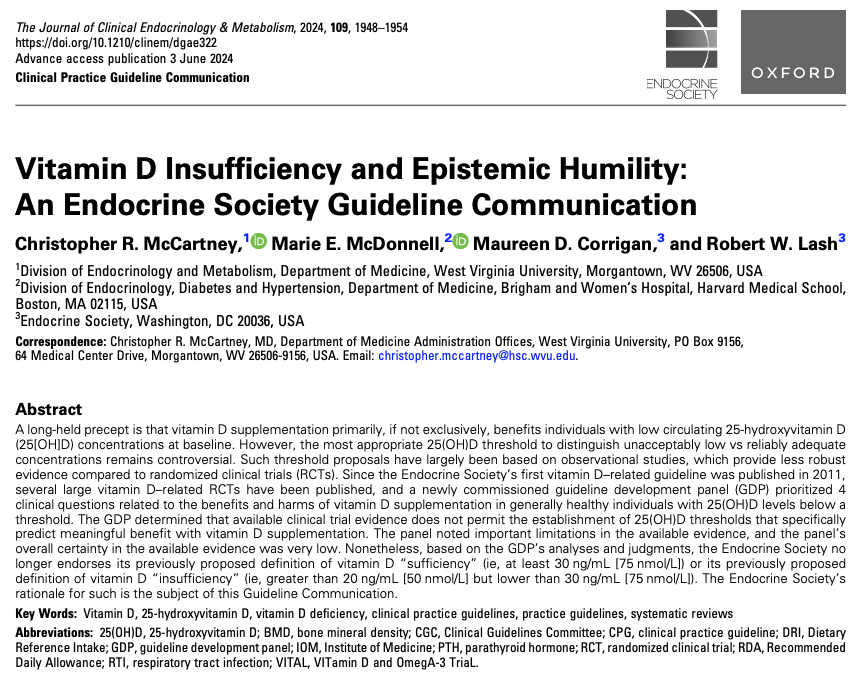
And it didn't happen quietly. It wasn't a minor tweak, a footnote, or an incremental update. It was a full reversal of a doctrine that has dominated labs, clinics, public-health brochures, and countless biomarker panels for decades. A classical paper even claimed that 50% of the world population is vitamin D insufficient. For years, we had to live with the tidy triplet:
<20 ng/mL = deficiency
20-30 ng/mL = insufficiency
≥30 ng/mL = sufficiency
That middle category "insufficiency" became a diagnosis in itself. It justified mass screening. It justified supplementation campaigns. It justified entire clinical cultures built around chasing numbers. And then 2024 arrived.
Because after reviewing all high-quality randomized trials, the Endocrine Society concluded something truly astonishing:
there is no reliable evidence that people with 25(OH)D levels between 20 and 30 ng/mL derive any clinically meaningful benefit from raising those levels
In fact, the guideline panel found that even below 20-24 ng/mL, evidence for clear benefit is surprisingly weak or uncertain - except perhaps in the very elderly, and even there the benefit didn't map neatly to a threshold. Vitamin D physiology makes the whole "insufficiency" concept biologically dubious, because serum 25(OH)D is only an external storage marker of an intracellular prohormone system - a tank that appears "empty" only in true deficiency like rickets. Let me put that differently: The category of "vitamin D insufficiency," introduced in 2011 and used worldwide, is now considered *scientifically unsupported*. The Society explicitly withdraws it.
That is not merely unusual. In the world of clinical guidelines, this is as close as you get to a scientific earthquake. Why did they withdraw it? Because the evidence never really showed what everyone assumed.
The new communication explains the problem with striking clarity:
1. Observational associations misled us.
Many early threshold claims came from correlations - low vitamin D and higher PTH, low vitamin D and lower bone density, etc. But none of this proved causality, and much of it turned out to be non-informative once RCTs were performed.2. Surrogate markers were overinterpreted.
Calcium absorption, PTH suppression, even bone mineral density - these are *indirect* signals. They don't automatically translate into fewer fractures, fewer falls, fewer infections, or longer life. And when RCTs finally tested real outcomes, the expected clinical benefits simply weren't there.3. Large RCTs showed no special benefit in "low-normal" ranges.
VITAL - one of the biggest vitamin D trials ever - found no difference in fractures even in participants below 24 ng/mL, and even those below 12 ng/mL did not exhibit the dramatic benefit everyone predicted (though the subgroup was very small).4. Across thousands of participants aged 50-74, supplementation beyond the RDA made essentially no difference - including in those below the supposed thresholds.
The forest plots in the guideline communication make this visually obvious: the <20-24 ng/mL subgroups almost never differ from the overall population in any meaningful direction. (See page 5 of the document: identical risk-change estimates for falls, fractures, cancer, CVD, etc.)
We rarely see a major medical society openly dismantle one of its own most influential guidelines - not because of scandal, not because of politics, but because the evidence finally matured and said: we were wrong. And they didn't hedge. They didn't massage the language. They called the new stance what it is: epistemic humility.
Still not convinced? For key readings go for the approx 10 vitamin D “umbrella reviews” and the 20 studies that show “vitamin D as a marker of inflammation“.