Category Archives: Vitamins

Unripe

A key event in the vitamin D hypothesis of allergy induction is the immature state of dendritic cells. So far, maturity has been mainly described in terms of reduced expression of cell surface marker like CD80. A new study in Nature now further unravels how the capacity of DC to present antigen may be disturbed. Ubiquitination – the covalent attachment of ubiquitin polymers – of the MHC II ß chain ceases on maturation allowing the transport from endosomal compartments to the plasma membrane. Immature cells seem to be capable to some level of peptide-MHC interaction (at least for some selected antigens) although this process is greatly enhanced by maturation of DCs. Semi-maturity is believed to be an important inetrim stage where at least an earlier review argued

we propose a model in which steady-state migration and partial maturation (semi-maturation) of DCs is embedded as a major component within immune homeostasis, established for permanent and active tolerance induction against self-antigens derived from peripheral tissues by inducing antigen-specific CD4+ Tr cells. Semi-maturation induced by proinflammatory cytokines, such as TNF-alpha, seems to represent a unique developmental tolerogenic stage for DCs, which is based on the absence of proinflammatory cytokine production, despite high expression of MHC II and costimulatory molecules.

Another interesting study in the J Immunol – coined “alternatively activated dendritic cells” the authors probably talk about the same immature cells (compare with my cartoon summarizing a 2002 paper in Trend Mol Med). These immature DCs secrete high levels of IL10 (a paradox discussed in my most recent paper). In addition these DCs produce low amounts of IL12p70, TLR4 and CCR7. What was new to me, was an impressive list of pharmacological agents that suppress DC development: aspirin (also paracetamol?), corticosteroids, cyclosporine A, rapamycin (also other antibiotics?), and finally mycophenolate mofetil.

There is also an update of the IL10 paradox: Allergic sensitization may be down regulated by CD40 AGONISTs independent of IL10!

Finally, I would like to understand what immature really do after encountering allergen exposure. A new paper in nature immunology says that

immature DC are also thought to carry antigen to lymph nodes and to interact with naive T cells but without a previous maturation stimulus, those interactions result in abortive activation of the T cells, which can be eliminated, rendered unresponsive or induced to differentiate into regulatory T cells.

which still does not answer my question.

Vitamin D actions
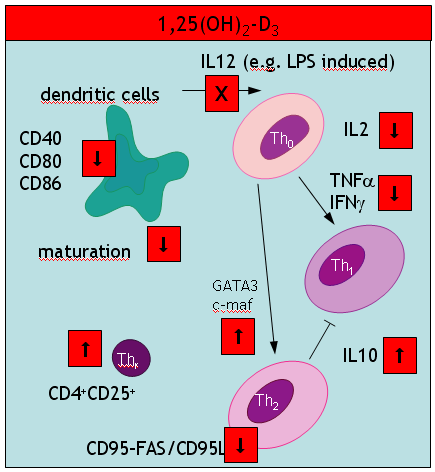
vd_immun.png

Yea, yea.


CC-BY-NC Science Surf accessed 09.01.2026

Is “vitamin” D a biological hub?

Folllowing up numerous emails to my recent review about allergy and vitamin D exposure, I wonder if there could be a quantitative relationship if we look at the vitamin D system as a major biological hub. This is not so much about connecting different playgrounds but of integrating signals (as shown in the hourglass blog). The East-West German difference, the farming studies as well as numerous other studies would even allow a quantitative effect. Yea, yea.

Addendum

Biospektrum will publish in their next issue a summary of the vitamin D story.

Addendum

4-07-2007 The list of vitamin D dependent genes that are associated with allergy (IL12B, IL12RB, SPP/OPN, CD14, CD23, VDR, TNF, GC, IFN, IL1RN, IL8, ADRB2, CARD15, IL4R, ALOX5, FLG, SOCS3) is expanding: TSLP and CD86


CC-BY-NC Science Surf accessed 09.01.2026

Beauty is skin deep but ugly goes all the way to the bones

Sorry, the original title of this paper is “Nothing but skin and bone“. It is an excellent JCI review of two diverse systems that do not seem to have so many common denominators. As the authors state a recurring theme is Wnt (a family of secreted glycoproteins) signalling during early patterning and for morphogenesis of skin appendages – common mesenchymal progenitors support both tissues. What the authors neglected is the effect of vitamin D signal in skin and bone, yea, yea.


CC-BY-NC Science Surf accessed 09.01.2026

Another difference between men and women

Aside from sex hormones, circulating vitamin D – calcidiol – serum levels show a consistent difference between men and women. Ok – I know that

  1. nuclear receptors are hormone-dependent transcription factors (Drané P, Mol Cell 2004; 16:187)
  2. 25-OH-D3 hydroxylase is upregulated by estradiol-17 (forgot reference)
  3. endometrium expresses VDR during cycling (Vigano, J Mol Endo 2006; 36:415)

but what is really responsible for this difference? A new Cell paper now shows that tamoxifen (an estrogen receptor antagonist) disrupts calcium homeostasis in yeast. Yea, yea.


CC-BY-NC Science Surf accessed 09.01.2026

Resurrection or reanimation of old myth?

JCI has a paper about resurrection of vitamin D deficiency (more about the author at 1, 2 and 3). The author uses references 46-59 to underpin his opinion that rickets has again become an epidemic. These references are from 1992, 1984, 2005, 2000, 1987, 1987, 1989, 1994, 1989, 2001, 1998, 2001, 1987, 2006. So nothing really new – no prospective study, no systematic survey, just a few isolated reports. Sure, that there might be a rickets problem in a selected areas or in minority groups, but there is no world-wide epidemic. He argues also that many (if not all) studies show “low” serum 25-OH-D3 values. Is this chasing a phantom? A more systematic study concludes that rickets in Africa is more a disease of calcium deficiency. The JCI article is particular poorly written when it comes to immunological effects; asthma is misquoted from the Camargo study (which is subject of my review at Pediatric Allergy. Nay, nay.


CC-BY-NC Science Surf accessed 09.01.2026

Nothing but skin and bone…

… was the title of a recent editorial in JCI. Clearly that’s not true for vitamin D as you may know of the many immunological functions. A new study now shows, that mice get atopic dermatitis by applying vitamin D ointment. A EJCN paper published on the same day concludes that “the national fortification of fluid milks and margarines with vitamin D safely improved the vitamin D status of children”. Nay, nay.


CC-BY-NC Science Surf accessed 09.01.2026