Just a quick link to a new Edge series What are you optimistic about? Why? that is just online for 24 hours. (I have recently been teached on being only 1x negative on being 5x positive – this post counts for 5x :-)
and read it also if you are not so much interested in German cars but in population-based DNA registries.
German BKA seems to have already 3900,000 DNA fingerprints in stock (other European countries store DNA profiles without any consent). Is there any way out? Here is an idea that I had on my morning daily bike trip:
Is that a solution?
No, this is not a post about another case of scientific misconduct (the sigma factor in transcription initiation published in Cell last October) but about Six Sigma, a process developed at Motorola in 1986 for measuring defects and improving quality of the production process (Motorola owns the trademark for Six Sigma). Read more at the excellent Wikipedia article – applying these principles could also help scientific projects, yea, yea.
The 3 Rs of regulating animal research are Refinement (to minimize suffering), Reduction and Replacement (to minimize the number of animals used). A Nature news feature now has a critical appraisal of current knockout projects where each of the 25,000 genes will be knocked out in the next future. Although current technology represent an advantage over recent undirected mutagenesis projects
… the number of mice needed to establish a line stretches from 50 to several 100. On top of this, another couple of 100 animals are needed for basic analysis of genetic make-up and phenotype…
Many genes cannot be knocked out – some knockouts may even be lethal.
We are also not so much interested in permanent destruction of genes in all tissues but in conditional and temporal shutdown of gene function.
And many researchers are not so much interested in the current 129 background than in BL6 (at least in immunology and allergology).
Finally (in human genetics) we are not dealing with knockouts but with multiple genomic variants of a gene. The question therefore is
Is the spirit of the knockout projects in line with [3R] principle[s]?
although I acknowledge that these industrial projects may generate many “nice to know” facts.
It was an interesting experiment that started on June, 1 in the Nature office: a first trial of of open peer review. Of the 10,000 papers received every year, 6,000 are immediately rejected and eventually 700 published after peer review. The result of the trial, however, is disappointing:
We sent out a total of 1,369 papers for review during the trial period. The authors of 71 (or 5%) of these agreed to their papers being displayed for open comment. Of the displayed papers, 33 received no comments, while 38 (54%) received a total of 92 technical comments.
The trial provoked some web traffic with approx. 800 page views/day. Welcome back to the altruism thread, the discussion may be followed at their blog, yea, yea.
In a previous paper I have questioned if LPS
nanogram exposure on the pulmonary epithelium will supersede the gram-wise exposure on the gut mucosa.
This may indeed work as now shown by Eyal Raz in a commentary in Nature Immunology where previous TLR studies
typically reproduce the splenic version of innate immunity (the spleen is used here as a metaphor for the sterile internal environment).
In the lung only the alveolar space is thought to be sterile while macrophages should not be in a constant state of activation (as inflammation would compromise gas exchange).
There are now several indicators for a lung-specific regulation of innate immunity: TLR9 is expressed in human plasmacytoid dendritic cells while TLR4 is only on myeloid DCs; TGFB-Ăź mediated crosstalk between alveolar macrophages and epithelial cells seems to be unique in the lung; in addition indeolamine induction or surfactant production is not found elsewhere. Yea, yea.
if you want to see Crison and me in the same stadium, you must bid him slacken his speed to mine, for I cannot run quickly, and he can run slowly.
(from Platons Protagoras dialogue English|German).
firstmonday has a wonderful paper “More, Faster, Better: Governance in an Age of Overload, Busyness, and Speed” basically arguing that the vast sources of information has a rather paradoxical effect: the abundance of information rather disconnects and distances us from ourselves and the world around us.
Immersed in a sea of media, information sources, technologies and devices, many of us are now becoming aware of the downside â€" some would say the dark side â€" of these powerful new modes of communicating and acting.
The mere number of papers being published even in my most genuine area of interest is impossible to monitor at the end of 2006 – bioscience looses more and more scientia. Although papers still have a “discussion” section, there is no more discussion as references are getting more and more eclectic.
The Levy paper in firstmonday is a “must read” – in particular the chapter on
Vannevar Bush, an American born in 1890, was trained as an electrical engineer and for the first part of his career worked as a professor and an administrator at MIT…. Bush was famous enough to appear on the cover of Time in April of 1944. Yet today he is best remembered not for his technical work or his contribution to winning the war, but for an article he published in the Atlantic Monthly in July, 1945, titled “As We May Think”
and what he says about two kinds of thought: routine or repetitive or logical thinking along an accepted groove – literature scan, arithmetic operations all that technical stuff that can be automated: In contrast there is mature, creative thought, deep, original thinking, reasoning – without any mechanical substitute. Levy makes the point that
Certainly the easy availability of information and the increasing pace of life can at times be empowering and even exhilarating, but too much stimulation can lead to numbing, a loss of focus, and withdrawal: it can dumb down, enervate and even stupefy.
the information overload (with less reliable, often questionable) information leads to a deprivation of mature thinking that severely affects now the academic world
Yet today’s universities â€" their faculty, students, and staff â€" are increasingly caught up in the current cultural frenzy; academics are now busier and more overloaded than ever before. The pressure on faculty to obtain outside funding is intense and increasing as the pool of available funds shrinks; time spent searching for potential funding sources, writing grant proposals, and shepherding them through intricate bureaucratic procedures is simply added on to the other expectations of the job…. increased student expectations that instructors should and will be available for consultation at all hours of the day and night, weekends included. Eâ€"mail has also made professors that much more reachable by the general public, the press, and academics at other institutions…
What can be done? Prescreening of relevant science by (institutionalised) editors or (anarchic) blogs? And by which criteria?
Rolf Zinkernagel in a commentary in Nature Immunology explains that today almost everything can be measured â€" and a nearly uncontrollable complexity often paired with weak detection methods renders experiments almost unrepeatable. His recommendations are
Most if not all experiments have limitations. Therefore researchers must think and argue and do experiments contrary to published results and against biases.
Nearly all studies need some funding; funding is controlled by peer review; peer review usually prohibits these experiments. Yea, yea.
Otto Warburg was not only lucky to win a Nobel prize but also three of his scholars. On of these, Hugo Theorell, describes the discovery of nicotinic acid amide as picrolonate in December 1933. The initial yield of the substance was poor – crystals of a few miligrams were obtained from 200 l of horse blood. Warburg estimated that they would have to kill all horses in Germany to find out the constitution. Theorell continues (quoted from Krebs: Warburg. 1981, p32)
Fortunately, they had the elementary analysis, melting point and the molecular weight. Now a friend of Warburg’s, Walter Schöller, who was the head of the Schering Kahlbaum Company Laboratory, made the simplest trick in the world: he looked into ‘Beilstein’ for substances with the same composition and melting point and within no time he said: “Well, this is nicotinic acid amide, synthesized by Mr so-and-so in 1878 or something like that.” Warburg’s comment was as laconic as usual: “Yesterday we could not buy it for any money in the world, today we can buy it for two marks a pound.”
Nicotinamide had powerful inhibitory effects on mycobacteria and led to the synthesis by Hoffman-La Roche of isonicotinic acid hydrazide or isoniazid – and Warburg had the chance to read his own obituary in The Times (Krebs, p.67) where he complained that the discovery of nicotinamide had been deliberately omitted (his former institute is here).
Looks pretty much that this discovery worked along the same strategy as proteomics today: 2-DE to tandem MS (MS/MS) and database lookup. Yea, yea.
At the moment I am reading the biography of Otto Warburg eloquently written by Hans Krebs. Here is a nice story about the banking house M. M. Warburg in Hamburg: Aby Warburg renounced his right to share in the banking business on the condition that his brothers would pay the bills for all the books that he deemed necessary for his library. The brothers enormously underrated the magnitude of this financial obligation – Aby Warburg (1866-1929) assembled a unique art history library which is now at London University. Would you like to have a brother who is a banker or would you like to be a banker with such a brother?
We are already waiting for the BMJ. This year
Yea, yea.
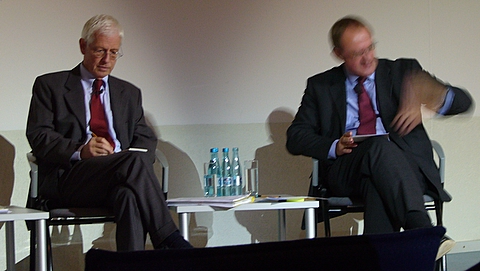
Last week I attended a meeting in Neuherberg about the future of science and ethics in medicine and biology. Prof. JĂĽrgen MittelstraĂź (Konstanz) gave the introductory lecture, Prof. Herwig Hulpke, Prof. Friedrich Wilhelm Graf and Prof. Klaus Peter participated in the discussion moderated by Fraua Ferlemann (BR). The lecture by Prof. MittelstraĂź was remarkable, I am offering here a 60 MINUTE PODCAST [in German only] while the manuscript will follow later in January 2007. Please let me know if you want the full audio records of the 2 hour meeting.
Prof. MittelstraĂź (left) and Prof. Graf (right) during the discussion
My interest in DNA pooling was always strong; we have developed methods doing this on the mass spec platform and applied it to the HLA region. I had, however, doubts if testing pools by less accurate methods like chip hybridization will work. The January issue of the AJHG now has a fascinating article how pooling may even work on the Affymetrix platform. Yea, yea.
DNA pooling can be even used in family context, see Wen Chung Lee in Cancer Epidemiology 2005 or Neil Risch in Genome Research 1998.
Science daily reports an interesting study how a protein recognizes a particular DNA binding site
Structural changes in both the protein and DNA, sometimes with the DNA within the complex kinked or sharply bent, allow for the specific contacts needed for a tight DNA-protein fit. Scientists think DNA is largely passive in this genetic tango. But new findings by Anjum Ansari, associate professor of biophysics at the University of Illinois at Chicago, suggest DNA may not be the wallflower that many had assumed…
Yea, yea.
In a recent book chapter we discussed new genotyping and sequencing technologies. Our concluding remarks haven´t changed so much – it seems that realtime detection of single molecules is still not possible; micro electropheresis based methods have already reached their limit while sequencing by hybridization has severe restrictions when it comes to de novo (or re-) sequencing of whole genomes. At least for research purpose I expect that whole genome re-sequencing will replace current SNP based disease mapping. So far, sequencing by synthesis seems to be one of the few HT methods that already works at that scale. The 454 platform consists of 3 consecutive steps:
With an average read length of 100 bp and 200,000 fragments (resulting in 20 Mb) in 6 hours, the throughput is about 60fold compared to Sanger sequencing. The recent Neanderthal paper raises five arguments why the 454 sequencing platform is extremely well suited for analyses of bulk DNA extracted from ancient remains.
- … it circumvents bacterial cloning, in which the vast majority of initial template molecules are lost during transformation and establishment of clones.
- … because each molecule is amplified in isolation from other molecules it also precludes template competition, which frequently occurs when large numbers of different DNA fragments are amplified together.
- … its current read length of 100â€"200 nucleotides covers the average length of the DNA preserved in most fossils.
- … it generates hundreds of thousands of reads per run, which is crucial because the majority of the DNA recovered from fossils is generally not derived from the fossil species, but rather from organisms that have colonized the organism after its death.
- … because each sequenced product stems from just one original single-stranded template molecule of known orientation, the DNA strand from which the sequence is derived is known. This provides an advantage over traditional PCR from double-stranded templates, in which the template strand is not known, because the frequency of different nucleotide misincorporations can be deduced … damage that affects different bases differently.
Except of the low read length most of these observations would benefit large scale resequencing projects in human individuals. My main point for starting ASAP resequencing projects: So far we have not achieved a dense resolution of the genome while deep resequencing project (for example at the CRP locus) got astonishing results. We do not even know what is going on in the “noncoding” regions. Finally deletions and CNVs have been largely neglected – another look at this question in the EJHG.
The question remains, what does 454 mean – my inquiry is still pending. As far as I know 0815 was a machine gun in World War I and is a synomym for something repeatedly boring while 4911 is a street number and stands for a perfume. Yea, yea.