A new paper in the EJCN examines genetic and non-genetic factors influencing vitamin D serum levels. The authors find 24% of the variability explained by season & intake Continue reading Genetics of 25-hydroxy D3
The former nature genetics editor has been recently here in Munich giving a talk on Open Access. Chatting after her talk, she told us that on another occasion a guy was yelling at her “you are my nemesis” because she once declined to publish his paper. We laughed but there is some serious background – journals editors often decide on careers of young people.
From my recent experience Continue reading Barbara you are my nemesis
X chromosomal inactivation is difficult enough to understand – there are now some more data on autosomal monoallelic expression (editorial & paper). Up to 10% of 4,000 genes in clonal cell lines were found to be monoallelic expressed (and up to 20% in some B cell clones). Only odorant and T cell receptors are selectively expressed while all other genes are thought to be randomly silenced.
I wonder how any transmission disequilibrium test makes sense if a variant is only transmitted to a silent chromosome? Possibly there are also epigenetic feedback loops where proteins can remodel chromatin and induce epigenetic marks ultimately silencing a chromosomal region. In any case, a fundamental paper, yea, yea!
isn´t my second paper as this NEJM letter was sent out without me. Authorship rules are less well defined than generally assumed. Why counting impact points from publication lists if these do not reflect your previous work?
The full crystal structure of the ß2 receptor is now clear after many attempts for its low natural abundance – with the extracellular domain still difficult to resolve (more on the relevance of the mutations depicted in Fig.1 in my recent Lancet editorial). Interesting: the effects of mutations on distant sites by breaking off van der Waals interactions like I135 that disrupt a ionic lock simply by a more loosely packed molecule.
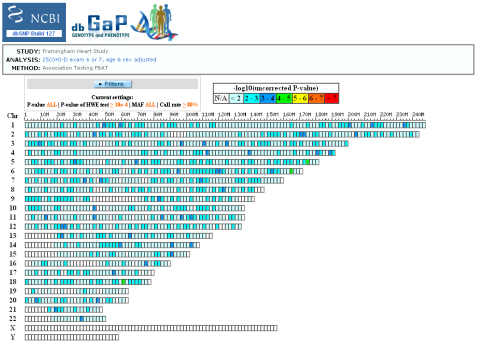
The first genomewide association for vitamin D serum levels is already online as the Framingham people told me earlier this day, many thanks!
There are 3 important regions on the above figure figure: around rs1394615, rs1877165 and rs2160595, see also the attached excel sheet fram25ohdexam6or7agesexadj.xls.
What are the reasons that my linkage study arrived at completely different regions? The accompanying BMC Genetics paper even highlights 2 different SNPs: rs1048516 + rs10507577). Anyway, the best region in my opinion is on chromosome 6. Here are the significant SNPs in relation to their neighboring genes: Continue reading First 25OH-D3 GWA online
A news focus in Science Magazine asks “Who’s the queen? Ask the genes” and shows new research that in some social insects nature, not nurture, determines whether offspring becomes worker or royalty.
I am not aware of any genetic studies of bosses but there might be also inherited personality traits in humans that favor a certain behavior.
Given my interest in a German gene-test law and the corresponding passivity of the German government, I am now proposing a “Biobank German Bundestag” that will allow me to go for gene variants that make our representatives different from us, the commonalty. I am sure that we will have a gene test law within 12 months …
Nature news reports an unpublished meta analysis of Cesarean section and asthma risk. The authors interpret the outcome in the light of the hygiene hypothesis: unhygienic siblings, risky! Normal delivery, risky!! No early bullshit, risky!!!
Again, delivery mode may be a proxy for physician contact and iatrogenic causes. Having heard today also lectures that take the hygiene hypothesis for granted, the old adage comes to my mind:
You may fool all the people some of the time. You can even fool some of the people all of the time. But you cannot fool all of the people all the time.
I always thought that toll like receptors owe their name to the toll function of the immune system. As I learned only today, the origin is with the German “toll” (amazing, phantastic) ascribed by Christiane Nüsslein-Volhard to a Drosophila protein.
After running a dual core CPU for two weeks I have a list here of all transcripts that are associated with the “ORMDL3” SNP gene cluster. Making sense from this list is a difficult task even with dozen of dedicated websites.
To get an overview of what is available I would start Continue reading GPS for biological pathways
It does not seem very unusual to have original research in blog posts. Evolgen is doing that by currently publishing a series exploring the evolution of a duplicated gene in the genus Drosophila. So finally science is more than knowing which is a high impact journal – peer review may be replaced comments below.
My latest idea is to create a wiki like annotation server that lets everybody create rules how to analyze an individual genome – we could use the CV dataset as a testbed.
Maybe we should start with SNPs only and develop some ground rules first at which threshold any predictive rule may be applied?
Otherwise these personal genomes will be quite useless, yea, yea.
A new nature medicine review has listed clinical trials targeting toll-like receptors. These including 3 preclinical studies using cpG-ODNs against TLR9 by Dynavax Astra-Zeneca, Coley / Sanofi-Aventis and Idera / Novartis. Lets wait and see…
Here are my gratulations to the current IG Nobel Prize Winners – see also Science magazine. Is there anything else that I may have missed? Oh yes, the official prizes… As a new service you can even ask them questions.

Over and over I am flooded with emails like
Let me introduce myself to you. I am xxxxxxxxxx, completed M. Sc Micro Biology. At present I am working as a research Fellow in Centre for xxxxxxxx, xxxxxxxxxx, India. How are you sir? I am your student. How can I mean, in January 2005 you come to India. At that time your engaged some class to us in xxxxxxxxx College, Axxxxxxxx. Presently I am working on Genetics of “xxxxxxxxxxxx†under the esteemed guidance of Dr. xxxxxxxxxxx and Dr. xxxxxxxxxx. I am very much interested to do PhD. Herewith, I am sending my curriculum Vitae as attachment to your kind perusal. I assure you, I shall work with at most devotion and sincerity to give you satisfaction and also I am confident that I can lead PhD successfully with the experience I gained during my research work at xxxxxxxxx. Given a chance I will prove my caliber.
Continue reading Want to work with you