Ueli Steck speed solo Eiger record from toshiki on Vimeo.
CC-BY-NC Science Surf , accessed 08.09.2026
Ueli Steck speed solo Eiger record from toshiki on Vimeo.
Well, I have been supporting startups even before Kickstarter and Indiego. Unfortunately Carbike never came into life, all my money was lost.
But if you think that science + arts are important, you can’t stop funding interesting projects. I even sold devices later for some unexpected problems (CloudFTP, The Nutter) or could not access the expected video projects (Bikes vs Cars).
But I see crowdfunding more like an altruistic way to support good ideas and do not feel scammed as many Zano backers.
Even right now where again two of my backed projects are in troubled water (Kraftwerk and Itraq) I see this as an experiment where I am not looking for revenues, at least not in the first instance. But maybe I would appreciate deadlines from the grant holders and any reason why they could not be met. And of course a note when the project is being dead.
Frank Uwe Laysiepen and Marina Abramovic: Not just the famous video but also the true story.
IC is a vanishing concept despite our efforts in the past. It could be so easy as explained in this tea video.
It is a ritual that I have seen for may years. All lights are switched on after a talk and the race starts for the microphones.
These are not always the best questions that are being asked after a talk. And as there is a time limit, not all questions will be asked. And why are these only oral questions while the lecture was multimedia?
Apart from the fact that asking a question is a mini-presentation of people who are not suffering from low self esteem, I think we may indeed develop new tools of communication.
Here is my current experimental setup. I open a local hotspot before the lecture where up to 250 mobile devices (phone, tablet, laptop) can connect. Each of these clients in the audience gets a comment / upload screen when following instructions given on the first slide.
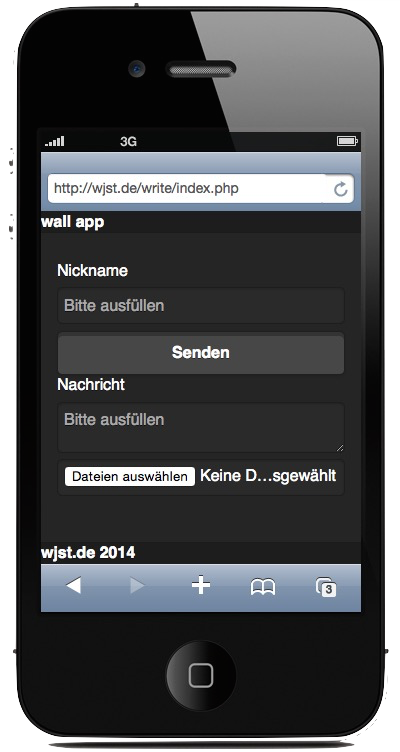
All audience response is being written to a database, while attached diagrams or screenshots are being saved to a cache directory.
The talk itself is not displayed from Powerpoint but from Chrome in presentation mode. Basically this is just one single presentation page built dynamically with one divs per slide. Next slide just means scrolling to the next div and can be controlled from any tablet or phone.
Periodically the presentation page is being appended with further divs containing new question slides from the audience.
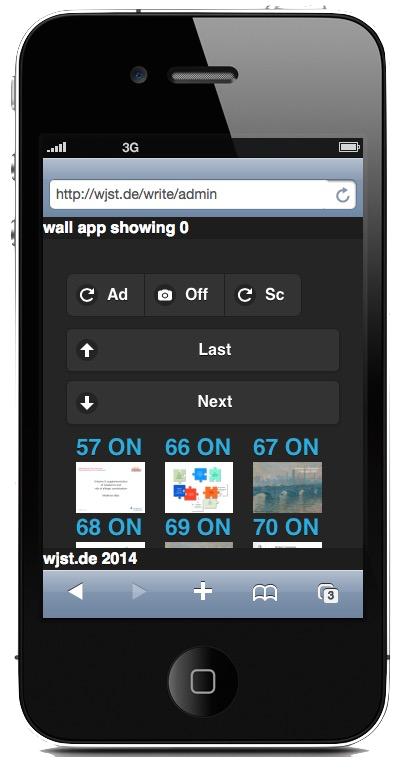
After the end of the talk, we can go to the admin page, where we may jump to single questions and display them just like the slides from my own talk.
But what is so much different now to the current practice?
If you interested in testing, I would be happy to share further details. The only thing you need is a local WLAN router and access to the command line where a local web server is being started.
A recent paper identifies 10 rules for better pictures. As I have also given several lectures on that topic, I was excited what the authors think…
1. Know your audience. This is trivial as you never know your audience.
2. Identify your message. True and not true at the same time. True as it makes your findings more evident – not true if you are allowing a reader to find his own message.
3. Adapt the figure to the support medium. Trivial. May be very time consuming.
4. Captions are not optional. Absolutely true, I also suppport good captions – mini stories for those who can’t read the whole text.
5. Do not trust the defaults. Trivial. No one does.
6. Use color efficiently. Not really, avoid colors for those of us who are colorblind and to avoid expensive page charges.
7. Do not mislead the reader. Why should I?
8. Avoid Chartjunk. Absolutely. Most frequent problem.
9. Message trumps beauty. Sure, form follows function.
10. Get the right tool. Maybe correct while the further recommendations look like a poor man’s effort to make his first graphic at zero cost: Gimp, Imagemagick, R…
It’s not easy to monitor science output. This may be particular true when it comes to Journal Hijacking. In brief
The Spanish journal Afinidad has been hijacked. Someone has set up a fake website for the journal and is soliciting submissions and payments from the authors in accordance with the gold open-access model.
With the recent quality of some scholarly journals I feel they may have been highjacked too: typing errors, omission of references, major misunderstandings, logical errors, you name it.
Edge sends me an email today
The strange thing about academics, which always fascinates me, is that they believe they’re completely immune to status considerations and consider themselves to be more or less monks. In reality, of course, academics are the most status-conscious people in the world. Take away a parking space from an academic and see how long he stays. I always find this very strange when you occasionally get in the realm of happiness research, you get fairly considerable assaults on consumerism as if it’s just mindless status seeking. Now, the point of the matter is, is that academics are just as guilty of the original crime, they just pursue status in a different way.
True? True!
Tom Brewster had an interesting idea: selling hsi own data. Why should anyone else make money with it?
When I decided to sell the secret details of my personal life, I had high hopes I'd get a willing buyer. It didn't go well.
I had been curious to see if I could make money from my online information - something that data brokers across the world are doing every day; collecting it, combining it with others' information and flogging it to marketing firms or anyone willing to pay. So I put myself on eBay.
The article is really interesting to read, yea, yea.
When sorting out old boookmarks to numerous internet articles and papers that I wanted to read over the past years, but never did, I came across “Ignore everybody”. The website is still up after all the years and has some interesting proposals