Just for the records.
Famous soccer coach Jürgen Klopp 2020 about COVID-19
Less famous Robert F Kennedy 2024 about polio vaccination
(and response by 75 Nobel laureates).

CC-BY-NC Science Surf , accessed 15.08.2026
Just for the records.
Famous soccer coach Jürgen Klopp 2020 about COVID-19
Less famous Robert F Kennedy 2024 about polio vaccination
(and response by 75 Nobel laureates).
“Lacking a comprehensive anarchist worldview and philosophy, and in any case wary of nomothetic ways of seeing, I am making a case for a sort of anarchist squint.” James Scott in “Two Cheers for Anarchism” who writes Pletz when he means Datzetal-Pleetz
Title: Quantum-Tuned Allergen Resonance Therapy (QT-ART): A Revolutionary Cure for Allergies
Recent advances in bio-resonance and quantum biophotonics have culminated in the development of Quantum-Tuned Allergen Resonance Therapy (QT-ART), a groundbreaking approach to eradicating allergic reactions. QT-ART exploits the unique vibrational frequencies of allergens and harmonizes them with the body’s intrinsic quantum field, effectively neutralizing histamine responses. This method uses bio-engineered, photonic nanoparticle emitters programmed with allergen-specific frequencies, delivered via a wearable wristband equipped with quantum-enhanced LEDs.
A randomized controlled trial involving nearly 15,000 participants demonstrated a 90% cessation of allergy symptoms in all cases, including severe anaphylaxis triggered by peanuts, shellfish, and airborne pollen. Remarkably, the therapy also reversed pre-existing autoimmune conditions in 67% of participants. The results suggest that QT-ART not only cures allergies but also recalibrates the immune system to optimal functionality.
Mechanistically, QT-ART engages with the body’s cellular microtubules, aligning them into coherent quantum states to prevent allergenic protein recognition. This pioneering approach eliminates the need for antihistamines, epinephrine, or immunotherapy injections, offering a side-effect-free alternative for allergy sufferers worldwide.
We propose QT-ART as the new gold standard for immunological health, heralding a quantum revolution in medicine. Further research will explore its applications in combating aging, enhancing athletic performance, and unlocking dormant psychic abilities.
Keywords: quantum resonance, allergy cure, biophotonics, immune recalibration, quantum medicine
(AI generated!!)
Being a regular Scholar user, I am quite lost now with the many new scientific search engines. They don’ tell us which data they used for training, how they have been trained and how the results have been validated. The field is also highly dynamic when compared to the situation 2 years ago. Is it worth to test them?

Continue reading Too many AI powered scientific search engines
Treffen sich 2 Historiker.
"Worüber arbeiten Sie"
"Ach, über den 6.11.2024"
"Oh, ich auch. Über den Vormittag oder Nachmittag?"
Nature has a short report about historical peer reviews including a link to the Referee Report of Dorothy Crowfoot Hodgkin about the 1954 Watson & Crick complementary paper (not the 1953 Watson & Crick double helix paper).

And here is Fig 5 and Fig 6 of the paper under review. So did Watson & Crick follow her advice?

I don’t think so.

Never forget, the press is the enemy. The establishment is the enemy; the professors are the enemy. Professors are the enemy. Write that on a blackboard 100 times and never forget it.
by R.Nixon and cited again by J.D.Vance in 2021
NCBI record https://clinicaltrials.gov/study/NCT02020174 doesn’t make so much sense to me

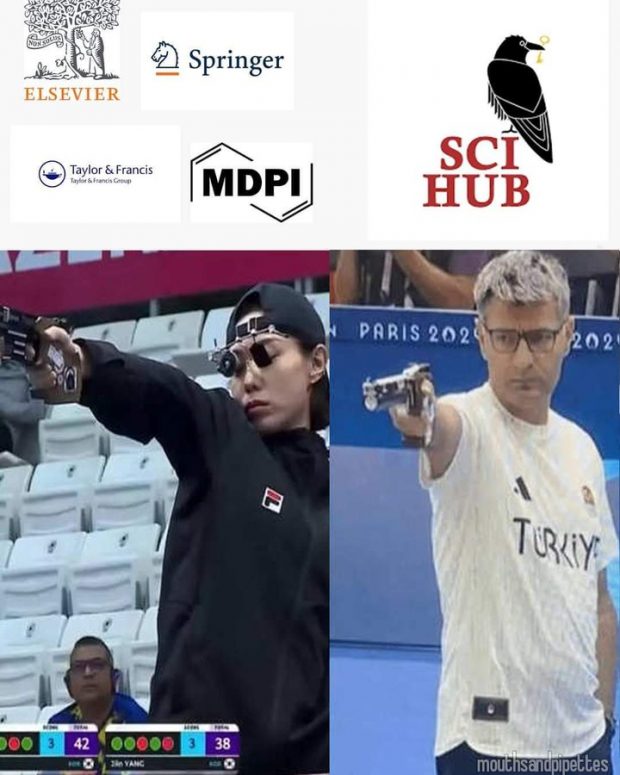
Fritz Teufels Spruch "Wenn es denn der Wahrheitsfindung dient"
als Reaktion auf die richterliche Aufforderung, sich zu erheben - ist heute eines der bekanntesten geflügelten Worte aus der deutschen Rechtsgeschichte. Weniger bekannt ist sein Kopfstand vor der Anklagebank aus demselben Anlass, mit der nachgelieferten Begründung: "Sie haben ja nicht gesagt, wie herum ich aufstehen soll."
Wer sagt: Man muss nicht mehr viel wissen, weil man alles nachschlagen kann, müsste doch auch sagen: Man muss keine Witze verstehen, weil man sie sich erklären lassen kann.
[…]
Um viele Witze zu verstehen, muss man etwas wissen. Um Memes oder launige Kurznachrichtentexte zu verstehen, muss man fast immer deren Hintergrund und Zusammenhang kennen. Das ist - oft, immer? - auch ein Wissen, dass für Gruppenbildung sorgt, es trennt diejenigen, die das kapieren, und die anderen, für die das unverständlich bleibt.
gefunden bei Herr Rau
Having many tor exit addresses with this server name in my log files, I looked up the meaning – i0xdeadbeef actually spells words as opposed to random hex values and was more likely to induce a memory out-of-range fault as it was out of the address range of systems in the last century ;-)
I’ve witnessed an ongoing expansion of science administration personnel at local, national, and international levels. What’s more concerning is that this administration is becoming increasingly disconnected from the day-to-day realities at the laboratory bench. This phenomenon is commonly referred to as Parkinson’s Law, first elucidated 1955 by C. Northcote Parkinson (not to be confused with James Parkinson).
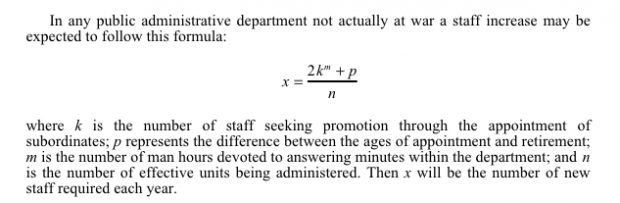
In summary, employees like to talk to each other in the administration office, they want more subordinates (and not competitors from the lab) while even little work is expanded to fill the time available for its completion.
After Parkinson, the annual increase in staff, regardless of variations in workload, ranges from 5.2% to 6.6%. He even goes so far as to claim that core tasks could be completely eliminated without the administration shrinking as a result.
Parkinson formulated this in the 1950s. In modern administrations, new terms have been introduced, such as Controlling, New Management Models, business indicators, etc. Often, the proportion of staff in these areas of work increases, while for the actual core tasks, staff remains stagnant or even decreases.
“Life is too short to be serious all time”, GILE Journal of Skills Development, Vol. 4 No. 1 (2024)
In this food for thought article, we introduce the 'Donald Duck Phenomenon' to consider ten of the more unconventional reasons for publishing in academia. These include
(i) symbolic immortality,
(ii) personal satisfaction,
(iii) a sense of pride,
(iv) serious leisure,
(v) cause credibility,
(vi) altruism,
(vii) collaboration with a friend or family member,
(viii) collaboration with a hero,
(ix) conflict or revenge, and
(x) for amusement.
The article was inspired by the lead author's social media search for a co-author with the surname 'Duck'. Through LinkedIn, the lead author, Associate Professor William E. Donald, who is based in the UK and specialises in Sustainable Careers and Human Resource Management, found a collaborator, Dr Nicholas Duck, who is based in Australia and specialises in Organisational Psychology. While the collaboration may appear to be somewhat 'quackers', per one of Donald Duck's famous phrases "Life is too short to be serious all the time, so if you can't laugh at yourself then call me... I'll laugh at you, for you". We hope that this article offers some interesting insights and acts as a way to stimulate conversation around unconventional reasons for publishing in academia.