Braucht Wissenschaft Kommunikation?

Natürlich muss Wissenschaft Ergebnisse kommunizieren, vor allem wenn Forschung staatlich gefördert ist. Schon immer wurden Ergebnisse veröffentlicht oder auf Kongressen vorgetragen.
Die Frage ist lediglich, ob jeder alles verstehen kann? Ich bin da skeptisch. Auszug aus dem DHV Newsletter von gestern:

Bundesbildungsministerin Anja Karliczek hat angekĂĽndigt, dass die Wissenschaftskommunikation einen größeren Stellenwert bei der Vergabe von Forschungsmitteln einnehmen soll. In einem Gastbeitrag fĂĽr die “Zeit” stellt Karliczek das Ziel eines Grundsatzpapiers ihres Ministeriums vor, nach dem Wissenschaftlerinnen und Wissenschaftler “in ihren Projekten die Kommunikation von Anfang an mitdenken und Ressourcen dafĂĽr einplanen” sollten. Es sei an der Zeit, “konkrete Anreize fĂĽr mehr Kommunikation im Forschungsalltag zu geben”. Die Ministerin kĂĽndigte an, dass es eine Plattform zur Evaluation der Wissenschaftskommunikation geben solle. Zudem werde sie eine Denkwerkstatt “#FactoryWisskomm” ins Leben rufen, die Selbstverpflichtungen der Wissenschaft erarbeiten solle. Wissenschaftskommunikation solle “endlich zur Chefsache in den Wissenschaftseinrichtungen” werden, so die Ministern weiter.

Wen interessiert schon der Forschungsalltag? Wir brauchen valide Ergebnisse und zwar dringend in vielen Bereichen. Mit begrenzten Ressourcen wäre es sinnvoller, das Geld in Personal und Ausstattung zu stecken. PR Abteilungen gibt es genĂĽgend, was fehlt sind mehr Postgraduierten Studiengänge zu Wissenschaftsjournalismus und damit Wissenschaftsredaktionen, die nicht auf jede PR und auf jede Stimmung hereinfallen, wie an dem berĂĽhmten “6000 Tote”-Beispiel zu sehen war.

Ansonsten sind wir auf dem besten Weg, dass bald 80% in den Overhead gehen, wenn wir auch noch die “Kommunikation von Anfang an mitdenken” sollen. Die EU macht es vor mit unzähligen Auflagen zu Timesheets, A1 Formularen, Equality, Ethik, SMEs, GDPR, Communication, Progamm Management … Fakt ist doch, dass es viel zu viele prekäre Arbeitsplätze in der Wissenschaft gibt.

Es gab im ĂĽbrigen auch empirische Untersuchungen zu dem Thema vor mehr als 10 Jahren (Small 2007)

This study aims at exploring and explaining scientists' responses to calls for increased dialogue and engagement with the public on the social and ethical implications of scientific research. Findings are presented from interviews with scientists regarding their views on the democratization of sci- ence and on the impacts of the increasing commercialization of science. Scientists supported the democratization of science but were divided on the extent of the public's role.

Die Reaktion auf den Vorschlag fällt somit auch vernichtend aus.

Der Deutsche Hochschulverband hat die Newsletter-Leserinnen und -Leser im November gefragt, ob sie es für eine gute Idee halten, dass Bundesministerin Karliczek Wissenschaftskommunikation zum Kriterium für Forschungsförderung erheben will. 98,5 Prozent der Teilnehmerinnen und Teilnehmer antworteten mit Nein und 1,5 Prozent mit Ja.
 

CC-BY-NC Science Surf , accessed 30.08.2026

Can you buy impact?

Yes you can. Only recently I came across an incredible example how a university has been pushing the own “impact”. It is the astonishing story of the King Abdulaziz University ( detected by Bits of DNA ) and goes back to an earlier Science article

In 2011 Yudhijit Bhattacharjee published an article in Science titled "Saudi Universities Offer Cash in Exchange for Academic Prestige" that describes how KAU is targeting highly cited professors for adjunct faculty positions.

Looks like the professional football league. If you do have a lot of money you can pay for whatever player you need for your club. There is, however, a big difference: As a player you have to show up on tht football field, as a scientist you just have to drop your name somewhere.


CC-BY-NC Science Surf , accessed 30.08.2026

Wie mit Wissenschaftsleugnern umgehen?

Hier eine Reihe von Link Tipps (eine Zusammenfassung aus der Scientists for Future Mailing Liste mit eigenen Ergänzungen).

Fakten zählen leider hier wenig, dennoch die Sache ist nicht ganz hoffnungslos, wenn man sich die Quellen ansieht, mehrfach Rollenspiel durchgeht, am besten einen Knopf im Ohr hat mit Supportern im Publikum.


CC-BY-NC Science Surf , accessed 30.08.2026

Doubling time

I always had the impression that whenever a scientific work group is growing too quickly, it is difficult to keep ethical and scientific standards. Maybe that’s even true on macroscopic scale? The paper “Age, Aging and Age Structure in Science” by Robert Merton & Harriet Zuckerman summarizes in 1972 (on p 498 of Merton’s collected works “Sociology of Science”) that

the population of scientists, with a doubling time of about fifteen years, is far outrunning the acceleration rate of increase in the general population.

and he quotes Derek Price “Little science, big science” p 19 that we

will soon have two scientists for every man, woman, child and dog.


CC-BY-NC Science Surf , accessed 30.08.2026

Organized ! Scepticism !! 2019 !!!

Here is the original 1942 text (“The Normative Structure of Science”) with an excerpt the 4th norm as found at panarchy.org/merton/science.html

As we have seen in the preceding chapter, organized skepticism is variously interrelated with the other elements of the scientific ethos. It is both a methodological and an institutional mandate. The temporary suspension of judgment and the detached scrutiny of beliefs in terms of empirical and logical criteria have periodically involved science in conflict with other institutions. Science which asks questions of fact, including potentialities, concerning every aspect of nature and society may come into conflict with other attitudes toward these same data which have been crystallized and often ritualized by other institutions. The scientific investigator does not preserve the cleavage between the sacred and the profane, between that which requires uncritical respect and that which can be objectively analyzed.

As we have noted, this appears to be the source of revolts against the so-called intrusion of science into other spheres. Such resistance on the part of organized religion has become less significant as compared with that of economic and political groups. The opposition may exist quite apart from the introduction of specific scientific discoveries which appear to invalidate particular dogmas of church, economy, or state. It is rather a diffuse, frequently vague, apprehension that skepticism threatens the current distribution of power. Conflict becomes accentuated whenever science extends its research to new areas toward which there are institutionalized attitudes or whenever other institutions extend their control over science. In modern totalitarian society, anti-rationalism and the centralization of institutional control both serve to limit the scope provided for scientific activity.

Note also the footnote as the text was written in 1942 only. By 1948, the political leaders of Soviet Russia strengthened their emphasis on Russian nationalism and began to insist on the "national" character of science.
The Merton text contains perfect predictions of what is currently going on with the Scientists for Future movement – conflict becomes accentuated whenever science extends its research to new areas invalidating particular dogmas of church, economy, or state. If organized scepticism is an integral part of the scientific method (which I believe) conflicts are preordained.


CC-BY-NC Science Surf , accessed 30.08.2026

CO2-AusstoĂź

nach Land – welche Regierung ist verantwortlich?

nach Einwohner – welche Menschen sind verantwortlich?

Quelle
Territorial emissions

Original
CDIAC: Boden, TA, Marland, G and Andres, RJ 2017. Global, Regional, and National Fossil-Fuel CO2 Emissions, Carbon Dioxide Information Analysis Center, Oak Ridge National Laboratory, U.S. Department of Energy, Oak Ridge, Tenn., USA. DOI: 10.3334/CDIAC/00001_V2017.
UNFCCC, 2017. National Inventory Submissions 2017. United Nations Framework Convention on Climate Change.
BP, 2017. Statistical Review of World Energy.

# R
co2pp <- read.csv("/Users/xxx/Desktop/export_20191116_1913.csv",sep = ";", quote = "\"'",)
visited <- colnames(co2)[-1]
register_google(key="???")
ll.visited <- geocode(visited)
ll.visited[, "country"] <- c("Afghanistan","Albania","Algeria","Andorra","Angola","Anguilla","Antigua.and.Barbuda","Argentina","Armenia","Aruba","Australia","Austria","Azerbaijan","Bahamas","Bahrain","Bangladesh","Barbados","Belarus","Belgium","Belize","Benin","Bermuda","Bhutan","Bolivia","Bonaire..Saint.Eustatius.and.Saba","Bosnia.and.Herzegovina","Botswana","Brazil","British.Virgin.Islands","Brunei.Darussalam","Bulgaria","Burkina.Faso","Burundi","Cambodia","Cameroon","Canada","Cape.Verde","Cayman.Islands","Central.African.Republic","Chad","Chile","China","Colombia","Comoros","Congo","Cook.Islands","Costa.Rica","Côte.d.Ivoire","Croatia","Cuba","Curaçao","Cyprus","Czech.Republic","Democratic.Republic.of.the.Congo","Denmark","Djibouti","Dominica","Dominican.Republic","Ecuador","Egypt","El.Salvador","Equatorial.Guinea","Eritrea","Estonia","Ethiopia","Faeroe.Islands","Falkland.Islands..Malvinas.","Fiji","Finland","France","French.Guiana","French.Polynesia","Gabon","Gambia","Georgia","Germany","Ghana","Gibraltar","Greece","Greenland","Grenada","Guadeloupe","Guatemala","Guinea","Guinea.Bissau","Guyana","Haiti","Honduras","Hong.Kong","Hungary","Iceland","India","Indonesia","Iran","Iraq","Ireland","Israel","Italy","Jamaica","Japan","Jordan","Kazakhstan","Kenya","Kiribati","Kuwait","Kyrgyzstan","Laos","Latvia","Lebanon","Lesotho","Liberia","Libya","Liechtenstein","Lithuania","Luxembourg","Macao","Macedonia..Republic.of.","Madagascar","Malawi","Malaysia","Maldives","Mali","Malta","Marshall.Islands","Martinique","Mauritania","Mauritius","Mexico","Micronesia..Federated.States.of.","Moldova","Mongolia","Montenegro","Montserrat","Morocco","Mozambique","Myanmar","Namibia","Nauru","Nepal","Netherlands","New.Caledonia","New.Zealand","Nicaragua","Niger","Nigeria","Niue","North.Korea","Norway",NA,"Oman","Pakistan","Palau","Panama","Papua.New.Guinea","Paraguay","Peru","Philippines","Poland","Portugal","Qatar","Republic.of.South.Sudan","Réunion","Romania","Russian.Federation","Rwanda","Saint.Helena","Saint.Kitts.and.Nevis","Saint.Lucia","Saint.Pierre.and.Miquelon","Saint.Vincent.and.the.Grenadines","Samoa","Sao.Tome.and.Principe","Saudi.Arabia","Senegal","Serbia","Seychelles","Sierra.Leone","Singapore","Slovakia","Slovenia","Solomon.Islands","Somalia","South.Africa","South.Korea","Spain","Sri.Lanka","Sudan","Suriname","Swaziland","Sweden","Switzerland","Syria","Taiwan","Tajikistan","Tanzania","Thailand","Timor.Leste","Togo","Tonga","Trinidad.and.Tobago","Tunisia","Turkey","Turkmenistan","Turks.and.Caicos.Islands","Tuvalu","Uganda","Ukraine","United.Arab.Emirates","United.Kingdom","United.States.of.America","Uruguay","Uzbekistan","Vanuatu","Venezuela","Vietnam","Wallis.and.Futuna.Islands","Western.Sahara","Yemen","Zambia","Zimbabwe")
ll.visited <- as.data.frame(ll.visited)
cnd <- ll.visited$country %in% colnames(co2)
for(i in 1960:2017){
  ll.visited[cnd,"CO2"] <- as.vector(t(co2pp[i-1959,ll.visited$country[cnd]]))
  p <- ggplot() +
    geom_polygon(data = map_data("world"), aes(x=long, y=lat, group=group), fill="grey", alpha=0.2) +
    theme_void() + 
    xlim(-160,190) +
    ylim(-60,90) +
    geom_point( data=ll.visited, aes(x=lon, y=lat, size=CO2, fill=CO2), alpha=.8, pch=21) +
    scale_fill_continuous(low="blue4", high="red", breaks=seq(0,10000,2500), limits=c(0,10000) ) +
    scale_size(range = c(.1,35), breaks=seq(0,10000,2500), limits=c(0,10000) ) +
    annotate("text", label=i, x=170, y=85, size=8.5) +
    scale_size(range = c(.1,14)) +
    guides( size = FALSE, fill = guide_colourbar(order = 1, title=expression('t CO'[2]*' per pers '), ) )
  fn <- paste("/Users/xxx/Desktop/tmp/",str_pad(i-1959, 3, pad = "0"),".png",sep="")
  ggsave(p, file=fn, width = 9, height = 4.5)
}
# ffmpeg -framerate 5 -i /Users/xxx/Desktop/tmp/%3d.png -r 5 -pix_fmt yuv420p -y /Users/wjst/Desktop/X/CO2.mp4

Anmerkung

  • Ich weiss nicht, worauf die Differenz zu anderen Angaben beruht.
  • Der Plot CO2 pro Kopf hat “capped outliers”, alles was ĂĽber der Skala lag, wurde auf die obere Grenze gelegt. Dennoch imponieren hier weiterhin Länder wie Curaçao mit einer starken Ă–l-Ă–konomie (Shell…), ebenso auch Katar.
  • Eine fixe Skala ĂĽber die Zeit (die Zeile mit scale_fill_continuous…) hat Vor- und Nachteile. Vorteil – man sieht besser die Entwicklung der Gesamtemission. Nachteil – die relative Entwicklung zu anderen Ländern geht etwas verloren.


CC-BY-NC Science Surf , accessed 30.08.2026

Time


<–blog posts kills sidebar–>


CC-BY-NC Science Surf , accessed 30.08.2026

Zur Neutralität von Wissenschaft

Peter André Alt in einem Gastbeitrag für den Tagesspiegel

Wissenschaft produziere Erkenntnisse, keine Meinungen […] Und Universitäten obliege es primär, diese Erkenntnisse in Lehre und Forschung zu ermöglichen.
Es lässt sich nicht bestreiten, dass wissenschaftliche Einsichten gesellschaftliche Prozesse beeinflussen können. Ja, es ist auch denkbar, dass sie selbst zum Gegenstand von Meinungsstreitigkeiten werden – in den jeweiligen Disziplinen ebenso wie unter Laien. Aber es wäre fatal, wenn man Wissenschaft gleichsam programmatisch darauf ausrichtete, die Lebenswelt direkt zu lenken oder politische Debatten zu befeuern.
[…] fĂĽr ihre Fragestellungen, Methoden und Lösungsangebote ist nichts fataler als eine Funktionalisierung im Dienste sei es noch so ehrenwerter gesellschaftlicher Zwecke. Spätestens dann, wenn diese Zwecke nicht mehr ehrenwert sind, wird erkennbar, dass die Subordination der Wissenschaft unter politische Programme zu gefährlichen Konsequenzen fĂĽhrt.

Wer wird da nicht zustimmen wollen?


CC-BY-NC Science Surf , accessed 30.08.2026

Performance management has long contributed to ill health in researchers

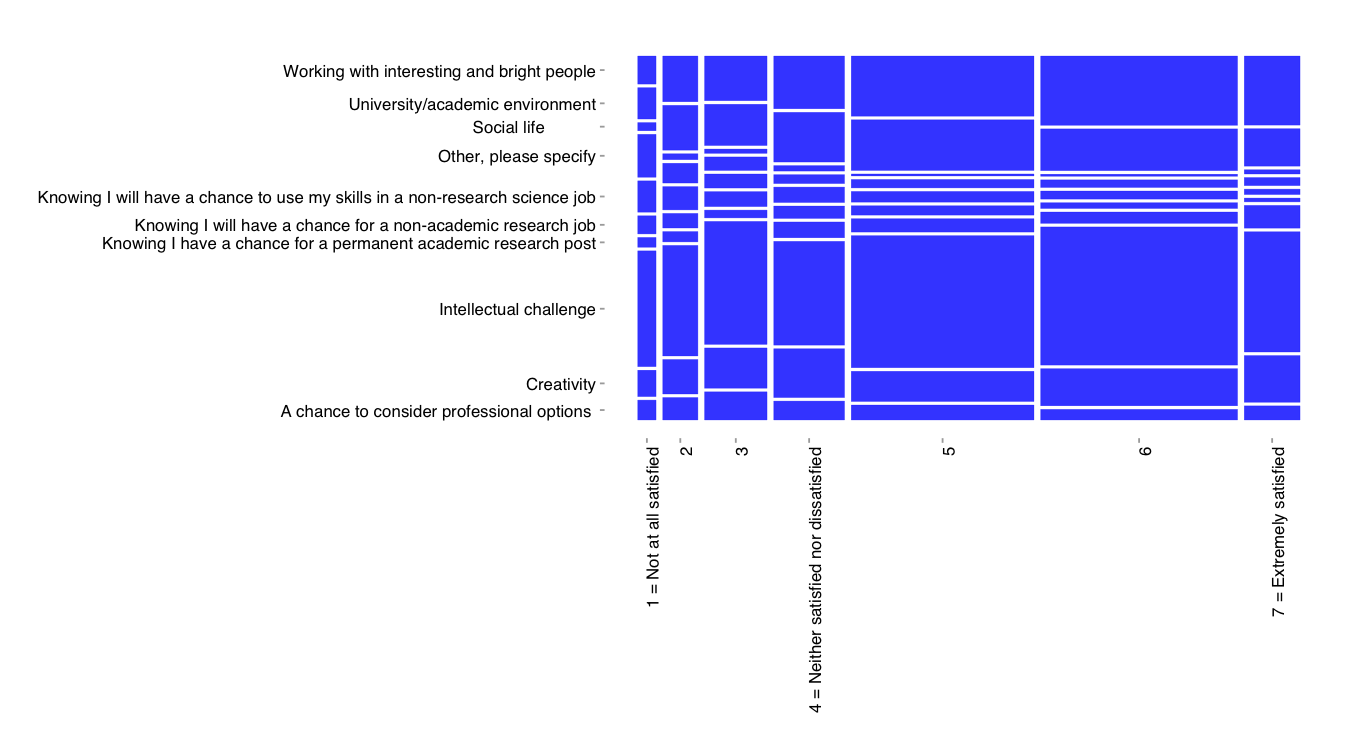
… which is the legend to a picture in Nature’s 13th Nov editorial accompanying their recent survey of 6,000 graduate students.

I'm concerned about the very competitive nature of early-career scientists. At some institutions people are very cut-throat rather than being supportive of colleagues."

Only 44% are satisfied with the decision to pursue a PhD.

I wonder if these are the same 38% who expected an intellectual challenge (those students we are most interested in)?

The full dataset is online.

list.of.packages <- c("ggplot2", "openxlsx")
lapply(list.of.packages, require, character.only = TRUE)
tmp <- tempfile()
download.file("https://ndownloader.figshare.com/articles/10266299?private_link=74a5ea79d76ad66a8af8",tmp)
unzip(tmp,exdir="/Users/wjst/Desktop")
unlink(tmp)
phd <- read.xlsx("/Users/wjst/Desktop/Nature_PhD survey_Anon_v1.xlsx", sheet = "Cleaned data - anonymised", startRow = 1, colNames = TRUE, rowNames = FALSE, detectDates = TRUE, skipEmptyRows = TRUE, skipEmptyCols = FALSE, rows = c(1,3:6811), cols = NULL, check.names = FALSE)
# the word documentation has wrong variable names!
phd[phd$Q28=="No" & !is.na(phd$Q28),"Depressed"] <- c(0)
phd[phd$Q28=="Yes" & !is.na(phd$Q28),"Depressed"] <- c(1)
ggplot(data = phd) +
  geom_mosaic(aes(x = product(Q17, Q19.a) ), na.rm=TRUE, fill="blue")

Good to see that “intellectual challenge” and “high satisfaction” occupies the largest area. But who is getting ill?
(TBC)


CC-BY-NC Science Surf , accessed 30.08.2026

Doktorarbeit zu kaufen gesucht

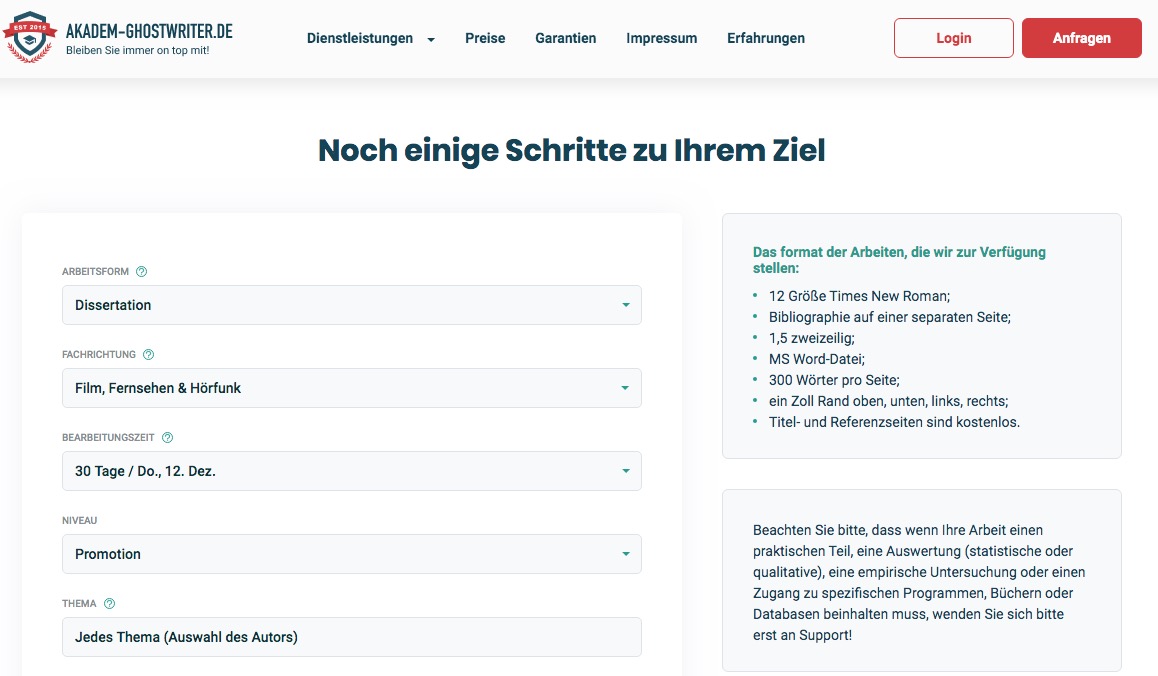
Mit immer mehr Hochschulabsolventen steigt auch der Betrug um die Promotionen, so Nature in der letzten Woche mit einem Beitrag von Tracey Betrag, der Autorin des “Academic Integrity Handbook“.

Stories of students paying others to do their work come from all around the world. In the 2015 MyMaser scandal in Australia, hundreds of students who were enrolled in more than a dozen universities paid a total o f at leas US$160,000 'service' that provided ghost-written essays and responses to online tests. In 2018, YouTube stars on more than 250 channels received money for promoting a cheating service called EduBirdie. Similar companies have been uncovered in the United States and elsewhere.

Ihre Schätzung: 6% der Doktoranden betrügen. Und auch ein weiteres Review ist der Meinung, dass der Betrug inflationär zunimmt.

Auf Deutsch heisst das dann auf wenig verschleiernd Beratung, Korrektur, Lektorat, Feedback, Weiterbildung – seit dem Urvater “Dr. Frank Grätz” (den es aber in der Form seit 2008 nicht mehr gibt), hat sich nicht viel geändert, ausser dass die Preise deutlich gestiegen sind.

Dilettiere mit uns.
Ist Promocode hier ein unfreiwilliges Wortspiel?
wir verfassen keine Plagiate, wir verfassen Falsifikate
Beachten Sie bitte, dass wenn Ihre Arbeit einen praktischen Teil, eine Auswertung (statistische oder qualitative), eine empirische Untersuchung oder einen Zugang zu spezifischen Programmen, BĂĽchern oder Databasen (sic!) beinhalten muss, wenden Sie sich bitte erst an Support (sic!)
Ist das ein Schreibfehler? Scientia?


CC-BY-NC Science Surf , accessed 30.08.2026