Category Archives: Philosophy

Bad apple or bad system?

A new piece in the Journal of Academic Ethics raises the important question if and why the earlier “bad apple” explanation of scientific misconduct has been largely abandoned by referencing to ‘institutional failure’ (bad barrels), and ‘structural crisis (bad system).

Dutch scientists in 2011 explained Diederik Stapel’s grand-scale data fabrication largely in systemic terms, whereas only fifteen years earlier, in the René Diekstra affair (1996) such explanations had been close to absent…


CC-BY-NC Science Surf accessed 19.02.2026

Citation is not Confirmation

this is basically reframing a recent Twitter thread

Excellence depends on citation. Citation depends on  popularity. Popularity depends on fanciness. Fanciness on newsworthiness. Newsworthiness on excellence. Excellence depends on citation …


CC-BY-NC Science Surf accessed 19.02.2026

Give us our daily bias

When working today about COVID-19 mortality, I was falling back to the survivorship bias that is nice illustrated at Wikipedia and which is just another type of selection bias that I explained in my last talk.

During World War II, the statistician Abraham Wald took survivorship bias into his calculations when considering how to minimize bomber losses to enemy fire.The Statistical Research Group (SRG) at Columbia University, which Wald was a part of, examined the damage done to aircraft that had returned from missions and recommended adding armor to the areas that showed the least damage, based on his reasoning. This contradicted the US military’s conclusions that the most-hit areas of the plane needed additional armor.


CC-BY-NC Science Surf accessed 19.02.2026

Eine politische Frage

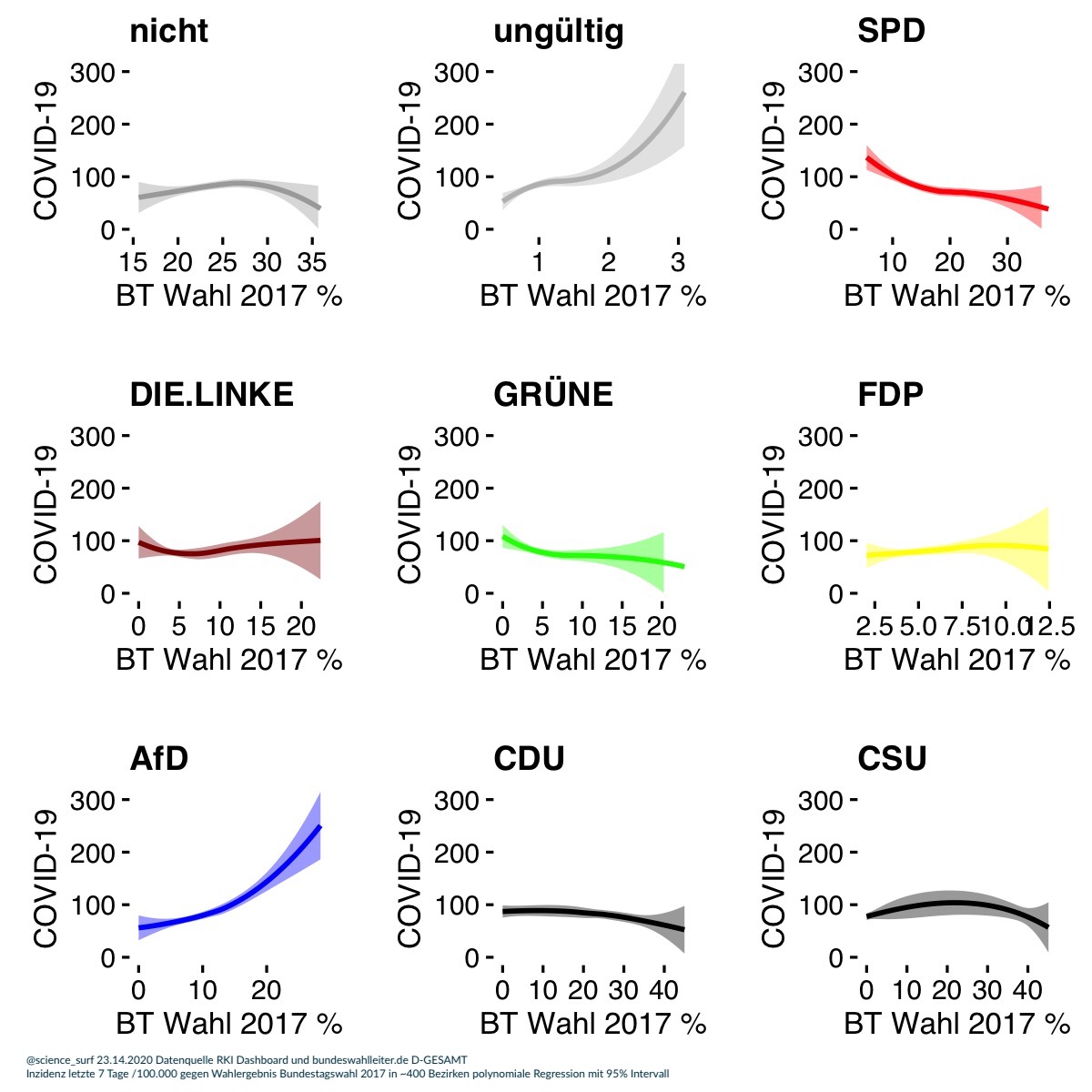
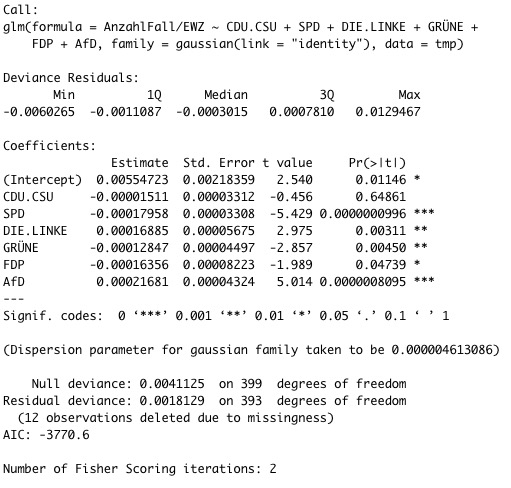
Die #COVID19 Pandemie wird in der zweiten Welle immer mehr zu einer politischen Frage – vor allem für die Regierenden aber nun auch für die Wähler. CDU/CSU/FDP/Nichtwähler stabilisieren dabei die Inzidenz, Wähler mit ungültiger Stimme und AfD Wähler treiben sie nach oben, SPD und GRÜNE verringern sie.


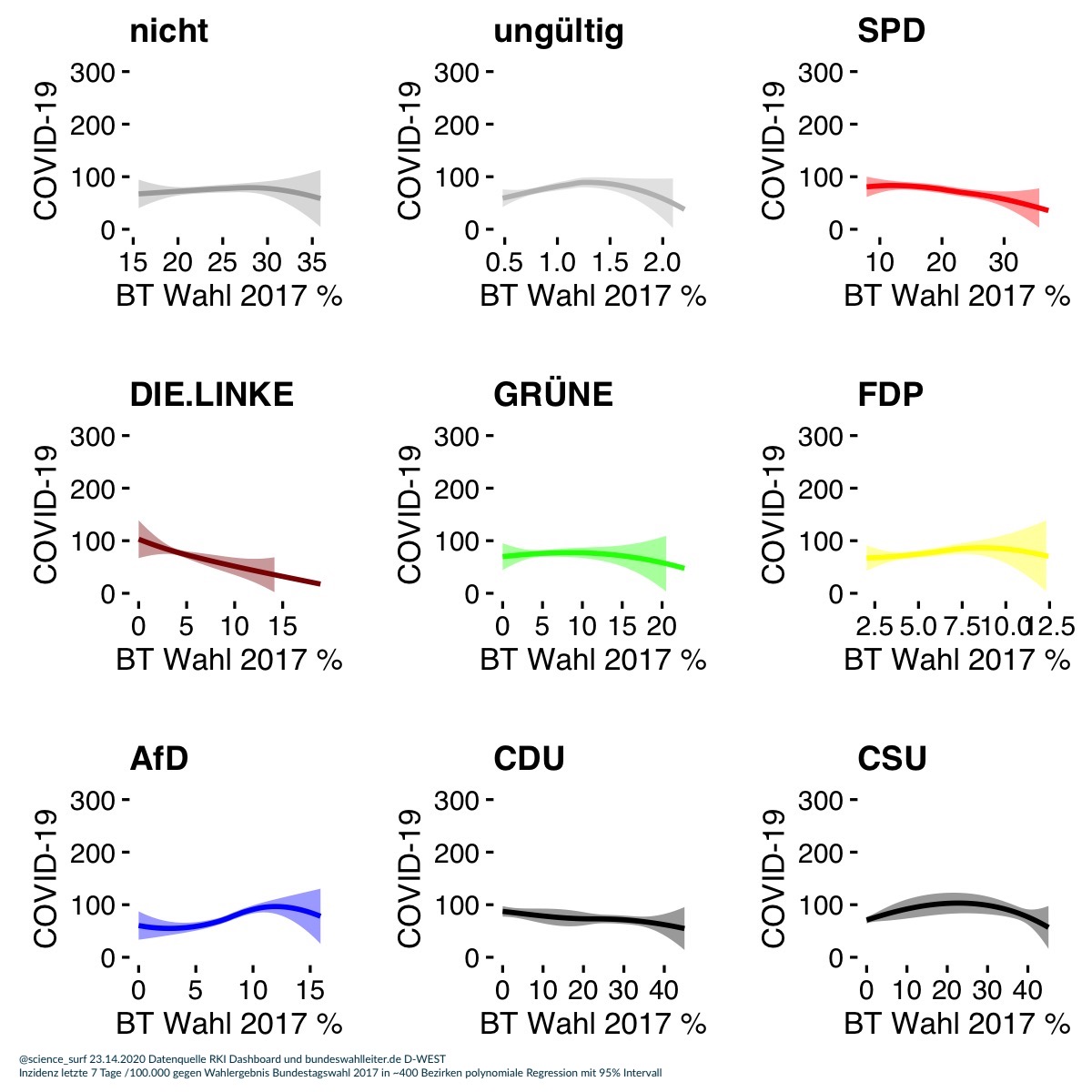
Nochmal das selbe Panel, diesmal allerdings nur die westdeutschen Bundesländer; der AfD Effekt schwächt sich hier deutlich ab; die LINKE zusammen mit der SPD wirkt sich positiv aus.


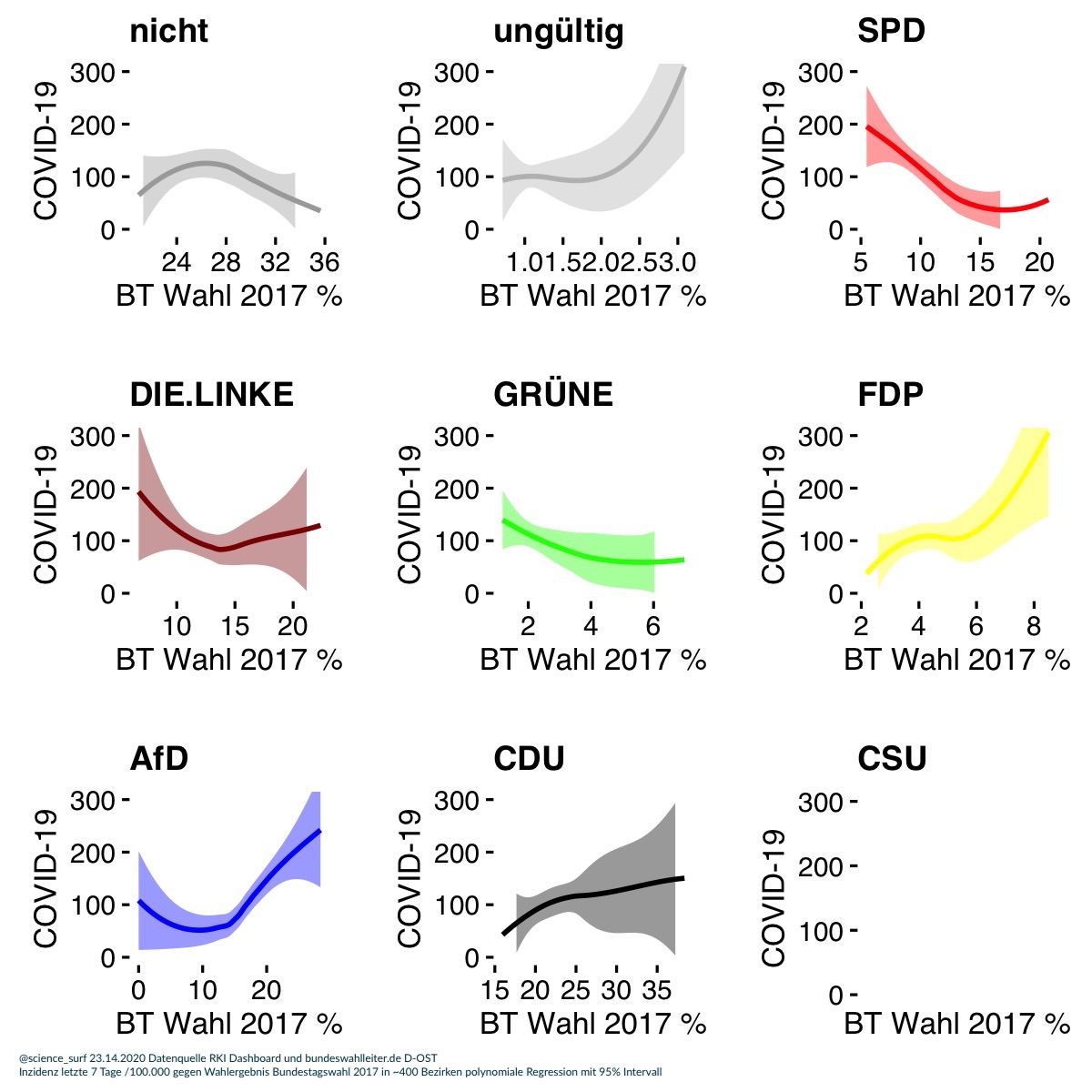
Ganz anders in den ostdeutschen Bundesländer: Bezirke mit hohem FDP Wähleranteil haben auch hier mehr Infektionen ähnlich wie in Bezirken mit hohem AfD und Nichtwähler-Anteil. Selbst bei der CDU gibt es  einen Anstieg, nur Bezirke mit SPD, GRÜNE und LINKE Anteil haben tendenziell eine niedrigere COVID-19 Inzidenz.


Das Thema hat wohl Matthias Quent am 6.12. zuerst aufgegriffen (nachdem es in der ersten Welle kaum Anhaltspunkte für solche Effekte gab).

In den vergangenen Tagen gab es in den Medien und in der Politik Thesen darüber, dass Regionen besonders stark von #Corona belastet sind, in denen die #AfD besonders stark ist. Was ist da dran? Wir haben nachgerechnet.

darauf die TAZ am 12.12.

Besonders stark diskutiert wird derzeit eine Kurzauswertung von Forschern am Institut für Demokratie und Zivilgesellschaft (IDZ) Jena. Deren Direktor Matthias Quent veröffentlichte auf Twitter eine Analyse, die nahelegt, dass es einen Zusammenhang zwischen hohen Coronazahlen und AfD-Anhängerschaft geben könnte.

die FAZ am 15.12.

Eine – auf den ersten Blick schlüssige – Vermutung lautet, dass die Zahl der Neuinfektionen in den Regionen besonders hoch ist, in denen viele AfD-Wähler leben. In Sachsen hatte die AfD bei der Landtagswahl im vergangenen Jahr mit 27,5 Prozent ihr bisher bestes Ergebnis eingefahren. Und die Partei hat sich, nachdem sie zu Beginn der Pandemie, als sich der Staat noch sehr zurückhaltend zeigte, besonders harte staatliche Eingriffe gefordert hatte, zu einer der schärfsten Gegner von Corona-Beschränkungen entwickelt, seit der Staat diese immer wieder anordnet. Bereits auf den ersten Demonstrationen der sogenannten Querdenker in Stuttgart waren Fahnen und Vertreter der AfD unübersehbar…

der SPIEGEL am 17.12.
Kaum eine Region in Deutschland ist so schlimm von der Pandemie betroffen wie der Landkreis Sächsische Schweiz-Osterzgebirge. Für Covid-Patienten gibt es keine freien Intensivbetten mehr. Ein Ortstermin in Pirna.
die ZEIT am 18.12.
Raj Kollmorgen:  …. Andererseits erstaunt es mich nicht, denn es gibt eine Reihe von Faktoren, welche die Epidemie in unserer Region begünstigen. Ein Faktor sind politische Mentalitäten. Teile der Bevölkerung sind grundsätzlich skeptisch gegenüber den Entscheidungen der Politik, nicht wenige sehen sich sogar im Widerstand und protestieren. Das hat sich in den vergangenen Monaten noch einmal verschärft.

Auf die Idee kann man schon kommen, wenn man die Nähe von AfD und „Querdenkern“ betrachtet. Aber kann es nicht auch sein, dass ein ganz sachlicher Grund dahintersteckt? Einer, der etwas mit den Wanderungsbewegungen der jungen Ostdeutschen zu tun hat? … Die Antwort auf die medial gestellte Frage wäre also eher nicht „die AfD ist schuld“, sondern: Die AfD ist genauso Symptom einer offenkundigen Fehlentwicklung wie die Überalterung und Destrukturierung …

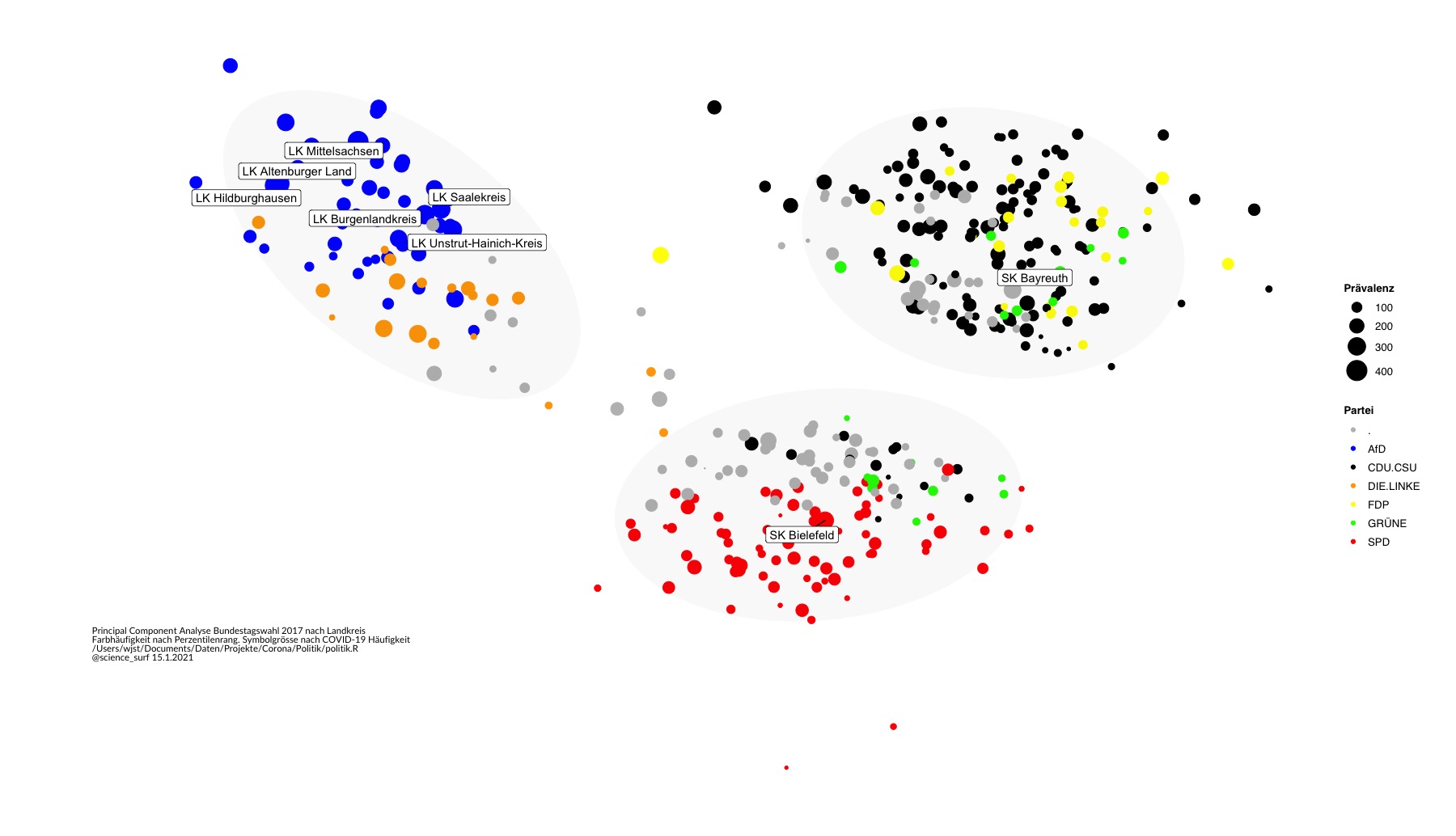
Hier nun ein Regressionsmodell sowie einPCA Plot  (im t-SNE Stil) mit eindeutigem Ergebnis: SPD dominierten Landkreisen ging es am besten in der Pandemie, AfD Landkreisen am schlechtesten. Ob das nun wirklich mit besserem Krisenmanagement zusammenhängt oder nur mit der zufälligen regionalen Koinzidenz ist dabei noch eine offene Frage.
Und hier noch die Principal Component Analyse der 3 Cluster (Anklicken zum Vergrössern)


CC-BY-NC Science Surf accessed 19.02.2026

let’s be honest

Flow Cytometry Basics by Christine Goetz Christopher Hammerbeck Jody Bonnevier, preface

let’s be honest, if you’re just learning something, you don’t know what you don’t know, and it’s hard to ask questions about the things you don’t know


CC-BY-NC Science Surf accessed 19.02.2026

About scientific myths

Natural / The Seductive Myth by Alan Levinovitz, p 18

People
 don’t
 just
 live
 by
 archetypal
 myths—they
 are
 constituted
 by them.
 As 
the 
scholar 
of
 myth 
Bruce 
Lincoln 
has 
argued,
 myth 
is 
ideology 
in narrative
 form.
Want 
to 
know 
what 
someone 
stands 
for? 
Look 
to 
the
 myths that
 shape
 them.
 Group
 identity,
 from
 religion
 to
 politics,
 depends
 on
 an investment
 in
 a
 few
 foundational
 stories,
 which
 serve
 as
 justifications
 of one’s
 preferred
 moral
 and
 social
 order.
 This
 is
 why
 mythically
 justified beliefs
 are
 so
 resistant
 to
 evidence:
 changing
 them
 means
 changing yourself.

This is what I think, when colleagues say, that a paper needs a story.


CC-BY-NC Science Surf accessed 19.02.2026

Sorry for the poor English

From a recent Nature email newletter: There’s more to science than English

The evidence shows that the pressure to write in English is a source of frustration and anxiety for some non-native English speakers, and hinders diversity in science. …. “English-speakers have become the gatekeepers of science, excluding a wide variety of opinions [and] perspectives,” says conservation scientist Tatsuya Amano.

https://journals.plos.org/plosone/article?id=10.1371/journal.pone.0238372


CC-BY-NC Science Surf accessed 19.02.2026

Science PR

Lutz Frühbrodt “- der Begriff Öffentlichkeitsarbeit ist ein typisch deutscher”

Der Begriff Öffentlichkeitsarbeit ist ein typisch deutscher. Er suggeriert, dass Unternehmen gegenüber der Öffentlichkeit eine Arbeit zu leisten hätten, zu deren Bedingungen. Aber, wenn es denn jemals überhaupt so war, dann stimmt das schon längst nicht mehr …Im Verhältnis von Unternehmen zu Journalisten gibt es seit einiger Zeit einen Umschwung von Pull- zu Push-Kommunikation. Anfragen werden immer später bearbeitet, stattdessen versuchen die Unternehmen, selbst Themen zu setzen. Sie betreiben stärker Content Marketing, also “Unternehmensjournalismus”, etwa mit Online-Magazinen und Web-Themenseiten. Es geht darum, in Abwandlung eines Begriffs des marxistischen Philosophen Antonio Gramsci, kommunikative Hegemonie zu erlangen. Themen zu setzen. Sich eigene Kanäle zu schaffen.

Die Entwicklung gibt es im übrigen auch in der Wissenschaft, allenfalls die amerikanischen Hochschulsport Mannschaften fehlen uns noch. Das Geld dafür ist ja schliesslich da und mit der Privatisierung wird das dann auch noch kommen. Zitat SZ

Vom neuen “Hochschulinnovationsgesetz” versprechen sich Staatsregierung wie Hochschulchefs viel: Weniger Bürokratie soll den Unis Freiheit, Flexibilität, Innovation und Schnelligkeit bringen. So sollen sie mithalten mit Harvard oder Cambridge, eigene Talente fördern und Spitzenforscher nach Bayern locken … Der Staat hätte nur die Rechtsaufsicht inne – und eine lange Leine: Die “Gestaltungsorganisation übergeordneter Art” werde das Ministerium behalten, sagte Sibler. Die Zielvereinbarungen des Freistaats mit jeder Hochschule sollen eine “stärkere Ergebnisorientierung” haben. Themen wie Ökologie, Geschlechtergerechtigkeit oder die Pflege kleiner Fächer werden festgelegt. Sind Ziele nicht erfüllt, gibt es weniger Geld.

Wissenschaft zu wenig ergebnisorientiert? Ich kenne niemand den Ergebnisse nicht interessieren würde. Spitzenforscher? Ich kenne Multifunktionäre die große Arbeitsgruppen haben. Aber was ist daran Spitze, wenn “ergebnisorientiert” immer noch mehr Artikel produziert werden?

Lesenswert auch der Twitter Thread in diesem Zusammenhang


CC-BY-NC Science Surf accessed 19.02.2026

The Nobel Prize violates a central paradigm of science

With the current hype around prize winners, we may not forget about the much larger number of scientists who have been never honored or even lost their live for doing good science.

The Nobel Prize violates a central paradigm of science that false opinions are always corrected, see also the summary at https://en.wikipedia.org/wiki/Nobel_Prize_controversies.

So this is not so much about the recent scandal around the secretary of the Nobel Committee for Physiology or Medicine, Urban Lendahl, who resigned due to the Macchiarini scandal.

Or about the recent Astra Zeneca money behind the nomination of Harald zur Hausen. I am thinking here about cruel treatments for example

1927 “for the discovery of the therapeutic value of malaria inoculation in the treatment of dementia paralytica” to Julius Wagner-Jauregg

1949 to Portuguese neurologist António Egas Moniz “for the discovery of the therapeutic value of leucotomy (lobotomy) in certain psychoses”.

The refrain is a familiar one that there are no isolated geniuses but (Atlantic), it

reinforces a flawed reward system in science in which the winner takes all, and the contributions of the many are neglected by disproportionate attention to the contributions of a few.


CC-BY-NC Science Surf accessed 19.02.2026

Book of the Year (2020)

Science Fictions by Stuart Ritchie / Kings College, is the clear winner. From the introduction

As this book will show, though, that system is badly broken. Important knowledge, discovered by scientists but not deemed interesting enough to publish, is being altered or hidden, distorting the scientific record and damaging our medicine, technology, educational interventions and government policies.
Huge resources, poured into science in the expectation of a useful return, are being wasted on research that’s utterly uninformative. Entirely avoidable errors and slip-ups routinely make it past the Maginot Line of peer review. Books, media reports and our heads are being filled with ‘facts’
that 
are 
either 
incorrect, exaggerated, or 
drastically 
misleading. 
And in the very worst cases, particularly where medical science is concerned, people are dying.

I couldn’t praise the book more than other reviewers

“A highly readable and competent description of the problems facing researchers in the 21st century… An excellent primer for anyone who wants to understand why and how science is failing to live up to its ideals.”
–Wired

“Excellent… A fascinating study… Sure, some scientists are corrupt. Some are negligent. Some are biased. But that does not mean we need less science. It means we need better science. That’s why books like this are so important.”
Evening Standard (London)

“We should listen to this warning about how neophilia and hype is ruining research… Ritchie has a gift for turning boring statistical processes into thrilling detective stories.”
The Times (London)

“A desperately important book. Stuart Ritchie’s much-needed work brilliantly exposes the fragility of the science on which lives, livelihoods, and our whole society depend. Required reading for everyone.”
–Adam Rutherford, author of A Brief History of Everyone Who Ever Lived

Amazon has a great review of Serguei Patchkovskii who wrote (full length)

The book offers a rather good catalogue of problems plaguing the scientific enterprise today. Every practicing scientist will recognize much of what Stuart Ritchie is writing about – sometimes in his or her colleagues, and quite frequently in the mirror. The collection of anecdotes on scientific mishaps, missteps, and outright fraud, which one finds in the book, is also rather entertaining and educational.
[… it] mostly ignores the well-fed elephant in the room: the perverse economics of the modern science, and the closely related misuse of the higher-education system. A lot, and in some fields the most, of the grunt work work in science is done by students (graduate and undergraduate) and post-docs. Both groups are routinely underpaid and under-rewarded, under the guise of being trained and educated. Both are also being held in check by the implied promise of the future academic career and well-paying jobs stemming from it – but for the vast majority of them, there will be no academic career, and no stable science job. […]
Worse, some of the proposed solutions would make it significantly harder for an honest scientist – which is really the majority of scientists, perverse incentives notwithstanding – to do their work, while barely inconveniencing a fraudster willing to break the rules if it benefits him.
Overall, I don’t regret paying my money for this book – but just barely.


CC-BY-NC Science Surf accessed 19.02.2026
The first scientific paper ever published

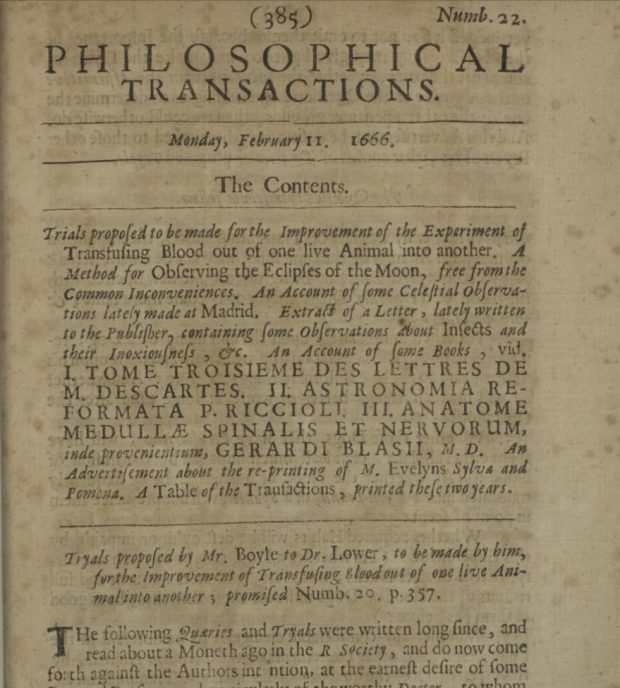
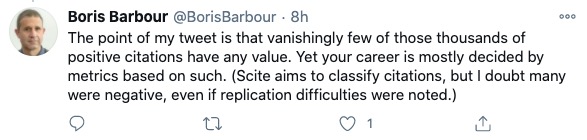
The first scientific paper (as far as we know) can  be retrieved from the excellent website of the Royal Society “Tryals proposed by Mr. Boyle to Dr. Lower, to be made by him, for the improvement of transfusing blood out of one live animal into another”.

This seems basically the same what Corona researchers are trying today with convalescent serum (although this may be dangerous due to rogue auto-antibodies against type I IFNs that may be transfused as well).


https://royalsocietypublishing.org/doi/pdf/10.1098/rstl.1665.0147

Science is about asking questions…

https://royalsocietypublishing.org/doi/pdf/10.1098/rstl.1665.0147


CC-BY-NC Science Surf accessed 19.02.2026