Category Archives: Philosophy

Organized ! Scepticism !! 2019 !!!

Here is the original 1942 text (“The Normative Structure of Science”) with an excerpt the 4th norm as found at panarchy.org/merton/science.html

As we have seen in the preceding chapter, organized skepticism is variously interrelated with the other elements of the scientific ethos. It is both a methodological and an institutional mandate. The temporary suspension of judgment and the detached scrutiny of beliefs in terms of empirical and logical criteria have periodically involved science in conflict with other institutions. Science which asks questions of fact, including potentialities, concerning every aspect of nature and society may come into conflict with other attitudes toward these same data which have been crystallized and often ritualized by other institutions. The scientific investigator does not preserve the cleavage between the sacred and the profane, between that which requires uncritical respect and that which can be objectively analyzed.

As we have noted, this appears to be the source of revolts against the so-called intrusion of science into other spheres. Such resistance on the part of organized religion has become less significant as compared with that of economic and political groups. The opposition may exist quite apart from the introduction of specific scientific discoveries which appear to invalidate particular dogmas of church, economy, or state. It is rather a diffuse, frequently vague, apprehension that skepticism threatens the current distribution of power. Conflict becomes accentuated whenever science extends its research to new areas toward which there are institutionalized attitudes or whenever other institutions extend their control over science. In modern totalitarian society, anti-rationalism and the centralization of institutional control both serve to limit the scope provided for scientific activity.

Note also the footnote as the text was written in 1942 only. By 1948, the political leaders of Soviet Russia strengthened their emphasis on Russian nationalism and began to insist on the “national” character of science.
The Merton text contains perfect predictions of what is currently going on with the Scientists for Future movement – conflict becomes accentuated whenever science extends its research to new areas invalidating particular dogmas of church, economy, or state. If organized scepticism is an integral part of the scientific method (which I believe) conflicts are preordained.

 

CC-BY-NC Science Surf accessed 19.02.2026

Zur Neutralität von Wissenschaft

Peter André Alt in einem Gastbeitrag  für den Tagesspiegel

Wissenschaft produziere Erkenntnisse, keine Meinungen […] Und Universitäten obliege es primär, diese Erkenntnisse in Lehre und Forschung zu ermöglichen.
Es lässt sich nicht bestreiten, dass wissenschaftliche Einsichten gesellschaftliche Prozesse beeinflussen können. Ja, es ist auch denkbar, dass sie selbst zum Gegenstand von Meinungsstreitigkeiten werden – in den jeweiligen Disziplinen ebenso wie unter Laien. Aber es wäre fatal, wenn man Wissenschaft gleichsam programmatisch darauf ausrichtete, die Lebenswelt direkt zu lenken oder politische Debatten zu befeuern.
[…]  für ihre Fragestellungen, Methoden und Lösungsangebote ist nichts fataler als eine Funktionalisierung im Dienste sei es noch so ehrenwerter gesellschaftlicher Zwecke. Spätestens dann, wenn diese Zwecke nicht mehr ehrenwert sind, wird erkennbar, dass die Subordination der Wissenschaft unter politische Programme zu gefährlichen Konsequenzen führt.

Wer wird da nicht zustimmen wollen?


CC-BY-NC Science Surf accessed 19.02.2026

Performance management has long contributed to ill health in researchers

… which is the legend to a picture in Nature’s 13th Nov editorial accompanying their recent survey of 6,000 graduate students.

I’m concerned about the very competitive nature of early-career scientists. At some institutions people are very cut-throat rather than being supportive of colleagues.”

Only 44% are satisfied with the decision to pursue a PhD.

I wonder if these are the same 38% who expected an intellectual challenge (those students we are most interested in)?

The full dataset is online.

list.of.packages <- c("ggplot2", "openxlsx")
lapply(list.of.packages, require, character.only = TRUE)
tmp <- tempfile()
download.file("https://ndownloader.figshare.com/articles/10266299?private_link=74a5ea79d76ad66a8af8",tmp)
unzip(tmp,exdir="/Users/wjst/Desktop")
unlink(tmp)
phd <- read.xlsx("/Users/wjst/Desktop/Nature_PhD survey_Anon_v1.xlsx", sheet = "Cleaned data - anonymised", startRow = 1, colNames = TRUE, rowNames = FALSE, detectDates = TRUE, skipEmptyRows = TRUE, skipEmptyCols = FALSE, rows = c(1,3:6811), cols = NULL, check.names = FALSE)
# the word documentation has wrong variable names!
phd[phd$Q28=="No" & !is.na(phd$Q28),"Depressed"] <- c(0)
phd[phd$Q28=="Yes" & !is.na(phd$Q28),"Depressed"] <- c(1)
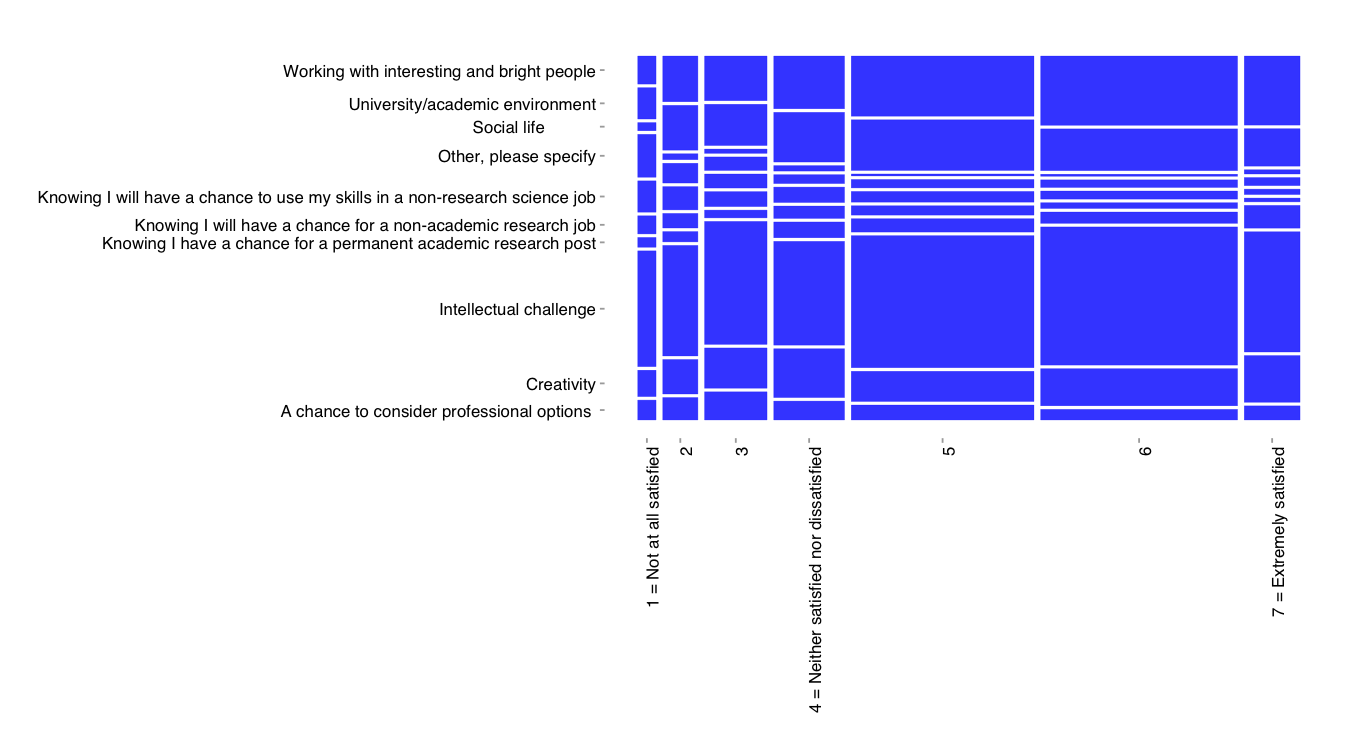
ggplot(data = phd) +
  geom_mosaic(aes(x = product(Q17, Q19.a) ), na.rm=TRUE, fill="blue")

Good to see that “intellectual challenge” and “high satisfaction” occupies the largest area. But who is getting ill?
(TBC)


CC-BY-NC Science Surf accessed 19.02.2026

Doktorarbeit zu kaufen gesucht

Mit immer mehr Hochschulabsolventen steigt auch der Betrug um die Promotionen, so Nature in der letzten Woche mit einem Beitrag von Tracey Betrag, der Autorin des “Academic Integrity Handbook“.

Stories of students paying others to do their work come from all around the world. In the 2015 MyMaser scandal in Australia, hundreds of students who were enrolled in more than a dozen universities paid a total o f at leas US$160,000 ‘service’ that provided ghost-written essays and responses to online tests. In 2018, YouTube stars on more than 250 channels received money for promoting a cheating service called EduBirdie. Similar companies have been uncovered in the United States and elsewhere.

Ihre Schätzung:  6% der Doktoranden betrügen. Und auch ein  weiteres Review ist  der Meinung, dass der Betrug inflationär zunimmt.

Auf Deutsch heisst das dann auf wenig verschleiernd Beratung, Korrektur, Lektorat, Feedback, Weiterbildung – seit dem Urvater “Dr. Frank Grätz” (den es aber in der Form seit 2008 nicht mehr gibt), hat sich nicht viel geändert, ausser dass die Preise deutlich gestiegen sind.

Dilettiere mit uns.
Ist Promocode hier ein unfreiwilliges Wortspiel?
wir verfassen keine Plagiate, wir verfassen Falsifikate
Beachten Sie bitte, dass wenn Ihre Arbeit einen praktischen Teil, eine Auswertung (statistische oder qualitative), eine empirische Untersuchung oder einen Zugang zu spezifischen Programmen, Büchern oder Databasen (sic!) beinhalten muss, wenden Sie sich bitte erst an Support (sic!)
Ist das ein Schreibfehler? Scientia?


CC-BY-NC Science Surf accessed 19.02.2026

Nahtod (Bewusstseinsmodelle V)

Interessant wäre es, sich dazu einmal die Nahhtod Forschung anzusehen, zumal es ganze Webseiten dazu gibt, wie die Near Death Experience Research Foundation. Hinter dem hochtrabenden Namen verbergen sich allerdings nur Erfahrungsberichte, die wenig objektivierbar sind. Es gibt – wie sollte es auch – keine prospektive Studie und schon gar keine Interventionsstudie.

Long hat mit den Büchern Evidence for the Afterlife und God and the Afterlife allerdings Bestseller geschrieben, so manipogo

Jeffrey Long legt jedem, der eine Nahtod-Erfahrung gemacht hat, 140 Fragen vor. Die Ergebnisse hat er aufgeschlüsselt. Da gibt es zum Beispiel 22 Nahtod-Erfahrung in Vollnarkose. Diese Leute berichteten von Bildern und Dialogen, die sie mitgekriegt hatten. Sollte es nicht geben. »Absolut unerklärlich«, sagt Doktor Long.

Aber das ist alles so eine Sache, vom einfachen Schwindel, bis zur Hypoxie des Gehirns oder dem implantierbaren Gedächtnis.


Nahtod ist eben nicht Tod.  Objektivierbare Verfahren sind jedenfalls gescheitert, so  “Militant Agnostic

In 1907 a Massachusetts physician named Duncan MacDougall tried to find out by weighing six dying patients before and after their death. He reported in the medical journal American Medicine that there was a 21-gram difference. Even though his measurements were crude and varying, and no one has been able to replicate his findings, it has nonetheless grown to urban legendary status.


CC-BY-NC Science Surf accessed 19.02.2026

How to recognize a predatory journal

There is a lot of  information out there, how to recognize a predatory journal (PJ), so there is no need to build an own list here. Just see the warning signs at instr.iastate.libguides.com/predatory/id or the 25 crits at tressacademic.com/identify-predatory-journals. PJs are big problem now, as they already entered Pubmed and even reputed journals can become a PJ over time. As a basic reference I would use the (outdated) Beall’s list and cross check with Thomson Reuters ISI listing. PJs do not behave like a normal journal – see also the 96 things publishers usually do.


CC-BY-NC Science Surf accessed 19.02.2026

Can a research school replace the former role model of a professor?

Nature yesterday about cheating students and misconduct

Institutions need to stop treating education as a product and refrain from determining the value of research by the amount of funding received or the number of papers produced. Instead, they should focus on building academic cultures that are committed to integrity and that place abiding faith in the value of knowledge creation.


CC-BY-NC Science Surf accessed 19.02.2026

The difference between science and humanities

Small pond science has some distinctions

  • Science writing is in journals, in humanities there are books
  • Science talks are less informal, humanities are reading a paper
  • Science research is more collaborative, humanities more solitarily
  • Science students get a small lab project within the frame of the institution, humanities students work on separate questions
  • Scientists need research programs, humanities can work without
  • A huge grant in the humanities is a small grant in the sciences
  • Academic job market is messed up in humanities, the job market for scientists is more robust
  • Scientists need good internet access while humanities need a library


CC-BY-NC Science Surf accessed 19.02.2026

How design choices shape research results

A new study examines the question how design choices shape research results: Justin F. Landy et al. Crowdsourcing hypothesis tests: Making transparent how design choices shape research results. Psychological Bulletin (in press)

The institutional background of most research is a research group that shares a hypothesis. The group hypothesis usually determines the methods. Methods and study design determine results. Due to this relationship there is a high risk even in replication studies that they just replicate systematic errors. It is therefore not unexpected that many scientific hypotheses only die with their proponents. To what extent are research results influenced by subjective decisions?

Fifteen research teams independently designed studies to answer five original research questions related to moral judgments, negotiations, and implicit cognition. Participants from two separate large samples (total N > 15,000) were then randomly assigned to complete one version of each study. Effect sizes varied dramatically across different sets of materials designed to test the same hypothesis: materials from different teams rendered statistically significant effects in opposite directions for four out of five hypotheses, with the narrowest range in estimates being d = -0.37 to +0.26. Meta-analysis and a Bayesian perspective on the results revealed overall support for two hypotheses, and a lack of support for three hypotheses. Overall, practically none of the variability in effect sizes was attributable to the skill of the research team in designing materials, while considerable variability was attributable to the hypothesis being tested.

So it is all about the hypothesis … something that we already know from the early Genome Analysis Workshops where the same dataset had been distributed to different groups.


CC-BY-NC Science Surf accessed 19.02.2026

Ethics and eugenics

Nature has an piece highlighting the history of the ethics profession along side the history of eugenics: Ethical research — the long and bumpy road from shirked to shared. Connecting these dots is only possible by partial omissions of the text

Eugenics […] is particularly associated with the mass-sterilization campaigns that began after Indiana’s 1907 act, and with the Nazi racial-hygiene programme that reached its nadir in the Holocaust. Another legacy of the eugenics movement is the management of populations using techniques such as demography, racial classification and statistical modelling. These, combined with family planning, became synonymous with modernity and progress. From Latin America and Scandinavia to India, China and the Soviet Union, eugenics took root in projects to ‘improve the population’ throughout the twentieth century. […] The stereotype of bureaucratic, box-ticking ethical compliance is no longer fit for purpose in a world of CRISPR twins […]


CC-BY-NC Science Surf accessed 19.02.2026

Kürschners Deutscher Gelehrten-Kalender

Kennt noch jemand Kürschners Deutscher Gelehrten-Kalender?
In der Vor-Internet-Zeit war das die einzige Möglichkeit, über einen Wissenschaftler irgendetwas herauszubekommen, von seinen Büchern, Artikeln oder Vorlesungen mal abgesehen.
Der Kalender erscheint immer noch bei de Gruyter, das Who is Who der deutschen Wissenschaft mit seinem kryptischen Abkürzungen, der seine Einträge von den Universitäten bezieht. 4807 Seiten. Gr. 8° (20 x 13 cm). Orig.-Pappbände. [Hardcover / fest gebunden] in 3 Bänden A-H, I-R, S-Z.
Als die Wissenschaft jedenfalls noch überschaubar war. Mit Diplom, Promotion und Habilitation. An Universitäten, die wie meine Alma mater Marburg (1527), Göttingen (1737), München (1472) noch universale Universitäten waren, keine FHs oder PHs.
Und Wikipedia weiss, dass der Kalender 77.000 in der Regel habilitierte Wissenschaftlern an deutschsprachigen wissenschaftlichen Institutionen umfasst und dass er zum ersten Mal 1925 erschien.
Mit Wikipedia ist das heute natürlich etwas aus der Zeit gefallen, wo jeder drittklassige Amateurlig Fussballer dort seinen eigenen Eintrag pflegt.  Die Wikipedia hört sich zwar auch bei den biographischen Einträgen objektiv an, trotzdem ist diese Anhäufung von Eigen-PR und Preisen ( siehe Matthäus-Effekt ) eher abstossend. (Haftungsausschluss/Interessenskonflikt: bei Kürschners Kalender habe ich einen Eintrag, nicht aber bei Wikipedia). Denn ich lobe mir dann doch den alten deutscher Gelehrten-Kalender, den man nicht so einfach selbst umschreiben konnte.


CC-BY-NC Science Surf accessed 19.02.2026

Can this be true?

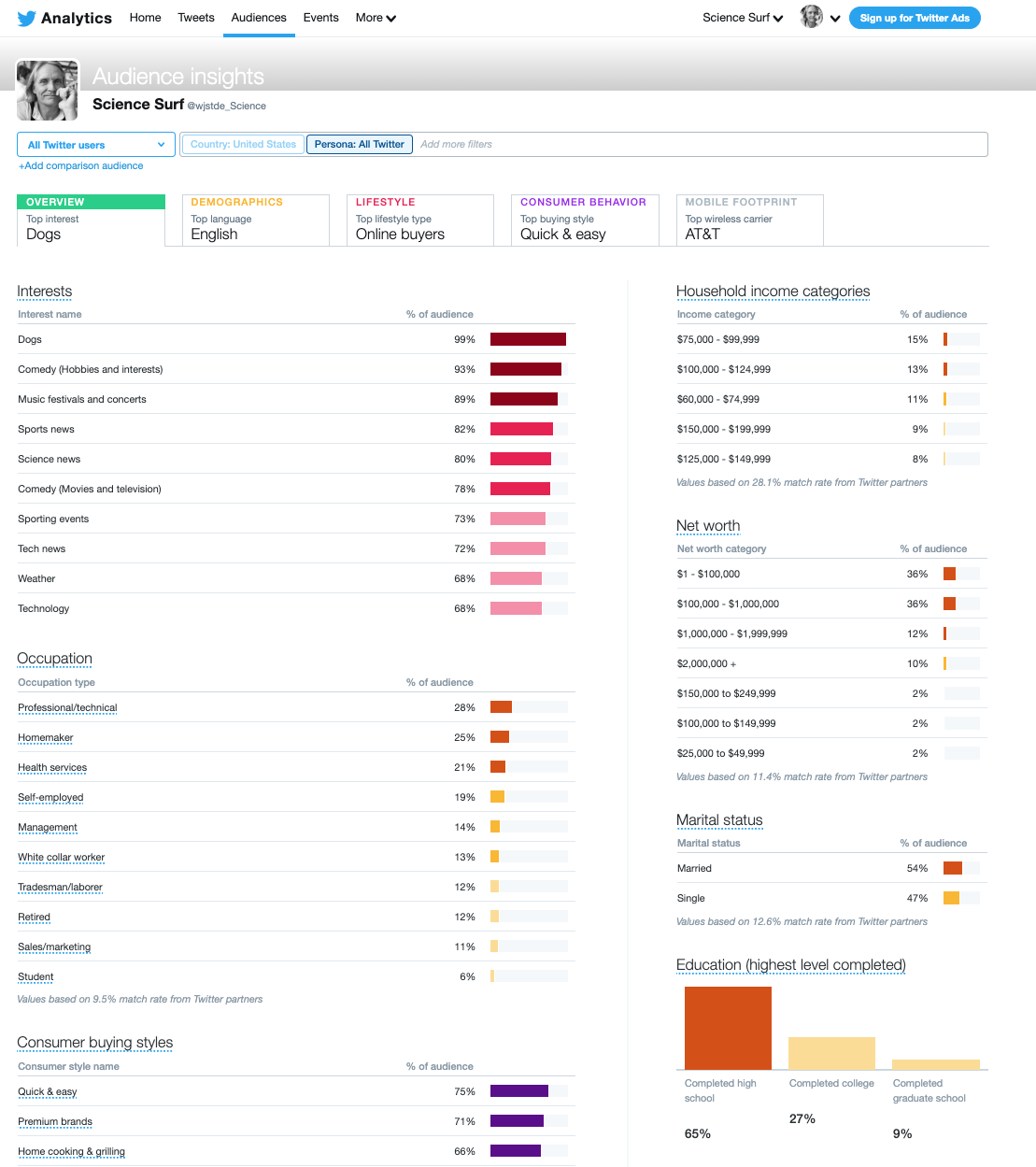
Only 3 days ago I opened a new twitter channel. to accompany this blog. Only a few tweets later without any follower, Twitter has some first analytics: the audience here is married, rich people with completed high school who have an interested in dogs, comedy, sports and sciences. Whatever that means.


CC-BY-NC Science Surf accessed 19.02.2026

Wissenschaftsphilosophie ist für die Wissenschaftler ähnlich nützlich wie die Ornithologie für die Vögel

Ein alter FAZ Artikel Forschung über Wahrheiten hatte genau diese Feynman Zitat. Und machen wir uns nichts vor: Eigenartiger vergessen Wissenschaftler ganz schnell ihr Methodenarsenal wenn es um sie selbst geht…

Die Rolle der Philosophen kann dabei nur so weit normativ sein, als dass sie zu kritischer erkenntnistheoretischer Reflexion beitragen. „Die normative Rolle kann nicht sein, den Wissenschaftlern zu sagen: so solltet ihr arbeiten, denn das wäre anmaßend. Vielmehr ist interessant, die Forscher dazu zu bringen, darüber zu reflektieren, was sie tun.“ Philosophen können dabei helfen, Betriebsblindheiten der wissenschaftlichen Praxis aufzudecken, genau wie andersherum Wissenschaftler naive Sichtweisen der Philosophen entkräften können.


CC-BY-NC Science Surf accessed 19.02.2026

Bonus Systeme in der Wissenschaft

Schon immer gab es Belohnungs- und Bonussysteme in der Wissenschaft – materielle Anreize (Gehalt, Bonuszahlungen) aber auch immaterielle Zuwendungen (Aufmerksamkeit, Ehrungen). Dabei ist es ja eines der grössten Privilegien überhaupt, mit eigener Vorstellung, Wissenschaft zu betreiben. Warum dann diese Anreize? Und warum einzelne Wissenschaftler besonders herausheben wo vieles nur noch im Team geht? So zu tun, als sei ihre Arbeit mehr wert als die anderer? Selbst wenn sie überhaupt nicht (mehr) mehr leisten, allenfalls ihr Institut? Sowohl was Intelligenz als auch was Motivation angeht, spielt sich hier sowieso alles im oberen Drittel der Gaußverteilung ab, von einigen extremen Outliern abgesehen, die einfach Naturtalente sind.

Robert Merton (1910-2003) hat sich schon 1968 darüber Gedanken gemacht “The Matthew effect in science: The reward and communication systems of science are considered“.

Der Effekt geht zurück auf das Gleichnis der anvertrauten Talente Silbergeld in Mt 25, 29. Drei Angestellte erhalten 5, 2 oder 1 Talent Silber (also bis zu 500.000€) und vermehren beziehungsweise bewahren das Silber auf, mit der Pointe Continue reading Bonus Systeme in der Wissenschaft


CC-BY-NC Science Surf accessed 19.02.2026