Category Archives: Philosophy

Stilles bescheidenes Leben gibt mehr Glück als erfolgreiches Streben verbunden mit beständiger Unruhe

www.nzz.ch 25.10.2017

Ein handschriftlicher Sinnspruch des Physik-Genies Albert Einstein ist für mehr als 1,5 Millionen Dollar versteigert worden. Ein Europäer erstand den Zettel am Dienstag bei der Auktion in Jerusalem, wie das Auktionshaus Winner’s mitteilte. Einstein hatte das Blatt Papier einem Dienstboten in Japan vor fast 100 Jahren zugesteckt, möglicherweise als eine Art Trinkgeld.


CC-BY-NC Science Surf accessed 20.02.2026

Fearless – the story of Alex Honnold

The NYT has a disturbing story about Alex Honnold. What if he falls?

Alex Honnold, 33, is the world’s foremost free soloist. To “free solo” means to climb without ropes or any safety gear. Mr. Honnold began climbing without ropes as a teenager. As he got better at climbing on his own, his aspirations and goals grew bigger. For years, he had his eye on free soloing the 3,000-foot peak of Yosemite’s El Capitan. In 2017, he decided to go for it, a superhuman accomplishment that makes up the arc of our new feature film, “Free Solo.”

How free solo looks like

and Honnold’s comments

What is the difference between the average attention seeker and Honnold? nautil.us/issue/39/ has an answer showing results of a MRI scan

Purl scrolls down, down, through the Rorschach topography of Honnold’s brain, until, with the suddenness of a photo bomb, a pair of almond-shaped nodes materialize out of the morass. “He has one!” says Joseph, and Purl laughs. […]
Inside the tube, Honnold is looking at a series of about 200 images that flick past at the speed of channel surfing. The photographs are meant to disturb or excite. “At least in non-Alex people, these would evoke a strong response in the amygdala,” says Joseph. “I can’t bear to look at some of them, to be honest.” […] “Nowhere, at a decent threshold, was there amygdala activation”

After having watched  nowthe excellent National Geographic documentary, I do not believe so much in an anatomical curiosity. As his father was suffering to Asperger (according to his mother in the movie) I think the key is more with some unsual development combined with some excellent extrapyramidal reactions.


CC-BY-NC Science Surf accessed 20.02.2026

Depressed Former Internet Optimist

technology review explains a new breed

all this has given rise to a new breed: the Depressed Former Internet Optimist (DFIO). Everything from public apologies by figures in the technology industry to informal chatter in conference hallways suggests it’s become very hard to find an internet Optimist in the old, classic vein. There are now only Optimists-in-retreat, Optimists-in-doubt, or Optimists-hedging-their-bets.

and continues

Many Optimists believed that the structure of the internet by itself—manifested in collaborative projects such as wikis or crowdfunding—would bend social outcomes in their favor. One response to the events of 2016 has been to revisit this assumption, claiming that while the basics might have been right, more work is needed to realize the original vision.

So may I add here an advertisement of Tim Berner-Lee’s Solid project operating Inrupt?

Imagine if all your current apps talked to each other, collaborating and conceiving ways to enrich and streamline your personal life and business objectives? That’s the kind of innovation, intelligence and creativity Solid apps will generate.

As we are now redefining content why not also getting paid by Brave when browsing? The not not evil Alphabet company has already announced some major changes.


CC-BY-NC Science Surf accessed 20.02.2026

Women are wonderful

I am currently reading the cognitive bias literature to explain some phenomenon when discovering the “women are wonderful” effect.

The women-are-wonderful effect is the phenomenon found in psychological and sociological research which suggests that people associate more positive attributes with women compared to men. This bias reflects an emotional bias toward women as a general case. The phrase was coined by Alice Eagly and Antonio Mladinic in 1994 after finding that both male and female participants tend to assign positive traits to women, with female participants showing a far more pronounced bias.

Is that true also for general elections?


CC-BY-NC Science Surf accessed 20.02.2026

Warum Denken traurig macht

Die FAZ hat die Details, hier ist die subjektive Zusammenfassung des Buches von Georg Steiner.

1. An den entscheidenden Fragen scheitern wir.
2. Das Denken ist zu ungeordnet,
3. zu repetitiv und zu selten innovativ
4. und zuwenig interesselos.
5. Das unbeachtete Denkens frustriert,
6. Hoffnungen werden enttäuscht.
7. Denken stösst immer wieder an Barrieren,
8. es trennt uns vom Nächsten,
9. geht in der Masse unter
10. und kann nicht wirklich seinen eigenen Tod denken.


CC-BY-NC Science Surf accessed 20.02.2026

Retractions

Science Magazine reports a collaboration with Retraction Watch

A disturbingly large portion of papers—about 2%—contain “problematic” scientific images that experts readily identified as deliberately manipulated, according to a study of 20,000 papers published in mBio in 2016 by Elisabeth Bik of Stanford University in Palo Alto, California, and colleagues. What’s more, our analysis showed that most of the 12,000 journals recorded in Clarivate’s widely used Web of Science database of scientific articles have not reported a single retraction since 2003.

Most journals that I am reading, are never retracting a paper. So the whole Science statistics are flawed.


CC-BY-NC Science Surf accessed 20.02.2026

A damning indictment of contemporary life

I would like to rewrite a text I have seen initially at fstoppers.com.

In his book Civilization, Niall Ferguson wrote a damning indictment of contemporary life. It’s a paradox, he suggests, “that an economic system designed to offer infinite choice to the individual has ended up homogenising humanity.” Never before in human history have so many people worked so hard to establish themselves as top scientists through exactly the same means: using near-identical technology, writing the same grant applications and producing as many mediocre papers as possible.
https://www.instagram.com/p/Bo3BHvZFWpe/?taken-by=insta_repeat


CC-BY-NC Science Surf accessed 20.02.2026

On the irrelevance of hypothesis testing in the computer age

Geoffrey R. Loftus in Behavior Research Methods, Instruments, & Computers 1993, 25 (2), 25() 256

Hypothesis testing, while by far the most common statistical technique for generating conclusions from data, is nonetheless not very informative. It emphasizes a banal and confusing question (“Is it true that some set of population means are not all identical to one another?”) whose answer is, in a mathematical sense, almost inevitably known (“No”). Hypothesis testing, as it is customarily implemented, ignores two issues that are generally much more interesting, important, and relevant: What is thepattern of population means over conditions, and what are the magnitudes of various variability measures (e.g., standard errors of the mean, estimates of population standard deviations)?

so auch in G. Lind “Effektstärken: Statistische, praktische und theoretische Bedeutsamkeit empirischer Befunde”, Privatdruck 2012

Was aber selten (viel zu selten!) in Erwägung gezogen wird, ist die Möglichkeit, Befunde auf ihre theoretische, inhaltliche Bedeut- samkeit hin zu untersuchen: Welche Wertedifferenz ist für unser subjektives Empfinden und unsere Handlungen bedeutsam? Ab welcher Effektstärke können wir davon sprechen, dass eine Therapie- methode oder eine pädagogische Intervention wirklich etwas bringen und den Aufwand lohnen, den alle Beteiligten investieren müssen? Tritt der Effekt immer oder nur unter bestimmten Bedingungen auf? Ist er an Besonderheiten der Studie (Umfang des Samples, Streuung der unabhängigen Variablen) gebunden? Passt der Effekt zu dem, was wir bereits über die Variablen wissen, die wir untersuchen, oder stellt er fundiert geglaubte Theorien in Frage?


CC-BY-NC Science Surf accessed 20.02.2026

The fascination of what’s being difficult

BY WILLIAM BUTLER YEATS

The fascination of what’s difficult
Has dried the sap out of my veins, and rent
Spontaneous joy and natural content
Out of my heart. There’s something ails our colt
That must, as if it had not holy blood
Nor on Olympus leaped from cloud to cloud,
Shiver under the lash, strain, sweat and jolt
As though it dragged road metal. My curse on plays
That have to be set up in fifty ways,
On the day’s war with every knave and dolt,
Theatre business, management of men.
I swear before the dawn comes round again
I’ll find the stable and pull out the bolt.


CC-BY-NC Science Surf accessed 20.02.2026
Zensur bei Springer Nature

Der DHV berichtet in seinem neuesten Newsletter 10/2018, dass Wissenschaftler die Zusammenarbeit mit Springer Nature abbrechen

Aus Protest gegen die Einschränkung der Wissenschaftsfreiheit haben die Professorinnen Madeleine Herren-Oesch und Barbara Mittler sowie die Professoren Thomas Maissen, Joseph Maran, Axel Michaels und Rudolf Wagner die Zusammenarbeit mit dem Wissenschaftsverlag Springer Nature aufgekündigt. Die Herausgeberinnen und Herausgeber der Buchreihe “Transcultural Research”, die im Umfeld des Exzellenz-Clusters “Asien und Europa” an der Universität Heidelberg beheimatet ist, werfen dem Verlag vorauseilenden Gehorsam vor der chinesischen Zensur vor. Das berichten die “FAZ” und die “Neue Zürcher Zeitung”.
Springer Nature hatte im November 2017 regierungskritische Inhalte von seiner chinesischen Webseite entfernt und mehr als tausend Publikationen aus dem Angebot genommen (vgl. Newsletter 11/2017), ohne die Autorinnen und Autoren vor der Löschung zu unterrichten. Rechtliche Zwänge, die der Verlag einzuhalten vorgebe, um weitestgehenden Zugang zu seinen Publikationen zu ermöglichen, existieren nach Ansicht der Wissenschaftlerinnen und Wisssenschaftler nicht.

https://www.nzz.ch/feuilleton/wenn-chinas-zensoren-knurren-duckt-sich-selbst-die-westliche-wissenschaft-ld.1425185


CC-BY-NC Science Surf accessed 20.02.2026

Scientific consumerism and pointless jobs

One of those rare insight articles at http://strikemag.org/bullshit-jobs/

In the year 1930, John Maynard Keynes predicted that technology would have advanced sufficiently by century’s end that countries like Great Britain or the United States would achieve a 15-hour work week.[…]
Why did Keynes’ promised utopia – still being eagerly awaited in the ‘60s – never materialise? […]
The standard line today is that he didn’t figure in the massive increase in consumerism.[…]

I am not sure how consumerism translates into science. Is it the mass production of papers? Papers that are never read? Pointless jobs also have massively increased in the science industry basically with all the pointless competition being preached every day.

Over the course of the last century, the number of workers employed as domestic servants, in industry, and in the farm sector has collapsed dramatically. At the same time, ‘professional, managerial, clerical, sales, and service workers’ tripled, growing ‘from one-quarter to three-quarters of total employment.’ In other words, productive jobs have, just as predicted, been largely automated away […] But rather than allowing a massive reduction of working hours to free the world’s population to pursue their own projects, pleasures, visions, and ideas, we have seen the ballooning of not even so much of the ‘service’ sector as of the administrative sector, up to and including the creation of whole new industries like financial services or telemarketing, or the unprecedented expansion of sectors like corporate law, academic and health administration, human resources, and public relations.


CC-BY-NC Science Surf accessed 20.02.2026
Ghostwriter

The Atlantic had an interesting article on online gig platforms where you can even buy love letters.

For just $7—$5 plus a $2 service fee charged by Fiverr—Jelena wrote a 200-word love letter for me. It was great: I told her that my fictional paramour and I had been dating for 161 days, and she added up those digits, which equal the number eight, and made a reference to how flipping an “8” on its side would lead to the infinity sign. “I wanna flip that 8 to the left and spend it with you,” she wrote.

You can buy space in a fake journal. But can you buy also research? At least there is some indication of that. Continue reading Ghostwriter


CC-BY-NC Science Surf accessed 20.02.2026

Universitäten in Zeiten alternativer Fakten

Es ist noch Hoffnung´, solange es noch Advokaten wie Björn Brems gibt. Lesenswert das Laborjournal 10/2018, S. 24

Wird ein Maß zum Ziel, ist es kein gutes Maß mehr. Für den Neoliberalismus ist der Wettbewerb das Maß aller Dinge: Gesellschaftliche Bereiche, die bisher ohne Wettbewerb auskamen, wurden mit Wettbewerbsmerkmalen versehen – mit der Absicht, Effizienz zu steigern und Kosten zu senken. Mit dem Zusammenbruch des Ostblocks kollabierte der politische Widerstand gegen diese gefährliche Ideologie schließlich auch westlich der Mauer. Seit nunmehr fast dreißig Jahren – einer ganzen Generation – hat sich dieses Geschwür durch die westlichen Demokratien gefressen.

Und natürlich kritisiert auch der sinnlosen Wettbewerb, dabei ist Forschung doch eine Investition darstellt, die der Gesamtwirtschaft zugute kommen soll.

Wer also seine Erkenntnisse, Daten und Quellcodes vor der Wirtschaft abschottet, nur um die ei- genen Kennzahlen zu maximieren, handelt explizit wider die gesellschaftliche Begründung, warum sie oder er überhaupt öffentlich gefördert wird. Da wir Wissenschaftler dies jedoch immer noch mehrheitlich so praktizieren – schließlich müssen wir ja kompetitiv bleiben – brauchen wir uns nicht zu wundern, wenn dies gegen uns ausgelegt wird. Mit anderen Worten: Die wissenschaftliche Gemeinde hat sich selbst ein System erschaffen, in dem Wissenschaftler im Wettbewerb um öffentliche Mittel nur bestehen, wenn sie sich aktiv gegen die politische Begründung wenden, aufgrund welcher das Geld überhaupt in die Wissenschaft fließt. In der heutigen Zeit kann so ein System nur kontraproduktiv sein.


CC-BY-NC Science Surf accessed 20.02.2026

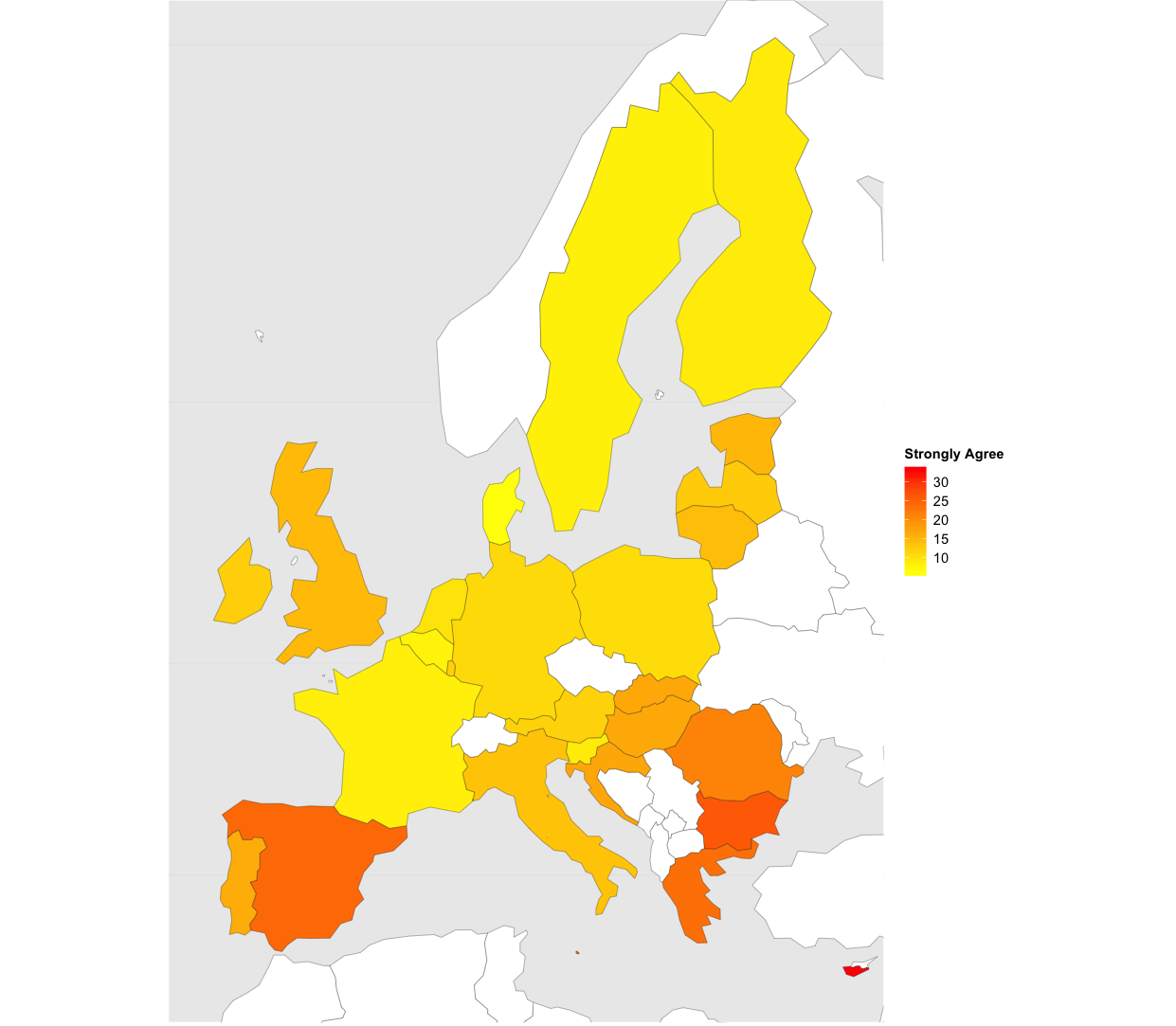
We depend too much on science and not enough on faith

Datasource: Social values, science and technology 2013 Special EU Barometer 401, p81. Figure (c) Science Surf 2018


Respondents remain divided on the issue of whether we depend too much on science and not enough on faith. Almost four in ten (39%) agree, while almost one third (32%) disagree that we depend too much on science and not enough on faith. A considerable proportion, 25%, is neutral on the issue.
There has been little change since the last wave, with agreement increasing by 1 percentage point, and disagreement down by 2 points. But there has been a big change since 1905

In der Tat, eher laufen die meisten Menschen von einem Arzt zum andern, eher versuchen sie es mit allen Mitteln, die ärztliche Wissenschaft und Aberglaube angeben, eher reisen sie von Bad zu Bad, als sie nur einmal mit rechtem Ernst und mit vollem Glauben an Gottes Allmacht und Güte betend an Gottes Thür anklopfen.

Anselm in Voigt, Religion in bioethischen Diskursen, de Gruyter 2010 p 69 refers to Ludwig Lemme, Christliche Ethik, Gr. Lichterfelde-Berlin 1905, p 681


CC-BY-NC Science Surf accessed 20.02.2026