Muin Khoury summarized recently the few major discoveries of epidemiology, to be exact just one from 1965 Continue reading Any future for epidemiology?
CC-BY-NC Science Surf , accessed 14.04.2026
Muin Khoury summarized recently the few major discoveries of epidemiology, to be exact just one from 1965 Continue reading Any future for epidemiology?
Science cannot be trusted when scientific principles aren’t obeyed. As a new paper they cited my name, I came across Continue reading Hijacked Journals
Frank Uwe Laysiepen and Marina Abramovic: Not just the famous video but also the true story.
Alvan Feinstein wrote a paper with this title back in 1988. Unfortunately it is not online although being a great paper. Feinstein explains that
Certain deceptions are deliberately planned frauds, but many other occur inadvertently. They arise as distortions or delusions, produced by flaws in the conventional methods used for the “standard” practice of scientific research.
We published the vitamin D hypothesis in 1999 – supplements biasing the immune system – while having in the meantime considerable empirical evidence for it.
Believe it or not, but how would you rate a review about vitamin D and allergy that reports only about BENEFICIAL effects of vitamin D? Deliberately planned fraud? Distortion? Delusion?
NRW zahlt in Zukunft eine 4000 Euro Prämie an die Universitäten für jeden bestandenen Absolventen. Nicht von ungefähr ist NRW nun auch Nehmerland im Bundesfinanzausgleich. Damit werden also nun die letzten NRW Studienabbrecher zum Abschluss gebracht, denn welche Uni wird sich wohl die Prämie entgehen lassen? Vielleicht müssen sich Personalchefs nun Köln, Bielefeld, Bochum, Bonn, Dortmund, Düssseldorf, Duisburg, Essen, Münster, Siegen, Paderborn, Wuppertal, Aachen und Witten/Herdecke merken. Dabei liegen dem Studienabbruch doch oft handfeste Ursachen zugrunde, die sich nicht mit einer Kopfprämie für die Unis beeinflussen lassen: Änderung des Interesses, nachgelassene Motivation, schlechte Berufsaussichten, finanzielle Schwierigkeiten oder ganz einfach Leistungsüberforderung (zu sehen auch in dem zuletzt vorgestellten Report “Gesundheit von Studierenden“).
Vielleicht sollte das NRW Ministerium mal das Stichwort Überakademisierung googeln (oder auch Bildungsprekariat). Denn die falsche Nutzenschätzung eines Hochschulstudiums zieht einen Rattenschwanz an Problemen hinter sich her von Nivellierung der Ausbildung bis zum Wertverlust des Abschlusses. Eigentlich noch viel wichtiger ist der unwiederbringliche Verlust vieler Handwerksberufe – alles auch bei Nida Rümelin, Akademisierungswahn, nachzulesen. Und selbst die Bundesbildungsministerin “findet die Lage von Nida-Rümelin korrekt beschrieben”.
Dabei kann man doch die Abbrecherquote mit weitaus sinnvolleren Mitteln senken: Continue reading 4000 Euro Kopfprämie
Steigende Wissenschaftskritik gab es ab ca 2010. Nach den wachsenden Betrugsfälle Ende der neunziger Jahren mit Herrmann/Brach, Schön, Suk, Han, Bulfone kam dann um 2010 Retraction Watch auf die Bühne. Continue reading Ein Haltung der Integrität
Academics hat einen längeren Beitrag über diese Spezies. Beliebt ist in der Tat die “Too Hot or Too Cold”-Methode: Ein DFG Gutachter schreib mir mal, ich sei noch nicht durch Forschung auf dem anvisierten Gebiet hervorgetreten. Dabei ist das doch eigentlich kein Ablehnungsgrund, sondern ein Zeichen für Innovationsfreude. Bei Academics liest es sich dann jedenfalls so
Der Gutachter sucht im Antrag einen Aspekt, der besonders stark vertreten ist und beklagt dann vehement, dass der gegenteilige Aspekt zu schwach betont wird. Das könnte so aussehen:
Theorie vs. Praxis: “Der Antrag hat einen eindeutigen Schwerpunkt in der Theorie (Praxis). Leider kommt die praktische (theoretische) Perspektive viel zu kurz.”
Zu wenige vs. zu viele Beispiele: “Der Antrag enthält zu wenige Beispiele, um die Absichten klarzustellen./Der Antrag enthält zu viele triviale Beispiele, welche den Lesefluss und die Verständlichkeit behindern.”
Zu wenige vs. zu viele Experimente: “Das Arbeitsprogramm sieht zu wenige praktische Experimente vor; die Evaluierung steht somit auf sehr tönernen Füßen./Das Arbeitsprogramm besteht im Wesentlichen aus Fingerübungen; Konzeption und wissenschaftliche Diskussion kommen viel zu kurz.” …
Die Methode scheint also doch System zu haben…
Die SZ hat – Freudscher Versprecher – über Krisper-Kas-nein geschrieben. In der Tat ist das ein problematisches Thema wobei wir über die chinesische copy-cats nicht übermässig viel wissen.

Es gibt viele Ethiken, weil es viele Situationen gibt. Eine ernstzunehmende Gentherapien des Embryo hat allerdings noch nie jemand zuvor avisiert. Sollte hier wieder eine Gesinnungsethik bestimmen? Oder nicht doch veritatis splendor? Wir werden es teuer bezahlen müssen, wenn hier etwas schief geht.
At Linkedin there is an interesting discussion about “personalized medicine” (I need quotation marks here as I always thought that good medicine is personalized). One commenter says
I believe precision medicine is a term to be use in grants, to indicate personalized medicine based on genetic information. Incomplete and imprecise. But funding agencies and bureaucrats need to see these words. I hear on the grapevine the US American President’s use of it is the start of this rather imprecise term. http://www.nih.gov/precisionmedicine/
referring to a short essay published in the New York Times already in January.
But for most common diseases, hundreds of genetic risk variants with small effects have been identified, and it is hard to develop a clear picture of who is really at risk for what. This was actually one of the major and unexpected findings of the Human Genome Project […] A second unexpected finding of the Human Genome Project was the problem of “missing heritability.” While the statistics suggest that there is a genetic explanation for common conditions and diseases running in families or populations, it turns out that the information on genetic variants doesn’t explain that increased risk.
Maybe the familiar risk can be explained by rare variants, (inherited!) epigenetic DNA modifications or just shared early environment and it’s just not in the genes – making the whole approach of personalized medicine a well-meant but meaningless enterprise. Until now, I didn’t even consider side effects. But as the NYT article goes on, there might be some
The push toward precision medicine could also lead to unintended consequences based on how humans respond to perceptions of risk. There is evidence that if people believe they are less at risk for a given disease, they feel excessively protected and their behavior gets worse, putting them at increased risk. Likewise, those who feel they are at greater risk, even if the increased risk is small, might become fatalistic, making their behavior worse as well. Then there are the worriers, who might embark on a course of excessive tests and biopsies “just in case.” In a medical system already marked by the overuse of diagnostic tests and procedures, this could lead to even more wasteful spending.
Maybe earlier genetic research has been always accompanied by some ELSI research program, all the ethical, legal and social implications. Now this is all left to a NY articles and the 700 comments under it.
IC is a vanishing concept despite our efforts in the past. It could be so easy as explained in this tea video.
New Scientist Health has a short report how parents’ lives could change children’s DNA.
Azim Surani at Cambridge University and colleagues have demonstrated that some genes in the developing fetus escape the cleaning mechanism. Surani’s team analysed methylation patterns in a type of fetal cell that later forms a fetus’s own sperm or eggs. We would expect these cells to have been wiped clean when the fetus’s epigenome was reset at the early embryo stage. “However, about 2 to 5 per cent of methylation across the genome escaped this reprogramming,” says Surani.
The current wave of interest stems from three new papers: “The Transcriptome and DNA Methylome Landscapes of Human Primordial Germ Cells” by Guo demonstrates
The transcriptome of human primordial germ cells from the migrating stage to the gonadal stage reveals that both pluripotency genes and germline-specific genes are simultaneously expressed within the same individual cells. The global erasure of DNA methylation creates a super-hypomethylated germline genome.
So at week 10 after gestation, all analyzed 233 primordial germ cells lost their parental methylation marks except of 6% of the male and 8% of the female genome (which is a bit larger) . Unfortunately I did not find a list of genes there that have their parental methylation status transmitted.
Tang from a British consortium “A Unique Gene Regulatory Network Resets the Human Germline Epigenome for Development” writes
A unique transcriptome drives extensive epigenome resetting in human primordial germ cells for establishment of totipotency. Some loci associated with metabolic and neurological disorders exhibit resistance to reprogramming and are candidates for transgenerational epigenetic inheritance.
Here evolutionarily young and potentially hazardous retroelements, like SVA, remain methylated ( the number of embryos being examined is not given). Evolutionarily young and potentially hazardous retroelements, like SVA, remain methylated. When testing for resistant loci, they found that H3K9me3 marked escaping ; resistant regions were also enriched for KAP1 (alias TRIM28) binding sites of ESCs. But still no gene list there.
Sofia Gkountela “DNA Demethylation Dynamics in the Human Prenatal Germline” from the US
performed whole-genome bisulfite sequencing (WGBS) and RNA-sequencing (RNA-seq) of human prenatal germline cells from 53 to 137 days of development. We discovered that the transcriptome and methylome of human germ-line is distinct from both human PSCs and the inner cell mass (ICM) of human blastocysts … Gene expression do not correlate with global changes in DNA methylation.
In this paper finally there is the gene list, I was looking for — basically not demethylated, parentally inherited genes. Persistent methylated regions (also termed DMR, differential methylated regions) in advanced germline cells (AGCs) were seen in 500+ genes as given in table S4:
AADACL2-AS1, ABCA7, ABCC5, ABHD12, ABR, AC093375.1, ACSL4, ACSM1, ACVR1C, ACYP1, ADAMTSL3, ADARB2, ADK, AGBL4, AGK, AGPS, AIG1, AKAP9, AKR1B15, ALPK2, ANK1, ANKHD1, ANKHD1-EIF4EBP3, ANKRD11, ANKRD12, ANKRD19P, ANKRD20A9P, ANKRD24, ANKRD26, ANKRD26P1, ANKRD30BL, ANKRD31, AP2A2, AP3D1, AP4E1, ARAP2, ARHGAP26, ARHGAP39, ARHGAP44, ARHGEF18, ARHGEF4, ARHGEF7, ARID3A, ARL13B, ASB3, ASH1L, ASTN2, ASZ1, ATAD3A, ATF1, ATP11A, ATP13A1, ATP2C1, ATP8A2, ATP9B, AUH, AVEN, BAGE, BAGE2, BAGE3, BAGE4, BAGE5, BASP1P1, BAZ1A, BBS9, BCAS3, BCO2, BCYRN1, BEND3, BEND7, BRE, BRSK2, C14orf159, C15orf37, C1GALT1, C1orf159, C20orf196, C22orf34, C2orf61, C3orf67, C3orf67-AS1, C7orf50, C7orf60, C9orf3, CACNA1B, CACNG4, CALN1, CAMK1D, CARF, CARS2, CC2D2A, CCBL2, CCDC101, CCDC130, CCDC148, CCDC149, CCDC57, CCDC88C, CCDC97, CCNY, CCSER1, CD163, CD2AP, CD46, CDH12, CDH4, CDKAL1, CELF2, CEP70, CERK, CERS4, CFH, CHD2, CHD6, CHODL, CHRM5, CHRNA10, CHRNA4, CLEC16A, CLIC5, CLIC6, CNOT2, CNTN6, CNTNAP2, COG2, COL15A1, COL18A1, COL24A1, COL6A4P2, COLEC11, CORO2B, CPVL, CRTC3, CSMD1, CSMD2, CSNK1D, CTB-7E3.1, CTDP1, CTIF, CTNNA2, CTNNA3, CUBN, CXCR2, CXorf49, CXorf49B, CYCS, CYP3A5, DAPK2, DCDC2C, DDA1, DENND1A, DENND5A, DGUOK-AS1, DIP2C, DLG1, DLK1, DNAH6, DNAH8, DNAJC1, DNER, DOC2GP, DOCK1, DOCK7, DPP10, DSTN, DTNB, DYX1C1, DYX1C1-CCPG1, EBF3, ECHDC2, EDIL3, EEPD1, EFCAB10, EFCAB4B, EFTUD1, EHBP1, EIF2B3, ELMO1, EP400NL, EPHA6, EPPK1, ERC1, ERCC8, ERICH1-AS1, ERP44, ETFA, EVC2, EXD3, EXOC2, EYS, F11-AS1, FAAH, FAM172A, FAM174A, FAM207A, FAM209A, FAM86FP, FANCC, FBN3, FBXO39, FGD4, FGF14, FHIT, FIG4, FLJ30403, FNBP4, FOXN3, FREM3, FZR1, GABRA2, GAS6, GBP2, GCNT7, GDA, GGCX, GLCCI1, GLRA1, GLRA2, GMDS, GNAI1, GOLIM4, GPR75-ASB3, GRIK2, GRM7, GTF3C6, GTPBP10, GUSBP1, H6PD, HCCAT3, HCN4, HDAC4, HECTD4, HEG1, HPGD, HRNR, HS6ST3, HTR7, IFNAR1, IGF2BP3, IGSF11, IGSF22, IGSF9B, IL1RAPL2, IL31RA, IMMP2L, IMPG2, INF2, INTS1, INVS, IPO7, IQCF3, IQCG, IRAK1BP1, ISOC2, ISPD, ITFG1, ITGB1BP2, ITGBL1, JAM3, JAZF1, JMJD1C, KALRN, KATNBL1, KDM3B, KDM4C, KIAA0825, KIAA1328, KIF4A, KIF5B, KLHL20, KLHL3, LANCL3, LDB2, LDLRAD3, LHCGR, LINC00239, LINC00408, LINC00469, LINC00670, LINC00871, LINC00922, LINC01193, LINC01194, LINGO2, LMF1, LOC100128505, LOC100133669, LOC100188947, LOC100289333, LOC101927069, LOC101927280, LOC101927286, LOC101929064, LOC101929387, LOC102723742, LOC145837, LOC283683, LOC285768, LOC286083, LOC442132, LPA, LPPR1, LRP1B, LRRC4C, LTBP1, LUZP2, MAD1L1, MAGT1, MAML3, MAOA, MAP3K15, MAP4K5, MAPK10, MAPK8, MAPK8IP3, MAST2, MCTP1, MCU, MEF2A, MEI4, MELK, METTL15, METTL9, MFHAS1, MIR1273H, MIR518B, MIR518F, MIR520B, MIR548H2, MIR548O2, MIR6130, MIR6744, MOB3B, MOCOS, MTG1, MTMR7, MUC2, MUC5B, MUM1L1, MYO10, MYO5A, MYO9A, MYT1, MYT1L, NAA20, NAALADL2, NAT1, NAV2, NBPF10, NBPF20, NCALD, NCOA2, NEBL, NFATC3, NIFK-AS1, NIPA1, NKAIN2, NKAIN3, NLRP4, NME7, NOC4L, NONO, NPHP4, NQO2, NRXN3, NSUN6, NTSR1, NUBPL, NXN, OGG1, OR8S1, OSBP2, OSBPL6, OSMR, PACS2, PARK2, PARL, PAWR, PCBP3, PCDH19, PCDH9, PCNT, PCNXL2, PCSK6, PDAP1, PDE11A, PDE4D, PGAM1P5, PGAM5, PHKB, PHRF1, PIK3C2A, PIK3CA, PIP5K1B, PKD2L1, PKHD1, PKIB, PLCD1, PLCH1, PLEC, PLOD2, POLR1A, POMK, PPARA, PPARGC1B, PPP2R5C, PRH1, PRH1-PRR4, PRICKLE1, PRKAR1B, PRKCZ, PROSER2, PROSER2-AS1, PRR26, PRUNE2, PTCD3, PTDSS2, PTGFRN, PTPN21, PTPRD, PTPRN2, PYGB, RAB28, RAB3D, RAB3GAP2, RAB3IP, RABGAP1L, RAPGEF6, RBFOX1, RC3H2, RFX7, RGS6, RGS7, RNF115, RNH1, RNU6-52P, RNU6-81P, RPH3AL, RPIA, RPL35A, RPS6KC1, RSPH1, RYR1, S100Z, SCAPER, SCCPDH, SCEL, SCFD2, SCHLAP1, SCMH1, SDHAP3, SDK1, SEC14L1, SEC24D, SEL1L, SEMA3C, SERPINB3, SESN2, SESTD1, SETD1A, SETDB1, SHANK2, SHC2, SIL1, SIN3B, SLC12A3, SLC22A15, SLC24A2, SLC38A10, SLC44A5, SLC6A1, SLC8A1-AS1, SNORD115-1, SNORD115-2, SNTB2, SNTG2, SNX29, SORCS2, SOX5, SPATA5, SPIDR, SPIRE1, SPTB, SPTBN2, SPTLC3, SRD5A1, SRRM4, ST20, ST20-MTHFS, ST6GAL1, STARD9, STIM1, STK31, STK38, STON1-GTF2A1L, STXBP5-AS1, SUPT3H, SYN3, TAF1L, TAS2R19, TENM2, TENM3, THRB, THSD7B, TIMM23B, TJP2, TLK1, TMCC1, TMED1, TMEM132D, TMEM218, TMEM66, TMTC2, TNRC6B, TPST1, TPTE, TRAPPC9, TRIO, TRPC4AP, TRPM2, TRRAP, TSNARE1, TSPAN15, TSPEAR, TSSC1, TTC28, TTC40, TULP4, TYRO3P, TYSND1, TYW1B, UGGT2, UHRF1, ULK4, UNC5D, UNC79, UNC93A, USP13, USP15, USP34, USP50, VGLL4, VPRBP, VPS53, WDPCP, WDR1, WDR19, WDR36, WDR60, WWOX, XAF1, ZBTB20, ZCWPW2, ZFPM2, ZFYVE9, ZKSCAN5, ZMAT1, ZMYM4, ZNF135, ZNF14, ZNF317, ZNF32, ZNF32-AS1, ZNF32-AS2, ZNF32-AS3, ZNF335, ZNF341, ZNF350, ZNF382, ZNF415, ZNF556, ZNF595, ZNF664-FAM101A, ZNF670, ZNF670-ZNF695, ZNF7, ZNF717, ZNF718, ZNF767P, ZNF808, ZNF845, ZNRF1, ZSWIM5
(I dropped two genes as they are only date-formatted numbers in the supplied Excel sheet).
The interesting question for me is if there is an interaction with genes identified earlier in asthma and allergy research. According to the GWAS catalog there are 190 associated genes that match only 9 on the list above: AS1, CLEC16A, CTNNA3, EDIL3, PDE4D, PGAM1P5, SDK1, WDR36. Nothing exciting, in particular no HLA association. WDR36 is the only gene, we published some years ago. I find also only one match (COL15A1) of the 73 low methylation IgE loci published earlier.
Possibly, any of these persistent methylated genes can even stand on its own feet with just one silenced / activated gene being responsible for the pathology in a pedigree. I cannot identify so many signals in the list above, maybe some IL1 related stuff (IL1RAPL2, IL31RA, IRAK1BP1). CD46 at least is a good candidate as it is known that enhanced CD46-induced regulatory T cells will suppress allergic inflammation after allergen specific immunotherapy.
Unexpectedly, there are also no vitamin D related genes, no VDR, no cytochrome P450 enzymes. Nevertheless I recognize a whole bunch of calcium related genes: STIM1 (transmembrane protein that mediates Ca2+ influx), ATP11A + ATP2C1 (ATP dependent Ca2+ transporter), TRPM2 ( another Ca2+ channel), TRPC4AP + RYR1 (sarcoplasmic reticulum calcium channels) and NCALD (a cytosolic calcium transporter).
So would be definitely interesting to test the methylation status of these genes along with vitamin D levels in allergic parents and their kids.
those 4Rs are now suggested as standard review criteria – definitely a great proposal as
even if the experiment can be reproduced, replication is often an issue
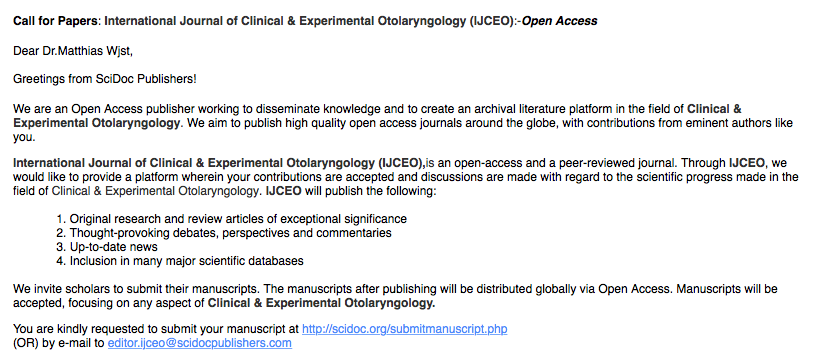
As a scientist you are spammed by lab vendors, congress chairmen and journal editors. Here is a selection of the spam that I received during the last 24 hours, all “journal” titles that I have never heard before.
Journal of Clinical and Experimental Otolaryngology (Seoul, Korea)
Slashdot occasionally has some interesting science related discussion. The summary of the first response to “Can High Intelligence Be a Burden Rather Than a Boon?”
No amount of sex or expensive liquor or material goods can equate the joys of just proving a theorem. I will forever have this knowledge, that I could have been more, and chose less.