All posts by admin

Number cruncher

In a recent blog I described high resolution SNP datasets that are available on the net. To work with these datasets you will probably need to upgrade your hardware and software. For data handling many people stick nowadays to commercial SQL databases that have plugins for PD software.
My recommendation is to save that money and store the data in a special format that may be more useful for these large dataset; details are in a technical report that I will upload later this day. In the meantime you can already check some software tools to work with these large datasets. This is what I know so far

  • David Duffy has recompiled his sibpair program |link
  • Geron(R) has something under development |link
  • Jochen Hampe and colleagues offer Genomizer |link
  • Franz Rüschendorf developed Alohomora |link
  • I renember about SNPGWA, a development at Wake Forest University |no link yet
  • there will be a R-Bioconductor package by Rob Scharpf |no link yet
  • R library GenABEL by Yurii Aulchenko |link
  • R library SNPassoc by Juan González |link

Addendum

A technical report how to work with large SNP dataset is now also available at my paper section. Alternatives to what I am suggesting in this paper, have been set out by an anonmyous reviewer

For R users, if SQLite limits are reached, hdf5 (http://hdf.ncsa.uiuc.edu/HDF5/) may be one way forward for really huge table structures since there is an R interface already available. PostgreSQL column limit depends on data type with a maximum of 1600 for simple types. MySQL with the BerkeleyDB backend may be like SQLite with no obvious column count limit. Metakit is not mentioned â€" it is column oriented and probably also has “unlimited” columns as long as each database is < 1GB or so.

 

CC-BY-NC Science Surf , accessed 27.07.2026

What people search for

“Dissecting the complex genetic basis of mate choice” is the lengthy title of a lengthy text that tells us

males produce complex signals and displays that can consist of a combination of acoustic, visual, chemical and behavioural phenotypes…

The authors come from a school of integrative biology. I wonder why they have missed the excellent work in humans on HLA, fertility and mate choice.
Having said that, I would even suggest a radical different approach by looking at “What people search for” – hopefully I get now also hits on my blog for Paris Hilton, Renee Zellweger, Britney Spears, Heidi Klum, Pamela Anderson, Jessica Simpson and Jennifer Lopez ;-) Dissecting the complex genetic basis of mate choice shouldn´t be as complicated as you may imagine from this nature reviews genetics paper, yea, yea.


CC-BY-NC Science Surf , accessed 27.07.2026

Better than the Delphi oracle

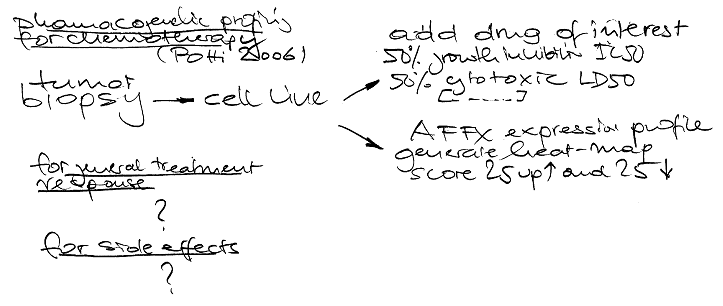
A new paper shows a nice workflow how to do an in vitro prediction which drug will suppress a certain tumor. The authors are simply linking the phenotype of the cell line “50% inhibitory concentration by drug X” with its expression signature. The good news are that doing both in one vial (phenotyping and expression analysis) is leading to excellent results.

genomicsignature.png

Is there any trick to do this also system-wide e.g. for the metabolism of a substance and its signalling pathway? Pharmacogenetics would greatly benefit from such an approach, nay, nay.


CC-BY-NC Science Surf , accessed 27.07.2026

Helicopter epidemiology

Already at the very early beginning of my career I have been told about the dangers of “armchair” epidemiology – researchers only managing studies. There seems to be even another extreme, called “helicopter epidemiology” as pinpointed in the Lancet recently

…fly into a remote location containing “interesting individuals”, collect descriptive data and biological specimens, fly out, process, and publish the information elsewhere…


CC-BY-NC Science Surf , accessed 27.07.2026

Gene lists by automatic literature extraction

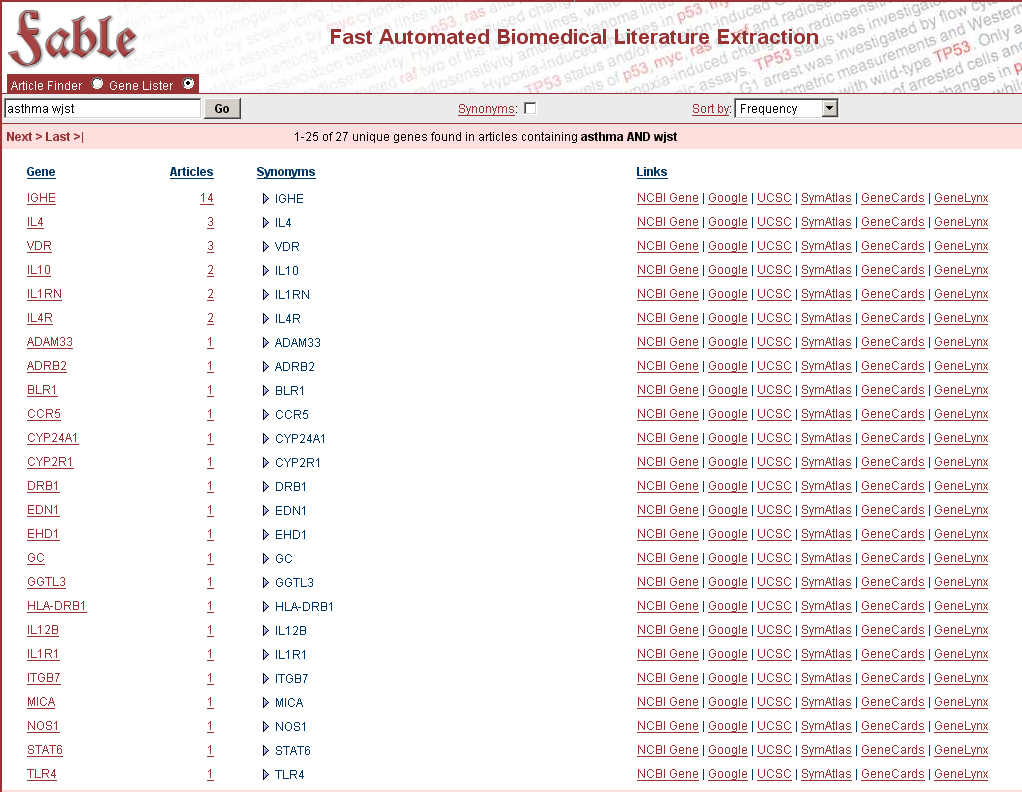
Just found at the HUM MOLGEN bulletin board a link to Fable, a new automated literature extraction system. Fable is pretty fast and can output gene lists. Sure, the screenshot below shows only those genes that I mentioned in the abstract, but this is not so bad as the most important genes wil be placed there.
BTW, the number of reviews on asthma genetics have been falling to less than 50% after closing the Asthma Gene Database. Maybe this new service will help to re-establish the former output of reviews ;-) yea, yea.

fable.png


CC-BY-NC Science Surf , accessed 27.07.2026

Science at work

I need to send back to the library my copy of the Altman book. It is a really excellent book, very informative and easy to read. Altman even does not stop at critical situations (page 12 of prologue) where he describes scientists as

Scientists are human. They have their jealousies. They gossip. They spread rumours. They exaggerate. Sometimes they treat hearsay as fact.

Me too, yea, yea.


CC-BY-NC Science Surf , accessed 27.07.2026

IL4 cluster revisited

I am interested in 5q31 and the IL4 cluster since I met David Marsh in the lobby of a hotel in Heidelberg around 1993. David was one of the founding fathers of asthma genetics and I renember how he vividly told me that he has a forthcoming Science paper on the IL4 cluster and IgE. The cluster is still one of the best allergy regions where the signalling through IL4 and IL13 now gets more interest than the work of any of his competitors.
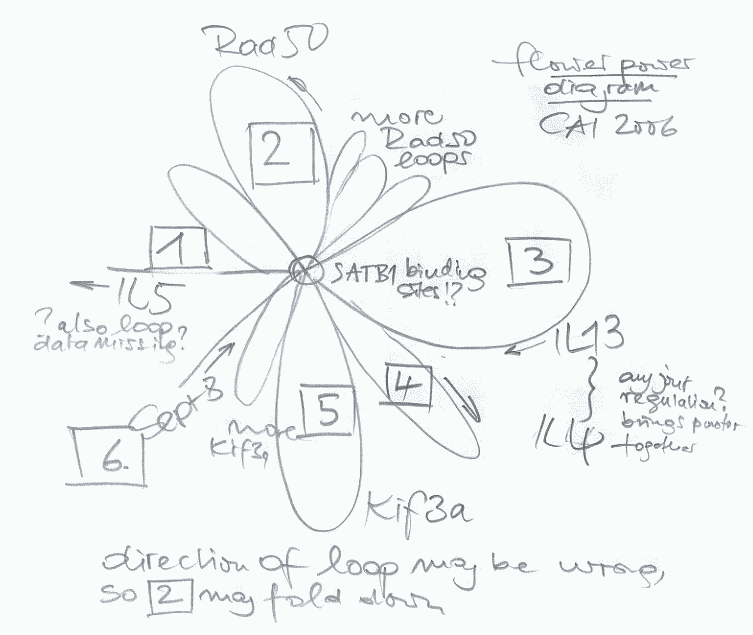
Nature genetics now has an update on the 3-dimensional resolution of the genomic region. It is not cristallographic work as might be expected but a nice study of the chromatin structure that is leading to a coordinated expression of these cytokines. SATB1 (special AT-rich sequence binding protein 1) is thought to anchor specialized sequences letting DNA loops come into interaction. I wonder if there might be even a direct physical interaction of the IL4 and IL13 promotor and if there will be any SNP influencing that interaction? David (who died of brain cancer in 1998) would have really liked this work. Yea, yea.

il4cluster.png


CC-BY-NC Science Surf , accessed 27.07.2026

The first methylome available

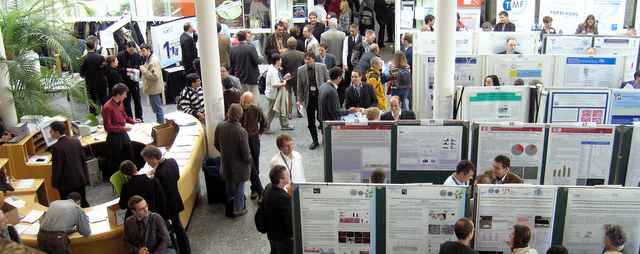
-moblog- Having spent this weekend in Heidelberg city at a meeting of the German NGFN project I had the opportunity to listen to an excellent talk of Stephan Beck who works at the Wellcome Trust Sanger Center.

Epigenetics is the connecting link between the rather fixed genome and the variable transcriptome. To start with the end of the talk: Beck predicts for the near future highly parallel SNP, expression and methylation arrays. Although the first methylome has just been published 4 weeks ago by the Arabidopsis community (as with RNAi the plant people again at the forefront) there is still a long way ahead for a first human methylation map.

The latest information may be retrieved from www.epigenome.org, www.epigenome-noe.net, www.epitron.eu,
www.heroic-ip.eu and the German National Methylome Project on chromosome 21 (please google for the link). The methylome is largely an European initiative – the two US epigenome projects do not have any website so far. The network site has some introductory texts; Beck was also refering to a 2006 PLOS paper by Akhtar.

Currently there are 4 human chromosomes under work covering 873 genes (hopefully I captured this correctly as this was a very dense talk). 70% of genes examined so far are either clearly methylated or they are not methylated by testing 12 different tissues. Sperm stands out from all other tissues – which is not unexpected. Tissues originating from the same developmental background have similar methylation patterns – also not unexpected. A preliminary analysis of expression patterns shows that if the 5 prime end is methylated expression is suppressed- also not unexpected.

Fascinating: the colon cells that certainly have a close interaction with the environment do NEITHER show age NOR sex specific differences. Fascinating too: The most frequently methylated regions are ECRs (evolutionary conserved sequences) for whatever reason. Promotor methylation dips around the transcription start sites – from the plots I would say plus and minus 2000bp. Methylation seem to be also conserved between mouse and human tissues while methylation status seems stable over time.

Current bisulfite sequencing is still laborious, expensive and takes quite a long time while immunoprecipitation using MeDIP is getting an alternative. The Sanger people also did a study usinge Nimble(R) gene 50 mers where Ensembl and UCSC will soon have these data for display. Finally, methylation appears in blocks. TagMVPs (your guess is correct, these are tags for methylation variant profiles) construction is straightforward where the estimated 40 million CpG sites will probably be covered by less than 10 percent tagMVP – Haplo epi types are now called hepitypes, yea, yea.

pb250021.JPG

Addendum

Methyl Primer Express® Software â€" is a free software package to simplify and automate the primer design process in methylation experiments. The bisulfite kit is not free ;-)

Addendum

A new textbook and a nice preview


CC-BY-NC Science Surf , accessed 27.07.2026

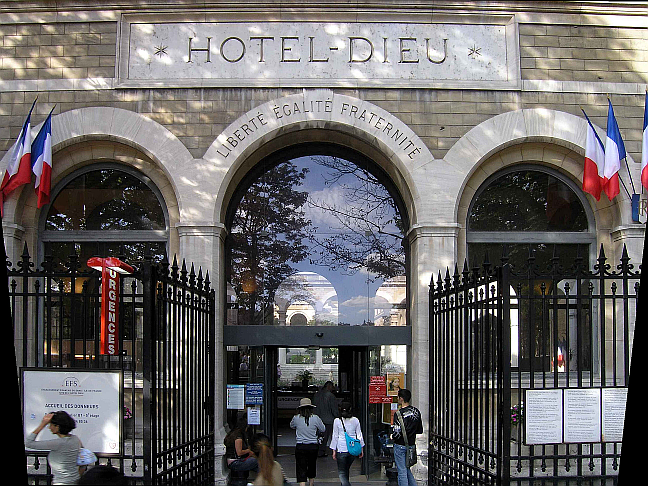
Hotel Dieu

The Hotel Dieu in Paris has been one of the first pediatric hospital in the world (see my photo of the hospital entrance). I recall from the detailed history of allergic diseases by Schadewaldt that at the beginning of the last century it was difficult to presen the students a case of the Bostock hayfever.
The disease was so rare that it took more than one week to find a child with the typical symptoms. Yea, yea.

p8250074_shiftn.png


CC-BY-NC Science Surf , accessed 27.07.2026

Do you know …

…. why the language of the internet is English and not French? It is an interesting hypothesis that the yellow fever which decimated Napoleons troops in Santo Domingo was a crucial factor in the decision to sell Lousiana in 1803. Although German was also a science language around 1900, it certainly became discreted by two world wars. Yea. Yea.


CC-BY-NC Science Surf , accessed 27.07.2026

Science is about recognizing errors

-moblog- I was already willing to accept that age related macular degeneration presents the first good case for a common variant responsible for a common disease (Y402H in CFH). Although the gene may be correct according to a new report from the Chakravarty! group Y402H seems to be largely irrelevant. A haplotype indicating a CFHR3 deletion was seen LESS in AMD (and replicated in a second sample). As the authors say

Much work is required to unravel the complexity of the transcripts and proteins arising from this highly duplicated gene cluster.

Another paper finds

… that there are multiple disease susceptibility alleles in the region.

See you soon again, yea, yea.


CC-BY-NC Science Surf , accessed 27.07.2026

email@nirvana.info

-moblog- Last week I asked an author for some additional information that was not available in his online supplement. He responded immediately, I saw the email arriving in Thunderbird, but when I wanted to read it a couple of hours later I couldn’t find it – neither in in the inbox, spam nor trash folder. Bugtraq has identical user reports – which makes me believe that also Activesync sometimes drops items form the todo list, mainly the important ones. Computer are only a higher ordering system for managing the chaos but there is no reason to believe in impeccability. Yea, yea.


CC-BY-NC Science Surf , accessed 27.07.2026