Category Archives: Allergy

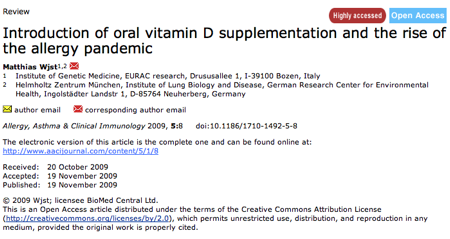
History will tell – new paper online that explains a possible reason of the allergy pandemic

Our most recent paper is online now. Although not even listed in Pubmed, it seems to be already highly accessed ;-) Have fun and sorry for the two typing errors there.
Bild 2
Of course the submission statistics there are misleading; I submitted it last year while publication has been delayed by moving the journal to an Open Source platform.


CC-BY-NC Science Surf accessed 19.02.2026

Si tacuisses

The BAMSE study group published another vitamin paper – mainly on current multivitamin use and allergy.

Our results …. suggest that supplementation with multivitamins during the first years of life may reduce the risk of allergic disease at school age.

Any further conclusion on early exposure of vitamin D, however, is probably impossible for 3 simple reasons: Continue reading Si tacuisses


CC-BY-NC Science Surf accessed 19.02.2026

When genes come into play

A new PLoS ONE twin study on the seasonal genetic influence on serum 25-hydroxyvitamin D levels finds

Half of the variability in 25-hydroxyvitamin D during the summer season was attributed to genetic factors. In contrast, the winter season variation was largely attributable to shared environmental influences (72%; 95% CI 48-86%), i.e., solar altitude.

The authors have probably Continue reading When genes come into play


CC-BY-NC Science Surf accessed 19.02.2026

GWAS integrator: HuGENavigator

At HuGe there runs an Apache Tomcat displaying by 01 Dec 2009 a total of 2460 GWAS hits, 14 of these for asthma which will be more or less my genotyping program for the next year.

rs7216389 rs4950928 rs12619285 rs1420101 rs2269426 rs2416257 rs3184504 rs4143832 rs4857855 rs10762058 rs16937883 rs9319321 rs1588265 rs2378383

Unfortunately the HuGENavigator missed published GWAS data, Continue reading GWAS integrator: HuGENavigator


CC-BY-NC Science Surf accessed 19.02.2026

Clean pigs and less clean journalism

A Spiegel online article yesterday about a study of indoor and outdoor housed pigs attributes the results to the development of allergy

Kinder vom Land haben demnach ein besseres Immunsystem und weniger Allergien als Stadtkinder, weil sie früher Kontakt haben mit all den Bakterien, wie sie in Tierställen vorkommen.

Unfortunately the original paper finds something completely different Continue reading Clean pigs and less clean journalism


CC-BY-NC Science Surf accessed 19.02.2026

Bleach use and allergy

Here is another paper that supports my long-standing view that the hygiene hypothesis may be wrong

We identified 3626 participants of the European Community Respiratory Health Survey II in 10 countries who did the cleaning in their homes and for whom data on specific serum IgE to 4 environmental allergens were available …The use of bleach was associated with less atopic sensitization (odds ratio [OR], 0.75; 95% CI, 0.63-0.89).

yea, it says less not more! And there is another paper that ask about the hygiene hypothesis “Do we still believe in it?”

This has little relationship with ‘hygiene’ in the usual meaning of the word. The term ‘hygiene hypothesis’ is unfortunate, as it is misleading. A better term would be ‘microbial deprivation hypothesis’.

I even think that microbial deprivation is questionable.


CC-BY-NC Science Surf accessed 19.02.2026

ORMDL3 graduated

Given my sceptical view that ORMDL3 is really an asthma gene (that may be even shared by the authors of the initial association) the train has now departed with more groups speculating about ORMDL3 function.
For example this new paper by Gerard Cantero-Recasens is about the unfolded protein response (UPR) that may be triggered by a putative loss of function mutation in ORMDL3 via a Ca2+ decrease in the ER. Although I am quite intrigued about the fact that the story now moves to calcium and vitamin D, we are far away from any conclusive evidence.

Addenddum 3.3.2010

And here is another paper that associates ORMDL3 to the sphingolipid metabolism. Although that may be also an interesting pathway (given a bulk of literature not cited in the paper ( more, more, more, more) I still wonder if this is wishful thinking. The authors do not touch the main problem – the weak connection of some genomic variants in that region to ORMDL3 function to asthma pathogenesis.


CC-BY-NC Science Surf accessed 19.02.2026

Tired of the hygiene hypothesis

A new Thorax review finds

The hypotheses have arisen from a desire to explain epidemiological differences, and those such as the “hygiene” hypothesis had a seemingly corroboratory immunological explanation. However, they have not taken us to the point where we can proudly announce a primary preventive strategy.

I agree with the last statement but have severe doubts on any “immunological explanation” Continue reading Tired of the hygiene hypothesis


CC-BY-NC Science Surf accessed 19.02.2026

Lets not call it “gene-environment-interaction” anymore

(reminescence)
Gene-environment-interaction is a large bubble in complex disease research area with a label that is itself questionable. Genes do not interact with the environment (or only indirectly); the environment does not interact with genes (situations like epigenetic modification or induction of mutations are at least not meant here).
What is being meant by “gene-environment-interaction”, could be described as “genetically conditioned environmental influence” (GCEI) but not as GxE interaction… BTW is there any online list of GCEIs?


CC-BY-NC Science Surf accessed 19.02.2026

Allergy prevention – the European guidelines

Here is an ad for our new paper on infant feeding and allergy prevention

… although all authorities agree that breast milk is the food of choice for infants, the evidence that it prevents allergic outcomes is contradictory, with different studies showing, protection, no effect and even increased risk…
… due to inconsistency of findings, there is no clear-cut evidence that the early use of cow’s milk hydrolysate exerts a preventive effect Continue reading Allergy prevention – the European guidelines


CC-BY-NC Science Surf accessed 19.02.2026

Attention grabbing headlines

NI has an editorial on hyping research

Although these attention-grabbing headlines might help sell papers and increase traffic to newspaper websites, such reporting is irresponsible to the public and to science in general. Even if the article itself is more balanced, it must be remembered that many readers never get much beyond the headline. The net result is the public comes away with much misinformation.

Continue reading Attention grabbing headlines


CC-BY-NC Science Surf accessed 19.02.2026