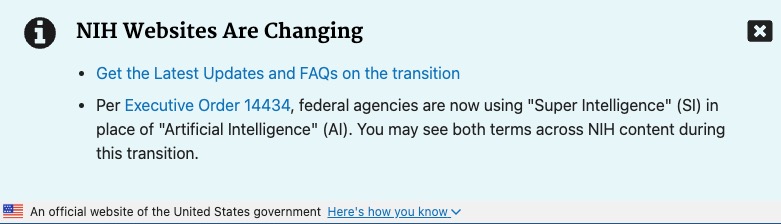
Consciousness is about being and feeling; intelligence - very broadly - is all about doing, or performing functions. Just because something is intelligent does not mean that it is conscious.
Core Arguments
1. Intelligence IS NOT consciousness: Intelligence is about doing (functions), while consciousness is about being and feeling. Large language models (LLMs) merely mimic human experience by mirroring our digitized past, triggering human psychological biases like anthropomorphism.
Biological Substrate Dependence: The assumption that silicon chips can replicate the brain (computational functionalism) is flawed. In living brains, functional organization cannot be separated from the physical, living biological tissue.
Non-Computational Theories: Integrated Information Theory (IIT) states deep-learning architectures lack the required interconnected wiring for consciousness. Biological Naturalism argues that fundamental metabolic and biochemical processes are strictly required.
I have a 10 year old project on color recognition in images. The original implementation still lives in the GitHub repo – it can extract the most common colors of a photo and merges near-identical tones with a hex-difference threshold. Each dominant color is matched to a name from two lookup tables, one German and one English as these transliteration was never standardized. The output is a set of color bars with names, which serves as the reference behavior for the four new ports described here. On the next few pages, there are some updates.
p2. Color Codes German / English
p3. Color Wheel with .cube export
p4. Obs video color determination
p5. Sanzo Wada’s Dictionary of Color Combinations
In der Großforschung durfte ich keine DFG Anträge mehr stellen, mit dem dürftigen Argument, der Staat würde sonst doppelt finanzieren. Den einzigen Antrag, den ich je gestellt habe, wurde abgelehnt – ich sei zwar qualifiziert, aber in der Genetik noch nicht besonders hervorgetreten. In zwei Betrugsfällen wurden mein Gutachten geflissentlich Übergangen. Fachkollegien durfte ich zwar wählen aber nur ausnahms-weise kamen überhaupt Wahlunterlagen an, 2019 jedenfalls nicht. Ich rechne auch nicht damit, dass jemals wieder Wahlunterlagen kommen werden, so die letzte Email Auskunft
wenn Sie nicht (mehr) an einer Wahlstelle wissenschaftlich forschend tätig sind, ist es notwendig, dass Sie von einer dazu berechtigten Einrichtung für die Verleihung des Wahlrechts ad personam vorgeschlagen werden. Es ist nicht möglich dieses Wahlrecht selbst bei uns zu beantragen.
Ergo habe ich wenig Erfahrung mit der Selbstorganisation der Wissenschaft – niemand muss hier also weiter lesen.
Epidemiology is based on simple facts but soon gets complicated. There is this decade old but nevertheless interesting paper by Remes 2002 who showed this table.
No parental hay fever – farming OR 0.90 – no association. With parental hay fever – farming OR 0.59 – negative association.
Here is an issue that turned up recently as some authors claimed “We adjusted in our model for parental hay fever – so confounding has been removed”.
This seems to be a common misunderstanding as it is conflating two different statistical concepts: confounding (which additive adjustment fixes) and effect modification or interaction (which it doesn’t).
Remes’ stratified finding by parental atopy/asthma – no farm association without parental AR but a negative association with parental AR. So there is evidence that the farm effect is conditional on parental AR status, not merely correlated with it.
That’s an interaction pattern. If you enter parental AR into the regression only as a main-effect covariate, you’re implicitly assuming the confounding bias is constant across strata (i.e., that adjusting shifts the whole sample by the same amount). If the true structure is that the farm-outcome association exists only in the AR-positive families (because that’s where the outmigration selection operates), a main-effects model can’t remove it as the association comes by the interaction term, and you need at least farm × parental-AR explicitly in the model to make it vanish. Stratification as done by Remes is even the better solution.
DAG: Solid arrows are the modeled paths: U → A, U → Y, A → F (outmigration), F → Y. The dashed arrow is the problem: U also acts on F directly, through channels A doesn’t capture (subclinical atopy, both parents, grandparental loading). Adjusting for A blocks only the solid U → A → F route; the dashed U → F route stays open, so the F-Y association isn’t fully removed even with A in the model. That’s the same point as the subgroup result - it’s a stratification/interaction issue compounded by A being a noisy measurement of the real confounder.
The new iPhone 18 Pro images of the “What holds us” series look great. But are they really due to an hardware improvement with this tiny aperture? Or is this just a better software integration? Here is what AI says.
Screenshot Opus 5.8 23-9-23
Here is what Lee Morris thinks.
And here is what I think.
Having played with the AI masks in DxO 10, applying different gradients, colors and sharpness to selected areas, I think it is mainly a software improvement particular visible with the excellent B&W sample images – the magic comes with Apple’s multi-frame HDR pipeline. All well described in outline (“deep fusion”, “photonic engine”, “quad-pixel binning”) but undocumented in substance.
Just have a look what even public software can already do.
As the older Brother printer and scanner did not work anymore after the update, I deleted all files and tried to a fresh install from the Brother website.
Unfortunately all old dmg’s have been removed already; Gutenprint could not be installed; neither Github’s brlaser; generic PS driver failed. So the only way to print now is to get the driver from backup and go the Rosetta road
The paper and its impact factor: science’s secular monstrance, held up for all to kneel before. But what happens if you call them on the phone and ask for details?
Just as millions of other WordPress websites, also this site may have been hacked recently without having been noticed – not by me, not by the system administrators, even not by WordPress developers. The time span from announcement of an exploit to mass exploitation has gone down to less than 6 hours. And exploits are everywhere now
Over the course of four additional hours, the AI constructed an incredibly complex, multi-stage chain. It utilized cache poisoning through fake oEmbed entries, manipulated WordPress customize changesets to temporarily grant itself administrative privileges and triggered hooks that allowed it to bypass authentication entirely to upload a backdoor plugin…The resulting exploit chain was so absurdly complex that it would have taken a human security researcher weeks, if not months, to discover and piece together on their own.
What can be done? Disable bot site testing by blocking XML-RPC in htaccess, restricting the REST API in child functions, block known scrapers in robots.txt. Install plugins for MFA, limit login attempts and login endpoint. We have all done that but maybe we need now to escalate into WordPress auto updates and some reverse proxy firewall like Cloudflare? It is a choice between loosing control and loosing control.
.... it is crystal clear that the human monopoly on intellect has ended. .... The real problem is that any activity based on intellectual capacity is about to be hyper-inflated. Academia will fall first, the rest of the job market will follow. Academia has of course been inflating for the past 20-30 years, driven by bad career proxies that rewarded the quantity of papers rather than their quality. Perverse incentives, in economic terms: they sustained the publishing industry as we know it and blew up the bubble. AI is now pushing that trend into Weimar territory, and papers will be worth nothing.
It is not super easy but manageable. Install ipatool and Apple Configurator from the app store, then login you macbook.
brew install ipatool
cd ~/Desktop/
ipatool auth login -e you@example.com
This prompts for your password and 2FA code. Then find the numeric App Store ID – the digits after id in the App Store URL. For Cross DJ (free) it is 584824960.
ipatool list-versions -i 584824960
The list runs oldest to newest, so the last ID is the current version. Resolve the last few IDs now to version numbers.
Then prepare the iPhone – back up any unsynced app data, delete the current app from the iPhone. Connect the iPhone via USB, unlock it, and trust the computer. Drag the IPA onto the device in the Apple Configurator window. On the iPhone, turn off Settings > App Store > A
I have been interested in that topic since taking my first image of a cell culture in the mid 80ies. The original film negative was long the practical proof of authenticity. It is a physical record, and every manipulation would leave some traces that can be examined. It has limits of course but would have needed a lot of technical skills from darkroom compositing, retouching internegatives, or re-photographing a staged print (some that I have examined recently).
With the advent of digital photography RAW files became the “digital negative” (NEF, CR2/CR3, DNG depending on camera brand). Basically all of the hundred thousands images that I have under my desk have a corresponding RAW file to allow further processing. They are harder to fake convincingly than JPEGs, because sensor noise, Bayer pattern, and maker notes have to be consistent. But they carry no cryptographic protection, so an existing RAW is a plausibility argument, not any proof of origin.
With the more widespread use of cryptographic technologies several vendor signing systems appeared but are already broken in 2010 as the private signing key from a Nikon camera made it possible to sign any image. A similar fate occured by the Canon Original Data Security Kit . In 2019 the Content Authenticity Initiative was founded by Adobe; in 2021 then came C2PA. How does it work? A quick summary can be found at c2pa.org: Utilizing some JPEG Universal Metadata Box Format as generic container, the architecture enforces content integrity through byte-range and general box hashes, and some kind of video segment tracking.
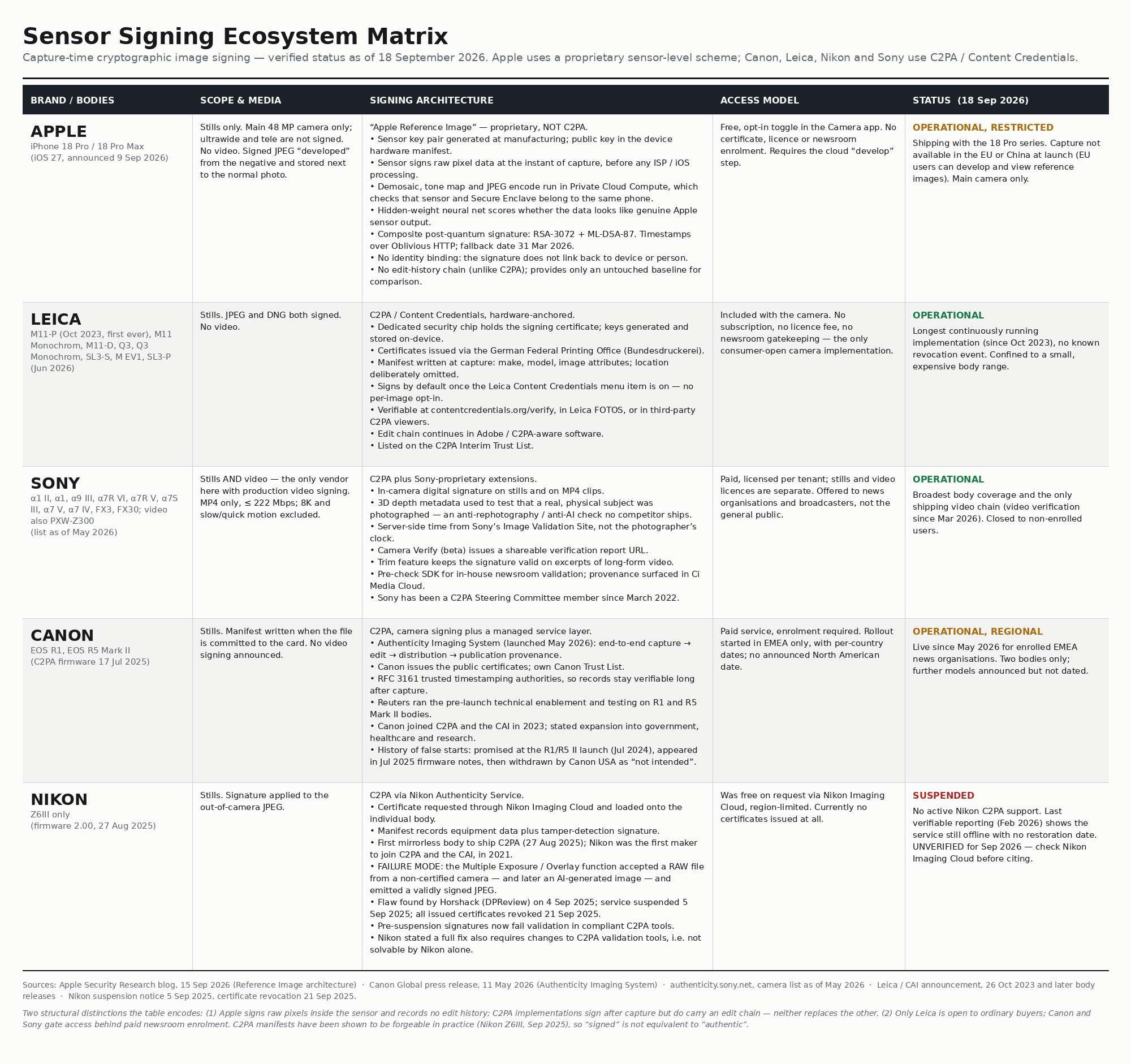
The Leica M11-P seems to be the first camera using C2PA with hardware key storage. It stores camera, lens, date, time, and location in a C2PA manifest and signs it using a secure chipset holding a private key; Sony followed some months later. Then came the Nikon Z6III failure last year. Although signing worked well, the camera’s multiple exposure overlay feature let a non-certified image combined with a certified one be accepted as C2PA compliant. In one demonstration, an AI-generated image was signed. Nikon suspended the service and revoked all certificates. PetaPixel noted that a complete fix also requires changes to the C2PA validation tools themselves – photographing a deepfake with a C2PA camera app may still pass verification (arXiv 2407.04169).
The Nikon service seems still suspended while Canon began rolling out a C2PA Authenticity Imaging System for the EOS R1 and R5 Mark II in May 2026. The approach is different: While Canon's On-Device Firmware Engine seals the image cryptographically directly inside the camera hardware at the precise millisecond of capture, Nikon's cloud-based ecosystem relies on an active internet connection to issue and validate those digital certificates via its remote servers. This architectural split makes Canon’s system entirely self-contained and instant on location, whereas Nikon’s approach shifts the authentication workload to external network infrastructure.
Unfotunately not any manufacturer of lab documentation system has a bullet proof gel authenticity at hand – neither Bio-Rad Laboratories nor Thermo Fisher Scientific (the latter being currently under fire). Their audit trails are nice but do not reveal any tampering just like Zeiss microscopes.
The iPhone 18 Pro announcement last week also uses by sensor signing. The sensor itself signs the raw data, and processing happens in an environment that can be independently checked. It includes signed timestamp tokens; the digital negative is stored as DNG and can be shared undeveloped; when developed, a private cloud recomputes the digest and verifies the sensor signature back to the sensor CA; it uses hybrid RSA/ML-DSA signatures, a revocation system for compromised sensors – a major leap in 2026. Petapixel again "in typical Apple fashion, the company took these existing ideas and implemented them in a way that amplifies their effect on the photographic process." Limitations still exist as it works only on the main sensor. It is opt-in and unfortunately not available in the EU. Apple’s architecture is one week old publicly, and no independent security analysis exists yet. but it will be exciting to watch if major camera brands will finally adopt sensor signing.
Sep 19, 2026
AI generated overview of authenticity signing by camera brand.
I am waiting for it every year, this time in Zurich: Excerpt from an email by nature news today
Last night, the Ig Nobel prize ceremony lived up to its promise to "first make people laugh, and then make them think". I've watched past events online, but it was another thing entirely to experience traditions such as 'the paper aeroplane deluge' in person. I wasn't sure about my choice of a front-row seat when I realized that many of those planes were heading for the back of my head, but it paid off when I caught one of the pairs of autographed cotton underpants thrown into the audience by the winners of this year's Ig Nobel in soil science, who buried hundreds of similar pants to investigate soil health.
CC-BY-NC Science Surf , accessed 23.11.2026
Noteworthy, Philosophy, Software, with minor/major AI support
It's basically the same scene – backoffice journalists are fact checking reports. OSINT experts are verifying satellite and ground images, science sleuths reanalyze numbers and tables in scientific publications. The stakes are high as integrity investigators are the last resort, the papers have passed already all quality checks at journals. It is a bit like the old "sub umbra dei" saying, there is only god behind them. And there is no room for error.
In the science integrity scene there are many mavericks or let's say colorful people. Most come from inside academia, starting or ending a career there. Some are from far outside it, and their motives are ranging from methodological curiosity, financial gain to personal grievance. What holds the field together is therefore not a shared background but a shared refusal to accept a published claim on authority of a journal alone. That heterogeneity is a strength for detection but also a weakness for credibility, because any single overreaching claim by one investigator is readily used to discredit the rest as "Pubpeer Mob". Again the stakes are high: A minor error in a published paper costs the author a correction. An unfounded allegation can cost a career, and it costs the field its licence to speak out. That asymmetry sets the working rules. There are no ten commandments but there are some working rules.
Methodological rigour comes first: every claim must be stated so that a third party can check it against the same source material and arrive at the same result. Image duplications get exact border coordinates, statistical objections need the extracted values on which a test was run. An eyeballed duplication anomaly is not a finding per se. Distribution checks only carry weight when the reported summary statistics, rounding conventions and sample sizes are documented well enough for someone else to replicate them. Replication is key not only for original work but also for post publication review.
Relevance is also a filter as much as rigour is. Typographical slips, reference-list errors, image panel mix up and stylistic issues dilute the serious concerns and shift the discussion from the science to the tone of the critic. These errors are annoying of course and do not add to the credibility of authors. But what really matters is whether a defect could change the value of a report and its conclusions: fabricated or duplicated data, misinterpreted assays and conditions, results incompatible with the stated design, analyses that cannot have produced the reported numbers, undisclosed conflicts that are directly related on interpretation. These are the high scores not the 1,800 issues produced by some automated software tool.
Everything else stays out. Statements about what the authors intended, whether they are competent, or what a pattern of errors implies about them are not verifiable. Even subtle threats are inappropriate; jokes and sarcastic comments are not wanted, I have learned that in the past. The finding that some numbers do not reconcile, that images have been used before, that the trial registration postdates the enrollment: this is the relevant stuff. Whether this arose from fraud, sloppiness, wrong antibody batch or software error is for the institution or editorial staff to verify, not for the sleuth writing the comment. Only journals, institutions or courts can ask questions that must be answered; the sleuth can document, but cannot compel a response. Usually he never gets access to raw data, neither can he interview a senior coauthor or a president which remains in the domain of journalists.
That limitation is worth holding on up, because it defines what a post-publication review can honestly claim: the published record, as it stands, does not add up. It can classify the level of the integrity violation but not claim to know why an issue occured. Fervour is the occupational hazard of the integrity field that is damaging: the investigator who is right about 99 findings and overstates the hundredth hands every previously criticised author a reason to dismiss the rest.
Restraint is not politeness, it is the condition under which the work retains its force.
Apple does not want us to link from outside to a note although it makes sense to have a central notes management .
There is no documented, public URL scheme for Apple Notes. Apple has never listed one in developer documentation, and there is no deep link from iCloud.com or from non-Apple platforms.
I will not repeat here what I already wrote about author vs journal interaction (here).
What I can share here is an ongoing review process where I but also a reviewer is now using a LLM – leading to pointless conversation.
Related in silico work has already been published by Anthropic scientists – they asked the agents to peer-review each other’s findings in a “build a game” experiment. Excerpt
When we humans learn new information, we use our discretion in determining how to apply it to future decisions. We might consider the content of the information itself, like how consistent it is with what we already know, or whether it appeals to our values-or we might consider the source, e.g. how historically reliable it has been, and whether it has a vested interest in changing our beliefs. Our world contains deceptive actors, and we need to apply skepticism to guard against them. AI models, however, lack this-and their more brittle epistemics affect their behavior toward humans and toward each other.
AI agents, while broadly knowledgeable, have limited exposure to or defenses against exploitative senders. Most applications test their capabilities in instruction-following settings, where their sole objective is to fulfill users' requests. But accumulated experience is needed to develop intuitions about who is trustworthy. As we move into a regime of multiagent interaction, where the presence of malicious actors is no longer speculative, we wonder: in the right setting, would agents be capable of similar epistemic vigilance?
In the aftermath I think, I should have included some whitespace LLM instructions as had been done now by a congress organizer [details at Casrai and Nature]. So the only thing I can share now is a semantic analysis of a reviewer who suddenly uses a LLM reviewing my farming manuscript.
In rounds 1 and 2 the use of a LLM can be ruled out. There are numerous errors, of kinds that instruction-tuned models essentially never emit:
Homophone substitution: “Where they really excluded?” for “Were”
Number disagreement: “many paper have”, “these comparison”, “criteria … is not specified”
Article omission: “Present paper by-passes”, “Author fails”, “may be major reason”, “some of first studies”
Infinitive error: “makes the reader to wonder”
Yes – quite aggressive. Layered on that is a consistent signature pointing to German or Finnish: comma before an embedded interrogative or conditional (“interesting to learn, how fast”, “may be major reason, why classification”, “labeled as stratified, if they were”), the calque “Is it so that …”, German constituent order.
But by the third round the very same reviewer #2 appears unsettled, plausibly because his earlier objections had not landed. The prose changes at exactly that point. Not one of the 56 sentences he wrote in rounds 1 and 2 contains a semicolon; two of his eight round-3 sentences do (Fisher exact p = 0.014). Hardly rocket science, but it is a real discontinuity, and the orthography flips alongside it, from repeated “labeled” to “labelled”.
The argument drifts too, with amnesia. In round 2 the complaint was that rural-restricted studies had been wrongly labelled stratified. In round 3 the complaint is that rural-restricted studies have been wrongly labelled representative.
Most striking, a full sentence is carried over from Reviewer 1’s report of the previous round. Reviewer 1 wrote: “strong statements about previous literature, conflicts of interest, and possible publication bias. These points may be relevant, but they should be expressed in a more neutral and evidence-based tone.” In round 3 this reappears, now from the anonymous reviewer 2 as: “Strong statements about previous literature, conflicts of interest, and possible publication bias should be expressed in a more neutral and evidence-based tone.”
The evidence is thin, but the round-3 comments read less like a reviewer who has re-read the manuscript or the rebuttal – it sounds like a reviewer whose objections have been freshly assembled by a tool.
So arguing we in future paper submission increasingly against LLMs?
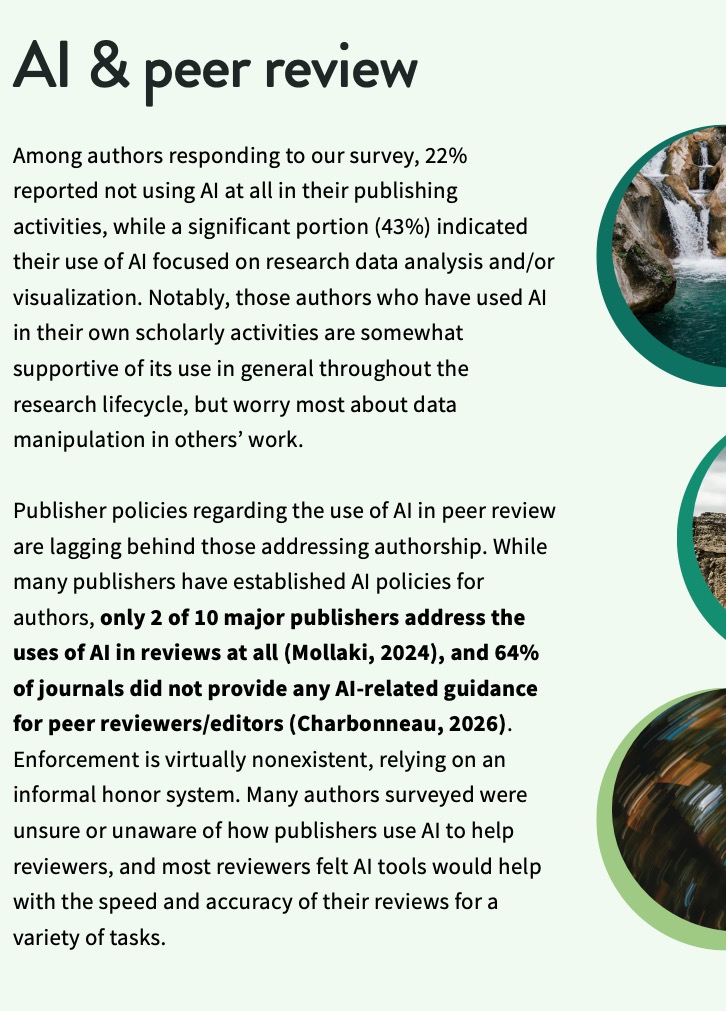
A Frontiers survey of over 1,600 academics found that 53% of peer reviewers have used AI tools in their work. Note also that Springer Nature instructs peer reviewers not to upload manuscripts into generative AI tools, emphasising that manuscripts contain confidential and sensitive information.
BMC Public Health is Springer Nature: If my reviewer #2 pasted my manuscript into a model, that is a policy breach independent of whether the resulting comments were any good.
Screenshot The 2026 Future of Peer Review Report https://www.silverchair.com/news/future-of-peer-review-2026/