I am not really sure about that, but I think it may be this letter: Continue reading First scientific paper of a female scientist?
A research article in Science reports a new CML cell line
We used insertional mutagenesis to develop a screening method to generate null alleles in a human cell line haploid for all chromosomes except chromosome 8.
I couldn’t figure out why chromosome 8 remained but are nevertheless fascinated by the opportunities, yea, yea.
A new PLoS ONE twin study on the seasonal genetic influence on serum 25-hydroxyvitamin D levels finds
Half of the variability in 25-hydroxyvitamin D during the summer season was attributed to genetic factors. In contrast, the winter season variation was largely attributable to shared environmental influences (72%; 95% CI 48-86%), i.e., solar altitude.
The authors have probably Continue reading When genes come into play
At HuGe there runs an Apache Tomcat displaying by 01 Dec 2009 a total of 2460 GWAS hits, 14 of these for asthma which will be more or less my genotyping program for the next year.
rs7216389 rs4950928 rs12619285 rs1420101 rs2269426 rs2416257 rs3184504 rs4143832 rs4857855 rs10762058 rs16937883 rs9319321 rs1588265 rs2378383
Unfortunately the HuGENavigator missed published GWAS data, Continue reading GWAS integrator: HuGENavigator
A Spiegel online article yesterday about a study of indoor and outdoor housed pigs attributes the results to the development of allergy
Kinder vom Land haben demnach ein besseres Immunsystem und weniger Allergien als Stadtkinder, weil sie früher Kontakt haben mit all den Bakterien, wie sie in Tierställen vorkommen.
Unfortunately the original paper finds something completely different Continue reading Clean pigs and less clean journalism
Here is my bit for the Ig Nobel – that piece that has just been published at PLoS ONE:
We studied the facial appearance of 102 pairs of female Danish twins aged 59 to 81 as well as 162 British females aged 45 to 75. Continue reading Why some women look young for their age
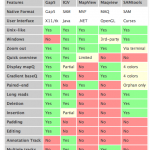
Heng Li has an excellent overview table on next generation sequence alignment viewers (as well as alignment programs) – thanks to TB for pointing me to that site. The Broad Institute has just bought another 30 Illumina Genome Analyzer – they now own 89 so the Broad people might have clearly a need for visualizing data.
The best choice is not easy to make – I am trying now the IGV in my lung sequence project. Annother interesting piece of software not listed by the Heng Li table is annoj that looks promising too, yea, yea.
Here is another paper that supports my long-standing view that the hygiene hypothesis may be wrong
We identified 3626 participants of the European Community Respiratory Health Survey II in 10 countries who did the cleaning in their homes and for whom data on specific serum IgE to 4 environmental allergens were available …The use of bleach was associated with less atopic sensitization (odds ratio [OR], 0.75; 95% CI, 0.63-0.89).
yea, it says less not more! And there is another paper that ask about the hygiene hypothesis “Do we still believe in it?”
This has little relationship with ‘hygiene’ in the usual meaning of the word. The term ‘hygiene hypothesis’ is unfortunate, as it is misleading. A better term would be ‘microbial deprivation hypothesis’.
I even think that microbial deprivation is questionable.
An interesting piece published in Science finds that
The accuracy and predictability of a hypothesis depend on the validity of the inputs used to generate and test it. Because problems are typically complex and information regarding their solution is limited, the solution is more likely to be found if the information base is greater. This rationale is a driving force behind systems biology, which attempts to define biological complexity from a systemic perspective using information technology … High-profile journals publish systems biology studies, including the human genome sequence, but most papers focus on hypothesis-driven investigations.
The most remarkable point here is the fact that there are still more people who believe in an underlying truth. This reminds me to the philosopher Continue reading Coordinates of truth and hypothesis-generating research
The new BMJ has an interesting letter on current vitamin D research
We are concerned that, in some areas of medicine, too much emphasis is placed on analysis and reanalysis of a limited amount of trial level data, rather than on the design and conduct of informative RCTs in relevant populations.
yea, yea.
Given my sceptical view that ORMDL3 is really an asthma gene (that may be even shared by the authors of the initial association) the train has now departed with more groups speculating about ORMDL3 function.
For example this new paper by Gerard Cantero-Recasens is about the unfolded protein response (UPR) that may be triggered by a putative loss of function mutation in ORMDL3 via a Ca2+ decrease in the ER. Although I am quite intrigued about the fact that the story now moves to calcium and vitamin D, we are far away from any conclusive evidence.
And here is another paper that associates ORMDL3 to the sphingolipid metabolism. Although that may be also an interesting pathway (given a bulk of literature not cited in the paper ( more, more, more, more) I still wonder if this is wishful thinking. The authors do not touch the main problem – the weak connection of some genomic variants in that region to ORMDL3 function to asthma pathogenesis.
The Biomed Experts site has a nice email notification of new papers which have been authored by my earlier co-authors – which is great! by focusing more on Continue reading Hot of the press
I am looking for some time for a MS-Acess like graphical interface addressing my large SQLite databases. Having tried out now more than dozen different packages, I found only one that fills my needs and even that only by 80% – RazorSQL.
Writing complex SQL queries is possible hwith an “autocomplete” function Continue reading SQLite and a graphical ER diagrammer for OS X
A new Thorax review finds
The hypotheses have arisen from a desire to explain epidemiological differences, and those such as the “hygiene” hypothesis had a seemingly corroboratory immunological explanation. However, they have not taken us to the point where we can proudly announce a primary preventive strategy.
I agree with the last statement but have severe doubts on any “immunological explanation” Continue reading Tired of the hygiene hypothesis
Wikepedia defines
“Fake it till you make it” (also called “act as if”) is a common catchphrase Continue reading Fake it till you make it