All posts by admin

Blink Plink

I had the chance to install now the new PLINK GWAS software for a further analysis of recently published ORMDL3 asthma data. It seems that PLINK is some software that I was looking for a long time (paper link|download link). There are great and foolproof functions to check the validity of your data. I discovered for example unnoticed stratification in the German case-control sample by first and second component of the MDS analysis Continue reading Blink Plink


CC-BY-NC Science Surf accessed 14.01.2026

Cha cha cha

SPIEGEL online points to a retrospective of former SCIENCE editor Daniel Koshland on the science typologies challenge, chance and charge.
Challenge – putting the pieces together like the discovery of the DNA structure of Watson & Crick.
Charge – solving longstanding ubiquitous problems like gravity laws by Newton, a rare event.
Chance – events like the development of PCR by Mullis.
I could add cha-uvinism (ignoring previous work), cha-os (also called creativity), cha-racter (???), cha-rity (work for nothing), cha-rade (also called congresses), cha-pter (many to write), cha-lk (many lectures), cha-nge (not really), cha-mpion (a few), cha-ir (less), cha-ff (most), cha-rts (hundreds), cha-t and cha-rivari (always), yea,yea.


CC-BY-NC Science Surf accessed 14.01.2026

I had a dream tonight

I had a dream tonight. I do the final revision of a paper following many months of work and submit it to an internet server. Only 30 minutes later the first science journal agent contacts me offering immediate publication. More and more offers arrive and I finally decide to hand it over to nice publishing company that will pay so much money to continue my research.

I woke up and Continue reading I had a dream tonight


CC-BY-NC Science Surf accessed 14.01.2026

Calendar sharing – 2 way

In a previous post we have create calendar snippets in ics format. PHPicalendar is the ultimate solution to stitch these calendar snippets together to a workgroup view.
I am using the built-in RSS feed to be noticed about any forthcoming events that are not sitting in my own calendar.
There is only one drawback: phpicalendar doesn’t offer any possibility to import back any new meeting into Sunbird or Outlook. By using the following patch of events.php it may, however, send you back an .ics file (that can opens Sunbird automatically if configured correctly) by just clicking on any new event.

events.php
|wj_events.txt|

If your calendar ics are really up to date, you may want to change $actual_calname in ical_parser.php to
$actual_calname = getCalendarName($filename) . ‘ (-‘ . round((time() – filemtime($filename) )/100000) . ‘ days old)’;


CC-BY-NC Science Surf accessed 14.01.2026

Sweave – seamless statistics and document automation

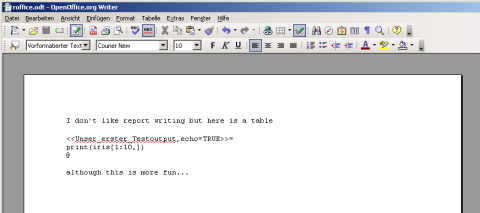
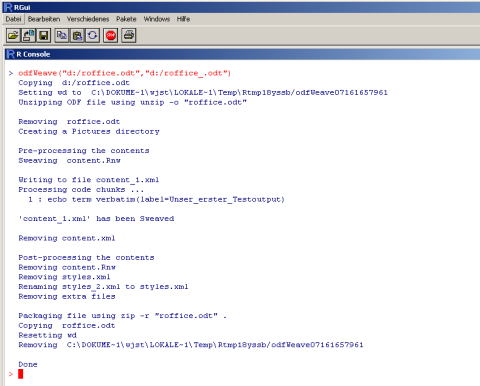
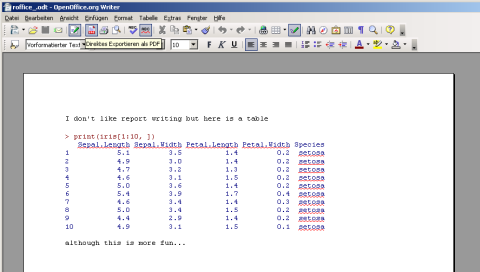
The R Munich user group likes Sweave. Here are 3 screenshots how to create a seamless R + Open Office integration (which works also for Word documents if you have installed the ODF converter plugin). First create your document

sweave.R
|wj_sweave.R|

the document

sweave01.png

save it, open R and execute

sweave02.png

Your document will then look like

sweave03.png


CC-BY-NC Science Surf accessed 14.01.2026

Human parthogenesis

Stem cell researchers now believe that the human ES cell line SCNT-hES-1 (you may renember Hwang who claimed having first cloned a human by somatic cell nuclear transfer) is derived by parthogenesis – the result of a dividing human oocyte.
They test the origin of the Hwang cells by genome-wide SNP analysis as the initial DNA fingerprint was doubtful Continue reading Human parthogenesis


CC-BY-NC Science Surf accessed 14.01.2026

Allergy transplantation

A new paper in Transplantation takes up an old question – can you passively transfer asthma or allergy? It seems so – the current study reports in 5 of 42 patients elevated IgE plus allergy symptoms. This is in line with earlier reports. Sorry to say — you can get allergy also by bone marrow transplantation.


Addendum 10/6/08
Blood

A total of 16 nonallergic recipients with allergic donors were reported to develop allergic disease posttransplant, however, conclusive information was available for only 5 cases. Allergic disease was reported to abate in 3 allergic recipients with nonallergic donors, however, conclusive information was available for only 2 cases. Problems in interpreting the reports include incomplete data on allergic disease in the donor or recipient pretransplant, not knowing the denominator, and the lack of controls. In summary, review of the literature generates the hypothesis that allergic disease is transferable


Addendum 14/7/22
Ann All Asthma Immunol


CC-BY-NC Science Surf accessed 14.01.2026