All posts by admin

Unripe

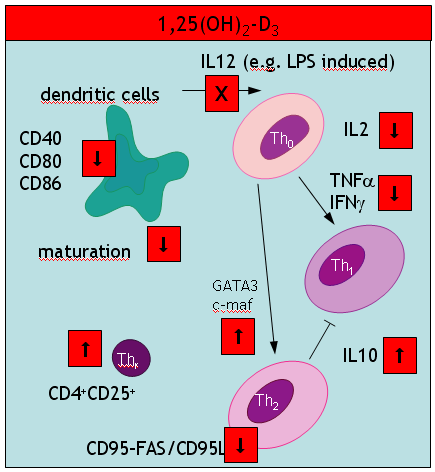
A key event in the vitamin D hypothesis of allergy induction is the immature state of dendritic cells. So far, maturity has been mainly described in terms of reduced expression of cell surface marker like CD80. A new study in Nature now further unravels how the capacity of DC to present antigen may be disturbed. Ubiquitination – the covalent attachment of ubiquitin polymers – of the MHC II ß chain ceases on maturation allowing the transport from endosomal compartments to the plasma membrane. Immature cells seem to be capable to some level of peptide-MHC interaction (at least for some selected antigens) although this process is greatly enhanced by maturation of DCs. Semi-maturity is believed to be an important inetrim stage where at least an earlier review argued

we propose a model in which steady-state migration and partial maturation (semi-maturation) of DCs is embedded as a major component within immune homeostasis, established for permanent and active tolerance induction against self-antigens derived from peripheral tissues by inducing antigen-specific CD4+ Tr cells. Semi-maturation induced by proinflammatory cytokines, such as TNF-alpha, seems to represent a unique developmental tolerogenic stage for DCs, which is based on the absence of proinflammatory cytokine production, despite high expression of MHC II and costimulatory molecules.

Another interesting study in the J Immunol – coined “alternatively activated dendritic cells” the authors probably talk about the same immature cells (compare with my cartoon summarizing a 2002 paper in Trend Mol Med). These immature DCs secrete high levels of IL10 (a paradox discussed in my most recent paper). In addition these DCs produce low amounts of IL12p70, TLR4 and CCR7. What was new to me, was an impressive list of pharmacological agents that suppress DC development: aspirin (also paracetamol?), corticosteroids, cyclosporine A, rapamycin (also other antibiotics?), and finally mycophenolate mofetil.

There is also an update of the IL10 paradox: Allergic sensitization may be down regulated by CD40 AGONISTs independent of IL10!

Finally, I would like to understand what immature really do after encountering allergen exposure. A new paper in nature immunology says that

immature DC are also thought to carry antigen to lymph nodes and to interact with naive T cells but without a previous maturation stimulus, those interactions result in abortive activation of the T cells, which can be eliminated, rendered unresponsive or induced to differentiate into regulatory T cells.

which still does not answer my question.

Vitamin D actions
vd_immun.png

Yea, yea.


CC-BY-NC Science Surf , accessed 26.07.2026

Some are hybrids, some are not

Microchimerism is an interesting phenomenon that describes the hosting of foreign cells in an individuum – the prefix micro relates to the rather low counts of foreign cells (see the self discussion).
It is believed (but unproven) that most cases of microchimerism relate to the persistence of fetal cells in the maternal organism. The background of microchimerism is extremely complicated as highlighted in a recent review about the immunology of placentation in mammals. This paper has some nice cartoons about the types of placentation (epitheliochorial, endothelichorial and haemochorial) where the invasive potential of fetal trophoblast cells is the culprit of reciprocal (?) cell traffic between mother and fetus. The highest risk is found in women with induced abortion; cell count is ranging from 0 to 21 male cells per 100,000 female cells in peripheral blood; transfer may occur from mother <-> child, twin <-> twin, or sib <-> mother <-> sib.
Microchimerism has been examined in transplantation medicine (where the recipient replaces the outer donor organ epithelium), in blood transfusion and HCT, as well as in some autoimmune diseases (systemic sclerosis, SLE, thyroiditis, PBC). A clinical review reports that fetal cells have been found to persist for many years, probably for a lifetime.
I have doubts if that is true as I am not aware of any quantitative long-term study. Nearly all studies identified only male cells in women although now genomic studies of single cells are possible allowing a much better identification of foreign cells. If you are looking for a PhD thesis, microchimerism could be your field!
I already wondered if microchimerism could lead to genotyping errors, a question that can now easily be tested on the garbage of genotyping labs: We usually have genotyping errors in the 1-10 o/oo range; sometimes we see also triallelic SNPs. As far as I can renember, microchimerism has never been analyzed in the allergy field, although allergy can transplanted as well as asthma. Yea, yea.


CC-BY-NC Science Surf , accessed 26.07.2026

Not just a face-lift

The redesign of the PLoS journals today is not just a facelift. They continue to have fresh ideas and unconventional approaches. A recent email said that

we encourage authors who are fluent in languages other than English to submit translated versions of an article summary … in other languages. Translations should be submitted as Supporting Information files labeled “Translation of the article summary (or entire article) into language XXX by author YYY”.

That is a nice idea, showing another benefit of online journals, yea, yea.

plosone.png


CC-BY-NC Science Surf , accessed 26.07.2026

Are genes becoming more important with increasing age?

I found an apparent paradox between two studies. John Whitfield did a twin study in Australia and concluded that shared environmental effects decreased with age (from about 50% to 10%) while additive genetic effects increased. The new Sardinian study found higher heritabilities among younger individuals and explained that by an increase of environmental insults with age. Nice said, but who is right?


CC-BY-NC Science Surf , accessed 26.07.2026

Born to be write

A decade ago Karen Hunter (at that time Senior Vice President of Elsevier) did a brilliant analysis why scientists publish:

For academic scientists, the research paradigm is the experiment and the publication output is a journal article. Academic science researchers publish to establish their claim at a specific time to a specific result. They publish to gain other forms of recognition (such as promotion and tenure) that require publication. They publish in order to have independent certification of the results and to have those certified (refereed) results archived in perpetuity. Finally, they publish to communicate with those who may be interested in their works today …

She continues with another important aspect

… not the circle of cognoscenti (who do not need publication to be informed) but researchers in related fields, researchers in less well-connected institutions and students working their way into the inner ring.

In my opinion, the “claim at a specific time to a specific result” is probably the most relevant motivation for a scientist. Nevertheless having claims on ideas presented in a printed paper seems to be still a habit of the pre 1995 stone age of scientific publishing. Databases will be certainly as reliable in the future as printed paper. I guess that in 50 years the access to current electronic documents will be even better than to any printed paper. Yea, yea.


CC-BY-NC Science Surf , accessed 26.07.2026

On the limits of science

Have you ever heard of the Wikipedia Knowledge Dump? With the headline “WikiDumper: The Official Appreciation Page for the Best of the Wikipedia Rejects. One man’s trash is another man’s treasure” Dr. Cliff Pickover collects the best entries. For example you can read about the Beard Theorem that suggests that the size of one’s beard has a direct correlation to the radicality of a person’s socialist views. The site is as good as the Ig Noble, yea, yea.


CC-BY-NC Science Surf , accessed 26.07.2026

Can anybody become a Nobel Prize winner?

Anders Sandberg attended a seminar in Stockholm and has written an interesting report. I have doubts if we have so much need for heroes. There are so many prizes that you can apply for – an impressive list of prizes and honours that you can find at the CVs of some laureates: Albert Lasker Award, Paul Ehrlich Prize, and many, many more. Google returns 60.100.000 hits if you search for “science prize” and there is now even the European database of science prizes that will find a prize for every scientist. Yea, yea.


CC-BY-NC Science Surf , accessed 26.07.2026

WordPress as CMS

I have read many useful (and also some less useful) comments how to squeeze WordPress to work as a CMS.

I did not want to make any major changes to scripts that would be lost after an upgrade. I did not want to have extra plugins to change home (for example by creating an overriding home.cfm). I did not want to have any new categories. I did not want to change permalink structure. I still need my directory plugin to work, I still need the blog (some redirects even loose the blog address!) and I wanted to keep the RSS feed.

After several hours I came up with an very simple solution: Take a standard page and rename its title and slug to “Home” – assign a special “Home” template – redirect htaccess to this page. The only trick is to make the “Home” template work: it is basically a copy of the index.cfm in your WordPress theme directory where the line calling loop.php is being replaced with a slightly modifed loop code.

myblog.php
|wj_myblog.php|


CC-BY-NC Science Surf , accessed 26.07.2026

HUGO Changing Offensive Gene Names

Hsien Hsien Lei has a good comment on gene names approved by Human Genome Organisation (HUGO) Gene Nomenclature Committee which are nevertheless offending . Some of the inappropriate names are LFNG – lunatic fringe homolog (Drosophila), MFNG manic fringe homolog (Drosophila) as well as SHH sonic hedgehog homolog (Drosophila). There are many more names that arise only from a particular culture (like death executioner Bcl-2); it seems also a particular kind of humour to call a deaf mouse Beethoven. Yea, yea.


CC-BY-NC Science Surf , accessed 26.07.2026

Our knowledge springs from two main sources

Immanuel Kant is now also online in English language

Our knowledge springs from two main sources in the mind, first of which is the faculty or power of receiving representations (receptivity for impressions); the second is the power of cognizing by means of these representations (spontaneity in the production of conceptions). Through the first an object is given to us; through the second, it is, in relation to the representation (which is a mere determination of the mind), thought. Intuition and conceptions constitute, therefore, the elements of all our knowledge, so that neither conceptions without an intuition in some way corresponding to them, nor intuition without conceptions, can afford us a cognition.


CC-BY-NC Science Surf , accessed 26.07.2026

Why we should believe professional cyclists

I renember a nice meeting in South Sardinia in 2002 (see my figure below) where a lot of famous people gathered for interesting talks in a wonderful surrounding.
A spin off from this Ogliastra Genetics Park – as the authors called it – is now a paper in PLOS Genetics that examines the heritability of 98 quantitative cardiovascular traits in 6,148 Sardinians.
Although the authors did not measure hematocrit, RBC related counts had an extremely high heritability (MCV 0.76, MCH 0.78). Hemoglobin was somewhat lower (0.47) which might in part be attributable due to some local selection factors. This result comes largely unexpected, as the high heritability of the MCV was not known so far.
In the absence of any assay for exogeneous EPO, hematocrit is used as an indirect parameter for testing athletes. I already wondered why cyclists are having such high values (if we exclude illegal drug use). This seems to be a genetically trait by self-selection – an anemic cyclist will not participate in the Tour de France. Yea, yea.

123-2325_img.JPG

Addendum

Here is an answer to the question what makes a champion ;-)


CC-BY-NC Science Surf , accessed 26.07.2026

On the “Self”

If I would ever find the time, I would write a book on the “self”. Inspired by the Eccles/Popper book that I bought as a student, I always wondered how different the self is being defined in sociology, psychology/psychiatry, philosophy and theology.
As my current focus is more on genetics and immunology, I found a paper by Francisco Borrego on the “missing self” quite interesting as it highlights the genetic self is determined mainly by MHC class I molecules, where only NK cells transfected with H-2Dd were able to confer resistance for being self-attacked. It would be nice if other disciplines could also provide such simple answers, yea, yea.

Addendum

I have another suggestion: Zfp608 protects mouse mothers against immune-mediated attack by fetal cells.

Is there also a “digiself“?

Our identity has, for many years, existed quite independent of our physical incarnation in government, financial and other institutional databases. We are not real to the bank or other authorities unless we can produce something that links our physical self to our “real identity” in their database. We have many versions of this digital identity – or digiSelf, as I like to call it – spread among many databases, each with its unique characteristics, and inferred behaviours. Each one is more real to the institution – and ironically, to the people in that institution – than our physical self, what we consider to be our real self.


CC-BY-NC Science Surf , accessed 26.07.2026