Looking at the log file I found that an anonymous visitor was looking for “Jim’s DNA data” here. I thought of James Watson first. Obviously, however, the anonymous visitor was looking for something different: Continue reading Your DNA data here
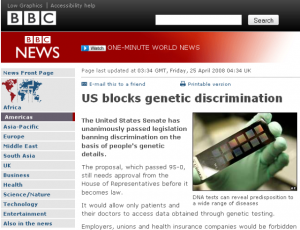
The BBC headline yesterday is close to the famous quote of Neil Amstrongs’ with reporting the United States blocking now genetic discrimination.
Or as Kennedy put it forward “the first new civil rights bill of the new century”. Unfortunately, we are lagging behind in Europe. My recent initiative to promote such a legislative in Germany was futile; the most recent goverment proposal only earned a lot of criticism.
a prosaic quotation from the recent Nature correspondence section that highlights why genetics has been leading us into nowhere.
Our lives are unrepeatble experiments lacking a control. Myriad external factors interact with genetic and epigenetic factors and with chance to determine whether we are well or ill, smart or dull, successes or failures.
Yea, yea.
is an exciting question that will have a large disease relevance. I think this is not so much about cytogenetic abnormalities but the general understanding which genetic modules are recombining, e.g. are compatible in terms of function, and which need to be tight together. Continue reading How we are reshuffling our genome
The non-scientific world doesn’t have any problem to show failure. Have a look at
failblog.wordpress.com
www.doingitwrong.com
www.shipmentoffail.com
Why is failure of science Continue reading Fail!
A new paper in PLoS Biology highlights the duty to recontact you for whole-genome research on any stored sample Continue reading Duty to recontact you
Bruce Alberts, the new editor-in-chief of Science magazine, has in his March, 21 editorial a nice comment that I would like to highlight here
Scientists share a common way of reaching conclusions that is based not only on the evidence and logic, but also requires honesty, creativity, and openess to new ideas.
Struggling in an area where no (or only seldom) conclusions ar being reached, I agree Continue reading To be honest
The central limit theorem states that a sum of independent identically distributed random variables (lets say allele counts in genomewide association scans) of finite variance will be approximately normally distributed. Unfortunately the maximum of the distribution will not reflect the true value … or did I get it wrong?
I am currently playing with MACH and SNPMStat to impute marker based on public datasets. I do not have any opinion about the usefulness of this approach – largely due to the fact that ~10% of my allele coding is different to the public hapmap data. Continue reading How to impute marker genotypes
We probably all agree that a publication bias against negative studies will severely distorts our opinion. To repeat an earlier Nature letter
Why negatives should be viewed as positives … This filtering of results undoubtedly biases the information available to scientists (see, for example “Null and void” Nature 422, 554â€"555; 2003). And communication is at the heart of science.
Here is an email that I received from the editor Continue reading Bias against negative studies
Current RNA chip technology, although quite advanced, is usually limited to known transcripts. As rare transcripts (N=1 to 5) usually cannot be quantified, current chip technology is probably useless for building realistic virtual cells. Maybe there are there are other options? SAGE – serial analysis of gene expression – has been also around Continue reading SuperSAGE plus highly parallel sequencing
A nice study in Hum Genet by Eiberg hit the public press (and the blogosphere 1|2). Although I agree with most commentators that this is a sound study with a bit antiquity dust in the methods, I am unsure if I should believe the main conclusion of a founder mutation Continue reading Blue eyes
“Positively disruptive” – a new nature genetics editorial – makes a U turn of the opinion voiced only two months earlier – having at that time cautioned users of new consumer genomics services. The current editorial now reads like an advertisement for deCODEme or Navigenics. Continue reading Unnecessarily disruptive
While Nature magazine is preparing something about Darwin’s enduring legacy here is a piece from Darwin’s own writings
doubt always arises whether the convictions of man’s mind, which has been developed from the mind of the lower animals, are of any value or at all trustworthy. Would any one trust in the convictions of a monkey’s mind, if there are any convictions in such a mind?
which can be found in Continue reading Would any one trust in the convictions of a monkey’s mind?
A recent editorial in PLoS Biology was about “Sex, dose and equality“. I always had problems to understand X linked recessive disease and carrier status of a woman: If the random X inactivation would have been complete why are there not much more colorblind women? Obviously the second X is at least partially active as a rescue system. Continue reading X activity center