Category Archives: Vitamins

Clean pigs and less clean journalism

A Spiegel online article yesterday about a study of indoor and outdoor housed pigs attributes the results to the development of allergy

Kinder vom Land haben demnach ein besseres Immunsystem und weniger Allergien als Stadtkinder, weil sie früher Kontakt haben mit all den Bakterien, wie sie in Tierställen vorkommen.

Unfortunately the original paper finds something completely different Continue reading Clean pigs and less clean journalism


CC-BY-NC Science Surf accessed 11.01.2026

A moratorium??

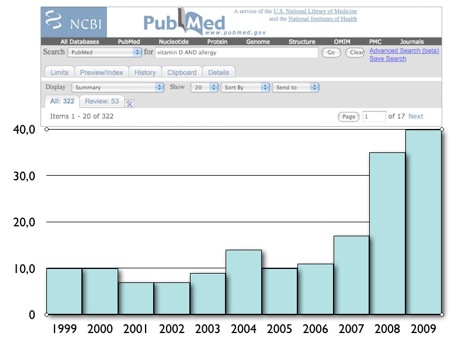
The new BMJ has an interesting letter on current vitamin D research

We are concerned that, in some areas of medicine, too much emphasis is placed on analysis and reanalysis of a limited amount of trial level data, rather than on the design and conduct of informative RCTs in relevant populations.

yea, yea.


CC-BY-NC Science Surf accessed 11.01.2026

ORMDL3 graduated

Given my sceptical view that ORMDL3 is really an asthma gene (that may be even shared by the authors of the initial association) the train has now departed with more groups speculating about ORMDL3 function.
For example this new paper by Gerard Cantero-Recasens is about the unfolded protein response (UPR) that may be triggered by a putative loss of function mutation in ORMDL3 via a Ca2+ decrease in the ER. Although I am quite intrigued about the fact that the story now moves to calcium and vitamin D, we are far away from any conclusive evidence.

Addenddum 3.3.2010

And here is another paper that associates ORMDL3 to the sphingolipid metabolism. Although that may be also an interesting pathway (given a bulk of literature not cited in the paper ( more, more, more, more) I still wonder if this is wishful thinking. The authors do not touch the main problem – the weak connection of some genomic variants in that region to ORMDL3 function to asthma pathogenesis.


CC-BY-NC Science Surf accessed 11.01.2026

Tired of the hygiene hypothesis

A new Thorax review finds

The hypotheses have arisen from a desire to explain epidemiological differences, and those such as the “hygiene” hypothesis had a seemingly corroboratory immunological explanation. However, they have not taken us to the point where we can proudly announce a primary preventive strategy.

I agree with the last statement but have severe doubts on any “immunological explanation” Continue reading Tired of the hygiene hypothesis


CC-BY-NC Science Surf accessed 11.01.2026

1, 2, 3

A new review [Allergy (2009) vol. 64 (3) pp. 348-353] examines the evidence that

(1) failure to up-regulate the interferon gamma (IFNg) response during infancy is an important determinant of the risk of allergic disease
(2) expression of the IFNg gene in naive T-cells is regulated by epigenetic mechanisms, and
(3) failure to up-regulate IFNg gene expression of naive T-cells associated with low early life microbial exposure.

If we replace “microbial exposure” with Continue reading 1, 2, 3


CC-BY-NC Science Surf accessed 11.01.2026

(1S,3Z)-3-[(2E)-2-[(1R,3aR,7aR)-7a-methyl-1-[(2R)-6-methylheptan-2-yl]-2,3,3a,5,6,7-hexahydro-1H-inden-4-ylidene]ethylidene]-4-methylidene-cyclohexan-1-ol

or briefly vitamin D3. There seems to be another vitamin D /allergy abstract at the forthcoming EAACI congress from the KOALA study. The authors find

Risk for AD was highest for children in the fourth quintile of maternal 25(OH)D level [adjusted odds ratio (aOR) 2.08; 95%CI 1.07-4.03] compared to those in the third quintile; P for trend over the quintiles 0.03]. Continue reading (1S,3Z)-3-[(2E)-2-[(1R,3aR,7aR)-7a-methyl-1-[(2R)-6-methylheptan-2-yl]-2,3,3a,5,6,7-hexahydro-1H-inden-4-ylidene]ethylidene]-4-methylidene-cyclohexan-1-ol


CC-BY-NC Science Surf accessed 11.01.2026