Gesund und krank: Diskriminierung bei Bipolar I Störung

Die Bipolar-I-Störung ist eine chronisch verlaufende psychiatrische Erkrankung, früher auch als manisch-depressive Psychose bezeichnet und gehört zu den affektiven Störungen. Kennzeichen der Erkrankung sind wiederholte manische und depressive Episoden, seltener einer Mischung aus beiden, sowie lange Phasen von unauffälligem, situativ angepasstem Verhalten (LUNDBECK.COM). “Menschen mit Bipolar-I-Störung können ungewöhnlich intensive Stimmungen haben, die jeweils über einen bestimmten Zeitraum anhalten, der als ‘Episode’ bezeichnet wird.” Continue reading Gesund und krank: Diskriminierung bei Bipolar I Störung


CC-BY-NC Science Surf , accessed 01.09.2026

2.225074e-308

I have recently read in a dataset with p<10e343 that has been set to zero. So here is what the R documentation says

.Machine
# the smallest non-zero normalized floating-point number, a power of the radix, i.e., double.base ^ double.min.exp.
$double.xmin
2.225074e-308
# the largest normalized floating-point number. Typically, it is equal to (1 - double.neg.eps) * double.base 
# ^ double.max.exp, but on some machines it is only the second or third largest such number, being too small 
# by 1 or 2 units in the last digit of the significand
$double.xmax
1.797693e+308


CC-BY-NC Science Surf , accessed 01.09.2026

München Flughafen Spengstoffkontrolle

Der neue SZ Bericht über die Beschwerden der Angestellten am Münchner Flughafen ist technisch nicht sehr ergiebig. Alles nur Sick Building Syndrom? Auch wenn von anderen Flughäfen keine solchen Symptome bekannt sind, kann es unter spezifischen Umgebungsbedingungen anders aussehen: andere Substrate, Gerätedefekte, Fehlbedienung. Im Prinzip wird eine Wischprobe genommen.

der Streifen wird anschließend in einem Analysegerät untersucht. Zwei Hochgeschwindigkeits-Gaschromatographen lösen die Sprengstoffe aus der Probe. Die Geräte erkennen so in 15 bis 18 Sekunden kleinste Mengen Sprengstoff und zwar schon ab der Menge von 100 Piktogramm.

Nach Presseberichten kommen zwei Arten von Gaschromatographen zur Anwendung: Itemizer 4DX und Quantum Sniffer QS-B220. Falls es dabei zu einer Luftionisation kommt, könnte man Ozon messen oder auch das Trockenmittel auf allergene Potenz untersuchen. Oder ganz einfach mal alle Geräte zwischen Frankfurt und München tauschen.


CC-BY-NC Science Surf , accessed 01.09.2026

Under fire

These messages look innocent but they are a constant invasion into privacy. Google tries to match all devices to a single person.


CC-BY-NC Science Surf , accessed 01.09.2026

Racist comments

I just received a Google alert of a new paper that cites our earlier work. The authors describe a Twitter analysis””23andMe confirms: I'm super white“. It showcases a lot of noise …

The two most popular DTC companies, 23andMe and AncestryDNA, also generate the most tweets. However, al-though 23andMe has half the customers, it produces almost 5 times more tweets, which is also due to controversy around their failure to get FDA approval in 2015.

and even more noise

In particular, the "ethnic" breakdown provided by ancestry reports seems to spur several instances of negative sentiment tweets associated with racism and disapproval of multi-cultural/multi-ethnic values. For instance, a user with more than 3K followers self-describing as a "Yuge fan for Donald Trump", tweets: "Get this race mixing shit off my time line!!" in response to a 23andMe video about ancestry […] Also, Twitter might be removing tweets with hate words as claimed in their hateful conduct policy. Nonetheless, we do find instances of hate speech, e.g., antisemitic tweets […]

This what I already feared, the largely useless genetic testing is being misused for inferior interests. It is dangerous too, just read the recent case history.


CC-BY-NC Science Surf , accessed 01.09.2026

Vitamin D buffering

Response to oral vitamin D seems to be different in humans . How do we buffer (artificial) vitamin D intake?

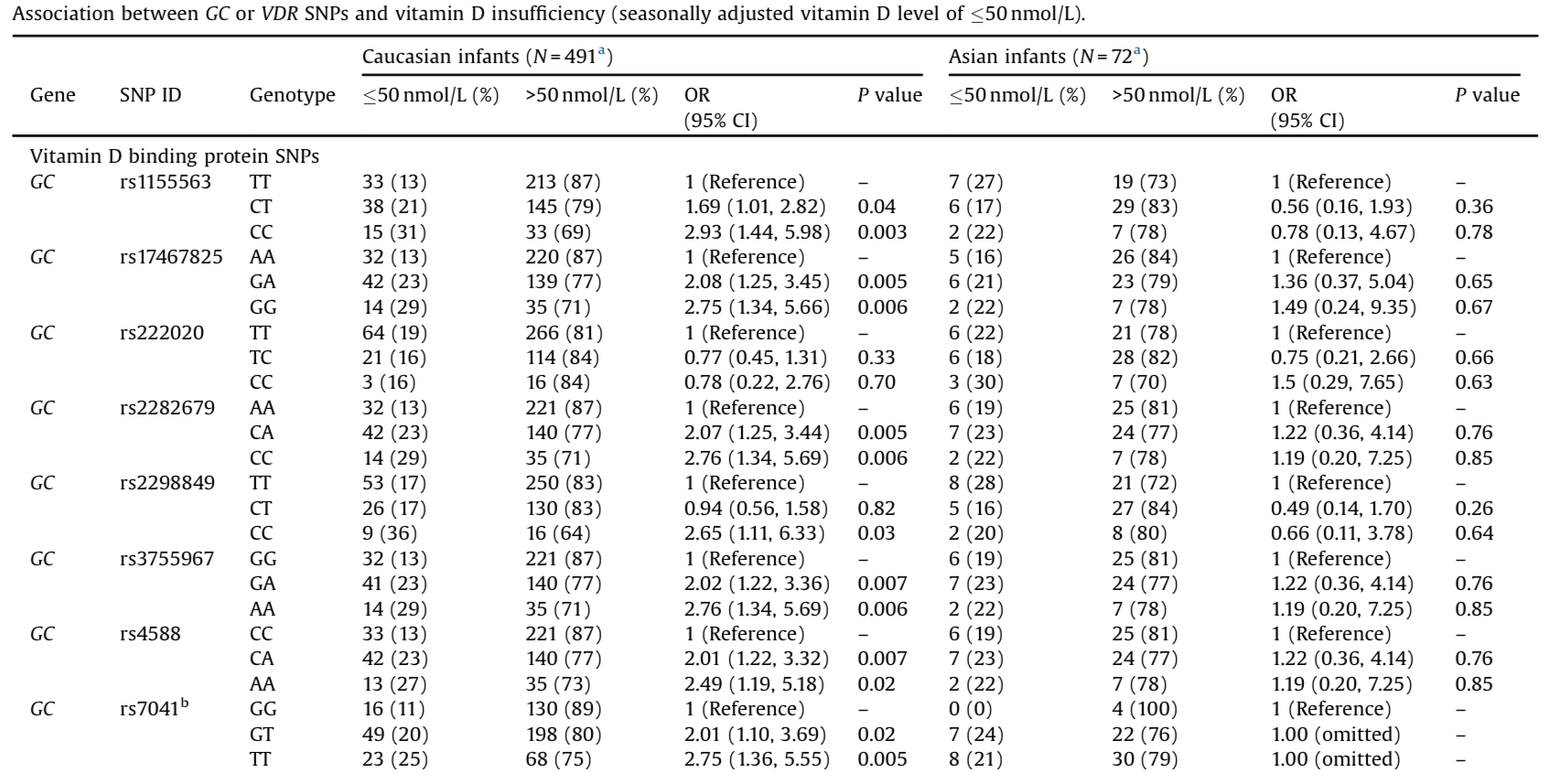
Vitamin binding protein or group specific component GC is a good candidate. GC regulates the bioavailability of 25(OH)D3, acting as the main transporterint he blood stream from liver to kidney. As described earlier GC binds with high affinity to 25(OH)D3, leaving less than 1% of circulating 25(OH)D3 free. In contrast to 25(OH)D3, which has a half-life of several weeks, GC has a short half-life of 3 days only, suggesting that the protein and its ligand are independently regulated. Also the free binding capacity of GC is variable. In addition there are GC variants that have different binding characteristics. Depending on these isoforms, serum levels increased between 97% and 307% after receiving 600 or 4000 IU/d vitamin D3 for one year. Taken together GC is assumed to be a buffer of vitamin D effects (and side effects) whenever transport in the blood stream is being involved.

The most recent GWAS study now shows again skyrocking p-values of GC variants and serum 25(OH)D3.
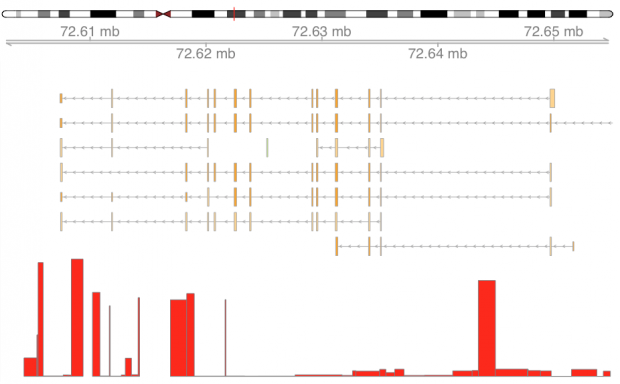
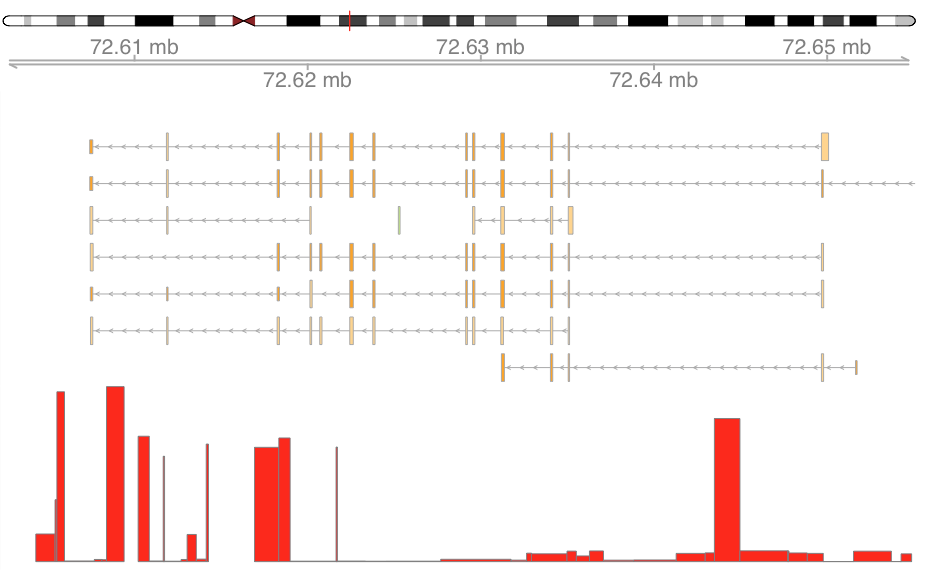
It is long known, that two missense variants of GC locate in exon 11. rs7041 encodes Asp432Glu pr D432E and rs4588 encodes Thr436Lys or T436K. These amino acid exchanges are leading to electrophoretically distinguishable proteins Gc1F/Gc1S and Gc2 respectively. We are moving the following gene plot bottom up to match the orientation.
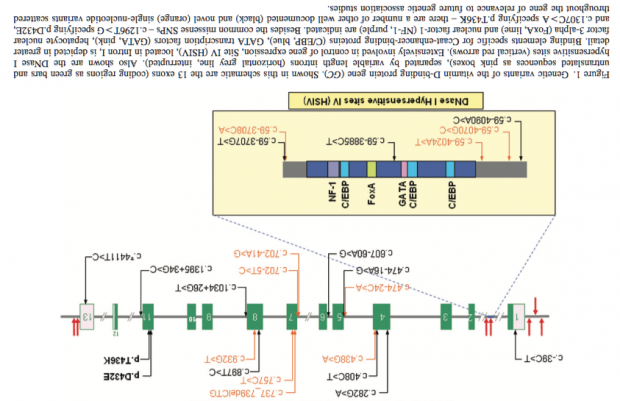
Unfortunately LD is extremely high at GC. The GWAS peaks are therefore in the first intron, at exon 11 and intron 12. Lets’ s get closer to exon 11 where the two most important SNPs reside.
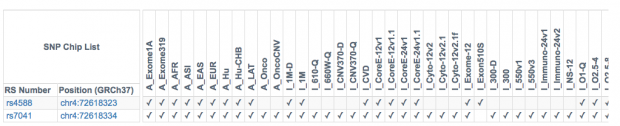
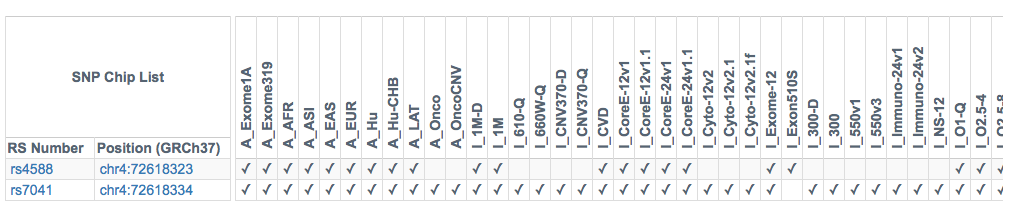
Although both variants are listed at many SNP chips I can find only results for rs7041 with p=10^-222 in the new dataset.

rs7041 is listed as a A->C SNP there but according to Fu 2009 it is definitely a G->T variant. Also SNPedia has numerous articles for rs7041 being a G->T exchange, for example Suaini 2014
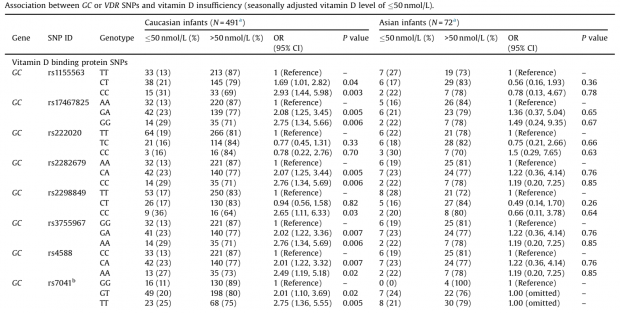
This is also confirmed by dbsnp. The GAT -> GAG exchange is equivalent to D -> E, so the online results report a wrong strand orientation. Unfortunately we are stuck here, as one of the main effect SNP seems to have an unclear allele assignment and the second most important SNP is missing from the meta-analysis.

What would be nice is a conditional analysis based on rs7041/rs4588 haplotypes. I predict there are further unknown functional variants in GC. Maybe in intron 1 that often contains regulatory elements at the 5'-site of the intron. As the strongest signal is in the last intron and even beyond the 3′- end, further studies of 3′-UTR would be interesting, looking for binding sites of regulatory proteins, some miRNA or AU rich elements that affect the stability or decay rate of the transcript.


CC-BY-NC Science Surf , accessed 01.09.2026

Ethik ohne Ethiker

Die Zeiten sind eigentlich vorbei, in denen Nobelpreisträger qua ausgezeichnetem Verstand über die Welt räsonierten. Oder die Zeiten, wo man gerade mal so nebenbei eine Ethik auf den Markt wirft.
Vorteile hat es allemal. Man kann kostengünstig von aktuellen Problemen ablenken, Freiräume schaffen und nebenbei auch noch Akzeptanz promoten, man ist politisch engagiert.
Worum es geht? Ein Wissenschaftskodex, so nebenbei auf dem Weltwirtschaftsforum erstellt. Continue reading Ethik ohne Ethiker


CC-BY-NC Science Surf , accessed 01.09.2026

Genetics of vitamin D

A new GWAS of vitamin D serum level reports two new loci as sample size could be increased from 16K to 79K. While the previous GWAS hits had a reasonable biological function (GC transport protein, DHCR7 converting to cholesterol, CYP2R1 to calcidiol and CYP24A1 degradation) the new loci look more like statistical artifacts.
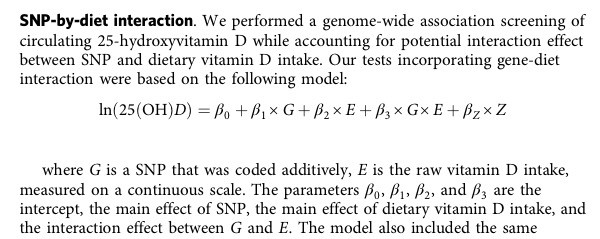
The authors tried some kind of dose effect estimates

where SNP effects on serum level became slightly weaker (which makes sense as diet is a clear environmental factor). Continue reading Genetics of vitamin D


CC-BY-NC Science Surf , accessed 01.09.2026

Forgetting curve

There are news on the "forgetting curve"

In 1885, Hermann Ebbinghaus collected data to plot a forgetting curve. Today, we approximate forgetting with an exponential curve where R is retrievability (a measure of how easy it is to retrieve a piece of information from memory), S is stability of memory (determines how fast R falls over time in the absence of training, testing or other recall), and t is time.

The Atlantic now adds to this

In the internet age, recall memory-the ability to spontaneously call information up in your mind-has become less necessary. It's still good for bar trivia, or remembering your to-do list, but largely, Horvath says, what's called recognition memory is more important. "So long as you know where that information is at and how to access it, then you don't really need to recall it," he says … Socrates hates writing because he thinks it's going to kill memory," Horvath says. "And he's right. Writing absolutely killed memory. But think of all the incredible things we got because of writing. I wouldn't trade writing for a better recall memory, ever." Perhaps the internet offers a similar tradeoff: You can access and consume as much information and entertainment as you want, but you won't retain most of it.


CC-BY-NC Science Surf , accessed 01.09.2026
Live votes during presentation (reveal.js)

I have revised now the setup of my “live vote” presentation as the bespoke.js framework had several glitches where plugins did not work correctly. I am using now reveal.js that allows also to embed external pages (like zenpen), zoom effects and slide overview in a nice graphic layout.

The graphics engine was also replaced. d3.js is an extremely versatile but it takes hours for doing minor changes. So I switched to Kendo UI charts that are much easier to program, making some fancy live statistics :-)

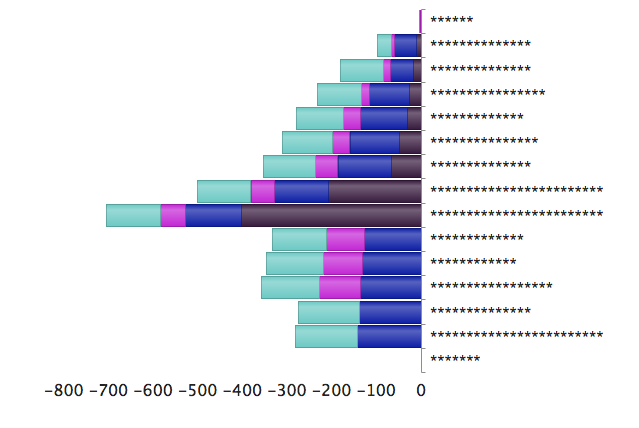
Individual response times in seconds from 15 students (anonymized names on the right). Students can respond to a question as long as the question is on display. The stacked bar shows the time being faster than the slowest responder with the first to last question from right to left end of the bar. The individual in the middle was extremely fast following my initial explanation. The two individuals at the bottom responded only to the same two questions probably talking to each other. Individuals were identified by their their mac address while all data had to be corrected for double entries.

I also thought to setup a socket.io server to push new pages to the clients (currently they initiate their own refresh) but at the end I found it too time consuming as spending time on content is being more important. Right now I am sending out an ajax request to store the actual presentation slide for the clients.

var i = Reveal.getCurrentSlide().children[0].id;
Reveal.addEventListener( 'slidechanged', function( event ) {
  i = $("span").eq(event.indexh).attr("id");
  $.ajax({
    url: "server.php",
    type: "GET",
    data: {"k":event.indexh}
  );
  return i;
});


CC-BY-NC Science Surf , accessed 01.09.2026
Forschung in verantwortungsethischer Perspektive

Am 12. und 13. Januar 2018 fand in der evangelischen Akademie Loccum ein Symposium zur Forschungsethik statt. Trotz des sperrigen Titels, die Ankündigung war spannend:

Wie finden wir in den Lebenswissenschaften wieder zu einer kühneren Forschungskultur, die gleichzeitig stärker verantwortungsbasiert arbeitet? Diese Frage steht deshalb im Zentrum der Tagung, weil heute ein hoher Leistungs- und Produktivitätsdruck die Forschung belastet und damit Qualitätsprobleme provoziert. Das hat zu einem dramatischen Seriositätsverlust in der Erarbeitung, Bewertung und Darstellung von Forschungsergebnissen geführt.
Während der Tagung wird nach Wegen gesucht, diesem Missstand wirkungsvoll entgegen zu treten: Wissenschaftler mit langjähriger Forschungserfahrung, wissenschaftlicher Nachwuchs, Experten entsprechender Bereichsethiken und hochschulpolitische Administrationen sind gefragt.
Welche Herausforderungen drohen die Erzielung verlässlicher Forschungsergebnisse zu verhindern? Welche zentralen Eckdaten kennzeichnen eine produktive Forschungskultur? Welche forschungsethischen und forschungsrechtlichen Rahmenbedingungen sind von Belang? Wie kommen hier Digitalisierung, Big Data und Verfahren wie die Bibliometrie ins Spiel?
Vor diesem Hintergrund: Wie kann es gelingen, angemessene Freiräume für forschende Kreativität mit Mut zum Risiko zu stärken? Wie kann Originalität und Nachhaltigkeit von Forschung gegenüber purer Publikations- und Zitationsindikatorik anerkannt werden? Was können die Hochschulleitungen und die Wissenschaftspolitik zur Unterstützung innovativer und zugleich seriöser Forschung tun?
Der Fokus wird nach einer grundsätzlichen Sichtung der Problemlagen auf den Lebenswissenschaften, insbesondere auf den medizinischen Fächern liegen. Ein generationen­übergreifender Austausch zwischen arrivierter Forschung und wissenschaftlichem Nachwuchs ist ausdrücklich erwünscht!

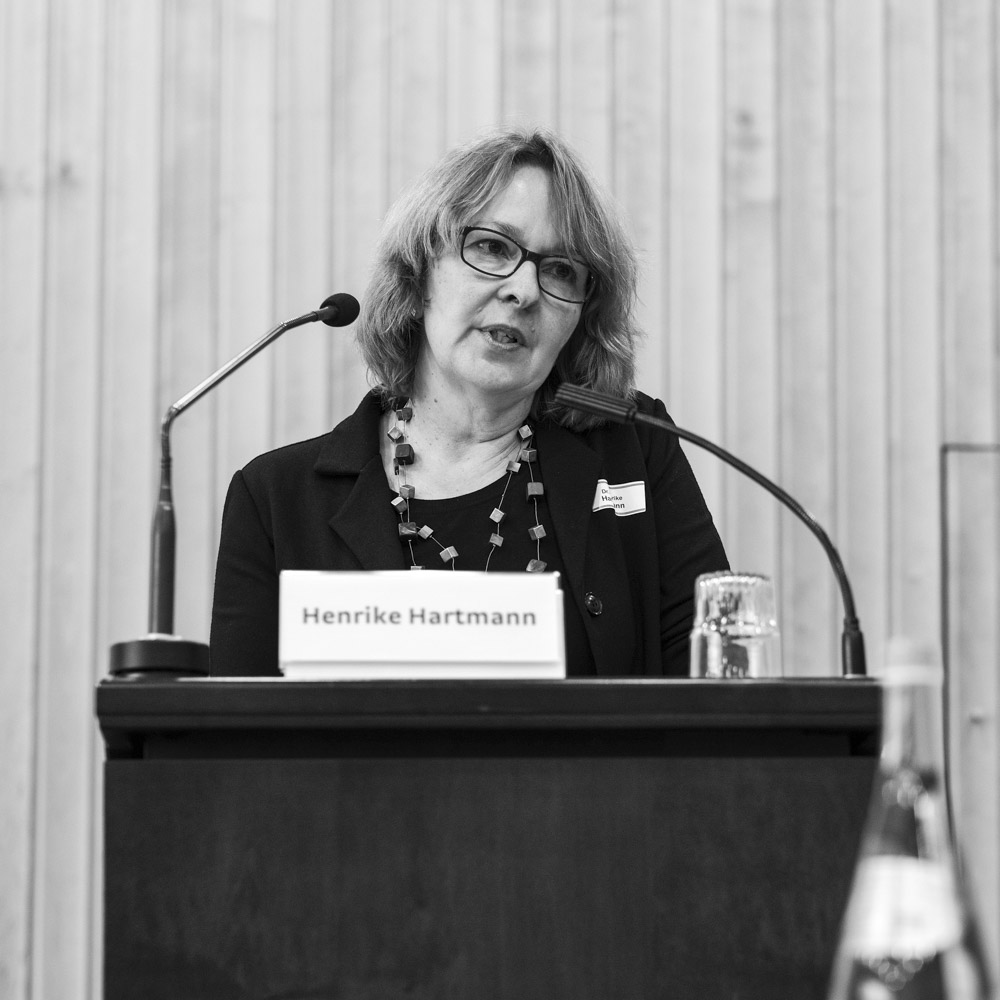
Hier ist mein Mitschrieb ohne Gewähr, solange es kein offizielles Protokoll gibt. Eröffnet wurde die Tagung von Henrike Hartmann (Volkswagen Stiftung) sowie Stephan Schaede (Akademie Loccum).

Henrike Hartmann, VolkswagenStiftung

Stephan Schaede, Akademie Loccum

Continue reading Forschung in verantwortungsethischer Perspektive


CC-BY-NC Science Surf , accessed 01.09.2026