Running R from Plink

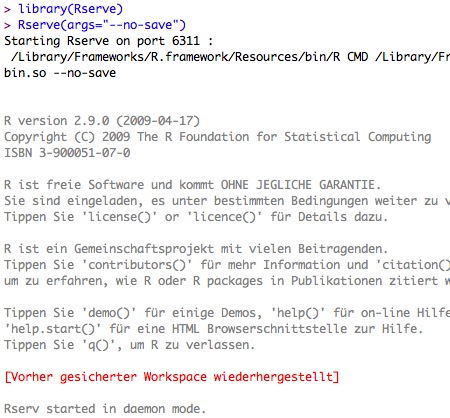
In principle, there are two methods marrying R and Plink – either by Applecscript or by TCP IP. I prefer the last one; the Plink website now as a nice documentation how to do that. Unfortunately I didn’ get the Rserve process running under OS X. Here is the trick – add the correct “args” option from the example below.
screenshot


CC-BY-NC Science Surf , accessed 29.08.2026

The use of Powerpoint has been a disaster

Being asked to give another presentation on whatesoever topic and to deposit my slides on whatsoever intranet, the famous quote of John Sweller came to my point

It is effective to speak to a diagram, because it presents information in a different form. But it is not effective to speak the same words that are written, because it is putting too much load on the mind and decreases your ability to understand what is being presented.

So, as I tend to use only slides with cartoons and figures (but no bullet points which are in my notes only) these illustrations are rather useless as a stand-alone file at any Ilias platform. In other words

if your presentation visuals taken in the aggregate (e.g., your “owerPoint deck”) can be perfectly and completely understood without your narration, then it begs the question: why are you there?

I remember a lecture by my doctoral advisor who came in the lecture room with just 1 glass slide in his shirt pocket … More intelligent comments about that issue at presentationzen.com


CC-BY-NC Science Surf , accessed 29.08.2026
Forget about genes IV

Here comes probably one of the first papers that say NO to a gene for depression. As expected it is a meta-analysis:

Contrary to a previous report, an analysis of 14 previous studies does not find an association between a serotonin transporter gene variation, stressful life events, and an increased risk of major depression … “A more serious concern … is that the findings of this [Caspi et al] and other nonreplicated genetic associations are now being translated to a range of clinical, legal, research, and social settings such as forensics, diagnostic testing, study participants, and the general public. It is critical that health practitioners and scientists in other disciplines recognize the importance of replication of such findings.”

no stool test;-) nothing!


CC-BY-NC Science Surf , accessed 29.08.2026
Why do we possess introns?

This seems to be a question with not so many good answers. “The origins of genome architecture” (Sinauer, 2007) has a nice chapter on “Genes in pieces” covering

  • the spliceosome fisson-fusion model: Did a single ancestral spliceosome diverge into different lineages or is there an endogeneous origin within a single species?
  • the introns early-introns late debate: Were introns present in the first prokaryotic cell or not?

Mechanisms about intron gain center about AGGT tetramer duplication that result in new splice sites —AG|gt … ag|GT— with the segment in lower cases being the new intron. (What I found a funny fact, when working for the first time with genomic sequences around 1994 is the “codon ignorance” and “domain ignorance” of introns while on the other hand allowing for alternative splicing). Another mechanism of intron gain may be transposable elements although retrotransposons cannot deliver introns as they are spliced out. More likely are already released introns and ectopic reintegration. Another (not mentioned mechanism) could be random mutations activating cryptic splice sites.
The key question remains Continue reading Why do we possess introns?


CC-BY-NC Science Surf , accessed 29.08.2026

1, 2, 3

A new review [Allergy (2009) vol. 64 (3) pp. 348-353] examines the evidence that

(1) failure to up-regulate the interferon gamma (IFNg) response during infancy is an important determinant of the risk of allergic disease
(2) expression of the IFNg gene in naive T-cells is regulated by epigenetic mechanisms, and
(3) failure to up-regulate IFNg gene expression of naive T-cells associated with low early life microbial exposure.

If we replace “microbial exposure” with Continue reading 1, 2, 3


CC-BY-NC Science Surf , accessed 29.08.2026

Danger of continuous information flow

Nassim Taleb points in his black swan book (p181 in the German edition 2008) towards the “toxicity” of continuously added information. He is citing experiments from the 1960ies where students were offered increasingly sharp pictures of water pipes. Students in the group with slightly inceasing sharp pictures had much more problems to recognize the pipe in constrast to the group being offered the same picture without any interim pictures. Together with the experiments of Stuart Oskamp it seems more difficult to discover real breakthroughs when being too deeply involved (and obsessed by getting the complete literature in a particular field). This even questions my daily Pubmed alerts; I will change them now to monthly update.


CC-BY-NC Science Surf , accessed 29.08.2026

Forget about genes III

Here is another opinion from a widely read German magazine (Spiegel online, 25. Mai 2009, Jörg Blech, Wahrsager im Labor) about our too great expectations in genetics:

Während die einen noch mehr und noch größere Vergleichsstudien fordern, halten Skeptiker wie Goldstein dies für reine Zeitverschwendung: “Wenn man 30.000 Patienten mit Diabetes Typ 2 untersucht hat, dann halte ich es für sinnlos, die Zahl auf 60.000 oder 100.000 zu erhöhen.”

good bye to the “common variant hypothesis”!


CC-BY-NC Science Surf , accessed 29.08.2026

I am a scientist

Widely cheered in the blogosphere, Science magazine asked if we as scientists “are ready to be become a number”.

So, in general, I think there’s plenty of agreement that this sort of author ID system is past due. It can do everything from ease the process of manuscript submission to help researchers mine the existing volume of scientific data.

Sure, a unique DOI like ID Continue reading I am a scientist


CC-BY-NC Science Surf , accessed 29.08.2026

Die Aerzte sind die Kranken

Life expectancy of physicians is lower in most countries – an argument why Karl Kraus may be right:

Was ist’s mit den Analysen? Kann da ein Zweifel bleiben? Die Methode ist bewiesen an jenen, die sie treiben. Daß man mit euch nur scherzte â€" welch törichter Gedanke! Im Gegenteil: die Ärzte sind Kranke.

While just recovering from an orthopedic procedure (see picture below) my impression is that the quality of medical care has very much approved during the years. The performance of a surgeon can be always immediately verified ;-)
screenshot3


CC-BY-NC Science Surf , accessed 29.08.2026

Ill will, good will – free will?

Neuroscientists largely see the “free will as an illusion” – according to a recent essay in Nature. As the author of this interesting essay, I have a major problem to give up the idea of a “free will” (mainly for theodicy reasons that needs a free will of humans). Maybe our will is being influenced by many factors, it is not always a conscious decision and it can of course be altered by chemicals or diseases. Nevertheless the subjective, sudden and not anticipated impetus to do something – for example writing a blog about free will – is a symptom of free will even with all existing antinomies, yea, yea.


CC-BY-NC Science Surf , accessed 29.08.2026