Forget about genes II

Blood pressure seems to have a complicated regulation according to a recent nature medicine editorial

If you ask a physiologist what organs are involved in blood pressure regulation, you will probably be told the kidney, the brain or the blood vessels. The kidney is responsible for handling sodium … The brain integrates afferent signals from peripheral sites such as the kidney … systemic vascular resistance is elevated in almost all adults with hypertension, suggesting that arteriolar vasoconstriction has an important role in this disease.

The editorial accompanies a new mechanistic report how a high-salt diet leads to interstitial hypertonic Na+ accumulation by activation of tonicity-responsive enhancer binding protein (TonEBP) binding the promoter of the gene encoding vascular endothelial growth factor-C (VEGF-C). As far, as good, Continue reading Forget about genes II


CC-BY-NC Science Surf , accessed 29.08.2026
Science flies

Still in the spirit of the last few posts, here comes something exciting: sciflies.org aims at

We look forward to receiving your application for funding of initial proof-of-concept STEM research projects in the range of $5,000 to $12,000. To participate in this unique online grassroots-funded opportunity, please complete the questionnaire about your project, including details of its possible outcome/impact and profiles of the researchers or research team.

but, sorry, I have to warn you – the website does NOT save your project – it took me 20 minutes to figure that out.


CC-BY-NC Science Surf , accessed 29.08.2026

In-tui-tion, In-tui-fiction and educated guess

During my recent lecture series on science and religion, I tried to make clear that science includes many beliefs in addition to hard facts while religions encompasses hard facts in addition to many beliefs.
So what about the fuzzy approach of intuition or educated guess in a prototypical biological experiment? If this is not just a dose or time variation from a previous experiment, it will always involve an extrapolation from somewhat related facts believing that the next experiment will be better than the last Continue reading In-tui-tion, In-tui-fiction and educated guess


CC-BY-NC Science Surf , accessed 29.08.2026

IL17- Jekyll and Hide

We will probably submit our IL-17 paper next week – so it was of interest to read a new paper in NJ that

demonstrate a protective function for IL-17 and identify T cells as not only the source but also a target of IL-17 in vivo

for inflammatory bowel disease. Asthma may, however, present a different situation.


CC-BY-NC Science Surf , accessed 29.08.2026

(1S,3Z)-3-[(2E)-2-[(1R,3aR,7aR)-7a-methyl-1-[(2R)-6-methylheptan-2-yl]-2,3,3a,5,6,7-hexahydro-1H-inden-4-ylidene]ethylidene]-4-methylidene-cyclohexan-1-ol

or briefly vitamin D3. There seems to be another vitamin D /allergy abstract at the forthcoming EAACI congress from the KOALA study. The authors find

Risk for AD was highest for children in the fourth quintile of maternal 25(OH)D level [adjusted odds ratio (aOR) 2.08; 95%CI 1.07-4.03] compared to those in the third quintile; P for trend over the quintiles 0.03]. Continue reading (1S,3Z)-3-[(2E)-2-[(1R,3aR,7aR)-7a-methyl-1-[(2R)-6-methylheptan-2-yl]-2,3,3a,5,6,7-hexahydro-1H-inden-4-ylidene]ethylidene]-4-methylidene-cyclohexan-1-ol


CC-BY-NC Science Surf , accessed 29.08.2026

Grant preparation costs may exceed grant given

FYI – a citation from “Accountability of Research

Using Natural Science and Engineering Research Council Canada (NSERC) statistics, we show that the $40,000 (Canadian) cost of preparation for a grant application and rejection by peer review in 2007 exceeded that of giving every qualified investigator a direct baseline discovery grant of $30,000 (average grant). This means the Canadian Federal Government could institute direct grants for 100% of qualified applicants for the same money. We anticipate that the net result would be more and better research since more research would be conducted at the critical idea or discovery stage.

Will that be ever read by our governments? Nay, nay.


CC-BY-NC Science Surf , accessed 29.08.2026

T_S_L_P

SPQR (is not necessary to be remembered) but certainly TSLP – at least if you are interested in allergy research (see the discussion here 2 years ago) when we knew from a PNAS paper that topical vitamin D3 induces thymic stromal lymphopoietin and triggers atopic dermatitis (in mice). Now there is an update – TSLP even mediates the progression to experimental asthma

vitamin D3 … not only triggers AD as we previously reported but also aggravates experimental allergic asthma induced by ovalbumin sensitization and challenge. Our study, which provides a mouse model to study human “atopic march

will be continued after Continue reading T_S_L_P


CC-BY-NC Science Surf , accessed 29.08.2026

The world is simultaneously infinitely horrible and infinitely wonderful

The world is simultaneously infinitely horrible and infinitely wonderful – a short quote to promote this great online book on “Trauma and nonviolent social change” – power up “power-under.

Oppression is a social toxin which, through the mechanism of trauma, literally makes people sick. It is a sickness that causes massive personal suffering, and when left to its own devices it is self-perpetuating and severely impedes efforts to achieve social change. We need to understand how groups of people who have been traumatized by oppression can harness our traumatic experience in ways which enable us to build effective social change organizations and movements. We particularly need to find ways to transform traumatic rage into a constructive force – one which can serve both individual recovery and societal transformation.
I will propose the concept of constructive rage as a framework for addressing this challenge. I attempt in this chapter to present strategies for how to contain the destructive potentials of traumatic experience and power-under, and how to harness the power of traumatic rage as a force for liberation.


CC-BY-NC Science Surf , accessed 29.08.2026

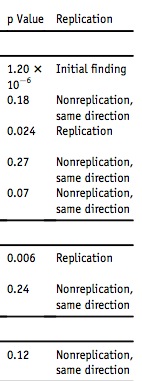
A fancy new category for a GWA result: same direction

screenshot7 Isn’t that a funny new category as reported in the last asthma genome scan – “same direction”? Should that provide evidence that isn’t there?
Of 10 samples only one replicates (FHS) and one shows borderline (COP) association to PDE4D / rs 1588265.

… in the absence of biological evidence we cannot exclude the possibility that the associations we measured were due to chance only

yea, yea.
BTW Also here – magically, previously associated genes disappear


CC-BY-NC Science Surf , accessed 29.08.2026

FGA

Frequently given answers – an article at Spiegel online has some of the answers you will need when being asked by research administratives or journalists for your work.

  • Everything is possible, we will make progress, future research will show, adds significantly to our understanding – blabla attack
  • Sorry, could you repeat your question (usually when asked to give short! summary) – the noway attack
  • Can I send you some more documents – the flooding attack
  • sorry for having to go now to the kindergarden – the privacy attack
  • no idea – the unpolite attack
  • silence – the ivory tower attack

Please, please, please don’t try on my phone.


CC-BY-NC Science Surf , accessed 29.08.2026