CC-BY-NC Science Surf , accessed 05.08.2026
Krautreporter hat ein interessantes Interview mit Bernhard Mittermaier der gerade für DEAL die deutschen Interessen am Verhandlungstisch vertritt. Und die rhethorische Frage stellt
Jede einzelne Uni könnte ohne Vertrag leben, aber das funktioniert nicht für das ganze System. Dann würden die Verlage gar kein Geld mehr verdienen, und von jetzt auf gleich wären die Zeitschriften tot. Es gibt genug Leute, die das gar nicht so schlimm fänden. Ich persönlich verfolge diesen revolutionären Ansatz nicht. Ich hätte zwar nichts dagegen, wenn diese Revolution geschehen würde. Mir wäre es nur lieber, wenn sie mit Ansage passiert. Wenn die Wissenschaft erklären würde, dass sie keine Zeitschriften mehr braucht. Das durch die Hintertür zu machen, fände ich schwierig.

from SCIENCE * VOL. 257 * 14 AUGUST 1992
As for scientists, they are not a breed apart. Compared to the scientists of only a few decades ago, they are more numerous, specialized, and costly. But as people, they are much the same, with individualities and frailties like those in other walks of life. Beyond the extreme of acceptable behavior, there may be laxity and negligence and rare instances of fraud, all of which now receive exaggerated media attention. It is common for science frauds to be attributed to ills in our society or to mismanagement of science, but I recall that 40 to 50 years ago, such psychopathic cases seemed as frequent as now on a per capita basis.
There is an interesting meta-analysis at JAMA Pediatrics about vitamin D supplementation during pregnancy and offspring growth, morbidity, and mortality. Nothing special, standardized methodology and even somewhat expected outcome.
In this systematic review and meta-analysis of 24 randomized clinical trials including 5405 individuals, vitamin D supplementation during pregnancy was associated with a lower risk of infants being small for gestational age and improved growth during infancy without an increased risk of fetal or neonatal mortality or congenital abnormality.
More interesting are the vitamin D lobbyists writing the accompanying editorial (Bo Chawes , Klaus Bønnelykke, Hans Bisgaard) . They try by nearly every sentence to devalue the findings of the meta-analysis. They are even getting to the point of
no adverse effects have been found
We don't see things as they are, we see them as we are.
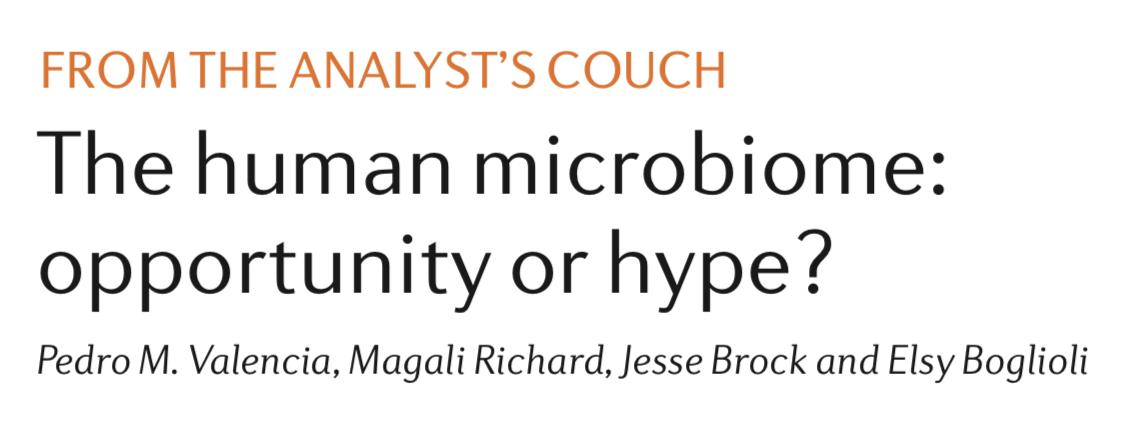
The recent encyclopedia article about the hygiene hypothesis seems to be well written. At least on the first instance … in reality it is more a novel than a scientific review.
For many years already, the hygiene hypothesis has been called an outdated concept; various times it was revised and transformed, and finally it gave birth to novel hypotheses.
In other words, the hypothesis has been rejected for being wrong . Even many revisions did not change that. There seem to be only one proven fact – the obsession of some authors with hygiene and nouvel Rousseauism.
Anyway, the hygiene hypothesis has promoted radical rethinking of infections, microbiota, and coevolution of mankind and microbes.
There is nothing radical in backward thinking. We still carry tons of microbes, freezer and antibiotics only did some qualitative but not so much quantitative changes,
With the advent of novel high-throughput sequencing technologies the human microbiome, which is sometimes called the 'forgotten organ,' has attracted much attention and is currently being implemented in a wider concept of self-foreign relationship, which may even include recognition of the nonmicrobial nonself as a vital stimulus to a well-developing immune system.
Given the many molecule classes regulating immune functions across individuals such as short RNAs, the hygiene hypothesis may eventually come back as a surprising explanation of the phenomena evoked by crowding, day care, sibship size, orofecally transmitted diseases, and respiratory infections.
Why that?
A comeback of the hygiene hypothesis by short RNA?
The listed phenomena are not intrinsically related, but are occuring only at the same time scale.
Even the old birth order effect might be rediscovered as epigenetic programming someday. Admittedly, these notions are entirely hypothetical, but without hypotheses, proven or not, science hardly advances.
So if David Strachan’s birth order effect would be really caused by epigenetic programming – why would that be related to hygiene at all?
Science is is not so much about proven or unproven but about reasonable and non reasonable hypotheses.
Cum assensione cogitare, Glauben heisst denkend zustimmen: René Buchholz bringt auf feinschwarz.net einige Gedanken zu Max Horkheimers Hypothese, der Glauben sei eine Erfindung des Protestantismus, um einerseits die Wissenschaft, andererseits den Aberglauben nicht als einzige Alternative zu haben.
Die Unterscheidung des Glaubens vom bloßen Meinen einerseits und Wissen andererseits kennzeichnet indessen nicht erst die Reformation, wie Horkheimer meint, sondern wird bereits in der Scholastik vertreten […]. Nach Augustinus und Thomas bedeutet Glauben "cum assensione cogitare" […] Der Glaube ist ein Akt des Intellekts […], verbunden mit dem Willen. Er bezieht sich auf eine Autorität, deren Glaubwürdigkeit durchaus geprüft werden darf, die vernünftigen Einsichten nicht widerspricht und Zustimmung verdient; eine Zustimmung, die getragen ist von göttlicher Gnade.
Unbedingt lesen!
A rather unimportant paper attracted my interest in this question. And there is quite some older literature out there, the two most prominent papers are by Elton 2002 and Geuna 2016 where I am trying to connect the dots. If we start with the second reference https://www.tandfonline.com/doi/abs/10.1080/00213624.2001.11506393?journalCode=mjei20 we immediately see the changes that occured.
After World War II, the higher education systems ofEU countries witnessed an impressive growth in the numbers of students and staff and in spending. For example, the number o f students in the EU countries increased from about one million in 1960 to approximately nine million in 1990. In the same period, the gross enrollment ratio-i.e., total enrollment, regardless of age, divided by the population of the age group 20-24-grew from less than 10 percent to around 30 percent, depending on the EU country. This rapid growth was also connected with a rise in society’s expectations ofeconomic returns. These two phenomena have led to conflicting pressures on the institutional orga- nization and role ofthe university. Examples of the tensions characterizing contemporary universities are (1) incompatibility between the demands o f elite and mass higher education; (2) friction between curiosity-driven research aimed at the researcher-directed advancement of the knowledge frontier and targeted research driven by the needs of society; and (3) the different impacts of private and public financing.
The “incompatibility between the demands of elite and mass higher education” seems to me the main issue as the masses of higher educated people are producing also masses of research papers. Now we may understand https://onlinelibrary.wiley.com/doi/abs/10.1111/1468-2273.00160
It is argued that many of the consequences that have followed successive Research Assessment Exercises (RAEs) have been unintended and a high proportion of these, particularly the longer term ones, are deleterious or potentially so. Of these, the most serious is almost certainly the competitive, adversarial and punitive spirit evoked by the RAE which is clearly inherent in it.
With the mass production of research papers, science goes on in “punitive spirit” leading to the most recent description of https://www.tandfonline.com/doi/abs/10.1080/00140139.2019.1664131?journalCode=terg20 (“Publish or Perish: Perceived Benefits versus Unintended Consequences” by Imad A. Moosa).
Even where bona-fide papers are published in reputable journals, the problem remains of deciding how important and relevant they are. Professor Moosa examines various measures (mainly counting the numbers of times a paper is cited), none of which appears satisfactory. …
Productivity is defined solely in terms of journal articles, so that books, blogs, software apps, awards, teaching and many other valuable activities count for nothing…
Professor Moosa rejects the current system, where academics are required to make an annual return of papers published, on which their continued employment depends. Equally, departments are required to make a return of the numbers of staff reaching annual publication levels, and much effort goes into 'gaming the system'. Staff with less than optimal publication records do not appear in the return. Other staff with exemplary records are hired for the week the evaluation takes place. In fact he suggests that so much effort is diverted from research into grant seeking that there are more 'managers' – always 'senior'- than lecturers in academic departments. Vice Chancellors become CEOs with inflated salaries and legions of Pro-Vice chancellors. The cost of 'administration' is such that only a small fraction of 'research' funding reaches the actual researchers.
So going back to the intitial point – what are unintended research consequence? It looks like that science is dying slowly of self-extinction by evolutionary suicide.
Evolutionary suicide is a process in which selection drives a viable population to extinction. So far, such selection-driven self-extinction has been demonstrated in models with frequency-dependent selection. This is not surprising, since frequency-dependent selection can disconnect individual-level and population-level interests through environmental feedback. Hence it can lead to situations akin to the tragedy of the commons, with adaptations that serve the selfish interests of individuals ultimately ruining a population.
ArXiv is operational since 1991, bioRxiv since 2013 and since 2019 there is now also medrxiv. More details at https://www.bmj.com/content/365/bmj.l2301
The main arguments in favour of sharing work in its preliminary form are, firstly, that science works faster if work is made available sooner after it is completed and, secondly, that articles are improved by feedback from a wider group of readers, alongside formal peer review by a few experts. Simple estimates suggest that halving the delay to sharing a research result can double the speed at which research progresses. Ambitious research funders are now embracing preprints and other measures that aim to accelerate the pace of research.
Although there was a mixed reception in the beginning, see Science back in 2017
MedArXiv will have a hard time attracting preprints if mainstream medical journal editors decide they won't publish final versions of the papers. Currently, The BMJ and The Lancet are among the few medical journals that have explicitly said that posting a preprint doesn't preclude publication; Nature and Science, which both occasionally publish medical studies, have the same policy. But at the JAMA Network, which publishes a dozen journals, the issue is hotly debated.
@medRxiv opened on June 6. So far they have only 304 followers on Twitter (and no allergy paper in the archive).
As the current “Allergy” editor and the publisher (John Wiley and Sons A/S) agreed to preprints last week, I have submited now my first preprint paper. Therefore, there are now 305 followers and 1 allergy paper :-)
We usually assume – even in science – that many if not all have high computer level skills. But that may not be true according to the Nielsen Norman Group. They summarize the results of any OECD survery where 215,942 people were tested, with at least 5,000 participants in most countries.
26% of adult population
can't switch on Computers
14% – Below Level 1
Being too polite to use a term like "level zero," the OECD researchers refer to the lowest skill level as "below level 1."
This is what people below level 1 can do: "Tasks are based on well-defined problems involving the use of only one function within a generic interface". An example of task at this level is "delete this email message" in an email app.
29% – Level 1
This is what level-1 people can do: "Tasks typically require the use of widely available and familiar technology applications, such as email software or a web browser. ” An example of level-1 task is "Find all emails from John Smith."
26% – Level 2
This is what level-2 people can do: "At this level, tasks typically require the use of both generic and more specific technology applications.” An example of level-2 task is "You want to find a specific document that was sent to you by John Smith in October last year."
5% – Level 3
This is what this most-skilled group of people can do: "At this level, tasks typically require the use of both generic and more specific technology applications." An example of level-3 task is "You want to know what percentage of the emails sent by John Smith last month were about a specific topic."
Es gibt keine Menschenrassen, von Rassen spricht man nur noch im Zusammenhang mit der Tierzucht, wo bestimmte Gruppeneigenschaften gezüchtet werden.
Trotzdem habe ich Probleme mit der Jenaer Erklärung (zitiert nach hpd.de) von Johannes Krause
Aus genetischer Sicht gebe es im Genom des Menschen “keinen einzigen fixierten Unterschied, der zum Beispiel Afrikaner von Nicht-Afrikanern trennt. Es gibt - um es explizit zu sagen - somit nicht nur kein einziges Gen, welches ‘rassische’ Unterschiede begründet, sondern noch nicht mal ein einziges Basenpaar”. Äußere Merkmale, an denen Rassisten ihre Abwertung von bestimmten Menschengruppen festmachen, seien oberflächliche und biologisch leicht wandelbare Anpassungen an geographische Gegebenheiten. Bis vor 8000 Jahren seien die Menschen in Europa noch “stark pigmentiert” gewesen. Erst durch die Einwanderung von Menschen mit hellerer Hautfarbe aus Anatolien und dem damit einsetzenden Beginn der Landwirtschaft habe sich dies geändert, da es sich bei einer stark pflanzenbasierten Kost im dunklen Winter Europas als evolutionärer Vorteil erwies, hellere Haut zu haben und damit genügend Vitamin D produzieren zu können.
“Die helle Hautfarbe der Menschen im nördlichen Europa ist jünger als 5000 Jahre”, hält die Jenaer Erklärung fest. “Die Verknüpfung von Merkmalen wie der Hautfarbe mit Eigenschaften oder gar angeblich genetisch fixierten Persönlichkeitsmerkmalen und Verhaltensweisen, wie sie in der Blütezeit des anthropologischen Rassismus verwendet wurden, ist inzwischen eindeutig widerlegt. Diese Argumentation heute noch als angeblich wissenschaftlich zu verwenden, ist falsch und niederträchtig. Es gibt auch keinen wissenschaftlich nachgewiesenen Zusammenhang zwischen Intelligenz und geographischer Herkunft, aber einen deutlichen mit sozialer Herkunft.”
Die Erklärung hat recht, insofern der Rassebegriff nur noch von Rassisten verwendet wird.
Sie hat auch recht daß es kein einziges Gen gibt, welches ethnische Unterschiede begründet – allerdings hat das auch niemand behauptet. Dagegen gibt es aber durchaus fixierte phänotypische und genetische Unterschiede in geographischen Regionen – einzelnen Volksgruppen, Populationen oder auch Ethnien.
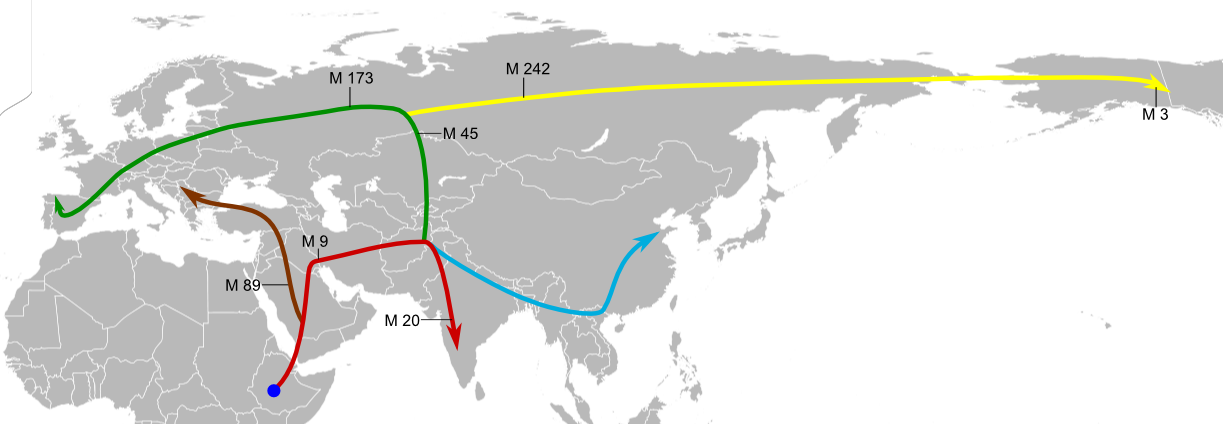
Die Erklärung sagt schliesslich auch, dass Europäer näher verwandt sind mit Ostafrikanern, als Ostafrikaner mit Südafrikanern. Wie ist aber eine solche Aussage möglich sein, wenn man keine populationsspezifische Marker dafür hätte?
Für Abstammungstheorien wird oft die Kombination von SNP (Single Point) Marker verwandt. Mit Hilfe etwa der Hauptkomponentenanalyse (PCA) wurde zum Beispiel der ursprüngliche afrikanische Stammbaum im letzten Jahr revidiert.
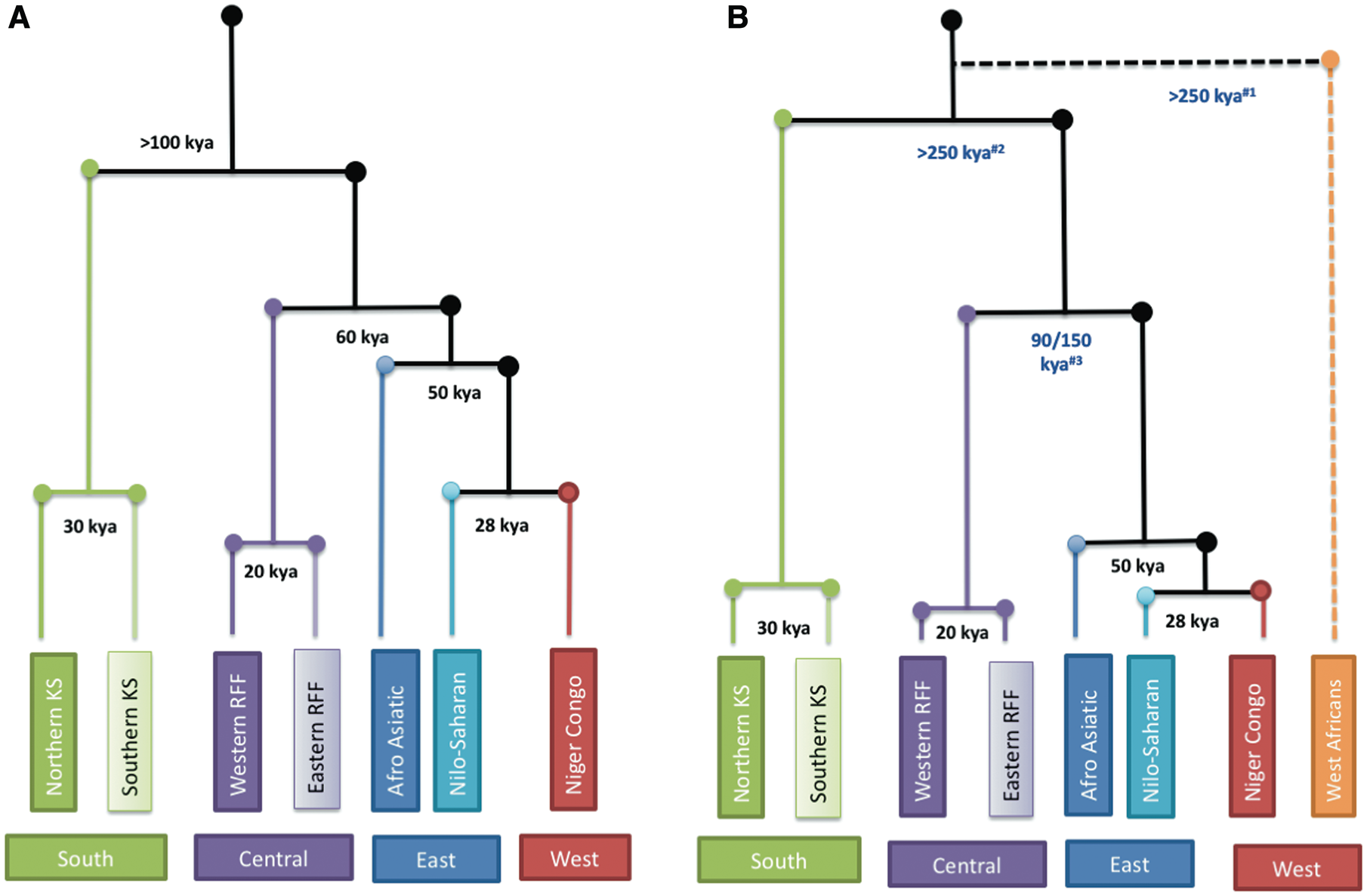
Was also die ethnischen Unterschiede ausmacht? Es sind arbiträre biologische und statistische Kennziffern, die oft in unterschiedlichen Ausmass mit soziologischen Kennzeichen korrelieren.
Arbiträr deshalb weil genetische Abstandmasse wie FST auch mathematisch kein echtes Distanzmasse sind und von einer Vielzahl von Parametern abhängen (mehr zu FST). Die Aussage, es gäbe keine fixierten genetische Unterschiede zwischen Europäern und Afrikaner ist damit auch schlicht falsch.
Extensive set of African ancestry-informative markers (AIMs) to study ancestry and population health. .. we generated a final set of 46,737 African ancestry-informative markers (AIMs).
AIMs sind nicht zuletzt wichtig, da die Unterschiede auch zu unterschiedlichen Krankheiten führen, Stichwort "precision medicine".
Und das ominöse Vitamin D? Helle Hautfarbe = bessere Vitamin D Konversion bei Niedrigversorgung im Norden, bekannt auch als Loomis Hypothese, ist als evolutionärer Faktor zwar naheliegend, aber reine Spekulation. Ohne die Literatur zur Pigmentierung der Haut zu rekapitulieren – der Zweck der Pigmentierung ist Schutz der Basalzellschicht vor UV Strahlung und nicht die Limitierung der Vitamin D Produktion.
By contrast, deeper skin tones with more melanin filters at least twice as muchTrusted Source UV light. Researchers believe this is why skin cancer rates are lower in People of Color. However, a 2020 articleTrusted Source also highlights that a lack of diversity in trials and studies, and a shortage of people of color in the field of dermatology, means that scientists may not accurately understand how common skin cancer is in skin of color.
Die Vitamin D Konversion ist auch ohne starke Hautpigmentierung selbst limitierend. Sie setzt allenfalls früher ein, nämlich bei heller Haut ca 20 Minuten nach Bestrahlung anstatt nach 40 Minuten bei dunkler Haut. Das ist Lehrbuchwissen aus Feldman und Pike. Nach aktuellem Kenntnisstand stimmt es wohl auch nicht, dass dunkle Hautfarbe die ursprüngliche Hautfarbe von H. sapiens in Afrika ist und Europäer mit heller Hautfarbe Mutanten sind. Ich vermute eher, daß helle und dunkle Hautfarbe die Extreme einer ansonsten mittleren Helligkeit sind (zur Diskussion dieser Hypothese siehe Scholar).
Der letzte Stand nach meiner Kenntnis steht in dem Science 2017 Paper von Sarah Tishkoff
Examining ethnically diverse African genomes, we identify variants in or near SLC24A5, MFSD12, DDB1, TMEM138, OCA2, and HERC2 that are significantly associated with skin pigmentation. … Functional analyses indicate that MFSD12 encodes a lysosomal protein that affects melanogenesis in zebrafish and mice, and that mutations in melanocyte-specific regulatory regions near DDB1/TMEM138 correlate with expression of ultraviolet response genes under selection in Eurasians.
In dieser Liste steht jedenfalls kein einziges Vitamin D Gen, so dass die Jenaer Erklärung auch hier nicht dem Wissenstand entspricht auch wenn sie gut gemeint ist.
20.9.2024
Journalisten werden allerdings auch weiterhin nicht müde, zu dem Thema zu fabulieren, leider auch wieder in einem neuen Video.
Die Gleichsetzung Hirn gleich Hardware oder Geist gleich Software habe ich bewusst in dem letzten Beitrag vermieden. Interessanterweise geht Dirnagl gerade im LJ darauf ein. Er schreibt über das Nonsense Papier “Brain Machine Interface” im LJ
… Zumal das Gehirn Programmierung und Codes auch gar nicht nötig hat. Gefühle, Gedanken, Absichten und so weiter sind die koordinierte Aktivität von Milliarden von Nervenzellen und Fantastillionen von Verbindungen zwischen ihnen - man kann auch sagen, Kognition ist "verkörpert" (embodied). Der Gedanke an einen Baum ist die elektrische Aktivität und neuronale Konnektivität wie sie beim Betrachten dieses Baumes auftritt. Und die Erinnerung an diesen Baum ist die Wiederherstellung dieses elektrochemischen Zustandes.
Dabei kann das Gehirn durchaus mit Codes umgehen. Nicht nur extern beim Programmieren, auch intern beim Sprechen und Schreiben. Sprache ist nämlich ein Code, also symbolische Repräsentation. Aber Sprache braucht man nicht für Fühlen, Denken, Handeln - sie ist nur ein Mittel dazu. Da Kognition sich folglich keines Codes oder Programms bedient, gibt es auch nichts auszulesen oder einzuspielen ins Gehirn.
Man könnte zwar versuchen, etwa beim Blick auf einen Baum, die Aktivität jeder einzelnen der 80 Milliarden Nervenzellen gleichzeitig zu messen - und dazu den Zustand der Hunderte von Trillionen Verbindungen zwischen ihnen. Aber dann wäre man immer noch nicht weiter. Denn dann hätte man zwar ein Abbild des elektrischen Gewitters dieses Gehirns beim Blick auf den Baum. Aber die Nervenzellen eines anderen Menschen erzeugen andere Verbindungen und andere Aktivitäten beim Blick auf denselben Baum. Auch weil verschiedene Gehirne eine über viele Jahre zurückreichende unterschiedliche Geschichte haben, die jeweils wiederum zu dieser spezifischen Konnektivität und Aktivität beim Blick auf den Baum beigetragen hat. Diese Geschichte müsste man kennen, um aus dem Gewitter Sinn zu machen, also den Inhalt "Baum" dekodieren zu können.
Das kann man nach aktuellem Wissensstand nicht besser sagen.
In Abwandlung von Descartes “sum quod cogito” ist Denken ein Zustand und zwar der parallelen Aktivität von Milliarden von Nervenzellen, die auch dann aktiv sind, wenn die Verbindung zur Aussenwelt (Thalamus etc) gestört ist.
Two major checkpoints of development in cerebral cortex are the acquisition of continuous spontaneous activity and the modulation of this activity by behavioral state. Despite the critical importance of these functions, the circuit mechanisms of their development remain unknown. Here we use the rodent visual system as a model to test the hypothesis that the locus of circuit change responsible for the developmental acquisition of continuity and state dependence measured in sensory cortex is relay thalamus, rather than the local cortical circuitry or the interconnectivity of the two structures. … Together our results indicate that cellular or circuit changes in relay thalamus are critical drivers for the maturation of background activity, which occurs around term in humans.
Wie aber passt nun das Konzept einer “Beseelung” des Menschen zu Beginn seiner Existenz? Einer bei Null startenden neuronalen Aktivität?
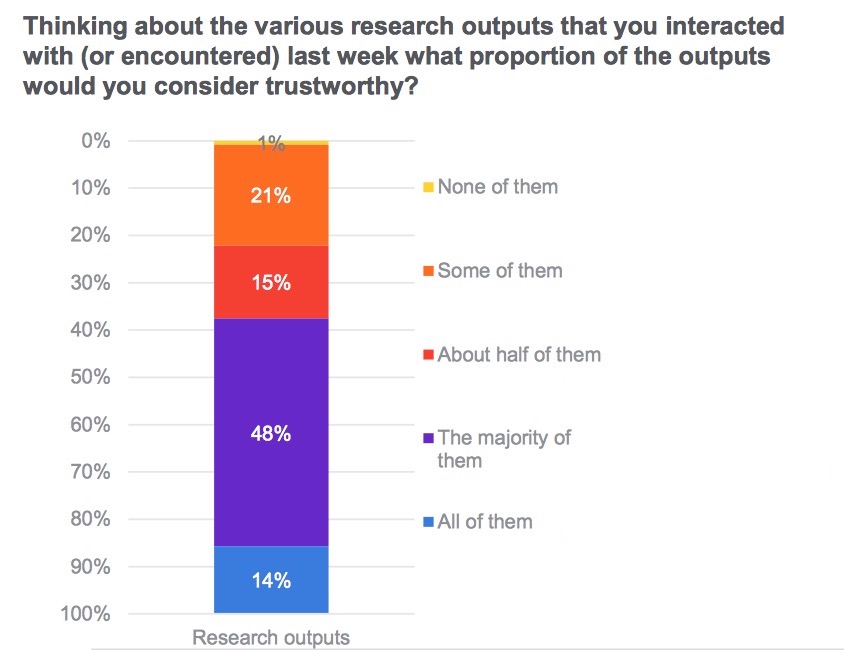
Method: Co-branded (Elsevier and Sense About Science) online survey in English, 15 minutes to complete. Fieldwork took place in May 2019 while the results are now at the Elsevier site.
Result: 3,133 researchers responded to a survey of 98,160 individuals selected from database of 3.6 million researchers (3.2 % response rate).
aus Cafe Del Mar Vol. 14 (2010) – mehr zu Michael Hornstein