A small luxurious law here in Germany – we may further offer limited documents to limited participants according to Heise news Continue reading Intranet exception
After a long time (to be exact: 27 years of Microsoft and 12 years of Linux use) I decided to switch to a Macbook Air. That may be an aesthetic decision (as buying an A4, a Nomos, a Bose or whatelse) :-) but may be heavily influenced of my obsession for lightweight and durable equipment. Continue reading Alt – Command – Escape
It seems that there are two numbering systems in humans – a general sense of numbers for some quick and dirty estimates and some more genuine computation skills of showing the result of (2327)^2. At least the first capacity seems to be inborn (and an important survival skill). According a recent SZ article (29th Sept 2008) a host of new studies now show that
the two number systems, the bestial and celestial, may be profoundly related, an insight with potentially broad implications for math education
and as I believe – for science in general as most science fields are being dominated by the Fermi problem. Continue reading Basic instinct for math?
For the first time, I found some data about “bench to bedside” transit times. Of 101 promising claims between 1979 and 1983, there have been only 5 clinical interventions in 2003 and only 1 had extensive clinical used; mean lag time 24 years, yea, yea.
Genowatch (paper|website) is doing pretty well by annotating large SNP sets that would require otherwise numerous hours to map their position on genes, biological function and pathways. Continue reading SNP batch annotation of GWAs
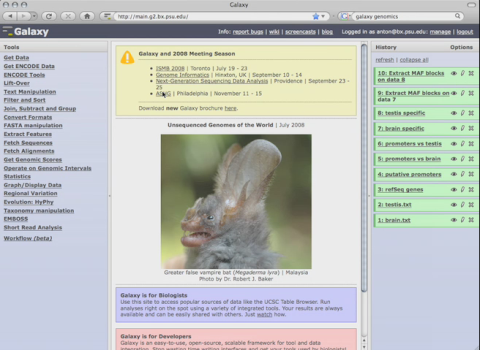
Galaxy, one of my favorite bioinformatics websites now offers the conversion of existing history into a work flow. Obviously source data (by UCSC or Ensembl) may be produced in the same format but everything else can then be delegated to a workflow – just a set of instructions how to modify your data.
As somebody who is dealing most time with large datasets I always arrive at genes and proteins that I do not know. Using Biocarta, Keggs and other services in the past, I find the new WikiPathways exciting and hope that it will grow over the years. A companion paper in PLoS biology describes its roots in GenMAPP and the current work of the authors on bots that identifiy inconsistencies but also pick up loose ends. Hopefully I will find some time to work a bit on nuclear receptors, yea, yea.
Having been asked now by several people, I am compiling here a list of programs can be used for CNV calling. Continue reading CNV (not London) calling
If you do have the same problem like me – operating a computer, pointing towards a wall and looking at the same time at an audience is somewhat odd – here may be a solution for you.
Initially found this at a blog with some java source code.
Another video example is
with abandonded C# code that compiled nicely on my mac (laserinteraction). Experiments are ongoing…
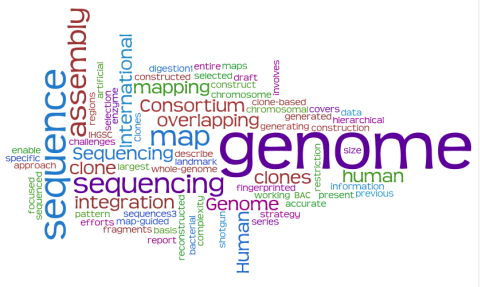
Feed this paper at this site to get the following result

As announced earlier this week, here is a first version of the PDF Pubmed Finder.The Finder helps to identify an unknown paper within seconds and rename it within milliseconds. Although the Finder consists of a single page only it uses several areas to update the data. I have written the code for my local installation but you may try it also online with your own PDFs either by uploading them with the available form or by appending the PDF URL to the Finder address http://wjst.de/pubmed/finder.php?http://medicine.plosjournals.org/test.pdf
The last method is certainly better as it can be used within a scripting environment; note that my domain may not retrieve a PDFs that you can see at your local computer. PDFs also need to have some inline text (run an OCR on scans before submitting them).

Here are some usage instructions: After selecting any article on the left (1.), clicking on relevant keywords (2., 3.) will lead to an immediate Pubmed search (4). Finish by clicking on “rename” or “Pubmed/Zotero” import of the correct reference. If your search doesn’t retrieve any useful hits, keywords will be automatically reset.
What I would like to know all from the AJAX experts who can inspect the sourcecode: I ran into deep problems described earlier with the prototype oncomplete function used in the links of the div2 container. They are checking how the div4 container was being updated. As you see it works, but I failed to clean up the code by having only one Javascript function in the beginning of the page with the div2 links calling this function. Your help would be greatly appreciated.
Just reveived an email from the creators of the Genetic Association Database (GAD)
… Your published genetic association study has been included in the recent update of the NIH based, Genetic Association Database (GAD), the database of human genetic association studies. Continue reading Genome Browser now with GADview track
… permanently leading to errors – the plus / minus strand orientation and the consecutive sequence / allele designation of SNPs. Only recently I came across a fancy way how to define strand direction – from a tech note Continue reading Orientation of genomic sequence and SNP allele designation
c’t 10.2008:82-89 has a nice article about open peer review “Die Weisheit der Massen” summarizing the current peer review process – the top line of the cartoon below. Following submission of a paper, it is initially screened for some formal requirements before being submitted to anonymous peer review and finally being published. Anonymous peer review lasts between 2 months and 2 years (!) and is abbreviated so far only by one biomedical journal Continue reading Open peer review – publish first, review later