Category Archives: Vitamins

Turning pale

Humans have always been attracted by white animals, tigers, elephants and crocodiles (BTW great melanosome pictures can be found at PLOS.
There seem to be also some evidence that light skin developed only recently as reported in a meeting report in Science by April, 20 based on sweeps around SLC24A5. This is somewhat in contrast to findings published more or less at the same time by the same group (but not mentioned in the meetings report) that a highly complex network is influencing skin color. Continue reading Turning pale


CC-BY-NC Science Surf accessed 10.01.2026

Osteopontin bridging air pollution and immunology of allergic inflammation

Ostepopontin (OPN) is a remarkable substance. The many aliases already point towards a multitude of biological functions: SPP1=secreted phosphoprotein 1, BSPI 1=bone sialoprotein-1, CIT, ETA-1, GC110940, nephropontin, osteoprotegerin, uropontin, bone sialoprotein I, early T-lymphocyte activation among others. Continue reading Osteopontin bridging air pollution and immunology of allergic inflammation


CC-BY-NC Science Surf accessed 10.01.2026

Vitamin D as a treatment of tuberculosis

There is now a lot of hype around the usefulness of vitamin D in the treatment of tuberculosis (scienceblog:doi:10.1164/rccm.200701-007OC ). The authors mention even their previous review (scienceblog:doi:10.1016/j.jsbmb.2006.12.052:) summarizing 13 studies between 1947 and 1998. Continue reading Vitamin D as a treatment of tuberculosis


CC-BY-NC Science Surf accessed 10.01.2026

Dont look at serum values alone

There is an ongoing discussion if 25-OH-D3 serum values can be used to diagnose vitamin D insufficiency. At least for rickets outcome there are now quantitatitive data that allow a comparison of clinical symptoms, radiological findings, cholecalciferol and alkaline phosphatase levels. I have rearranged the values of a new paper into the following figure Continue reading Dont look at serum values alone


CC-BY-NC Science Surf accessed 10.01.2026

The sunshine cure

Nature medicine news has a short text about the sunshine cure.

The strongest evidence available is perhaps for the vitamin’s protective role in MS. Several studies have documented a dramatic ‘sunshine belt’ […] Latitude also seems to play a role in the incidence of hormone-dependent cancers. […] The effect is almost certainly because of vitamin D, Feldman says. “People tend to think it can’t do all these things when it’s a vitamin,” notes Feldman. “It’s not a vitamin, it’s a hormone.”

As always there seems no fun without risk. We could add links to arteriosclerosis and allergy.


CC-BY-NC Science Surf accessed 10.01.2026

Another path from vitamin D to allergy

As far as I know vitamin D3 influences only RUNX2 expression (RUNX2 has a VDRE, possibly also RUNX3 but not RUNX1?). The RUNX factors

colocalized in common subnuclear foci. Furthermore, RUNX subnuclear foci contain the co-regulatory protein CBFβ, which heterodimerizes with RUNX factors, and nascent transcripts as shown by BrUTP incorporation. These results suggest that RUNX subnuclear foci may represent sites of transcription containing multi-subunit transcription factor complexes.

Variants in RUNX1 have already been reported earlier to be weakly associated with IgE serum levels in Korea.

A Nature paper todays reports that Foxp3 controls Treg function by interacting with AML1/RUNX1 – is there any connecting path?


CC-BY-NC Science Surf accessed 10.01.2026

Higher metabolic rate or better signalling

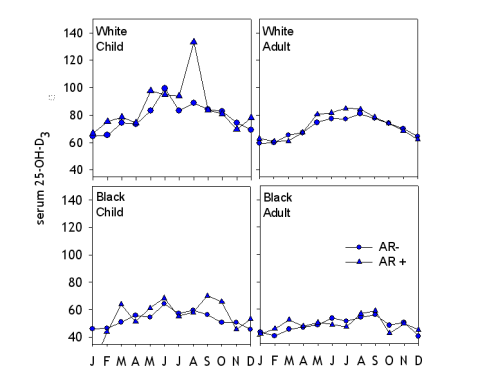
In a forthcoming paper in Allergy (scienceblog:doi:10.1111/j.1398-9995.2007.01437.x:) we will show an association of vitamin D (25-OH-D3) serum levels and allergic rhinitis (AR) mainly in white Caucasians. Here is a supplemental figure that shows the seasonal variation in AR+ and AR- individuals.

Except of the singular peak in white children, I can´t see so much difference – so probably the vitamin D signalling pathway is different in AR.

Figure: Month of examination in allergic rhinitis patients of NHANES III by age age and ethnic background – no clear effects by higher metabolism.

metaborsignal.png


CC-BY-NC Science Surf accessed 10.01.2026

Lymphopoetin and allergy

This is to convince me that the thymic stromal lymphopoietin (TSLP) is a master switch in allergy

15 Aug 2004

Skin-specific overexpression of TSLP resulted in an AD-like phenotype, with the development of eczematous lesions containing inflammatory dermal cellular infiltrates, a dramatic increase in Th2 CD4+ T cells expressing cutaneous homing receptors, and elevated serum levels of IgE.

5 Jun 2006

Topical application of the physiologically active ligand [1{alpha},25-(OH)2D3; calcitriol] of the vitamin D receptor, or of its low-calcemic analog MC903 (calcipotriol; Dovonex), induces TSLP expression in epidermal keratinocytes, which results in an atopic dermatitis-like syndrome.

22 Jan 2007

TSLP, synergistically with interleukin 1 and tumor necrosis factor, stimulates the production of high levels of Th2 cytokines by human mast cells (MCs) … TSLP is released by primary epithelial cells in response to certain microbial products, physical injury, or inflammatory cytokines.

23 Jan 2007

Proinflammatory TNFalpha or IL-1alpha and Th2 (IL-4 or IL-13) cytokines synergized to induce the production of TSLP in human skin explants … Our data provide the first evidence of TSLP induction and subsequent DC activation in human skin.

25 Feb 2007

Mice with an IEC[intestinal epithelial cell]-specific deletion of IKKbeta show a reduced expression of the epithelial-cell-restricted cytokine thymic stromal lymphopoietin in the intestine and, after infection with the gut-dwelling parasite Trichuris, fail to develop a pathogen-specific CD4+ T helper type 2 (TH2) response and are unable to eradicate infection. Further, these animals show exacerbated production of dendritic-cell-derived interleukin-12/23p40.

June 2007

… (TSLP) and interleukin-7 share a common receptor chain, IL-7Rα … The gene encoding the IL-7Rα chain is polymorphic, and investigation of inhalation allergic patients compared with controls showed significant association with two alleles at position +1237 and +2087.

Aug 2007

… TSLP represents a master switch of allergic inflammation at the epithelial cell and dendritic cell interface.


CC-BY-NC Science Surf accessed 10.01.2026

An update of the Barker hypothesis

Do you know the Barker hypothesis? It says that early life events may induce later disease. A new study in the Eur J Clin Nutr now reports

Children whose mothers had a 25(OH)-vitamin D concentration in pregnancy >75 nmol/l had an increased risk of eczema on examination at 9 months (OR 3.26, 95% CI 1.15–9.29, P=0.025) and asthma at age 9 years (OR 5.40, 95% CI, 1.09–26.65, P=0.038) compared to children whose mothers had a concentration of <30 nmol/l.

These are quite remarkable results. I wonder only why two forthcoming studies click + click using food frequency questionnaires will describe only a reduction of respiratory infection rates (which is not too bad in the context of the hygiene hypothesis) with no effects on allergy.

Food intake measures are probably not good enough for internal dose estimates as main source of vitamin D production is sunlight, isn´t it?

Addendum

12 March 2007 – the long awaited AJCN paper is now out. I have already feared that stratification by FFQ is only partially relevant. Indeed, the authors could have used also college graduate level which increased with intake catgeories 1-2-3-4 from 53-74-80-82% with all the problems by SES dependency (and not corrected for in model 2+3 in table 2 or model A…D in table 3). The discussion seems to be also far away from being an objective report on the immunology of vitamin D actions…


CC-BY-NC Science Surf accessed 10.01.2026

Dual vitamin D effects on type 1 diabetes and allergy

Early vitamin D supplementation may have dual effects, protecting against type 1 diabetes and inducing allergy. Is that possible? Yes, individual genes variants may determine the outcome.

In addition to HLA the most prominent type 1 diabetes genes are INS – CTLA4 – PTPN22 – CD25 – IF1H1, the most prominent asthma/allergy genes ADAM33 – DPP10 – IL12 – IL4 – GPR154 – FLG. I can´t see any joint master regulator, however, we know that

Could that be a model to explain the dual involvement of vitamin D in both diseases?


CC-BY-NC Science Surf accessed 10.01.2026

Asthma – a disease of the gut

When starting in the asthma field in 1989, the textbooks told me that asthma is a disease of the lung. Some years later, asthma turned out to be a disease of the bone marrow cells. More recently, I raised the question if asthma could be even a disease of the gut – our largest immunological organ being frequently exposed to allergen & plenty of immunological active substances. Although on the different track (vitamin A) also other authors now think of an early impaired immune gut response.
Rather unexpected for me was a study in J Steroid Biochem Mol Biol that 1,25(OH)2D3 inhibits in vitro and in vivo intracellular growth of the parasite Toxoplasma gondii. yea, yea.


CC-BY-NC Science Surf accessed 10.01.2026

Genes wanted

The NIH and Jackson ask for nominations of their gene targeting approach (see also A mouse for All Reasons and my previous comment on the 3 R)

KOMP is a trans-NIH initiative to generate a public resource of mouse embryonic stem (ES) cells containing a null mutation in every gene in the mouse genome. Both conditional and null knockouts are being generated. The purpose of this form is to gather input from the scientific community on which genes should have the highest priority for being knocked out.

The Cell paper also explains the hard to understand differences in knockouts

  1. targeted deletion
  2. targeted conditional
  3. trapped conditional

although I still have semantic problems to understand the nomenclature. Anyway my whishlist – you can do me a favor by voting for CYP27B1, VDR, CYP24A1, OPN, IL4, IL5, IL10, IL12, IL13, FLG, CCR5 and CCR9.

Addendum

You can also leave some input at the Environmental Genome Project.


CC-BY-NC Science Surf accessed 10.01.2026

Let vitamin D shine in

said the Denver Post giving a nice overview of vitamin D research. This was just 1 day too early for a fascinating nature immunology paper (scienceblog:doi:10.1038/ni1433:) that links for the first time natural sunlight induced vitamin D action on dendritic cells. Seems that D3 will influence homing of T cells – we are again at “Licht und Leben“, yea, yea.

Addendum


CC-BY-NC Science Surf accessed 10.01.2026

Vitamin D and asthma

My previous work on vitamin D focused mainly on allergy but according to new research of Bosse et al vitamin D also stimulates bronchial smooth muscle and airway remodeling

Genetic variants in the vitamin D receptor (VDR) gene were recently associated with asthma. The biological mechanisms explaining this association is unknown, but are likely to involve many cell types given the pleiotropic effect of its ligand … The most significant network of up-regulated genes included genes involved in morphogenesis, cell growth and survival as well as genes encoding structural proteins, which are potentially involved in airway remodelling.

Another study published more or less at the same time by Wittke shows

Conversely, WT splenocytes, Th2 cells and hematopoetic cells induced some symptoms of experimental asthma when transferred to VDR KO mice, but the severity was less than that seen in the WT controls … Lipopolysaccharide (LPS) induced inflammation in the lungs of VDR KO mice was also less than in WT mice. Together the data suggest that vitamin D and the VDR are important regulators of inflammation in the lung…


CC-BY-NC Science Surf accessed 10.01.2026