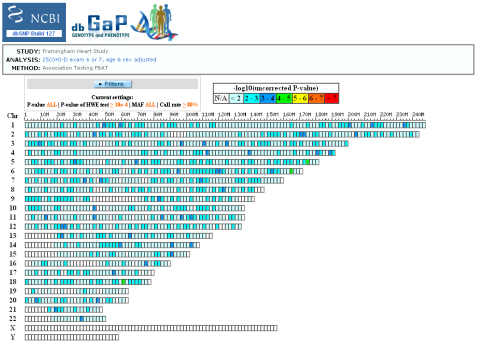
A new paper in the EJCN examines genetic and non-genetic factors influencing vitamin D serum levels. The authors find 24% of the variability explained by season & intake Continue reading Genetics of 25-hydroxy D3
The first genomewide association for vitamin D serum levels is already online as the Framingham people told me earlier this day, many thanks!
There are 3 important regions on the above figure figure: around rs1394615, rs1877165 and rs2160595, see also the attached excel sheet fram25ohdexam6or7agesexadj.xls.
What are the reasons that my linkage study arrived at completely different regions? The accompanying BMC Genetics paper even highlights 2 different SNPs: rs1048516 + rs10507577). Anyway, the best region in my opinion is on chromosome 6. Here are the significant SNPs in relation to their neighboring genes: Continue reading First 25OH-D3 GWA online
Nature news reports an unpublished meta analysis of Cesarean section and asthma risk. The authors interpret the outcome in the light of the hygiene hypothesis: unhygienic siblings, risky! Normal delivery, risky!! No early bullshit, risky!!!
Again, delivery mode may be a proxy for physician contact and iatrogenic causes. Having heard today also lectures that take the hygiene hypothesis for granted, the old adage comes to my mind:
You may fool all the people some of the time. You can even fool some of the people all of the time. But you cannot fool all of the people all the time.
Diogenes, “the Cynic,” Greek philosopher, was born at Sinope about 412 BC, and died in 323 at Corinth, according to Diogenes.
Do not stand between me and the sun – the vitamin/allergy story is getting confusing with the new JACI review. Continue reading Do not stand between me and the sun

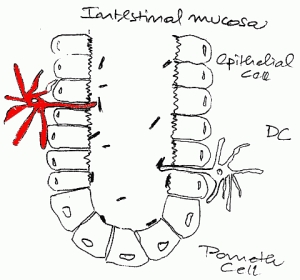
… reaching into the intestinal lumen? They belong to dendritic cells and are depicted also in a nice review about immune responses to commensal and environmental microbes Continue reading Can you see these neat little fingers
I did not expect what a new Cochrane writes on the prevention of nutritional rickets in term born children — Cochrane Database Syst Rev. 2007 concludes
There a only few studies on the prevention of nutritional rickets in term born children. Until new data become available, it appears sound to offer preventive measures (vitamin D or calcium) to groups of high risk, like infants and toddlers; children living in Africa, Asia or the Middle East or migrated children from these regions into areas where rickets is not frequent. Due to a marked clinical heterogeneity and the scarcity of data, the main and adverse effects of preventive measures against nutritional rickets should be investigated in different countries, different age groups and in children of different ethnic origin.
May I summarize: 1. only a few studies; 2. vitamin D OR calcium and 3. to high risk kids only. This looks different to what Nestlé manufactures at the moment.
A forthcoming “Perspectives in asthma” paper in “JACI” by Litonjua and Weiss will be about the vitamin D hypothesis. Although the authors find that
Evidence exists that vitamin D induces a shift in the balance between TH1 and TH2-rype cytokines toward TH2 dominance
they make a largely unexpected turn by saying that vitamin DEFICIENCY may be to blame for the asthma epidemic. The basic argumentation is
We hypothesize that as populations grow more prosperous and more Westernized, more time is spent indoors and there is less exposure to sunlight leading to vitamin D deficiency…
Given the immediate and effective vitamin D production in skin and its longterm availability by fat stores I cannot follow their last conclusion. Continue reading Contrary or Contradictory
There is a new German dissertation about Vigantol (R) excellently written by Jochen Haas and just published at Wissenschaftliche Verlagsgesellschaft “Vigantol, Adolf Windaus und die Geschichte des Vitamin D”. Altogether 425 pages, it contains a biographical sketch of Windaus (p 32-83), a detailed summary of the juristical questions about irradiating ergosterin (p 96-154), a detailed history of the pharmaceutical production (p 155-238) and finally a chapter about marketing of different brands by Merck (p 238-281). Continue reading The history of vitamin D discovery, industrial production and marketing
moblog – I have now spent another day at the Berlin Document Center browsing through hundreds of RKI pages – manuscripts, correspondence, bills and personal files. My goal was to find out why the allergy epidemic did not already start off 1935 in Germany when vitamin D synthesis was already possible on a large scale.
Indeed, I found evidence that at least 3 companies radiated at that time yeast derived ergosterin by UV quartz lamps – I.G. Farben, Nordmark-Werke and Deutsche Vitamin Gesellschaft. The number of companies in this field Continue reading Why the allergy epidemic did not already start 1935 in Germany
Slowly but surely, the hygiene hypothesis is going to be more and more perforated. A new NEJM paper finds Continue reading One small step for man
No, I am not confusing here vitamin A and vitamin D as done in the early days of vitamin research. This post is really about vitamin A (but with similar nomenclature problem as with vitamin D). Retinol is ingested in a precursor form; animal sources like liver (–>cod liver oil) contain retinyl esters, whereas plants like carrots contain carotenoids. Continue reading Vitamin A and allergy
First use of liver cod oil probably originates with the fishing communities of Norway, Greenland and Iceland several centuries ago – an excellent reference is at “Cod liver oil and chemistry” 1895 by Peckel Möller. This book has a nice account on fishing at the Lofotes around the turn of the last century with many details about the cod fish migration.
The first medical use is being dated to 1789 Continue reading A short history of steamed cod liver oil
When discussing the problem of inducing allergy by rickets prophylaxis I have argumented earlier that there are many alternatives:
There is even another option that I missed so far – the parental application. Supplementation of the mother might work if given ~6000 IU/die to the mother as been nicely shown in a new study.
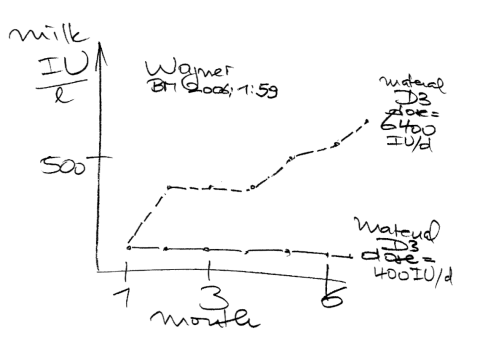
The principle is not very new – probably known since 1927. RCTs are urgently needed comparing all these treatment options while a direct oral exposure of the gut mucosa by allergen and vitamin D should be avoided.
BTW “The road not taken” is a by Robert Frost
Two roads diverged in a yellow wood,
And sorry I could not travel both
And be one traveler, long I stood
And looked down one as far as I could
To where it bent in the undergrowth.
3/9/2007
Rolf Zinkernagel made an interesting proposal last Saturday here in Munich – desenzitiation not by intradermal injection but by ultrasound directed lymphnode application.
A new study reports a rather expected finding – young Finnish men in a military base ;-)
… conditions with respect to physical activity, nutrition, clohting, living quarters, and exposure to sunlight were homgenous
had twice as many respiratory infections if having serum vitamin D concentrations <40 nmol/L. The discussion, however, misses the point that there are many studies showing the same effect in children with rickets (references 82-86) eventually leading to pneumonia leading to death. “Enlighten the people generally, and tyranny and oppression of body and mind will vanish like evil spirits at the dawn of day” (Thomas Jefferson?)
I have now used the PLINK software package also for analysing family data. Again it is an excellent program that allows many new views on old data. I could run >20 traits all together on ~1000 SNPs in just a few seconds. There are only a few tweaks that I have already emailed to the author Continue reading Tonk, Plonk and Plink