Wenn der Wind weht

Wenn der Wind weht” mit diesem Film (und seiner Titelmelodie von David Bowie) sind wir Mitte der 80er Jahre sozialisiert worden. Der drohenden Atomkrieg, das wardie reale und unmittelbare Gefahr dass eine der Pershing II in die Luft geflogen wäre.

Roland Emmerichs Katastrophenfilm The Day after Tomorrow 2004 konnte das nur schwer toppen. Experten sind aber der Meinung, dass die Spiefilme einen falschen Eindruck der Kimakrise vermittelt haben: zu sehr Katastrophen-orientiert, bekommt man allenfalls das Gefühl der Ohnmacht. Auch kommt neben der erfundenen Darstellung einer allumfassenden Katastrophe in dem Spielfilm die reale Erderwärmung vergleichsweise harmlos daher.

Oder doch nicht, wenn man sich “chasing ice” auf Youtube ansieht?

Urs Bruderer hat diese Frage in einem wunderbaren Essay über “Die große Überforderung” thematisiert

Ich habe die Klimakatastrophe viele Jahre kaum beachtet. Und hielt das für die klügste Entscheidung.
Seit Menschen denken können, warnen sie vor ihrem Ende.

Ob der Atomkrieg, das Waldsterben oder das Auslaufen des Maya-Kalenders im Dezember 2012, ob im Cern produzierte schwarze Löcher, Milleniumsbug oder Vogelgrippe – im Rückblick bewies jedes Weltuntergangsszenario nur, dass wir eine Lust an der Angst vor dem Ende haben.

Der Weltklimarat hat inzwischen unzählige Berichte und Sonderberichte veröentlicht. Die Warnungen wurden immer genauer und bedrohlicher. Und ich wurde immer besser darin, sie zu überhören.

Einen Artikel, den man vollständig gelesen haben muss.


CC-BY-NC Science Surf accessed 19.01.2026

Johan Rockström talking about tipping points

Last week I had the opportunity to attend a lecture by Johann Rockström explaining his most recent Nature commentary about tipping points “too risky to  bet against”.

The Intergovernmental Panel on Climate Change (IPCC) introduced the idea of tipping points two decades ago. At that time, these ‘large-scale discontinuities’ in the climate system were considered likely only if global warming exceeded 5 °C above pre-industrial levels. Information summarized in the two most recent IPCC Special Reports (published in 2018 and in September this year) suggests that tipping points could be exceeded even between 1 and 2 °C of warming.

Prof. Dr. Johan Rockström Nov 28, 2019 @ 1. Helmholtz Sustainability Summit Max-Dellbrück Zentrum in Berlin explaining his recent Nature paper. The full stream is at https://www.youtube.com/watch?v=Ppj04TGaX-Y&feature=emb_logo and the report at https://www.helmholtz.de/index.php?id=6449

This is a cruel message in particular as probably already one tipping point has been passed @ the Amundsen Sea embayment of West Antarctica. There is a thick ice sheet of about 3 km which forms one of the three major ice-drainage basins of the West Antarctic Ice Sheet. And the ice is melting rapidly – with the tipping point having been passed in 1996.

The Amazon is burning right now — the world’s largest rainforest. Estimates of the Amazon tipping point ranges between 20% and 40% deforestation.

Panel discussion 1st Helmholtz Sustainability Summit Max-Delbrück Zentrum Berlin. From left to right Prof. Dr. Thomas Hirth, Prof. Dr. Martin Visbeck, Prof. Dr. Otmar Wiestler, Prof. Dr. Heike Graßmann, Prof. Dr. Michael Backes, Heike Leitschuh. More talk than action.


CC-BY-NC Science Surf accessed 19.01.2026

Is the Loomis Hypothesis wrong?

I remember an old vitamin D book – I believe it was Feldman’s Vitamin D – that argues that if we are going down the Transsahara Route (Algier-Lagos) human skin color gets always darker towards Tamanrasset due to increased solar power- also known known as the  Loomis hypothesis (Science 1967).


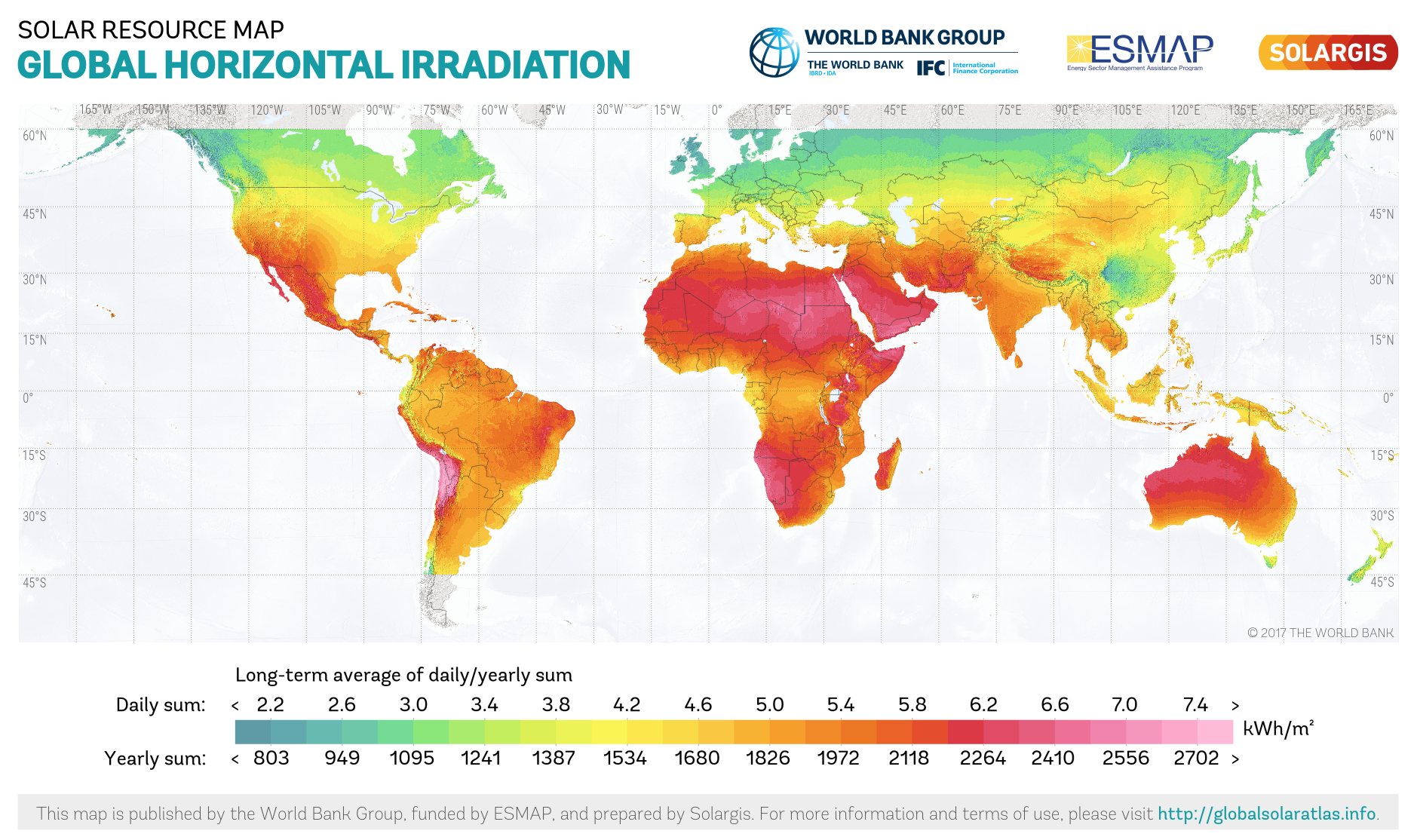
So , let’s have a look at three maps. Solar power first.

1. Solar power. Source: https://upload.wikimedia.org/wikipedia/commons/1/1e/Global_Map_of_Global_Horizontal_Radiation.png


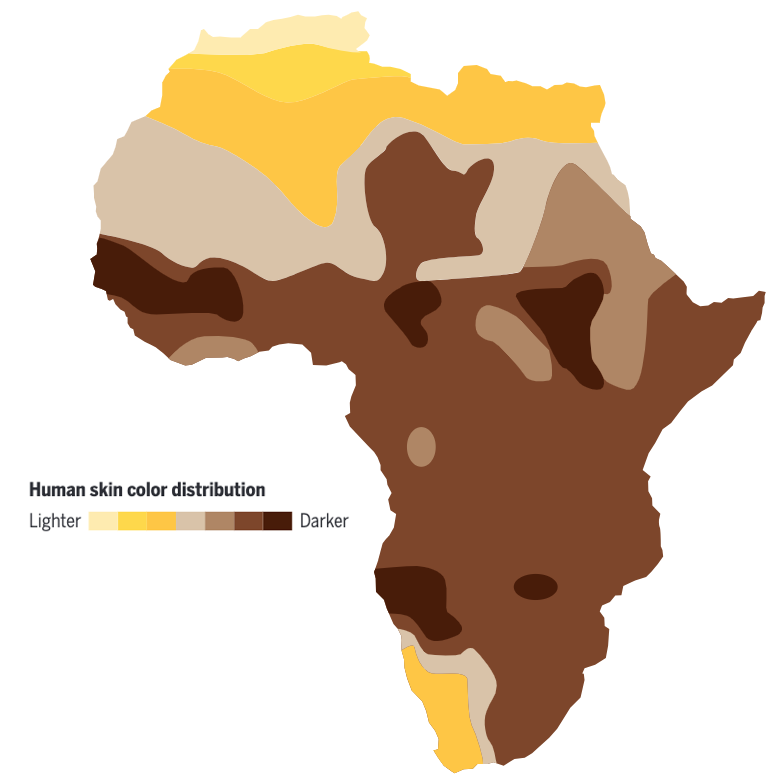
Second, skin tones – the Tamanrasset observation is correct but the overall picture does not match the Loomis hypothesis.

2. Skin tone. Source https://science.sciencemag.org/content/358/6365/867.full For full details see the original paper


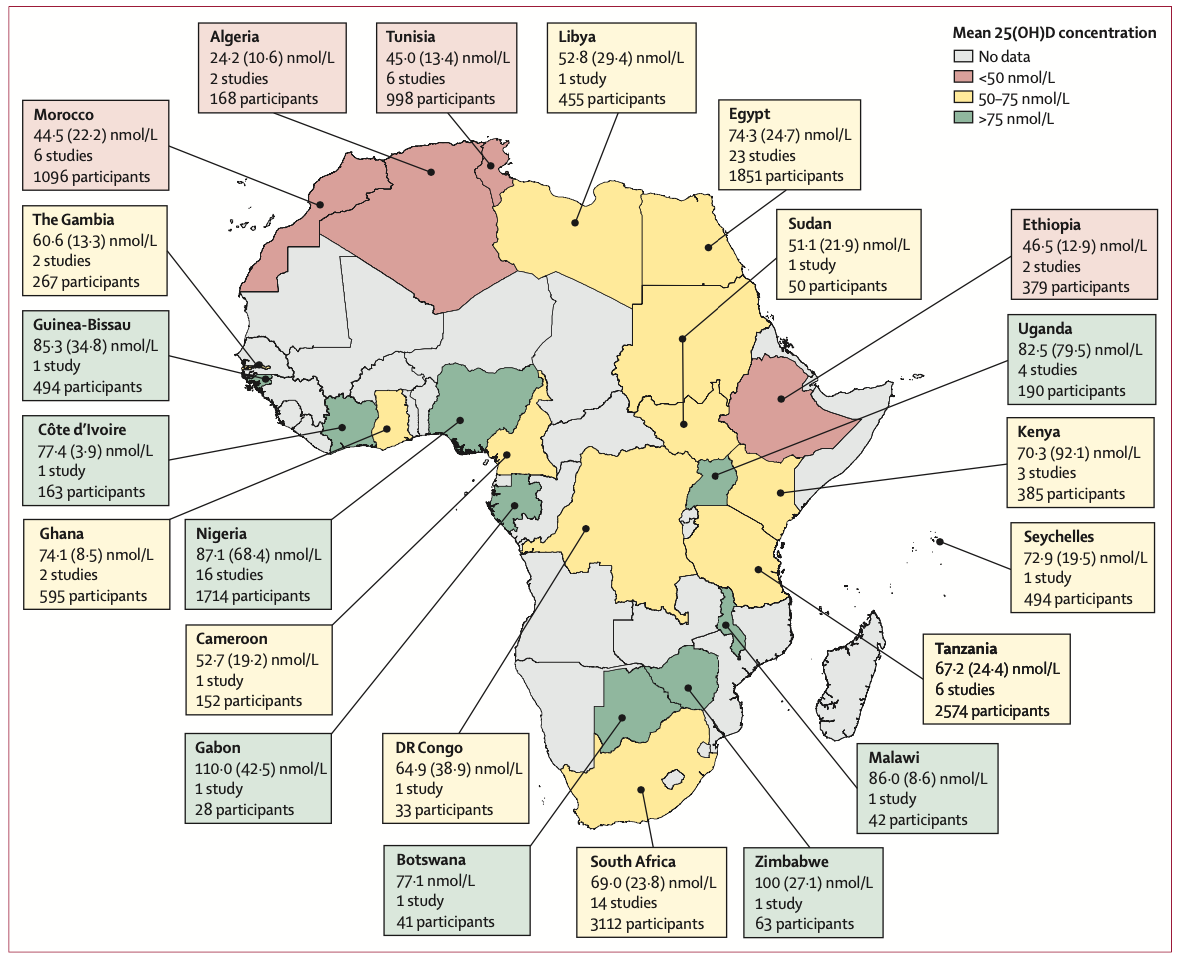
Neither does the new vitamin D map published last week in the Lancet.

3. Vitamin D map. Source: https://linkinghub.elsevier.com/retrieve/pii/S2214109X19304577 For full details see the original paper


No need to calculate any formal correlation coefficient. – maps are patchy but let me conclude that either the vitamin D data or the Loomis hypothesis is wrong.


CC-BY-NC Science Surf accessed 19.01.2026

Wann sind Tiere am erfinderischten?

Die SZ weiss die Antwort

Womöglich gedeihen Innovationen manchmal ganz im Gegenteil besonders gut, wenn ein Tier genug hat: ausreichend Zeit und Energie, um etwa mit dem Schloss einer Futterkiste herumzuspielen. Neues ausprobieren kann vor allem, wer sich nicht rund um die Uhr mit Futtersuche, Wacheschieben und Revierverteidigung aufreiben muss, sondern derartige Verpflichtungen auch mal an Artgenossen delegieren kann.

Vermutlich ist es bei den Menschen auch nicht viel anders. Wenn man sich nicht rund um die Uhr mit Futtersuche, Wacheschieben und Revierverteidigung aufreiben muss.


CC-BY-NC Science Surf accessed 19.01.2026

Vitamin D3 in breast milk

Here is the math: 1 µg/L D=> 40 IU/L D3 => 2,5 nmol/L D3

The detection limit in breast milk is 0,2 nmol/L = 0,08/µg/L = 3,2 IU/L according to vid Streym who measured a median of 0.34 nmol/L  25-OH-D3 in hind milk which is approx 5,4 IU/L.

Li-Chieh Wang gives no detection limit but measures approx 5 ng/mL = 5.000 ng/L = 5 µg/L = 12,5 nmol/L D3 in breast milk equivalent to 200 IU/L, the 40fold amount to vid Streym.

What is correct?


CC-BY-NC Science Surf accessed 19.01.2026

How to include a PDF in reveal.js

Right now there is a lot of information out there how to export a reveal presentation as PDF but much less not how to include a PDF document. The most natural way would be some embed

<section><object data="test.pdf" style="width:100%"><a href="test.pdf">PDF laden</a></object><section>

looks strange, not full frame, no handlers

<section data-background-iframe="test.pdf" data-background-interactive></section>

works but cannot jump to a certain page and cannot style the background.

So I am using now additionally the Chrome plugin that is based on pdf.js.


CC-BY-NC Science Surf accessed 19.01.2026

Tour de France average speed

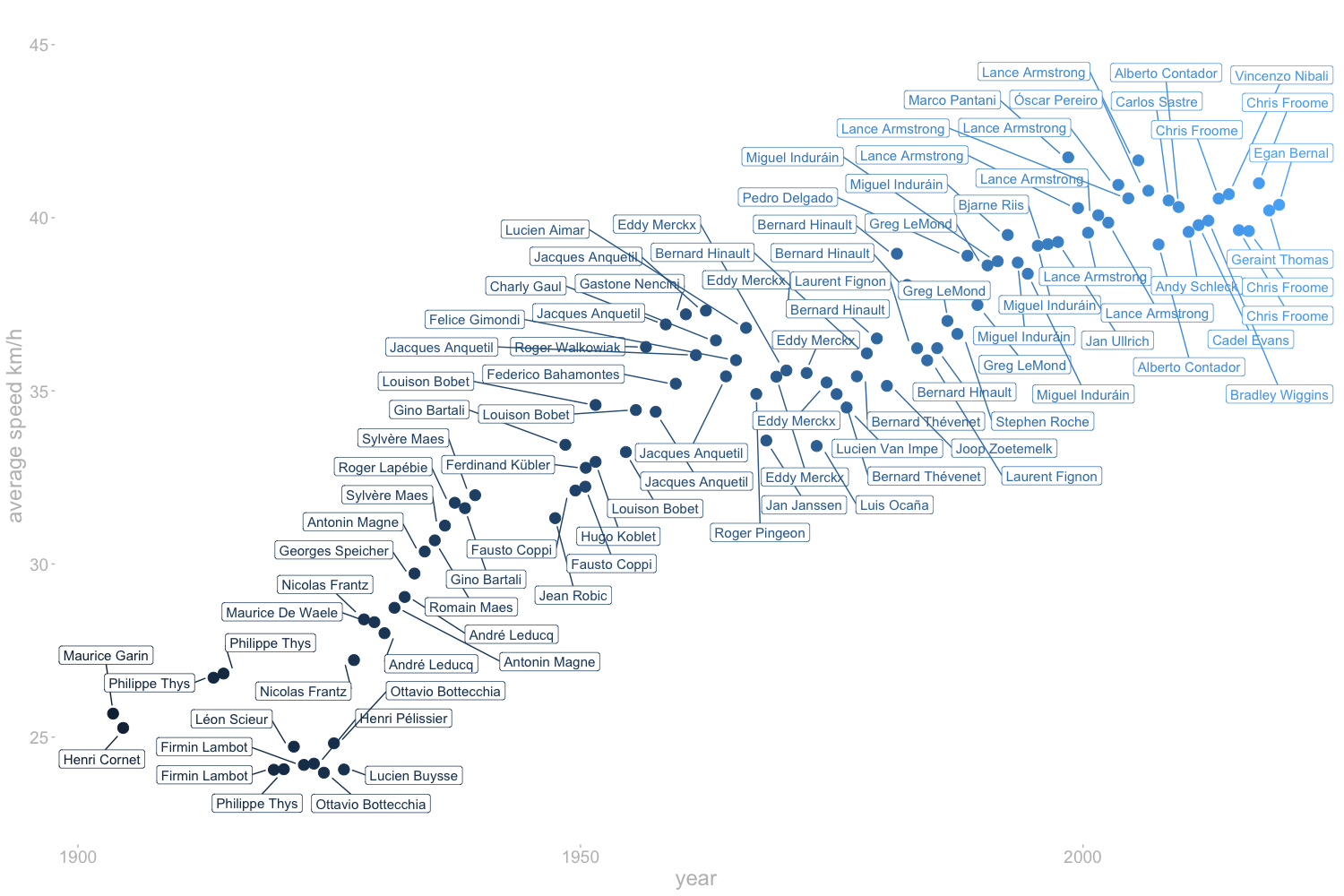
Using the new TdT R package, I have re done the speed plot

library(remotes)
install_github("alastairrushworth/tdf")
library(tdf)
editions %>%
  ggplot(aes(x = start_date, y = distance / time_overall, color = edition)) +
  geom_point(na.rm = TRUE,size=4) + 
  geom_label_repel(data = editions, aes(label = winner_name), size = 4, na.rm = TRUE, segment.alpha = 1, point.padding=1) + 
  xlab('year') + 
  ylab('average speed km/h') +
  ylim(23,45)
click to increase Tour de France average speed by year


CC-BY-NC Science Surf accessed 19.01.2026

A 498 references paper on climate change and allergy

This is certainly the most comprehensive paper that examines the association of air pollution, climate change and allergen exposure: “Air Pollution and Climate Change Effects on Allergies in the Anthropocene: Abundance, Interaction, and Modification of Allergens and Adjuvants

Air pollution and climate change are potential drivers for the increasing burden of allergic diseases. The molecular mechanisms by which air pollutants and climate parameters may influence allergic diseases, however, are complex and elusive.

There is no causal effect of allergens on human allergy, as allergens have been always abundant even without allergy. Nevertheless allergens are drivers aggravating symptoms in allergy-prone patients by basically four factors

  1. Stability effects; influencing the accumulation and degradation of allergenic proteins, the duration of exposure times to cellular receptors, and the process of antigen presentation via major histocompatibility complex (MHC) class II
  2. Epitope effects, i.e., generation of new epitopes or modification of existing epitopes, changing the binding properties of antibodies and receptors, by direct chemical modification or as a result of conformational changes
  3. Adjuvant effects, i.e., generation of new adjuvant functions or modification of existing adjuvant functions such as lipid-binding capacities due to modified ligand binding sites
  4. Agglomeration effects, i.e., multiplication or shielding of epitopes or adjuvant functions by cross-linking (oligomerization) of allergenic proteins, which may enhance the cross-linking

I would add 5. that the absolute number of pollens increased in some areas as a stress response of dying trees.


CC-BY-NC Science Surf accessed 19.01.2026

Harmed by the hygiene hypothesis

A new paper by a British-Kazakhstan-Armenian group nicely summarizes why we need good hypothesis papers.
As a deterring example they use the hygiene hypothesis

the hygiene hypothesis that was originally proposed by David Strachan in 1989. David Strachan studied the epidemiology of hay fever in a cohort of 17,414 British children and concluded that declining family size and improved personal hygiene had reduced the chances of cross infections in families, resulting in epidemics of atopic disease in post-industrial Britain. Over the past four decades, several related hypotheses have been proposed to expand the potential role of symbiotic microorganisms and parasites in the development of human physiological immune responses early in life and protection from allergic and autoimmune diseases later on.

I agree with the description although David never claimed to be the first author writing about the hygiene hypothesis. When I spoke to him the last time London he wasn’t even happy with this popularity.

The chain certainly started also much earlier than 1989 with “continuing activity of an immune system made redundant by man’s cleanliness” (Godfrey, 1975) continued with Gerrard 1976, Frick 1986, Busse, 1989 until David Barker argued in 1985 that there is a “decreased incidence of infection among children, especially in wealthier families, that changed their pattern of immunity”.

The harm inducted by the hygiene hypothesis is described as

The misunderstanding of the hygiene hypothesis that primarily aimed to shed light on the role of the microbiome in allergic and autoimmune diseases resulted in decline of public confidence in hygiene with dire societal implications, forcing some experts to abandon the original idea. Although that hypothesis is unrelated to the issue of vaccinations, the public misunderstanding has resulted in decline of vaccinations at a time of upsurge of old and new infections.

I fear the authors are right – some people may have been harmed by the hygiene hypothesis leading them back in the pre-Semmelweis era.


CC-BY-NC Science Surf accessed 19.01.2026

Klimakrise und Hyernomie Theorie

Anomie, der Zustand bisher fehlender oder schwacher Normen, ging in die Anomietheorie von Robert Merton ein als der Widerspruch zwischen Ziel zB Konsum und Realität etwa aufgrund fehlender Finanzen. Darauf kann individuell auf verschiedene Arten reagiert werden (gekürzt) nach  Wikipedia)

  1. Konformität: Hoher Konsum, Mittel vorhanden, Rationalisierung
  2. Innovation: Konsumwunsch, Mittel fehlen, Kriminalität
  3. Ritualismus: Konsum reduziert, damit die legalen Mittel reichen, Vernunfthandlung
  4. Rückzug: Konsum und legale Mittel werden für sich abgelehnt, eigene Isolation
  5. Rebellion: Konsum und legale Mittel werden für alle abgelehnt, Krieg

In der Klimakrise kommen plötzlich hohe Normen auf uns zu – ich würde es Hypernomie nennen – von denen Reto Knutti sagt (1,2)

Wenn sich alle so verhalten wie Sie, werden wir die Klimaziele verfehlen», sagt Knutti. «Es geht mir nicht darum, zu moralisieren. Wir befinden uns alle in diesen Widersprüchen. Wenn ich in der Wissenschaft auf dieser Ebene arbeiten will, ist es unumgänglich, dass ich hin und wieder zu Kongressen fliege. Aber dennoch: Was bis 2050 gefordert ist, ist null CO2. Das heisst nicht: ein bisschen sparen. Null bedeutet null. Den Verbrennungs­motor gibt es dann nicht mehr. Fliegen gibt es nicht mehr, ausser es gelingt uns, synthetisches Kerosin als Alternative auf den Markt zu bringen oder CO2zu sequestrieren. Eine Ölheizung gibt es nicht mehr. Wir werden unser Leben umstellen müssen.

Ich vermute auch unter Hypernomie Bedingungen bleiben die Reaktionen gleich

  1. einige AfD Mitglieder
  2. einige DAX Unternehmen
  3. hoffentlich die Mehrheit
  4. einige Religionen
  5. einige XR


CC-BY-NC Science Surf accessed 19.01.2026

Useful reveal.js plugins

The list is somewhat hidden but here is the link https://github.com/hakimel/reveal.js/wiki/Plugins,-Tools-and-Hardware
My preference is

dependencies: [
{ src: 'library/reveal.js/lib/js/classList.js', condition: function() { return !document.body.classList; } },
{ src: 'library/reveal.js/plugin/highlight/highlight.js', async: true, callback: function() { hljs.initHighlightingOnLoad(); } },
{ src: 'library/reveal.js/plugin/zoom-js/zoom.js', async: true },
{ src: "library/speech.js",
callback: function() {
RevealSpeech.configure({
nextKeyword: 'nextslide', 
prevKeyword: 'previousslide',
lastKeyword: 'lastslide',
firstKeyword: 'firstslide',
debug: true,
lang: 'en-GB' // default de-DE
});
}

plus zenpen in an iframe.

The slide builders at the plugin page are quite useless except for slides.com which is, however, too expensive.
I therefore design everything in Keynote, export as jpg and loop over all jpgs to write the section tags.

The best option would certainly be if Apple would directly support reveal.js and not some fancy own HTML formats

slide/assets/7D643FA7-9A1F-45A5-A30F-7828735F3C35/7D643FA7-9A1F-45A5-A30F-7828735F3C35.json

Or is anyone willing to write a converter?


CC-BY-NC Science Surf accessed 19.01.2026