Category Archives: Allergy

Primary prevention of cow's milk sensitization and food allergy by avoiding supplementation

Note to self – here is a list of the vitamin D / allergy related clinical trials following the first case report was

0. Moneret-Vautrin DA, Hatahet R, Kanny G, Ait-Djafer Z. Allergenic peanut oil in milk formulas. The Lancet 1991; 338: 1149. doi: 10.1016/0140-6736(91)92008-p.

1. De Montis G, Gendrel D, Chemillier-Truong M, Dupont C. Sensitisation to peanut and vitamin D oily preparations. The Lancet 1993; 341: 1411. doi: 10.1016/0140-6736(93)90976-N.

2. De Montis G, Gendrel D, Chemillier-Truong M, Dupont C. [Peanut sensitization and oily solution vitamin preparations]. Arch Pediatr 1995;2(1):25-8. doi: 10.1016/0929-693x(96)89804-6.

3. Norizoe C, Akiyama N, Segawa T, et al.. Increased food allergy and vitamin D: randomized, double-blind, placebo-controlled trial. Pediatr Int 2014 Feb;56(1):6-12. doi: 10.1111/ped.12207

4. Rueter K, Jones AP, Siafarikas A, Lim EM, Bear N, Noakes PS, et al. Direct infant UV light exposure is associated with eczema and immune development. J Allergy Clin Immunol 2018; in press, doi: 10.1016/j.jaci.2018.08.037.

5. Rosendahl J, Pelkonen AS, Helve O, et al. High-Dose Vitamin D Supplementation Does Not Prevent Allergic Sensitization of Infants. J Pediatr. 2019 Jun;209:139-145.e1. doi: 10.1016/j.jpeds.2019.02.021

6. Urashima M, Mezawa H, Okuyama, M et al. Primary Prevention of Cow's Milk Sensitization and Food Allergy by Avoiding Supplementation With Cow's Milk Formula at Birth. A Randomized Clinical Trial. JAMA Pediatr 2019;173;(12):1137-1145 10.1001/jamapediatrics.2019.3544

This new study by Urashima et al. shows that sensitization to cow's milk and food allergy, including CMA and anaphylaxis, is preventable by avoiding CMF (cow milk formula) supplementation for at least the first few days of life. Although examined only indirectly in this study, vitamin D supplementation seems to be involved in the sensitization process. The Urashima study is accompanied by a valuable editorial of George du Toit and Kari Nadeau

There is currently a lack of consensus among national allergy societies .. Although the EAACI3 and American Academy of Allergy, Asthma and Immunology (AAAI) currently recommend the use of hypoallergenic formulas in infants at high risk of allergy, the Australian Society of Clinical Immunology and Allergy does not. The EAACI and the AAAI are likely to reconsider their guidelines because results of more re- cent studies have been contradictory. … Guidelines in the United States and United Kingdom recommend routine vitamin D supplementation in all breastfed infants, whereas guidelines in Australia recommend supplementation only in breastfed infants at high risk of vitamin D insufficiency.
 

CC-BY-NC Science Surf , accessed 29.08.2026

Medizin ist keine Wissenschaft sondern eine Kunst

Fragil ist das wissenschaftliche Fundament in der Medizin ja schon immer auch wenn es die hauptsächliche Abgrenzung zur Quacksalberei ist.
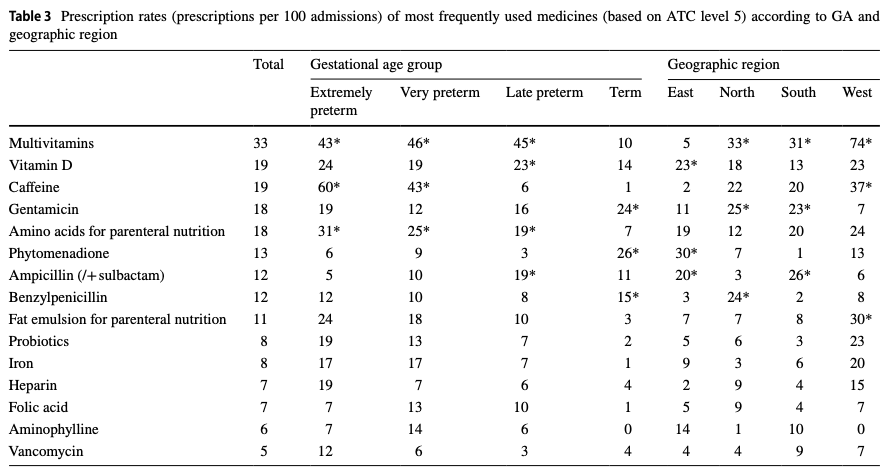
Aber auch wenn man sich manche Fragen der Schulmedizin genauer anschaut, wie zum Beispiel letzte Woche die Empfehlung zu Säuglingsnahrungen oder heute ein Artikel zu Verschreibungen auf Säuglingsstationen, dann ist das weder Wissenschaft noch Kunst sondern bestenfalls industriegeleiteter Aktionismus.
Mesek et al. untersuchten dabei in 21 europäischen Ländern die Verschreibungspraxis auf 89 Stationen. Versorgungsforschung ist ja noch am nähesten an der Realität.

Vitamine sind die am häufigsten verschriebene Pharmaka, wobei unklar ist, warum in machen Regionen 74% und in andern nur 5% Vitamine verschreiben. Wenn es generall notwendig wäre, warum dann nicht 100%? Und wenn es nicht notwendig ist, warum dann nicht 0%?


CC-BY-NC Science Surf , accessed 29.08.2026

An open letter to EAACI / PAAM 2019 organizers

Together with many other colleagues I was astonished about the Nestle booth at EAACI / PAAM 2019 conference in Florence.

The advertisement of Nestle for the NAN HA formula (“state-of-the-art routine infant formula", "proven to reduce the risk of atopic dermatitis", "long term effects up to 15 years of age") along with other milk marketing violates recommendations of the WHO and other medical organisations about breast-feeding. None of the claims made is justified from a scientific viewpoint.

Having paid 650 € entry fee for a 3 day conference, it is also not acceptable that Dr Antonella Muraro (Padua) explains in Symposium 9 “Special products for cow's milk allergy" that if Nestle would not be sponsoring the event, the congress fees would be even higher.

At present, there is no generally accepted benefit of any baby food on long-term allergy prevention while also the therapeutic benefit is questionable. Commercial baby food may even increase later allergy by including supplements that are itself allergenic.

We therefore recommend a review of the EAACI ethics guidelines of industry sponsorship, and an immediate action against further participation of Nestle at future EAACI allergy congresses.


CC-BY-NC Science Surf , accessed 29.08.2026

Distance calculations are not plausible

Rompa et al. claim that

Asthma and atopy were inversely associated with presence of a farm within a radius of maximum 100m.

wich refers to their FIG 3

FIG 3 (click for zoom)
Original legend: Number of farms within a given radius was dichotomized for at least one farm in the radius versus no farms. Associations are calculated by logistic regression resulting in odds ratios (OR) with 95%- confidence intervals.

The authors probably want to say that a non farm child that lives within a smaller distance to a farm shows a stronger negative association. Unfortunately it is not clear from the methods how the categories have been exactly defined, including or excluding category borders? And why is the highest category of 1.000-10.000 excluded here? There is a negative association with asthma in ALL strata irrespective of distance – what is the reference? The increased atopy risk by a farm in a circle with 1.000m radius is never discussed. BTW I am also quite sure that this plot has been produced with some kind of drawing software and not with “R version 3.2.3” if you zoom into the picture.

For whatever reason the authors abandon the distance definition above in favor of some data-derived classification afterwards. Why?

[1] children living on a farm currently run by the family [2] children not living on a farm, but with regular contact to farms, meaning at least once a week for a period of 6 months minimum and [3] children without any contact to farms.

I have no idea what regular contact is. But lets have a look on FIG 2

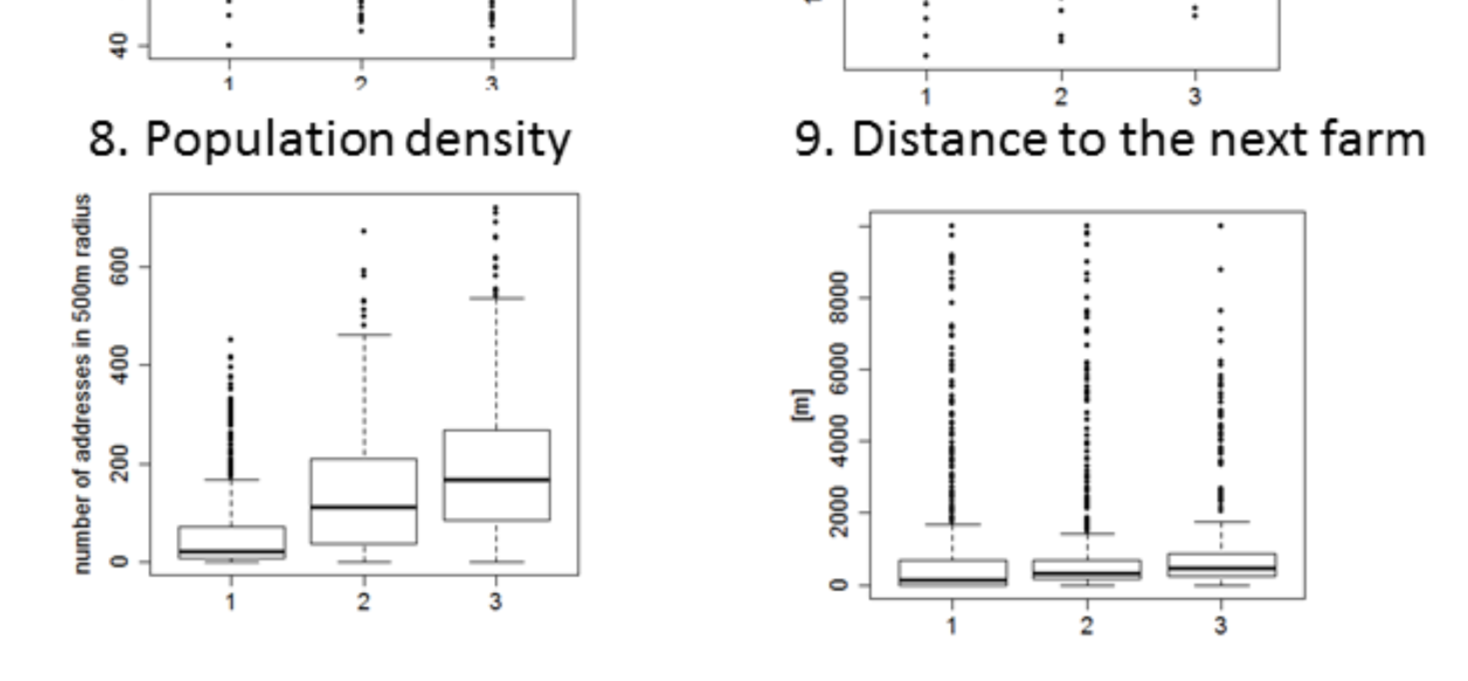
FIG 2: also misaligned and implausible
Original legend: Distribution of environmental variables across exposure strata 1 = farm children, 2 = exposed non-farm children, 3 = non exposed non-farm children. Differences between the subgroups were statistically significant (p<0.01) except for ozone, altitude and distance to the next farm.

This is also not a facet_warp() as I would expect from a R analysis but some manually cut & pasted figures where P<0.01 is contradicting the methods. FIG 2.9 basically says that the distance to the next farm is not different in groups of “farm exposure”.

The abstract

The environmental variables greenness, tree cover, soil sealing, altitude, air pollution differed not only between farm and non-farm children, but also between farm children with and without another farm nearby.

is therefore wrong (it maybe even trivial as farms of course have less soil sealing than villages). In any case, we are now trapped in a loop as according to Fig 1 the prevalence of asthma and atopy over the exposure strata should have been different.


CC-BY-NC Science Surf , accessed 29.08.2026

Schutz vor Allergien auf dem Bauernhof?

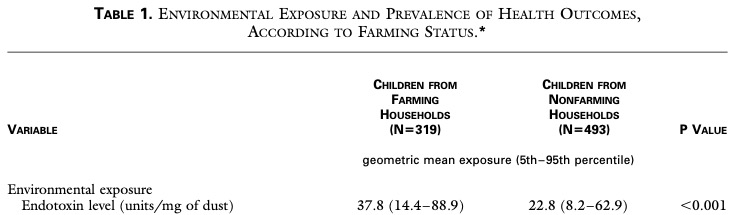
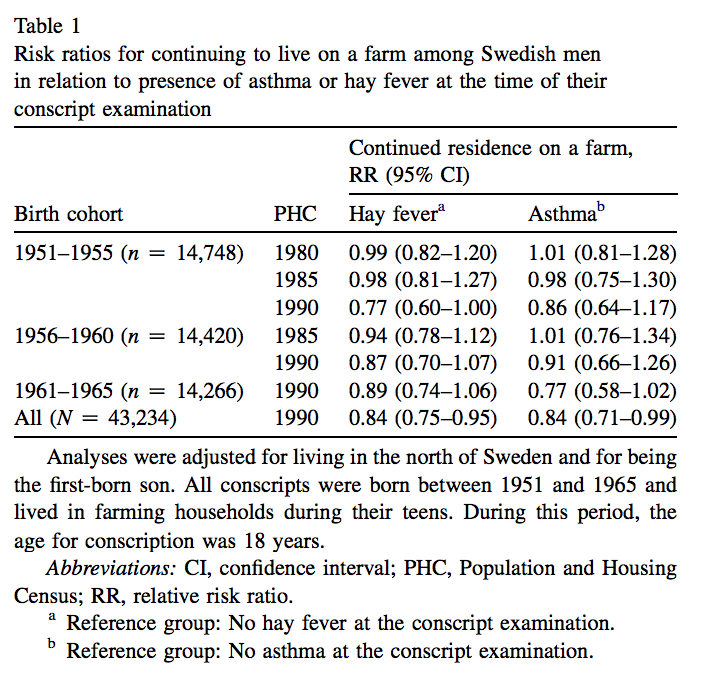
Keine Frage, die Lebensbedingungen auf Bauernhöfen sind anders. Mehr Tiere, mehr Dreck, mehr frische Luft, vieles ist anders als in der Großstadt. Dass es hier auch weniger Allergien gibt, wird wohl an den Bedingungen liegen, die bereits an einer der ersten Studien vor 30 Jahren zu sehen waren.

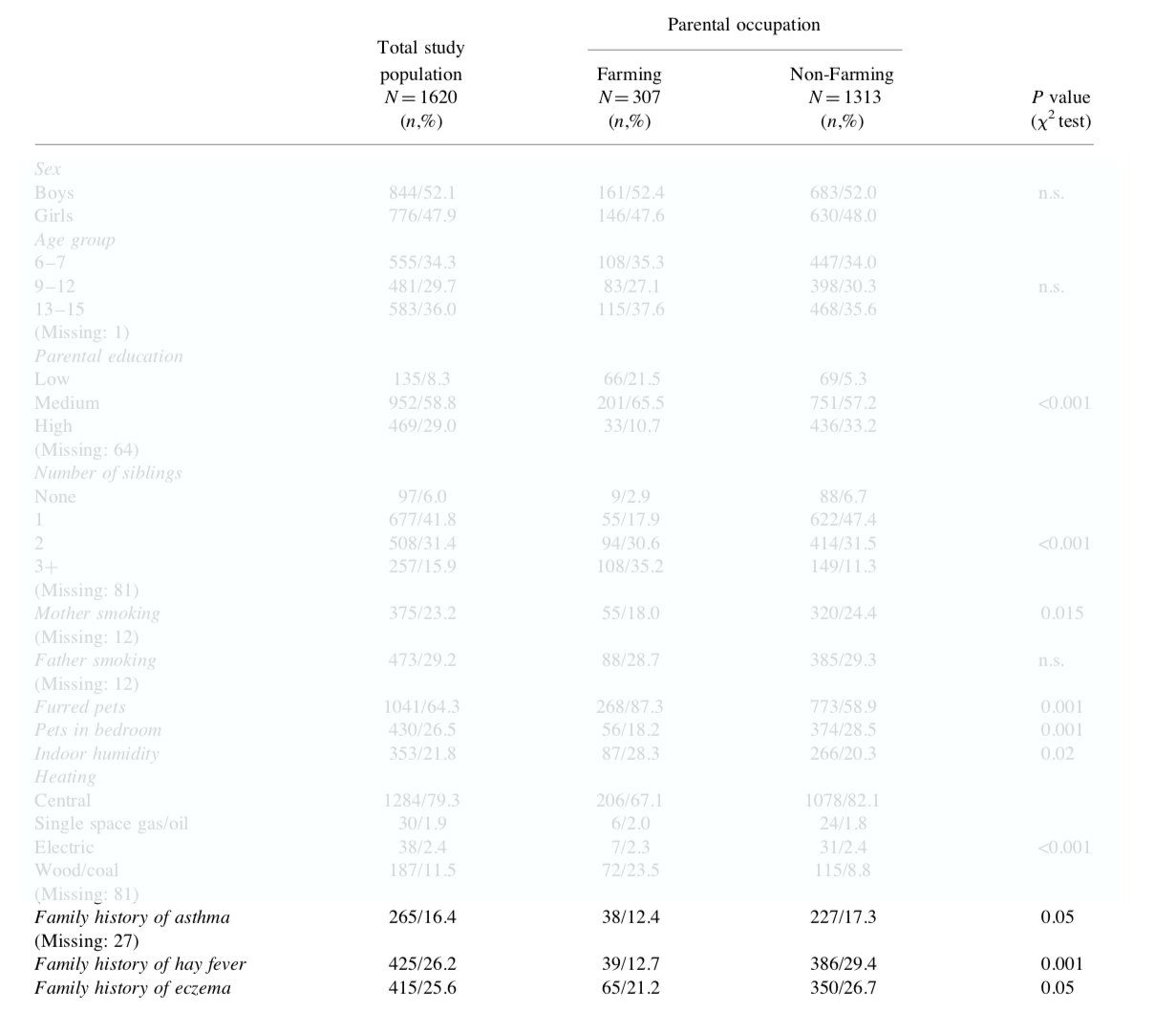
Clin Exp Allergy. 1999 Jan;29(1):28-34. https://doi.org/10.1016/S0140-6736(01)06252-3 Hier nicht relevante Daten ausgegraut

Auch die Eltern hatten schon weniger Allergien. Der “protektive” Effekt kann also einfach dadurch erklärt werden, dass mit weniger Eltern als “Risikofaktor” auch weniger Kinder Allergien haben. Und warum die Eltern wohl weniger Allergien haben? Nun ja, mit Heuschnupfen wird man nicht gern im Heu arbeiten wollen. Auch das zeigen Studien ziemlich eindeutig.

Wenn man genau hinschaut, dann haben alle Bauernhofstudien immer wieder dieselbe Argumentationsstruktur: weil die Bedingung X dort so ist, dann kann die Folge Y auch auf die Bedingung X zurückgeführt werden. Allerdings machen immer mehr Beschreibungen von X die Story nicht glaubwürdiger. Keine der jemals beschriebenen Bedingungen X, ist aus der Bauernhofsituation auf eine allgemeine Situation übertragbar gewesen, von einem einzigen verunglückten Versuch abgesehen.

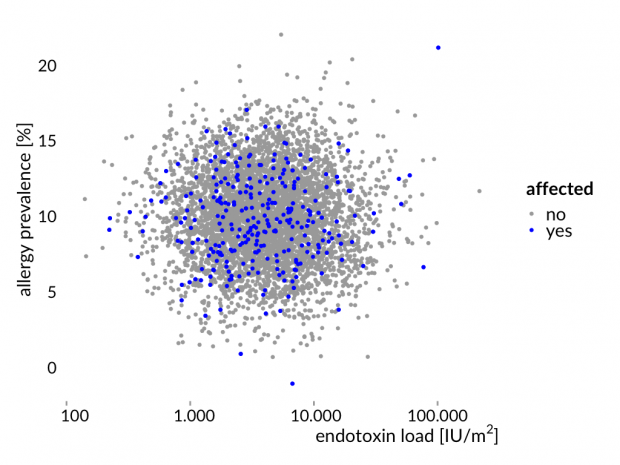
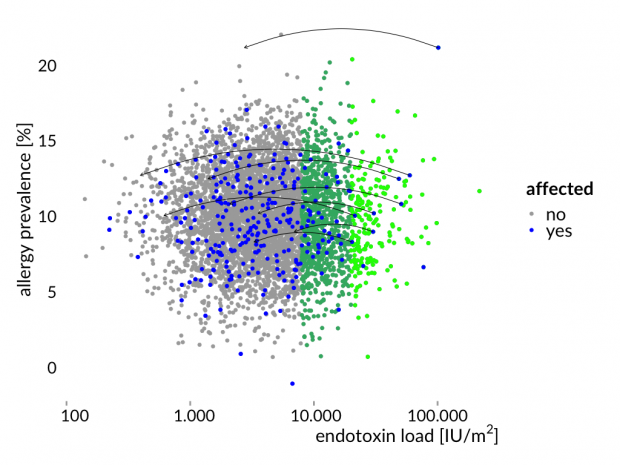
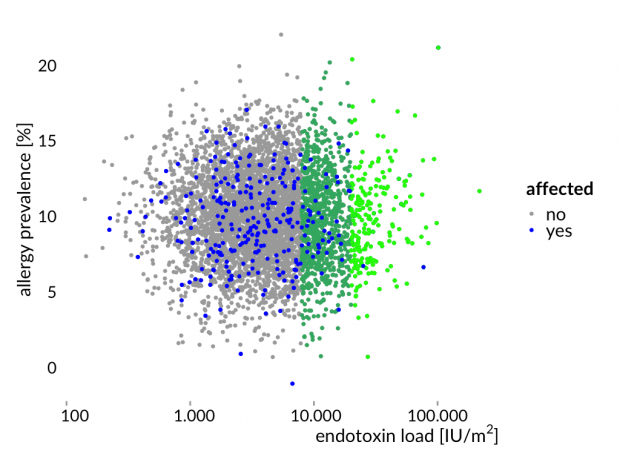
Hier die Story mal erläutert an einem simulierten Datensatz – eine normal verteilte Allergiehäufigkeit und normal verteilte Endotoxinwerten. Zwischen beiden Variablen gibt es keine Korrelation.

Ausgangssituation: Jedes 10. Kind hat eine Allergie. Es gibt keine Korrelation zwischen Allergiehäufigkeit und Endotoxin.
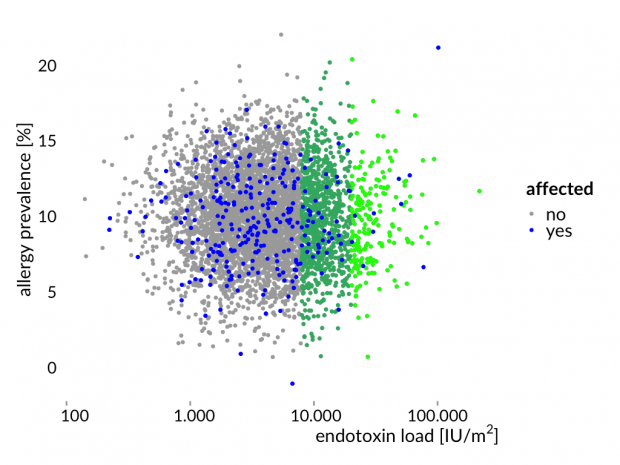
Wir beginnen nun eine Studie im ländlichen Raum (dunkelgrün) und sind dabei vor allem an den Bauernhöfen interessiert (hellgrün), also nur der Region mit hoher Endotoxinbelastung.
Hier läuft aber schon seit längerem eine Wanderungsbewegung. Wer Heuschnupfen hat, wird nicht Heu machen können..
Somit fallen in dem oberen rechten Quadranten Allergiker weg und verteilen sich im dunkelgrünen oder grauen Bereich. Müssen nicht viele sein, 30% weniger reichen schon.
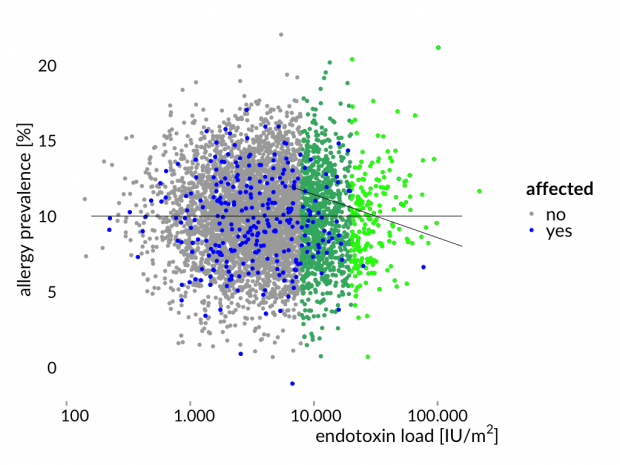
Wenn wir nun erneut eine Regressionsgleichung aufstellen, so gibt es eine negative Assoziation im ländlichen Bereich (kurze Linie) während in der Bevölkerung insgesamt die Verschiebung nicht besonders in das Gewicht fällt (lange Linie).

Das ist nun genau das Ergebnis der Bauernhofstudien.


Natürlich kann ein hoher Endotoxin Spiegel auf den Bauernhöfen eine bestimmte Wirkung haben – zumindest bei einigen Menschen und bei einigen Mäusen – aber mehr ist nach aktuellem Kenntnisstand auch sehr unwahrscheinlich.

Da die Lebensbedingungen auf dem Bauernhof angeblich protektiv sind, müsste es eigentlich Kinder geben, die eine Allergie haben sollten (zB wenn beide Eltern allergisch sind) aber nun doch keine Allergien bekommen haben. Solche Kinder gibt es aber nicht…

Und hier auch noch das ganze auf Englisch im Blog oder in einem wissenschaftlichen Artikel – Epidemiologen kennen den Effekt als klassischen Collider Bias.


CC-BY-NC Science Surf , accessed 29.08.2026

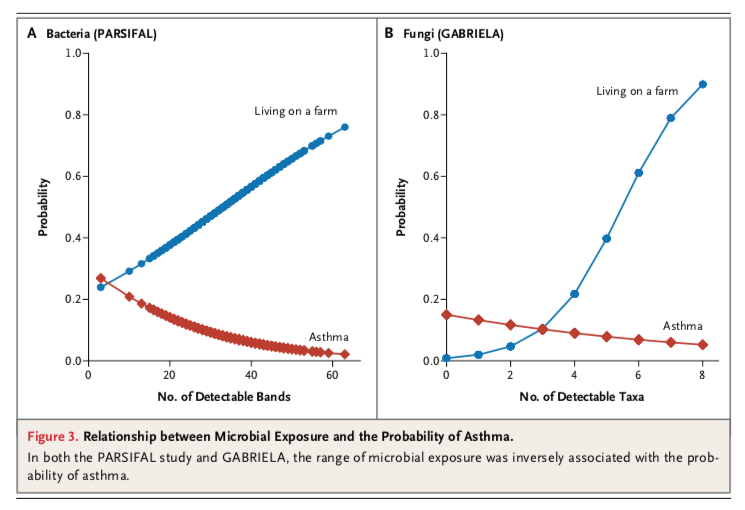
What is wrong with the 2011 NEJM paper?

N Engl J Med 2011;364:701-9 is another paper with 1000+ citations that had a lasting impression on some but not all people.

First, I can’t remember of any study with such an enormous selection bias where >94% of individuals have been lost.

Second, we should not forget that farm is not protective per se – farmers may just avoid a known allergy risk factor. PARSIFAL participants in this study included Steiner schools — anthroposophic medicine mostly avoids vitamin D (ref). This is of course a major issue for any cross-sectional study that doesn’t take into account the temporality of events.

Third, in PARSIFAL dust from children’s mattresses were collected by vacuuming — it is not very likely that many helminthic eggs were transported from stable to bedroom. In GABRIELA, only airborne dust samples were collected which again may miss helminth eggs although being certainly present in stable dust.

Fourth, more microbial exposure and more fungal taxa on farms are a trivial finding.

The inverse associations of the diversity scores with asthma were not confounded by status with respect to living on a farm because adjustment did not change the respective point estimates for asthma (Table 2), although the associations became nonsignificant.

Small sample size, borderline p-values even after a long fishing expedition?

What do these strange “probability” plots really show – the probability of asthma or the probability to live on a farm?

N Engl J Med 2011;364:701-9 Figure 3 Does it refute any general effect of diversity?

The plots are misleading if adjustment for farm living does not change the parameter estimates for bacterial/fungal diversity.

Sixth – even many years later, the main findings of this study have not been independently replicated. There is not any single study that shows listeriosis (Listeria) or diphtheria (Corynebacterium) to be protective.


CC-BY-NC Science Surf , accessed 29.08.2026

Allergy protection on farms – why also studies in mice could have failed

There are many immunological differences in humans and mice (follow my link) that are never discussed — not even in Science 2015;349/6252:1106.

Ignoring the long-standing paradox that endotoxin is also acting as a natural adjuvant to atopic inflammation, the credibility of the Science paper is further reduced.

IMHO it is also a strange experimental condition to have all animals on a standard vitamin D diet – a known co-sensitizers – and looking then for A20 which is co-regulated by vitamin D ??

And here is the last argument – more than 90% of studies in mice fail to translate into humans.


CC-BY-NC Science Surf , accessed 29.08.2026

Does a healthy worker effect explain the allergy protection” at Bavarian farms?

Unfortunately most studies in the farming environment do not report the prevalence of parental history. Neither did they report the effect size of parental genetic risk in the farming population. This is, however, a critical issue as the so called healthy worker effect (HEW) may be a rather trivial explanation of the results.

Specifically, it is a sampling bias: the kind of subjects that voluntarily enroll in a clinical trial and actually follow the experimental regimen are not representative of the general population. They can be expected, on average, to be healthier as they are concerned for their health [or as ill people already dropped out]

At least Braun-Fahrländer 1999 reported that allergic parents were seen much less at farms. Consecutively history of allergy at farms is no more a risk factor as it is otherwise reduced compared to the general population – no diseased parent, no increased risk. So lets see if there are any further studies in adults?

I know of three studies (plus a review Le Moual N 2008).

Leynaert 2001 showed only a slightly reduced prevalence of “allergy” (39.1% vs 41.5%, NS). Her table 4 is most interesting. The association started only after year 1960 which points towards severe misclassification as far as the analysis is not stratified by year of birth.

Remes 2002 showed a dose dependent effect decline between farming (36.2%) and controls (31.6%, P=0.075),

Perkin 2006 also found some significant lower prevalence in farmers 47.3% versus 57.7%, P<0.001. HWE is therefore likely.

I found further six studies (Thelin 1994, Braback 2006, Chenard 2007, Thaon 2011, Elholm 2013 and Spierenburg 2015) that examined in detail a possible relationship of HWE, allergy and farming. Unfortunately the examination period in five of these studies is too short to make any conclusion while Braback 2006 seems to be the only reliable study.

Source: Braback 2006

From this study, we can safely conclude, that there is a significant HWE.


Addendum 22 Nov 2019

It seems that I missed some papers on HWE and farming.

Timm 2019 is a hard to understand cluttered 3 generation study of unclear asthma type. Point estimates of parental asthma on farm upbringing are not really a measure of HWE – shuffling exposure and outcome distorts temporality. In contrast to the interpretation of the authors, I see a clear effect if both parents are born on a farm and one parent has asthma. The RR drops here to 0.33 that their child will be raised on a farm.

Vogelzang 1999: 400 pig farmers, X-sectional point estimates, not a real HWE study, although HWE offered as explanation.

Health-based selection of nonasthmatics for pig farming, which tends to mask a work-related hazard for asthma, is offered as an explanation for these results.

Eduard 2015: compares asthma prevalence of 313 Danish farm children to their 518 sibs (which is identical) but useless, as affected parents would basically dropout all children.

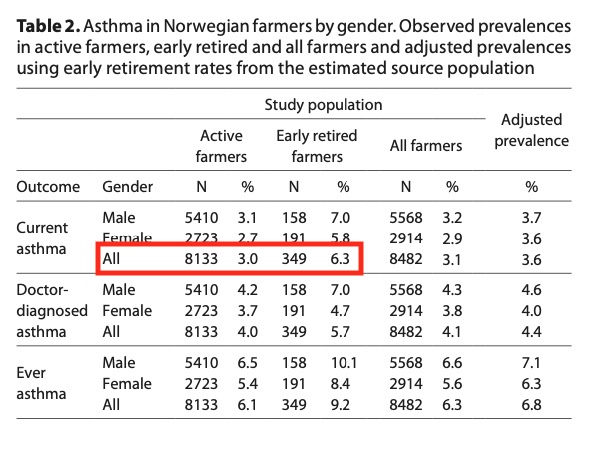
There is even a second comparison of Norwegian farmers with a clear effect. Instead of comparing the early retired farmers with their respective age cohort they invented a c complicated quantile logitic regression in 4 year intervals. Detailed model parameter and significance levels are missing.

At least the conclusion was

A healthy survivor selection was observed in Norwegian farmers, but it was too small to fully explain the reduced risk of asthma observed in this population. A strong selection effect was observed among farmers who had changed production type

will be continued…


CC-BY-NC Science Surf , accessed 29.08.2026

we don't see things as they are, we see them as we are

There is an interesting meta-analysis at JAMA Pediatrics about vitamin D supplementation during pregnancy and offspring growth, morbidity, and mortality. Nothing special, standardized methodology and even somewhat expected outcome.

In this systematic review and meta-analysis of 24 randomized clinical trials including 5405 individuals, vitamin D supplementation during pregnancy was associated with a lower risk of infants being small for gestational age and improved growth during infancy without an increased risk of fetal or neonatal mortality or congenital abnormality.

More interesting are the vitamin D lobbyists writing the accompanying editorial (Bo Chawes , Klaus Bønnelykke, Hans Bisgaard) . They try by nearly every sentence to devalue the findings of the meta-analysis. They are even getting to the point of

no adverse effects have been found

We don't see things as they are, we see them as we are.


CC-BY-NC Science Surf , accessed 29.08.2026

Claim to fame of the hygiene hypothesis

The recent encyclopedia article about the hygiene hypothesis seems to be well written. At least on the first instance … in reality it is more a novel than a scientific review.

For many years already, the hygiene hypothesis has been called an outdated concept; various times it was revised and transformed, and finally it gave birth to novel hypotheses.

In other words, the hypothesis has been rejected for being wrong . Even many revisions did not change that. There seem to be only one proven fact – the obsession of some authors with hygiene and nouvel Rousseauism.

Anyway, the hygiene hypothesis has promoted radical rethinking of infections, microbiota, and coevolution of mankind and microbes.

There is nothing radical in backward thinking. We still carry tons of microbes, freezer and antibiotics only did some qualitative but not so much quantitative changes,

With the advent of novel high-throughput sequencing technologies the human microbiome, which is sometimes called the 'forgotten organ,' has attracted much attention and is currently being implemented in a wider concept of self-foreign relationship, which may even include recognition of the nonmicrobial nonself as a vital stimulus to a well-developing immune system.

  1. So the interest is technology and not science driven.
  2. The microbiome is not an organ.
  3. The hype is already over.
  4. The Self is not defined by any bacterium.
  5. Most bacteria are excreted and not vital stimulus.

Given the many molecule classes regulating immune functions across individuals such as short RNAs, the hygiene hypothesis may eventually come back as a surprising explanation of the phenomena evoked by crowding, day care, sibship size, orofecally transmitted diseases, and respiratory infections.

Why that?
A comeback of the hygiene hypothesis by short RNA?
The listed phenomena are not intrinsically related, but are occuring only at the same time scale.

Even the old birth order effect might be rediscovered as epigenetic programming someday. Admittedly, these notions are entirely hypothetical, but without hypotheses, proven or not, science hardly advances.

So if David Strachan’s birth order effect would be really caused by epigenetic programming – why would that be related to hygiene at all?

Science is is not so much about proven or unproven but about reasonable and non reasonable hypotheses.


CC-BY-NC Science Surf , accessed 29.08.2026

medRxiv

ArXiv is operational since 1991, bioRxiv since 2013 and since 2019 there is now also medrxiv. More details at https://www.bmj.com/content/365/bmj.l2301

The main arguments in favour of sharing work in its preliminary form are, firstly, that science works faster if work is made available sooner after it is completed and, secondly, that articles are improved by feedback from a wider group of readers, alongside formal peer review by a few experts. Simple estimates suggest that halving the delay to sharing a research result can double the speed at which research progresses. Ambitious research funders are now embracing preprints and other measures that aim to accelerate the pace of research.

Although there was a mixed reception in the beginning, see Science back in 2017

MedArXiv will have a hard time attracting preprints if mainstream medical journal editors decide they won't publish final versions of the papers. Currently, The BMJ and The Lancet are among the few medical journals that have explicitly said that posting a preprint doesn't preclude publication; Nature and Science, which both occasionally publish medical studies, have the same policy. But at the JAMA Network, which publishes a dozen journals, the issue is hotly debated.

@medRxiv opened on June 6. So far they have only 304 followers on Twitter (and no allergy paper in the archive).

As the current “Allergy” editor and the publisher (John Wiley and Sons A/S) agreed to preprints last week, I have submited now my first preprint paper. Therefore, there are now 305 followers and 1 allergy paper :-)


CC-BY-NC Science Surf , accessed 29.08.2026

Vitamin D polygenic risk score is not associated with any disease

It is one of the minor papers in a minor journal but nevertheless has some big impact: “A phenome-wide Mendelian-randomization study of genetically determined vitamin D on multiple health outcomes using the UK Biobank” in Int J Epidemiol. 2019 Sep 13

Existing studies suggest that a low vitamin D level is associated with more than 130 outcomes. … We then implemented a Mendelian Randomization-Phenome Wide Association Study (MR-PheWAS) analysis on data from 339 256 individuals of White British origin from UK Biobank. We first ran a PheWAS analysis to test the associations between a 25(OH)D polygenic risk score and 920 disease outcomes…The PheWAS analysis did not identify any health outcome associated with the 25(OH)D polygenic risk score.

The message is clear – we know it for years.


CC-BY-NC Science Surf , accessed 29.08.2026

Vitamin D Warnhinweis

Das Deutsche Ärzteblatt hat einen Warnhinweis “Fachgesellschaften warnen vor unkritischem Umgang mit Nahrungs­ergänzungsmitteln” allem Internet Hype zum Trotz

“Die Werbeaussage, wonach jeder Mensch eine Extraportion Vitamine oder Mineralstoffe zur Aufrechterhaltung der Leistungsfähigkeit und Gesundheit braucht, ist schlicht und einfach falsch", sagte Jürgen Schölmerich, Facharzt für Gastroenterologie und ehemaliger ärztlicher Direktor und Vorstandsvorsitzender des Universitätsklinikums Frankfurt am Main. Nur für wenige Personengruppen, etwa Schwangere oder Veganer, seien bestimmte Nahrungsergänzungsmittel-Präparate tatsächlich empfohlen.


CC-BY-NC Science Surf , accessed 29.08.2026

Why do we have so much atopic dermatitis?

I think it is quite reasonable that childhood skin care practices is involved in the increase in atopic dermatis (AD) according to a recent review.

Kelleher and colleagues found skin barrier dysfunction precedes AD development. Thus, soaps and detergents may aggravate preexisting tendencies to skin barrier dysfunction and promote skin inflammation and initiate AD in susceptible individuals. Whether skin care practices have changed over time to explain the increase in AD incidence remains unknown, but high bathing frequency and the use of fragranced lotions are commonplace in US children, two practices potentially harmful to the skin barrier. Protecting the skin barrier early in life with emollients appears to reduce the risk of AD development.


CC-BY-NC Science Surf , accessed 29.08.2026