The Biomed Experts site has a nice email notification of new papers which have been authored by my earlier co-authors – which is great! by focusing more on Continue reading Hot of the press
CC-BY-NC Science Surf
accessed 11.03.2026
The Biomed Experts site has a nice email notification of new papers which have been authored by my earlier co-authors – which is great! by focusing more on Continue reading Hot of the press
The first one is Anno-J, an excellent way to show your own annotation track that has some benefits compared to Ensembl or the Genome Browser.
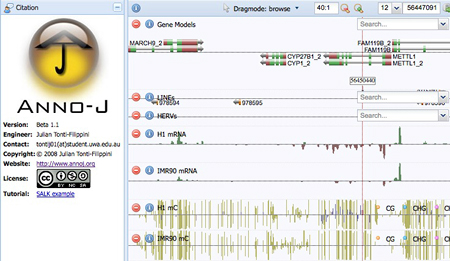
The second one Continue reading Two new bioinformatics services
A review of “Unscientific America” on p 678 in Science Magazine 7 Aug 2009 finds
According to Mooney and Kirshenbaum, atheistic scientists such as Richard Dawkins and P. Z. Myers [who runs the immensely popular science blog Pharyngula] drive people away from science by forcing them to choose between the facts and their faith.
I am curently working on a new lecture series on that topic – having a gut feeling that the evolutionary history will explain how and why we get diseases. Some German magazines (“Fehlkonstruktion Mensch” DER SPIEGEL 40/2009) even write about that topic quoting a forthcoming book of Ganten / Deichmann / Spahl). I will rely, however, mostly on Continue reading evo-devo-dis
(reminescence)
Gene-environment-interaction is a large bubble in complex disease research area with a label that is itself questionable. Genes do not interact with the environment (or only indirectly); the environment does not interact with genes (situations like epigenetic modification or induction of mutations are at least not meant here).
What is being meant by “gene-environment-interaction”, could be described as “genetically conditioned environmental influence” (GCEI) but not as GxE interaction… BTW is there any online list of GCEIs?
There was a news item in the Jan issue of NGR
Born to run? A DNA test to identify future sports stars. The latest personal DNA test to hit the US market, from Atlas Sports Genetics in Colorado, promises to “determine if a child would be best at speed and power sports such as football or sprinting, or endurance sports such as runningâ€
What a nonsense! It would be even deleterious if anybody would be influenced by any genetic test to decide on physical fitness.
What’s possible and what’s unlikely to be possible: sportsscientists.com discusses the recent watt burst of the TdF winner at the Verbier climb. Continue reading VO2max of 99.5ml/kg/min and 440 Watt?
Here is another reference to an earlier paper
Although a disease can be causally genetic, intensified mapping efforts have so far been unable to identify genes that account for more than a small fraction of the familial risk, perhaps because the responsible variation arises by somatic mutation Continue reading Sequence, sequence, sequence it
None of us, I think, in the mid-’70s, when “The Selfish Gene” was published, would have thought we’d be devoting so much mental space now to confront religion. We thought that matter had long been closed
is a commentary from Edge 294. Although even more British colleagues were dedicating chapters to that Dawkins meme I always found it stupid difficult to materialize a DNA regulatory unit by a personality trait – introducing another “Darwinian fairytale” (Stove). Continue reading Selfish gene – bad weeds grow tall
I am a great fan of DNA pooling (mainly for cost reasons). During our recent experiments we have lost the identity of a single DNA source by pooling. Then we found that the source DNA may be tagged with a unique oligo allowing the assembler to reconstruct the DNA source from the pool. He comes another variation of The Sequencing Game
The pooling of DNA sequencing samples is not new, but current protocols rely on bar coding each sample with a short oligonucleotide, which is then used to associate a read to the correct sample. This approach is laborious, however, as a unique tag has to be created for each sample. The new method creates pools of samples, and then associates a bar code to each pool, rather than to each individual sequence.
Dr. Zamel, one of the PIs of the Tristan da Cunha study pointed me today to the interesting 30 min BBC documentation online at Allergy Canada
Allergy Island is an exclusive documentary on the history of asthma in Tristan da Cunha and the discovery of the gene related to asthma in that highly inbred community by the expedition that I did in 1993. I went in May 2008 to Tristan da Cunha with the BBC crew to film both parts for the entire month.
Nature genetics published recently an association paper of an of an autism researcher researcher writing here on narcolepsy
Using genome-wide association (GWA) in Caucasians with replication in three ethnic groups, we found association between narcolepsy and polymorphisms in the TRA@ (T-cell receptor alpha) locus, with highest significance at rs1154155 (average allelic odds ratio 1.69, genotypic odds ratios 1.94 and 2.55, P < 10-21, 1,830 cases, 2,164 controls). This is the first documented genetic involvement of the TRA@ locus, encoding the major receptor for HLA-peptide presentation, in any disease.
I am always cautious of these “first ever” claims Continue reading Can’t believe in a TCRA association (at the moment)
A welcome initative of the Golden Path Genome Browser:
Users often send us notes and hints about how we might better curate and annotate the genome. These contributions are valuable but it isn’t feasible for us to update our annotations on a per-user basis. Continue reading Genome browser introduces error lane
Thenew book by Gibson “It Takes a Genome: How a Clash Between Our Genes and Modern Life Is Making Us Sick” raises some interesting points (from the Amazon review)
Our genome is out of equilibrium, both with itself and its environment. Simply put, our genes aren’t coping well with modern culture. Continue reading Clash between our genes & environment
was an earlier title of a BBC documentation about gene methylation. While running today an analysis of segregating methylation marks, I have major difficulties to find out the status of the human epigenome map. The Sanger site seems to be down for a long time, there aren’t any updates of the AHEAD consortium, the site of the Epigenetics Society is largely uniformative, methDB gives me “information about the research situation in France and why French scientists are in conflict with the current government”, an EU network excellence has only a fashionable website while another EU project is even not fashionable. Or do I miss something??