CC-BY-NC Science Surf , accessed 13.04.2026
e! Science News reports a new study in EPJ Data Science by Marcel Salathé showing that anti-vaccination sentiments spread more easily than pro-vaccination sentiments.
We find that the effects of neighborhood size and exposure intensity are qualitatively very different depending on the type of sentiment. Generally, we find that larger numbers of opinionated neighbors inhibit the expression of sentiments. We also find that exposure to negative sentiment is contagious
Read the full paper for the tricky design – at least the results fully underpin daily life experience. It’s certainly much easier to do Twitter than Facebook studies on the other hand these rather short messages are certainly not the main channel of many great “opinionated” people.
The turn of the year may not only indicate many new chances but also allow a higher standpoint. IMHO the best paper in the vitamin field was published by Rousseau Gama in the BMJ 2012;345 :e5706.
We measured serum C reactive protein and 25-hydroxyvitamin D concentrations before and two days after elective knee or hip surgery in 30 patients. After surgery the mean serum concentration of C reactive protein increased (5.0 (SD 5.5) v 116.0 (81.2) mg/L; P <0.0001), whereas serum 25-hydroxyvitamin D decreased (56.2 (30.3) v 46.0 (27.6) nmol/L; P <0.0006).
The reasons are not fully clear but the results are consistent with two other studies reporting a fall in serum 25-hydroxyvitamin D concentration during a systemic inflammatory response. So, it looks like 1 simple study will make 1000 other studies useless. That seems to be the beauty of science… although I do not understand how that related to a serum half-life of two weeks?
So far I argued that vitamin D is always a lifestyle proxy e.g. pubmed/22698792) but there maybe also biological reasons.
BTW I would also have a candidate for the worst vitamin D paper, just in case, ….
Genomes Unzipped just published guidelines for tweeting at conferences.
Check the conference social media guidelines first. Continue reading A new dress code, ahem write code, for conferences
We were recently dicussing that problem too what Nature writes about the Encode project:
The question is, where to stop? Kellis says that some experimental approaches could hit saturation points: if the rate of discoveries falls below a certain threshold, the return on each experiment could become too low to pursue
As always – the scientific method once invoked – creates beautiful results but when it comes to justification of programs or methods it’s all about personal preferences, irrational beliefs, common misunderstandings, conformance to general trends, and whatsoever non-scientific influences.
Retractions are increasing anytime I look around retraction watch. A new PNAS paper now has the most thorough analysis of retractions:
A detailed review of all 2,047 biomedical and life-science research articles indexed by PubMed as retracted on May 3, 2012 revealed that only 21.3% of retractions were attributable to error. In contrast, 67.4% of retractions were attributable to misconduct, including fraud or suspected fraud (43.4%), duplicate publication (14.2%), and plagiarism (9.8%) …fraud has increased ∼10-fold since 1975.
So, fraud is the most frequent cause – and it usually does not come isolated Continue reading The true reason for retractions?
Found an interesting comment in Nature Sept, 13, p177
All existing metrics capture only what a scientist has done, not what he or she would be able capable to.
I am not sure Continue reading A future predicting metrics for scientists?
received that today / das kam heute morgen an

The idea might not be new – we already diluted DNA already a decade ago ( see this 2003 paper ). A new Nature paper by Peters ( Accurate whole-genome sequencing and haplotyping from 10 to 20 human cells… ) now shows that diluting DNA into 384 wells, adding unique tags, and pooling again before sequencing everything on a Hiseq, will result in an enormous reduction of sequencing errors – a problem that we are fighting now for a year. IMHO the paper isn’t primarily about the low number of cells that can be sequenced, but also about error reduction in WGS. The two key facts are certainly
To ensure complete representation of the genome we maximized the input of DNA fragments for a given read coverage and number of aliquots. Unlike other experimental approaches this resulted in low- coverage read data for each fragment in each of the wells a fragment is found in.
plus an intelligent phasing algorithm Continue reading An enormous step forward in whole genome sequencing
The EU is supporting Open Access too. 12431 scientists already signed the petition at http://www.thecostofknowledge.com by today!
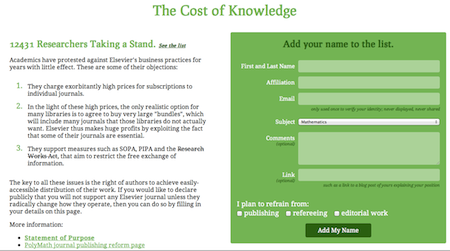
Continue reading EU supporting Open Access
There are so cute little files while I am constantly looking up addresses in travel guides, madly identifying them at google earth before transferring location bookmarks to my mobile devices.
Why can’t publishers produce just some small geo.kml or geo.rdf files, deposit them somewhere on their web server and link them with barcodes that are printed each time a geolocation is referred too (example link Groebenzell)?
The iPhone needs a slightly different form (without kml) as well as an app like i-nigma that is pointed by this barcode
to maps://?geocode=&q=gr%C3%B6benzell&ie=UTF8&client=safari&oe=UTF-8&hnear=Gr%C3%B6benzell,+Oberbayern,+Bayern&gl=de&t=m&z=14”>Groebenzell.
Nature 486, 157 (14 June 2012) warns:
Scientists discussing their work through written media, including e-mail, should be aware that they could at any time be asked to reveal their conversations.”You are commanded to produce…any and all documents, data, and/or communications.” Towards the end of last year, those orders appeared in a subpoena that landed at the Woods Hole Oceanographic Institution in Massachusetts.
so please write me private things only in a closed letter. Maybe it’s not such a problem Continue reading Warning: Reply to all
Erika Check Hayden ( who asked me by email before she wrote that piece ) has a new article about “A broken contract – as researchers find more uses for data, informed consent has become a source of confusion. Something has to change“. While I largely agree with her analysis of the current situation, her points for change are somewhat weakly described ( BTW that paper already generated a heated discussion at The Mermaid’s Tale: “Informed consent — who’s it supposed to protect, anyway?” ). Continue reading A broken contract