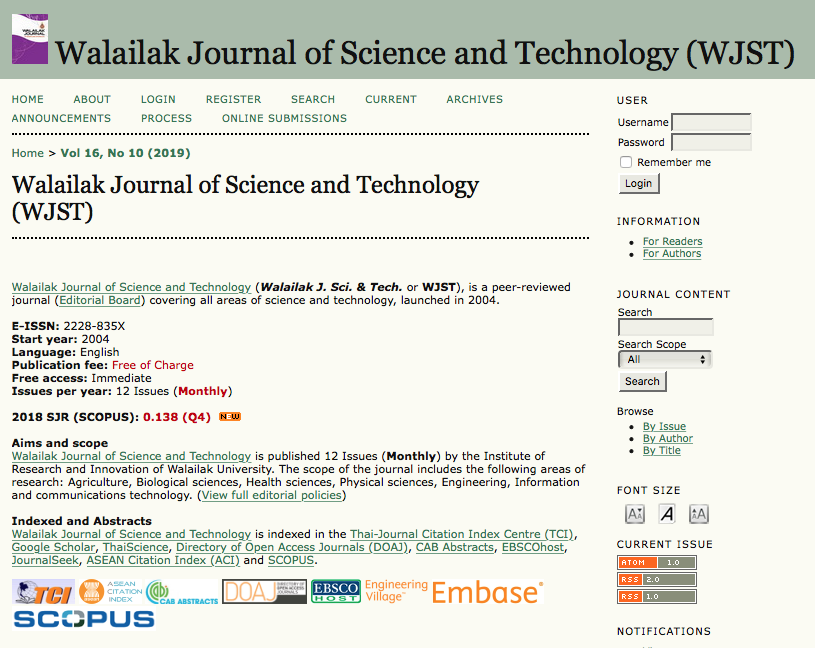
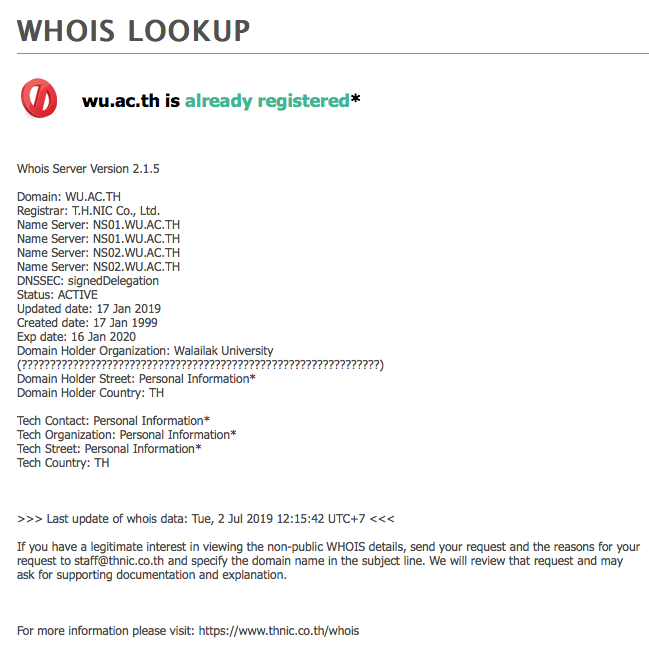
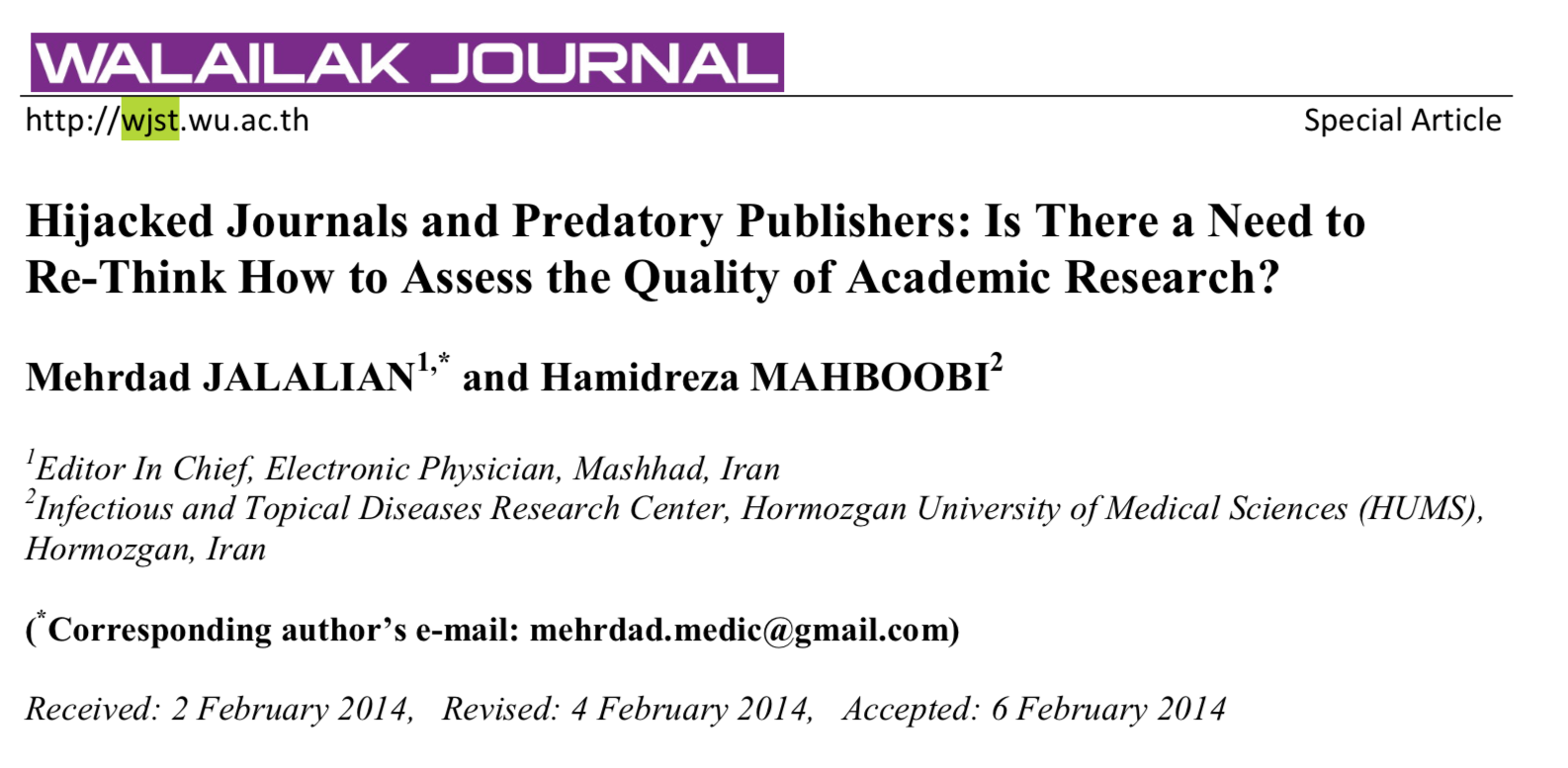
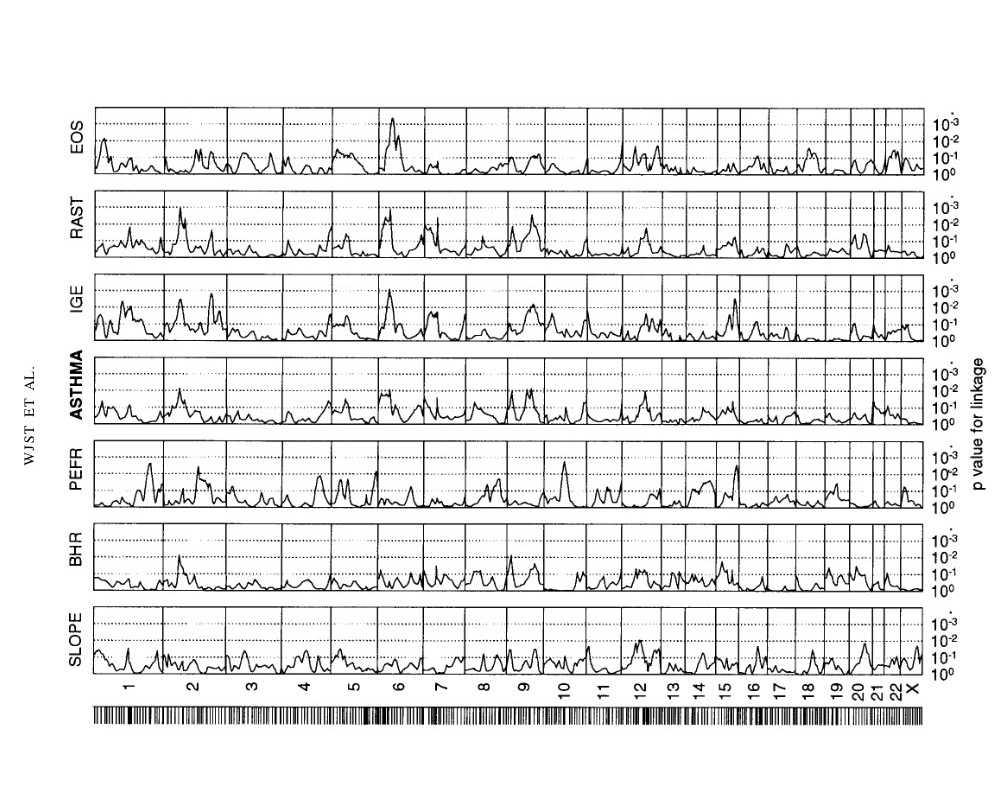
The “Walailak Journal of Science and Technology” (WJST) is a predatory Thai journal – zero impact, editorial board consist of local faculty, costs paid by local university – which is listed on the official Beall list. of predatory journals.
Really funny that the Walailak Journal (“attack best defense”) even publishes about predatory publishers…
I hoped that the journal will give up my name but unfortunately they are now even publishing a new Proceedings series, giving rise to an Elsevier name conflict.
Doch führt ihn bald ein tiefer Zug,
Zu höherem Gedankenflug.
Schon brennt der Kopf,
schon glüht der Sitz,
Schon sprüht ein heller Geistesblitz;
Schon will der Griffel ihn notieren;
Allein es ist nicht auszuführen.
Even many bank accounts rely on it. But given the fact that there are a dozen of web sites commonly used to receive SMS authentication tokens on behalf of users (Twilio, Sellaite, Pinger, TextNow…) it may be insecure as the SMS are public available. A new study in Firstmonday looked into that and found some astonishing results. As expected most users needed it for Tinder… More importantyl, 76.5 percent of those messages included the name of the application for which the message was intended compromising their accounts.
In einem Repost heute (Original vom 20. Juni 2016) erkärt René Buchholz, was mich auch schon immer an dem religiösen Fundamentalismus gestört hat – nämlich die Verbindung von Religion und einer unangreifbaren Offenbarungslegitimation mit einer zutiefst reaktionären politisch rechten Identität.
Von diesem Ausverkauf der Religionen setzt sich die strong religion entschieden ab. Sie inszeniert sich nicht nur in den USA als Bollwerk gegen Relativismus, Modernismus, Werteverfall und Auflösung der Gesellschaft. Familie, Autorität – die Bibel im Sinne der Verbalinspiration und wörtlichen Inerranz eingeschlossen –, Bekenntnis zum freien Markt und zum Eigentum verschmelzen im protestantischen Fundamentalismus, der seit Beginn des 20. Jahrhunderts gleichsam die Copyrights für den Begriff hat, zu einem geschlossenen System nationaler und religiöser Identität. … Die katholische Variante der strong religion teilt mit dem protestantischen den antimodernen Affekt, betont aber weniger die Autorität der Schrift, sondern legt den Akzent auf Tradition, Lehramt und eine streng hierarchische Ordnung. Die Unterwerfung unter die Autorität – nicht nur unter die kirchliche – tritt im katholischen Fundamentalismus noch offener hervor.
Es ist einer der besten Texte zu dem Thema, wenn nicht sogar der ultimative Text dazu.
Auch der Fundamentalismus kennt eine Ökonomie des Tausches; er ist gnadenlos und selbst bei Gott scheint es nichts gratis zu geben: Als Gegenleistung für die Submission, die Auslöschung des Ich und die Übernahme einer geistfeindlichen, dualistischen Weltanschauung, wird die Mitgliedschaft in einer Gruppe mit bedeutender Mission gewährt … Das sacrificium intellectus ist ein autodestruktiver Gewaltakt, der alle Fundamentalismen … verbindet. Er führt aber nicht notwendig zur Gewalt gegen andere. Nur ein relativ kleiner Teil der Fundamentalisten überschreitet diese Grenze, denn menschliche Handlungen folgen nur selten einem einzigen Motiv; sie unterliegen unterschiedlichen Kriterien und Motivationen, die nicht in eine einzige Richtung deuten. Erst wo das Tötungstabu mit Blick auf vermeintlich höhere Ziele oder umgelenkte Aggression außer Kraft gesetzt wird, wendet sich die destruktive Seite des Fundamentalismus sichtbar und medienwirksam nach außen.
Ich habe lange vergeblich versucht, ein Interview mit dem Ratzeburger Kindesmörder zu führen (Karl K.), der mir über die Staatsanwaltschaft nur ein Bibelvers ausrichten liess (Lukas 9:62 – Jesus aber sprach zu ihm: Wer seine Hand an den Pflug legt und sieht zurück, der ist nicht geschickt zum Reich Gottes). Ich kann nur hoffen, dass diese Uneinsichtigkeit zur Sicherheitsverwahrung führt.
Buchholz nimmt in seinem Essay jedenfalls auch meine geplante Schlussfolgerung vorne weg
Von der Nichtigkeit des Fundamentalismus überzeugen kaum Argumente; wie beim Vorurteil werden Argument und Erfahrung ähnlich dem Kantischen Schematismus vorab auf den Wahn bezogen und so neutralisiert. Aus dem Fundamentalismus erwacht man gleichsam schockartig, wie aus Benjamins Traumschlaf der Moderne. Ob Religion während der unvermeidlichen Katerstimmung nach dem Rausch verworfen oder, mit Kritik fusioniert, erwachsen wird, lässt sich nicht voraussagen.
Ich habe beides gesehen – die Verwerfung als das Erwachsenwerden. Die einzige Strategie, damit umzugehen?
Subversion. Sagt jedenfalls Hubert Schleichert in “Wie man mit Fundamentalisten diskutiert, ohne den Verstand zu verlieren”.
In den letzten 12 Monaten haben rund 10 Prozent der Befragten nach eigener Einschätzung Erfahrung mit Mobbing am Arbeitsplatz gemacht. Im Vergleich mit bisherigen internationalen Studien ist dies ein durchschnittlicher Wert. Erfahrungen mit sexueller Diskriminierung haben im gleichen Zeitraum 3,9 Prozent aller Befragten mindestens gelegentlich gemacht, was im internationalen Vergleich eher unterdurchschnittlich ist. So gibt beispielsweise ein aktueller Bericht der US-amerikanischen National Academies of Sciences, Engineering and Medicine diesbezüglich einen Wert von 20 Prozent an.
Hört sich ziemlich harmlos an. Aber es geht hier nur um die letzten 12 Monate. Und Mobbing ist auch nicht eine harmlose Stichelei, sondern oft ein schwerwiegender Angriff bis hin zu Karriereende und Suizid. Da passen die Interviewaussagen nicht.
Jedem Einzelfall wird nachgegangen, einige haben sich als substanzlos erwiesen. Auch bei den anderen gab es keine dramatischen Konsequenzen. Die Fälle sind im Großen und Ganzen bislang unter meiner Aufmerksamkeitsschwelle erledigt worden.
Im übrigen hat auch Nature heute das Thema aufgegriffen.
Seit Beginn der Messungen schneiden Menschen immer besser in den IQ-Tests ab. Über eine lange Zeit lag dieser Zuwachs in vielen Industrienationen relativ stabil bei rund 0,3 Punkten pro Jahr … Neuere Datensätze zeigen, dass der Zuwachs mancherorts allmählich abflaut. In manchen Ländern konnten Forscher sogar eine Abnahme der Intelligenzwerte feststellen; man spricht bereits von einem »Anti-Flynn-Effekt« … Der Chemnitzer Psychologe Heiner Rindermann erkundigte sich bei 75 Intelligenzforschern, welche Ursachen diese für ein mögliches Ende oder eine Umkehr des Flynn-Effekts vermuten. Die Ergebnisse der Umfrage machen stutzig. Beliebtester Erklärungsversuch: Weniger intelligente Eltern würden mehr Kinder in die Welt setzen als intelligente. Änderungen im Genpool würden dann dafür sorgen, dass die kognitive Leistungsfähigkeit in der Bevölkerung immer weiter abflaut. Dieses Konzept ist auch als Dysgenik bekannt, eine zunehmende Verbreitung von vermeintlich unvorteilhaften Genen also. Neu ist die Idee nicht; schon der österreichische Zoologe Konrad Lorenz (1903-1989) warnte 1943 vor einer »Verhausschweinung des Menschen«.
Konrad Lorenz hat einiges an rassistischen Kommentaren abgelassen und war nicht umsonst im rassenpolitischen Amt der NSDAP. Das wirkliche Problem? IQ-Tests messen nicht die Intelligenz, sondern nur Testleistungen die vage etwas mit Intelligenz zu tun haben. So wird das räumliche Vorstellungsvermögen der Deutschen immer schlechter während Vokabeltests eher besser ausfallen.
The most recent study introduces FaRMI, a “bacterial relative abundance farm home microbiota index”, probably introduced as the authors couldn’t find anything else. It reminds me very much to the polygenic risk score that rescues your study if you could not find the gene.
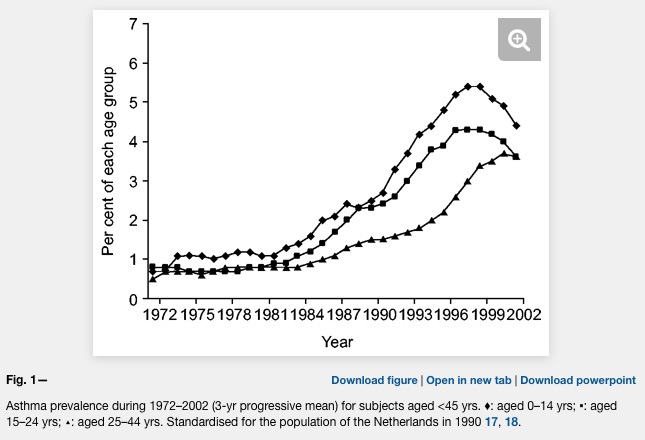
Asthma prevalence has increased in epidemic proportions with urbanization
Already the first sentence is wrong if we look at the following plot where asthma is clearly levelling off.
Urbanization happened in the late späten 19th century and not after 1950. Source of plot: The prevalence of asthma in children: a reversing trend ( ERJ 2005 )
Unfortunately, the difference between farm and non farm children is never explained in the Kirjavainen et al. paper. What is the average distance of a non farm house to a farm house? Are there any joint school or sports activities of children from farms and non farms (allergens travel in the classroom)? And why is there such a strong conclusion in the title?
Farm-like indoor microbiota in non-farm homes protects children from asthma development
A lower risk score is not equivalent to protection.
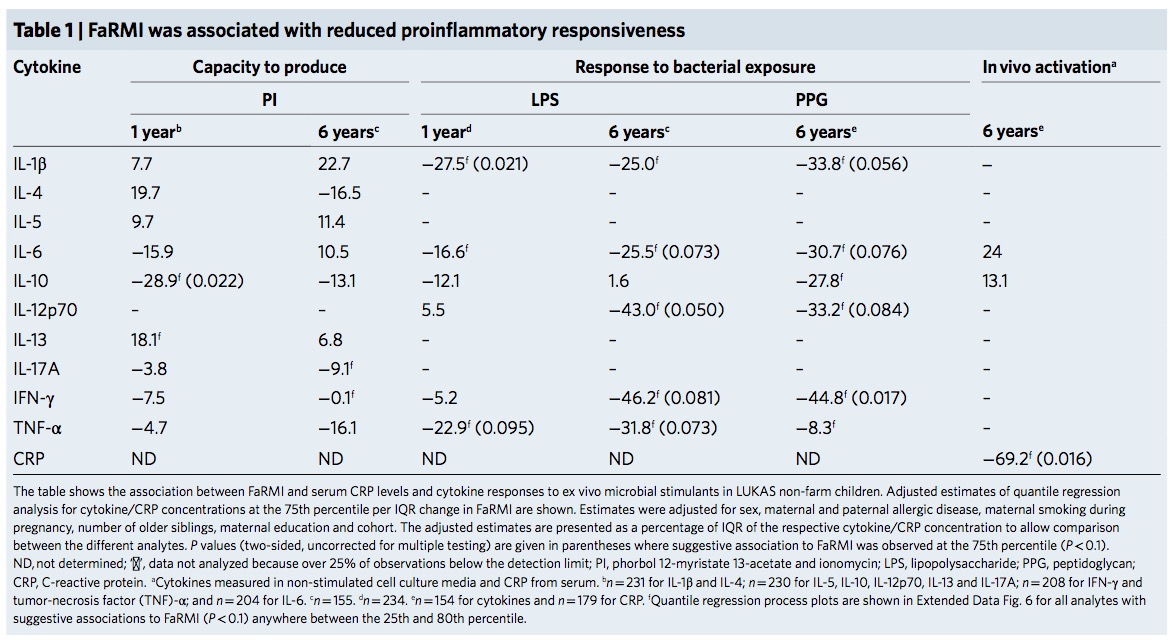
And did any reviewer ever look at the plots or tables?
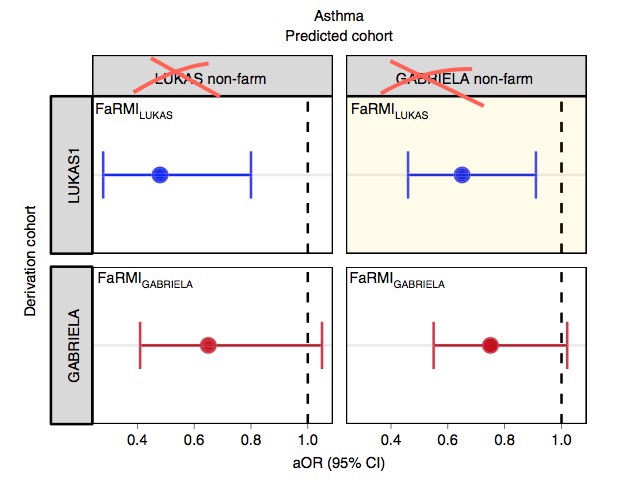
I do not understand Figure 3c. It even makes only sense when I cross out the top labels. But even then it menas: GABRIELA does not show a significant replication.
What should these values tell us? 5 times p<0.05 in a grid of 6×11=66 tests? Quantile regression that has been “adjusted” by the data?
The FaRMI calculation is overly complicated. Probably the calculation can never be replicated by changing software, changing samples, unclear wording, suboptimal dimension reduction and data snooping.
Farm home microbiota-like community composition was modeled in LUKAS1 with logistic regression analysis (PROC LOGISTIC statement, SAS version 9.3). The home location on a farm or non-farm rural environment was the dependent variable and the main components of PCoA axis scores of β-diversity matrices were the predictor variables. Bacterial and fungal microbiota were investigated separately. For both bacteria and fungi, separate models were built using axis scores from PCoA of abundance-unweighted and -weighted β-diversity matrices. The PCoA axes were selected based on the scree plot method including axes above the point at which the variance explained by the additional axes levels off (Supplementary Fig. 3). The models give an estimate of the probability that the sample is from a farm home. The farm home likeness of the microbial composition in the LUKAS2 non-farm homes was then estimated by applying the regression coefficients obtained from the LUKAS1-based models to the corresponding microbial data from LUKAS2 samples.Some analyses were performed in non-farm homes of both LUKAS2 and LUKAS1 to obtain increased sample size and power if results remain comparable as was observed. Due to the discovered association with asthma, the probability that was modeled based on the relative abundance-weighted bacterial/archaeal β-diversity was named FaRMI and was studied further in greater detail.
And isn’t that just an association that may have a rather simple explanation?
As FaRMI is weakly associated with muramic acid concentration in dust, the authors make Gram-positive bacteria responsible for the effect. The rhizosphere of soil is extremly rich of bacteria. The world’s first soil atlas showed hundreds of taxa but never differentiated between water resistant, gram positive and less water resistant gram-negative taxa. Maybe Gram positive Streptococcaceae are ubiquitous and depend on where you draw your samples?
FaRMI is found in non farm / rural children by bacterial/archaeal operational taxonomic units (OTUs) of soil origin which basically confirms my initial assumption: There was the same contamination of soil both in farm and non-farm homes if we look at supplement table 6 where walking indoors with outdoor shoes results in significant higher FaRMI values…Maybe the microbiome hype is already over.
Our results warrant translational studies to confirm the causal relationship through indoor microbial exposure-modifying intervention that may also form a novel strategy for primary asthma prevention.
Good luck with your future studies.
BTW – The scripts at Github are useless references to shell and Python scripts that will never run due to “—” characters. And what about that baby code?
Using R heredoc syntax I can rewrite 20 unreadable by 8 readable lines.
tmp <- 'Eigenvalue min / max: min.eigen / max.eigen
Sum of all eigenvalues: neg.eigensum
Sum of all eigenvalues (negatives as 0): nonneg.eigensum
Eigenvalues (pos & neg): pcoa
Percents (Negatives as negatives):  neg.percent %
Percents (Negatives as 0): nonneg.percent %'
for (i in c("min.eigen","max.eigen","neg.eigensum","nonneg.eigensum","pcoa$value$Eigenvalues","neg.percent","nonneg.percent") ) { tmp <- gsub(i,get(i),tmp) }
write(tmp, file=paste(getwd(),out,"/")
And why moving to SAS for a simple logistic regression? Is there anyone else in the academic world who pays $8,700 annually for a basic SAS Windows Analytics package just for that reason?
Ein lesenswertes Interview in der ZEIT mit Frank Trentmann “Die Herrschaft der Dinge“. Können wir mit Optimierungen im Alltag zu einem guten Leben gelangen? Der Historiker Frank Trentmann sagt: Wir sollten endlich aufhören, unserem Ich hinterherzujagen.
Die Pensionäre, Manager, Millionäre hingegen hatten Muße. Zeit zu haben war Teil des gehobenen sozialen Status. Wer einen hohen sozialen Status hatte, gab damit an, dass er im Sommer für acht Wochen in seine Villa nach Baden-Baden oder an die Côte d’Azur fuhr. Heute ist es genau andersherum: Einen hohen Status haben jene Menschen, die ständig unterwegs und beschäftigt sind.
Und die Optimierung des Alltags in der Wissenschaft? Früher war es das Privileg von Wissenschaft, Zeit zu haben, zu lesen, nachzudenken, Schlüsse zu ziehen, Ideen zu skizzieren. Heute gibt es das nicht mehr, nur noch Emails, Benchmarks, Impact, Fly-in und Fly-out, Meetings, Skype, Hype und PR q.e.d.
I installed the “Network Subsite User Registration” plugin which gives an extra menu point at each dashboard under Users>Registration>allowed There is, however, a glitch as wp-activate.php redirects to the main site in “signup-welcome” and “lead-in” sections that need to be commented out.
After all, I changed to “Profile Builder“, but it had its own problems, missing functions, large overhead, $$$ for extras and strange formatting instead of using the theme definitions.
Finally, I ended up with https://userswp.io , a lightweight user profile plugin that features front end user directory, a registration and a login form. The only modification here is another line in my child theme to suppress the WordPress admin bar.
I remember a long struggle against gene DNA patenting in the 1990ies around the Venter case while Science magazine has now an update.
Patents balance providing incentives to take the financial risks necessary to convert an invention into useful products with the benefits of sharing information to drive other useful inventions. Since the advent of DNA sequencing and gene identification methods, patenting human genes has been controversial. A notable example involves patents for the genes BRCA1 and BRCA2, variations in which modulate risks for breast and ovarian cancer. These patents supported increased costs and hence, limited accessibility, for diagnostic tests for cancer patients and their families. In 2013, the U.S. Supreme Court ruled that these patents were invalid (Association for Molecular Pathology v. Myriad Genetics).
I still think that there is way to much money spent on rather trivial discoveries of natural products where purification doesn’t justify a patent. So maybe only now the existing law is being revised.
Faktensammlung auf sz.de, Auszug “Ihr seid eine Plage” leider hinter Paywall, aber die Originalstudie (Link unten) ist frei verfügbar
Ein Berliner Projekt von Studierenden der Best-Sabel-Hochschule errechnete 2014, dass den Autos 19-mal so viel Fläche im öffentlichen Straßenraum zur Verfügung steht wie den Fahrrädern. 58 Prozent zu drei Prozent. Diese Autos, die in Werbespots ja immer so dynamisch durch malerisch endlose Fjordlandschaften düsen, stehen in Wahrheit mehr als 23 Stunden am Tag Stoßstange an Stoßstange im Stadtraum herum. In Berlin gibt es zehnmal so viel Fläche für Parkmöglichkeiten wie für Spielplätze. Laut dem dortigen “Flächen- Gerechtigkeitsreport” sind 19 Prozent der öffentlichen Verkehrsfläche parkenden Autos vorbehalten – ein Fünftel der Stadt ist Parkplatz.
Nun kostet ein Quadratmeter Bauland in Berlin im Schnitt 600 Euro. Ein Bewohnerparkausweis kostet aber nur 20,40 Euro. Für zwei Jahre. … Wer darauf hinweist, dass diese Parkgebühren doch absurd niedrig sind (in Amsterdam zahlt man 535 Euro für einen Jahresausweis in der Innenstadt, in Stockholm 827 Euro), der wird meist mit dem sozialen Argument ausgekontert: Parken müsse sich jeder leisten können. Komischerweise scheint dieses Argument aber nicht so wichtig zu sein, wenn es um Preiserhöhungen im ÖPNV geht: Seit 2004 verlangt die Stadt München die immer gleichen Parkgebühren pro Stunde (abgesehen von einigen Lizenzgebieten mit besonders hohem Parkdruck, in denen 2018 der Preis erhöht wurde). Im selben Zeitraum sind die Kosten für Einzeltickets und Monatskarten des ÖPNV um 40 beziehungsweise 60 Prozent gestiegen. Ähnlich ist es mit Regelverstößen: In den Niederlanden kostet Falschparken zwischen 50 und 140 Euro, in der Schweiz rund 100 Euro, bei uns kommen Falschparker oft mit 10 bis 20 Euro davon. Schwarzfahren kostet meist das Sechsfache.
Alle Zahlen in diesem Absatz stammen aus Untersuchungen der Berliner Mobilitätsforscherin Uta Bauer vom Deutschen Institut für Urbanistik.
Misconduct is ever increasing with the increasing science industry. The spectrum of misconduct is large – as I explained some years ago with an extended version of the N-S-C Diagram. Unfortunately, protection of whistleblowers as well as quality of university investigations remain low (or are even suppressed for various reasons). This is also the view of a new Nature editorial “What Universities could learn from one of the biggest science’s fraud”
university investigations into research misconduct are often inadequate, opaque and poorly conducted. They challenge the idea that institutions can police themselves on research integrity and propose that there should be independent organizations to evaluate allegations of research fraud should.
I agree.
Too many research-misconduct investigations turn out to be inadequate or flawed, says Gunsalus, who had a hand in creating a 26-point checklist that university officials can use to guide probes into research misconduct, which Grey’s team used to rate the investigations.
Madonna has about 14 million followers on Instagram, so the American singer knows first-hand how powerful the photo-sharing social network is for “influencing.” But now she’s speaking out against Instagram and the darker side of using it.
“You get caught up in comparing yourself to others,” the 60-year-old star tells The Sun in a new interview. “I think Instagram is made to make you feel bad.”
She says it’s especially hard for artists to develop their art and as people under the Instagram microscope.
“I was lucky enough to have a life as an artist before the phone and Instagram and social media because I did have that time to develop as an artist and a human without feeling the pressure of judgment of other people or comparing myself to other people,” Madonna states, adding that social media culture “runs people’s lives” and makes it harder for artists to “stick to your guns and be who you are.”
Der EU-Grenzwert für Stickstoffdioxid ist nach neuen amtlichen Daten im vorigen Jahr in 57 deutschen Städten überschritten worden. Wie das Umweltbundesamt (UBA) heute mitteilte, sank die Zahl der betroffenen Gemeinden damit um acht: 2017 war der Grenzwert noch in 65 deutschen Städten überschritten worden. UBA-Präsidentin Maria Krautzberger forderte weitere Maßnahmen, darunter die Nachrüstung von älteren Diesel-Autos mit „wirksamen Katalysatoren“.
An verschiedenen Benziner- und Flüssiggasmotoren in den Modellen Opel Corsa und Opel Adam könnte die Lambdasonde nicht richtig arbeiten. Das könnte zu erhöhten Emissionswerten führen. Opel ruft europaweit insgesamt rund 209.000 Kleinwagen der Typen Corsa und Adam in die Werkstätten zurück.
Es gibt weiterhin keine Diesel Nachrüstung, es kommt kein Tempolimit, auch keine Maut – und damit ändert sich auch weiterhin nichts an der Verkehrsbelastung in Deutschland.