
Geocode of “Platz der Grundrechte“
CC-BY-NC Science Surf , accessed 23.03.2026
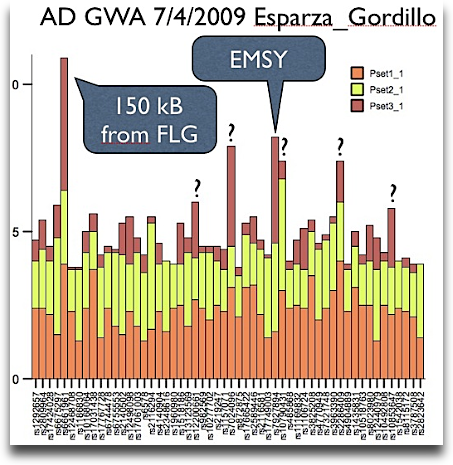
I have already seen this data in Washington and even talked to one of the two first authors (pun!) at the airport – the first genomewide scan for atopic dermatitis is now being online at the nature genetics website. The overall effects are disppointing small – my quick plot gives the cumulative (sic!) negative log p values.
Continue reading Why just C11orf30?
A new First Monday paper examines our modern publishing system that has been driving the art of doing science into a primitive strategy of making impact points.
These disruptive forces are represented by changing technological, economic, distributional, geographic, interdisciplinary and social relations to knowledge. The article goes on to examine three specific breaking points. The first breaking point is in business models — the unsustainable costs and inefficiencies of traditional commercial publishing, the rise of open access and the challenge of developing sustainable publishing models. The second potential breaking point is the credibility of the peer review system: its accountability, its textual practices, the validity of its measures and its exclusionary network effects. The third breaking point is post–publication evaluation, centered primarily around citation or impact analysis. We argue that the prevailing system of impact analysis is deeply flawed.
yea, yea.
NYT reports that Knome plans to offer its personal gene-sequencing service to the highest bidder in an eBay auction set to begin on Friday and continue for 10 days. This will include also a private dinner Continue reading I don’t want to bid for this dinner
A new editorial in one of my most favorite journals now finds that immune cell signal transduction is just too complicated to be effectively queried using traditional methods and mindsets – something that I felt for some long time to be true not only for immunology for also for genetics, yea, yea.
Having written in the last year a widely discussed paper about Informed Consent the new WMA revision #25 makes this rather waste paper:
For medical research using identifiable human material or data, physicians must normally seek consent for the collection, analysis, storage and/or reuse. There may be situations where consent would be impossible or impractical to obtain for such research or would pose a threat to the validity of the research. In such situations the research may be done only after consideration and approval of a research ethics committee.
With this paragraph in effect you can now to do every test on every sample that you possess. I will tell you from my practical experience how this work Continue reading Seoul update of the WMA declaration – you lost your rights
Thanks to the great audience in Washington DC watching our pro-con show about vitamin D and allergy. Are you still wondering about all the monkeys on my opponent’s slides? Me too…
With having fever from a flu on the way back to Europe, a picture came to my mind showing the 3 apes that are unable to see, hear and speak …
Mail me if there remain any doubts about the Th1 blocking effect of D3 or go to one of the recent reviews – I have take this for granted as it is even in standard textbooks like Roitt’s Immunology. Continue reading Three unwise monkeys
An American team believes to describe science activity by web clicks on journal pages.
Over the course of 2007 and 2008, we collected nearly 1 billion user interactions recorded by the scholarly web portals of some of the most significant publishers, aggregators and institutional consortia.
with the conclusion Continue reading Clickstreams
There seems to be a GWAS repository that has an entry of an asthma study otherwise not known in the biomedical literature and – as see on the screenshot -results tables are empty. Continue reading Factory science
New rumors say about Wolfram alpha
In this respect it is vastly smarter than (and different from) Google. Google simply retrieves documents based on keyword searches. Google doesn’t understand the question or the answer, and doesn’t compute answers based on models of various fields of human knowledge.
…
or those who are more scientifically inclined, Stephen showed me many interesting examples — for example, Wolfram Alpha was able to solve novel numeric sequencing problems, calculus problems, and could answer questions about the human genome too.
I have applied for a test account as I am interested in methods how to deal with genomic and all the other pentabyte of data — we urgently need a paradigm shift as single genome prices will go down to 1000 €. Continue reading A better search engine for science?
Find more like this at morenewmath
Another link tip is “Cut the Not“.
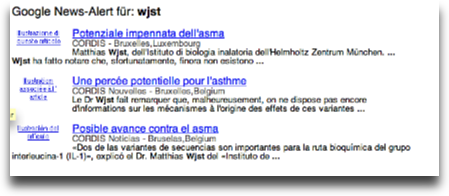
It’s a pleasant experience to write something that is being translated afterwards into so many languages afterwards. It is, however, irritating that this dissemination is irrespective of what I (and all second and third hand journalists and translators) understand of this curious world.
There are many interesting objects at the virtual Science Museum covering the long history of medicine. The site is currently down but will hopefully be restored this night.
