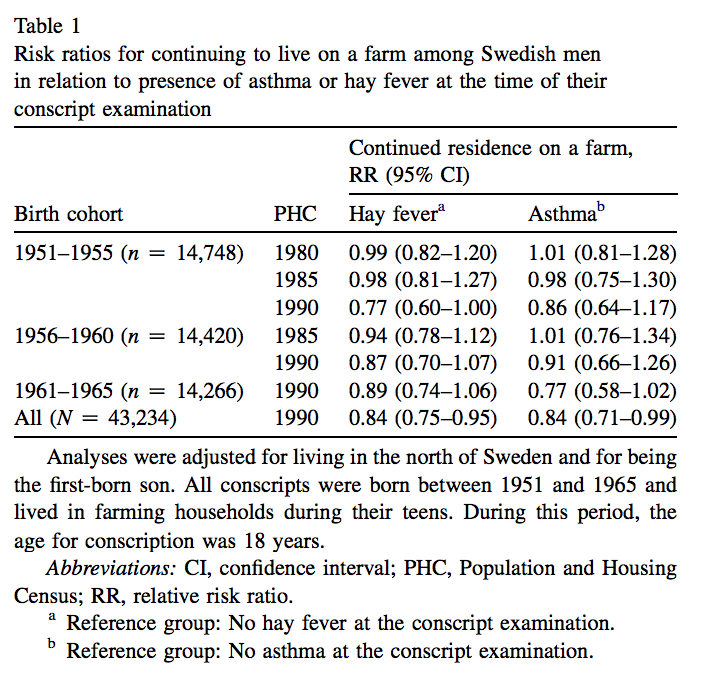
Unfortunately most studies in the farming environment do not report the prevalence of parental history. Neither did they report the effect size of parental genetic risk in the farming population. This is, however, a critical issue as the so called healthy worker effect (HEW) may be a rather trivial explanation of the results.
Specifically, it is a sampling bias: the kind of subjects that voluntarily enroll in a clinical trial and actually follow the experimental regimen are not representative of the general population. They can be expected, on average, to be healthier as they are concerned for their health [or as ill people already dropped out]
Leynaert 2001 showed only a slightly reduced prevalence of “allergy” (39.1% vs 41.5%, NS). Her table 4 is most interesting. The association started only after year 1960 which points towards severe misclassification as far as the analysis is not stratified by year of birth.
Remes 2002 showed a dose dependent effect decline between farming (36.2%) and controls (31.6%, P=0.075),
Perkin 2006 also found some significant lower prevalence in farmers 47.3% versus 57.7%, P<0.001. HWE is therefore likely.
I found further six studies (Thelin 1994, Braback 2006, Chenard 2007, Thaon 2011, Elholm 2013 and Spierenburg 2015) that examined in detail a possible relationship of HWE, allergy and farming. Unfortunately the examination period in five of these studies is too short to make any conclusion while Braback 2006 seems to be the only reliable study.
From this study, we can safely conclude, that there is a significant HWE.
Addendum 22 Nov 2019
It seems that I missed some papers on HWE and farming.
Timm 2019 is a hard to understand cluttered 3 generation study of unclear asthma type. Point estimates of parental asthma on farm upbringing are not really a measure of HWE – shuffling exposure and outcome distorts temporality. In contrast to the interpretation of the authors, I see a clear effect if both parents are born on a farm and one parent has asthma. The RR drops here to 0.33 that their child will be raised on a farm.
Vogelzang 1999: 400 pig farmers, X-sectional point estimates, not a real HWE study, although HWE offered as explanation.
Health-based selection of nonasthmatics for pig farming, which tends to mask a work-related hazard for asthma, is offered as an explanation for these results.
Eduard 2015: compares asthma prevalence of 313 Danish farm children to their 518 sibs (which is identical) but useless, as affected parents would basically dropout all children.
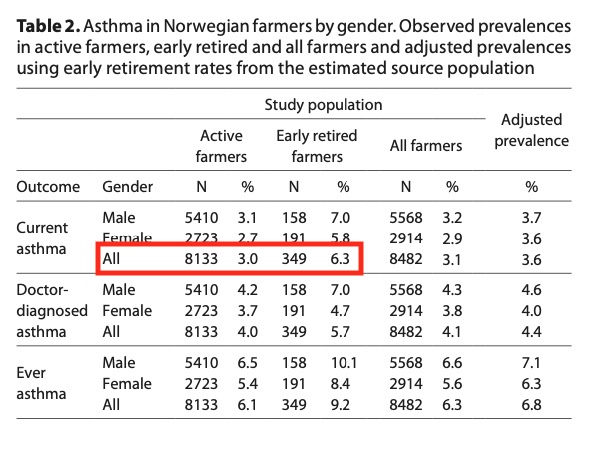
There is even a second comparison of Norwegian farmers with a clear effect. Instead of comparing the early retired farmers with their respective age cohort they invented a c complicated quantile logitic regression in 4 year intervals. Detailed model parameter and significance levels are missing.
At least the conclusion was
A healthy survivor selection was observed in Norwegian farmers, but it was too small to fully explain the reduced risk of asthma observed in this population. A strong selection effect was observed among farmers who had changed production type
One of the most fascinating articles earlier this year was the report of Timmers et al. about the “Genomics of 1 million parent lifespans implicates novel pathways and common diseases and distinguishes survival chances“. The British-Swiss-Estonian-Chinese-US collaboration identified by genome-wide SNP association of 1 million parental lifespan some new genes (ABO, ZC3HC1, and IGF2R) and replicate others (CDKN2B-AS1, ATXN2/BRAP, FURIN/FES, ZW10, PSORS1C3, 5q33.3/EBF1 and FOXO3).
Most of the variance is explained by disease variants that lead to dementia, cardiovascular disease, and lung cancer – of course people die of disease and not by bad genes. So whether correct or not, what worries me more is the construction of polygenic hisk scores that show a mean lifespan difference of around five years of life across the deciles.
This may become an ethical nightmare whenever treatment allocation will dependent on a polygenetic risk score that is largely irrelevant in an individual.
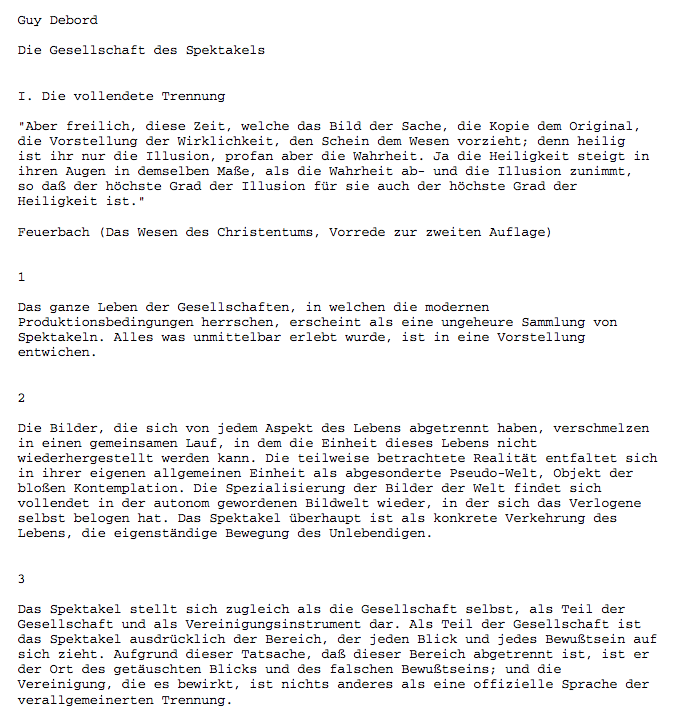
Die Gesellschaft des Spektakels (La société du Spectacle) ist das 1967 erschienene Hauptwerk des französischen Künstlers und Philosophen Guy Debord…Das Buch hatte großen Einfluss auf die französische Studentenbewegung des Pariser Mai 1968, erlangte später einen Kultstatus in Kunst und Subkultur und wird bis heute als medientheoretisches wie politisches Werk an Universitäten gelesen.
There is an interesting twitter thread by @Psychologists4F about news concerning the climate crisis and how we respond to the cognitive dissonance – the mental discomfort or psychological stress experienced by a person who holds contradictory beliefs or values. There are at least four possibilities how to respond to it
Change the behavior (“reduce, refine, replace”)
Changing the conflicting situation by just ignoring it
Justify own behavior by pseudoexplanations, pointing to others
Eine der häufigsten Formen der Greta-Skepsis aber findet sich bei … Angela Merkel. Sie sprach auf der Uno-Klimakonferenz in New York ein leicht vergiftetes Lob aus, weil in Gretas Rede “aus meiner Sicht nicht ausreichend zum Ausdruck kam, in welcher Weise Technologie, Innovation gerade im Energiebereich, aber auch im Energieeinsparbereich uns Möglichkeiten eröffnet, die Ziele zu erreichen.” … Es ist die Hoffnung, dass eine Technologie der Zukunft die Probleme von heute auf beinahe magisch-mystische Weise lösen werde. Es grenzt an die “Dunkle Technikhörigkeit der Ahnungslosen”, nur dass hier die Akteure sogar Ahnung haben. … Damit steht sie für eine ganze Denkschule.
Krautreporter hat ein interessantes Interview mit Bernhard Mittermaier der gerade für DEAL die deutschen Interessen am Verhandlungstisch vertritt. Und die rhethorische Frage stellt
Jede einzelne Uni könnte ohne Vertrag leben, aber das funktioniert nicht für das ganze System. Dann würden die Verlage gar kein Geld mehr verdienen, und von jetzt auf gleich wären die Zeitschriften tot. Es gibt genug Leute, die das gar nicht so schlimm fänden. Ich persönlich verfolge diesen revolutionären Ansatz nicht. Ich hätte zwar nichts dagegen, wenn diese Revolution geschehen würde. Mir wäre es nur lieber, wenn sie mit Ansage passiert. Wenn die Wissenschaft erklären würde, dass sie keine Zeitschriften mehr braucht. Das durch die Hintertür zu machen, fände ich schwierig.
As for scientists, they are not a breed apart. Compared to the scientists of only a few decades ago, they are more numerous, specialized, and costly. But as people, they are much the same, with individualities and frailties like those in other walks of life. Beyond the extreme of acceptable behavior, there may be laxity and negligence and rare instances of fraud, all of which now receive exaggerated media attention. It is common for science frauds to be attributed to ills in our society or to mismanagement of science, but I recall that 40 to 50 years ago, such psychopathic cases seemed as frequent as now on a per capita basis.
There is an interesting meta-analysis at JAMA Pediatrics about vitamin D supplementation during pregnancy and offspring growth, morbidity, and mortality. Nothing special, standardized methodology and even somewhat expected outcome.
In this systematic review and meta-analysis of 24 randomized clinical trials including 5405 individuals, vitamin D supplementation during pregnancy was associated with a lower risk of infants being small for gestational age and improved growth during infancy without an increased risk of fetal or neonatal mortality or congenital abnormality.
More interesting are the vitamin D lobbyists writing the accompanying editorial (Bo Chawes , Klaus Bønnelykke, Hans Bisgaard) . They try by nearly every sentence to devalue the findings of the meta-analysis. They are even getting to the point of
no adverse effects have been found
We don’t see things as they are, we see them as we are.
The recent encyclopedia article about the hygiene hypothesis seems to be well written. At least on the first instance … in reality it is more a novel than a scientific review.
For many years already, the hygiene hypothesis has been called an outdated concept; various times it was revised and transformed, and finally it gave birth to novel hypotheses.
In other words, the hypothesis has been rejected for being wrong . Even many revisions did not change that. There seem to be only one proven fact – the obsession of some authors with hygiene and nouvel Rousseauism.
Anyway, the hygiene hypothesis has promoted radical rethinking of infections, microbiota, and coevolution of mankind and microbes.
There is nothing radical in backward thinking. We still carry tons of microbes, freezer and antibiotics only did some qualitative but not so much quantitative changes,
With the advent of novel high-throughput sequencing technologies the human microbiome, which is sometimes called the ‘forgotten organ,’ has attracted much attention and is currently being implemented in a wider concept of self-foreign relationship, which may even include recognition of the nonmicrobial nonself as a vital stimulus to a well-developing immune system.
So the interest is technology and not science driven.
The microbiome is not an organ.
The hype is already over.
The Self is not defined by any bacterium.
Most bacteria are excreted and not vital stimulus.
Given the many molecule classes regulating immune functions across individuals such as short RNAs, the hygiene hypothesis may eventually come back as a surprising explanation of the phenomena evoked by crowding, day care, sibship size, orofecally transmitted diseases, and respiratory infections.
Why that?
A comeback of the hygiene hypothesis by short RNA?
The listed phenomena are not intrinsically related, but are occuring only at the same time scale.
Even the old birth order effect might be rediscovered as epigenetic programming someday. Admittedly, these notions are entirely hypothetical, but without hypotheses, proven or not, science hardly advances.
So if David Strachan’s birth order effect would be really caused by epigenetic programming – why would that be related to hygiene at all?
Science is is not so much about proven or unproven but about reasonable and non reasonable hypotheses.
Cum assensione cogitare, Glauben heisst denkend zustimmen: René Buchholz bringt auf feinschwarz.net einige Gedanken zu Max Horkheimers Hypothese, der Glauben sei eine Erfindung des Protestantismus, um einerseits die Wissenschaft, andererseits den Aberglauben nicht als einzige Alternative zu haben.
Die Unterscheidung des Glaubens vom bloßen Meinen einerseits und Wissen andererseits kennzeichnet indessen nicht erst die Reformation, wie Horkheimer meint, sondern wird bereits in der Scholastik vertreten […]. Nach Augustinus und Thomas bedeutet Glauben „cum assensione cogitare“ […] Der Glaube ist ein Akt des Intellekts […], verbunden mit dem Willen. Er bezieht sich auf eine Autorität, deren Glaubwürdigkeit durchaus geprüft werden darf, die vernünftigen Einsichten nicht widerspricht und Zustimmung verdient; eine Zustimmung, die getragen ist von göttlicher Gnade.
After World War II, the higher education systems ofEU countries witnessed an impressive growth in the numbers of students and staff and in spending. For example, the number o f students in the EU countries increased from about one million in 1960 to approximately nine million in 1990. In the same period, the gross enrollment ratio-i.e., total enrollment, regardless of age, divided by the population of the age group 20-24-grew from less than 10 percent to around 30 percent, depending on the EU country. This rapid growth was also connected with a rise in society’s expectations ofeconomic returns. These two phenomena have led to conflicting pressures on the institutional orga- nization and role ofthe university. Examples of the tensions characterizing contemporary universities are (1) incompatibility between the demands o f elite and mass higher education; (2) friction between curiosity-driven research aimed at the researcher-directed advancement of the knowledge frontier and targeted research driven by the needs of society; and (3) the different impacts of private and public financing.
The “incompatibility between the demands of elite and mass higher education” seems to me the main issue as the masses of higher educated people are producing also masses of research papers. Now we may understand https://onlinelibrary.wiley.com/doi/abs/10.1111/1468-2273.00160
It is argued that many of the consequences that have followed successive Research Assessment Exercises (RAEs) have been unintended and a high proportion of these, particularly the longer term ones, are deleterious or potentially so. Of these, the most serious is almost certainly the competitive, adversarial and punitive spirit evoked by the RAE which is clearly inherent in it.
Even where bona-fide papers are published in reputable journals, the problem remains of deciding how important and relevant they are. Professor Moosa examines various measures (mainly counting the numbers of times a paper is cited), none of which appears satisfactory. …
Productivity is defined solely in terms of journal articles, so that books, blogs, software apps, awards, teaching and many other valuable activities count for nothing…
Professor Moosa rejects the current system, where academics are required to make an annual return of papers published, on which their continued employment depends. Equally, departments are required to make a return of the numbers of staff reaching annual publication levels, and much effort goes into ‘gaming the system’. Staff with less than optimal publication records do not appear in the return. Other staff with exemplary records are hired for the week the evaluation takes place. In fact he suggests that so much effort is diverted from research into grant seeking that there are more ‘managers’ – always ‘senior’- than lecturers in academic departments. Vice Chancellors become CEOs with inflated salaries and legions of Pro-Vice chancellors. The cost of ‘administration’ is such that only a small fraction of ‘research’ funding reaches the actual researchers.
So going back to the intitial point – what are unintended research consequence? It looks like that science is dying slowly of self-extinction by evolutionary suicide.
Evolutionary suicide is a process in which selection drives a viable population to extinction. So far, such selection-driven self-extinction has been demonstrated in models with frequency-dependent selection. This is not surprising, since frequency-dependent selection can disconnect individual-level and population-level interests through environmental feedback. Hence it can lead to situations akin to the tragedy of the commons, with adaptations that serve the selfish interests of individuals ultimately ruining a population.