COPE has some interesting videos to watch

CC-BY-NC Science Surf , accessed 23.11.2026
There is a new Science paper that shows
A central promise of artificial intelligence (AI) in healthcare is that large datasets can be mined to predict and identify the best course of care for future patients. … Chekroud et al. showed that machine learning models routinely achieve perfect performance in one dataset even when that dataset is a large international multisite clinical trial … However, when that exact model was tested in truly independent clinical trials, performance fell to chance levels.
This study predicted antipsychotic medication effects for schizophrenia – admittedly not a trivial task due to high individual variability (as there are no extensive pharmacogenetics studies behind). But why did it completely fail? The authors highlight two major points in the introduction and detail three in the discussion
So are we left now without any clue?
I remember another example of Gigerenzer in “Click” showing misclassification of chest X rays due to different devices (mobile or stationary) which associates with more or less serious cases (page 128 refers to Zech et al.). So we need to know the relevant co-factors first.
There is even a first understanding of the black box data shuffling in the neuronal net. Using LRP (Layer-wise Relevance Propagation) the recognition by weighting the characteristics of the input data can already be visualized as a heatmap.
sondern wie es sich mit der Wahrheit verhällt – so Thomas von Aquin
Quia studium philosophiae non est ad hoc quod sciaturquid homines senserint sed qualiter se habeat veritas rerum.
De caelo et mundo, lib. I, lect. 22, nr. 228
Here is an interesting proposal of a bug bounty program

An interesting Nature editorial reporting a recent study
A study in Nature last month highlights a previously underappreciated aspect of this phenomenon: the existence of data voids, information spaces that lack evidence, into which people searching to check the accuracy of controversial topics can easily fall…
Clearly, copying terms from inaccurate news stories into a search engine reinforces misinformation, making it a poor method for verifying accuracy…
Google does not manually remove content, or de-rank a search result; nor does it moderate or edit content, in the way that social-media sites and publishers do.
So what could be done?
There's also a body of literature on improving media literacy - including suggestions on more, or better education on discriminating between different sources in search results.
Sure increasing media literacy at the consumer site would be helpful. But letting Google earn all that money without any further curation efforts? The original study found
Here, across five experiments, we present consistent evidence that online search to evaluate the truthfulness of false news articles actually increases the probability of believing them.
So why not putting out red flags? Or de-rank search results?
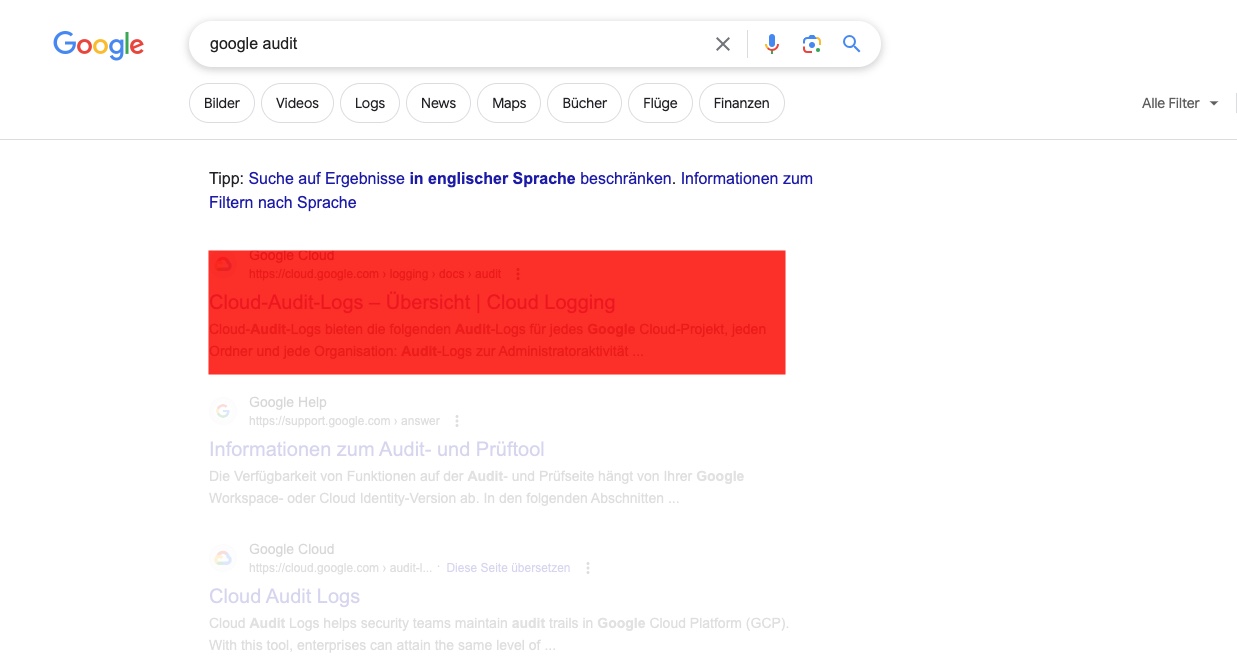
ist wohl schon eingeleitet zumindest bei der Betriebswirtschaft in Prag, Zitat
Texte, die mit Künstlicher Intelligenz verfasst wurden sind kaum von menschlichen zu unterscheiden. Eine Prüfung sei für Unis deshalb nur sehr schwer möglich, sagt Dekan Hnilica. “Wir haben andere Teile unseres Studiums, in denen die Studierenden ihre Lernergebnisse oder erwarteten Lernergebnisse nachweisen können. Daher ist die Bachelorarbeit überflüssig.”
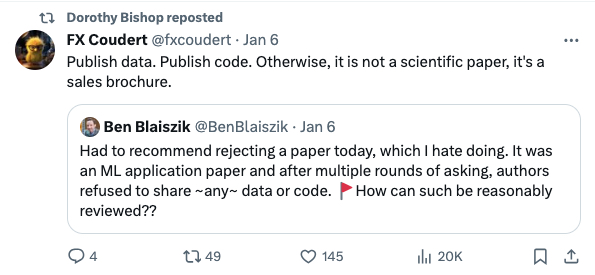
Bill Ackman is threadening Harvard faculty on X
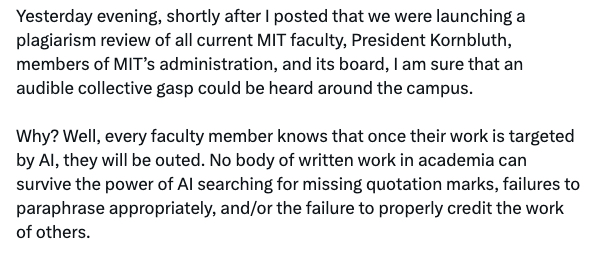
I expect that in the not too distant future AI will target every paper and not only a suspicious table or an image found by chance. Nevertheless using this now as a weapon is immoral and at high risk of false accusations. And , it may even be prosecuted as criminal defamation.
Feb 11, 2025
Unfortunately scientific integrity is being used again as personal weapon. Stefan Weber is making a business from right wing clients to verify doctoral theses. Without doubt, he has excellent technical skills (or at least a Turnitin account) but also completely lost all sense of proportion and direction. See
Back to SPIEGEL yesterday, translated
In some cases, his accusations turned out to be unfounded or less serious than he portrayed them. That's why he is viewed more critically in Austria. … Until the Föderl-Schmid case, none of this had harmed him much. But for those he accused, it was a different story. Even if the allegations came to nothing, their reputation was tarnished
5 tips for using PubPeer to investigate scientific research errors and misconduct

As an introductory text I can recommend a 5 year old blog entry introducing PubPeer
Battle lines are being drawn on the internet, between the scientific establishment and volunteer vigilantes trying to impose their own vision of the scientific process through “post-publication peer review”.
On one side is the cream of the scientific aristocracy: a professor with a meteoric career trajectory at Imperial College London, one of the best universities in the world, and the top academic publisher, Nature Publishing Group. On the other side: a few anonymous malcontents carping on an obscure web site called PubPeer (welcome to our site!).
Gravestein discusses the 70 page arXiv paper “Consciousness in Artificial Intelligence: Insights from the Science of Consciousness and 14 indicator properties from 6 areas

TBC
sleepwatcher(8) System Manager's Manual sleepwatcher(8)
NAME
sleepwatcher - daemon to monitor sleep, wakeup and idleness of a Mac
SYNOPSIS
sleepwatcher [-n] [-v] [-V] [-d] [-g] [-f configfile] [-p pidfile]
[-a[allowsleepcommand]] [-c cantsleepcommand]
[-s sleepcommand] [-w wakeupcommand] [-D displaydimcommand]
[-E displayundimcommand] [-S displaysleepcommand]
[-W displaywakeupcommand] [-t timeout -i idlecommand
[-R idleresumecommand]] [-b break -r resumecommand]
[-P plugcommand] [-U unplugcommand]
DESCRIPTION
sleepwatcher is a program that monitors sleep, wakeup and idleness of a Mac. It can be used to execute a Unix command when the Mac or the display of the Mac goes to sleep mode or wakes up, after a given time without user interaction or when the user resumes activity after a break or when the power supply of a Mac notebook is attached or detached. It also can send the Mac to sleep mode or retrieve the time since last user activity.
Continue reading The missing sleepwatcher manpage
1. What is all about?
Starting with Corona I have been streaming lectures and church concerts. A Macbook and a n old Chromebook, some old iPhones and Nikon DSLR cameras were connected by HDMI cables to a Blackmagic ATEM mini pro. This worked well although there are many shortcomings of HDMI as it is basically a protocol to connect just screens to a computer and not devices in a large nave.
2. What are the options?
WIFI transmission would be nice but is probably not the first choice for video transmission in a crowded space with even considerable latency in the range of 200ms. SDI is an IP industry standard for video but this would require dedicated and expensive cabling for each video sources including expensive transceivers. The NDI protocol (network device interface) can use existing ethernet networks and WIFI to transmit video and audio signals. NDI enabled devices started slowly due to copyright and license issues but is expected to be a future market leader due to its high performance and low latency.
3. Is there any low-cost but high quality NDI solution?
NDI producing videocameras with PTZ (pan(tilt/zoom) movements are expensive in the range of 1,000-20,000€. But there are NDI encoder for existing hardware like DSLRs or mobile phones. These encoders are sometimes difficult to find, I am listing below what I have been used so far. Whenever a signal is live, it can be easily displayed and organized by Open Broadcaster Software running on MacOS, Linux or Windows. There are even apps for iOS and Android that can send and receive NDI data replacing now whole broadcasting vehicles ;-)
4. What do I need to buy?
Assuming that you already have some camera equipment that can produce clean HDMI out (Android needs an USB to HDMI and iPhones a Lightning to HDMI cable), you will need
5. Which devices did you test and which do you currently use?
The Teltonika router and the two Zowietek converter cost you less than 500€, the Obsbot also comes at less than 500€ while this setup allows for semi-professional grade live streams.
6. Tell me a bit more about your DSLR cameras and the iPhones please.
There is nothing particular, some old Nikon D4s, a Z6 and a Z8, all with good glass and an outdated iPhone 12 mini without SIM card.
7. Have you ever tried live streaming directly from a camera like the Insta 360 X3?
No.
8. What computer hardware and software do you use for streaming and does this integrate PTZ control?
I use now a 2017 Macbook (which showed some advantage over a Linux notebook). NDI Video has to be delayed due to the latency of other NDI remote sources. I usually sync direct sound and NDI video with the sound being delayed with +450ms in OBS.
Right now I am testing also an iPad app called TopDirector. The app looks promising but haven’t tested it so much in the wild.
PTZ control can be managed by an OBS plugin, while TopDirector has PTZ controls already built in.
9. How much setup time do you need?
Setting up 2 DSLR cameras and 1 PTZ on tripods with cables takes 30-60-90 minutes . OBS configuration and Youtube setup takes another 15 minutes if everything goes well.