All posts by admin

5% of methylated sites escape reprogramming – a new allergy research direction

New Scientist Health has a short report how parents’ lives could change children’s DNA.

Azim Surani at Cambridge University and colleagues have demonstrated that some genes in the developing fetus escape the cleaning mechanism. Surani’s team analysed methylation patterns in a type of fetal cell that later forms a fetus’s own sperm or eggs. We would expect these cells to have been wiped clean when the fetus’s epigenome was reset at the early embryo stage. “However, about 2 to 5 per cent of methylation across the genome escaped this reprogramming,” says Surani.

The current wave of interest stems from three new papers: “The Transcriptome and DNA Methylome Landscapes of Human Primordial Germ Cells” by Guo demonstrates

The transcriptome of human primordial germ cells from the migrating stage to the gonadal stage reveals that both pluripotency genes and germline-specific genes are simultaneously expressed within the same individual cells. The global erasure of DNA methylation creates a super-hypomethylated germline genome.

So at week 10 after gestation, all analyzed 233  primordial germ cells lost their parental methylation marks except of 6% of the male and 8% of the female genome (which is a bit larger) . Unfortunately I did not find a list of genes there that have their parental methylation status transmitted.

Tang from a British consortium “A Unique Gene Regulatory Network Resets the Human Germline Epigenome for Development” writes

A unique transcriptome drives extensive epigenome resetting in human primordial germ cells for establishment of totipotency. Some loci associated with metabolic and neurological disorders exhibit resistance to reprogramming and are candidates for transgenerational epigenetic inheritance.

Here evolutionarily young and potentially hazardous retroelements, like SVA, remain methylated ( the number of embryos  being examined is not given). Evolutionarily young and potentially hazardous retroelements, like SVA, remain methylated. When testing for resistant loci, they found that H3K9me3 marked escaping ; resistant regions were also enriched for KAP1 (alias TRIM28) binding sites of ESCs. But still no gene list there.

Sofia Gkountela “DNA Demethylation Dynamics in the Human Prenatal Germline” from the US

performed whole-genome bisulfite sequencing (WGBS) and RNA-sequencing (RNA-seq) of human prenatal germline cells from 53 to 137 days of development. We discovered that the transcriptome and methylome of human germ-line is distinct from both human PSCs and the inner cell mass (ICM) of human blastocysts … Gene expression do not correlate with global changes in DNA methylation.

In this paper finally there is the gene list, I was looking for — basically not demethylated, parentally inherited genes. Persistent methylated regions (also termed DMR, differential methylated regions) in advanced germline cells (AGCs) were seen in 500+ genes as given in table S4:

AADACL2-AS1, ABCA7, ABCC5, ABHD12, ABR, AC093375.1, ACSL4, ACSM1, ACVR1C, ACYP1, ADAMTSL3, ADARB2, ADK, AGBL4, AGK, AGPS, AIG1, AKAP9, AKR1B15, ALPK2, ANK1, ANKHD1, ANKHD1-EIF4EBP3, ANKRD11, ANKRD12, ANKRD19P, ANKRD20A9P, ANKRD24, ANKRD26, ANKRD26P1, ANKRD30BL, ANKRD31, AP2A2, AP3D1, AP4E1, ARAP2, ARHGAP26, ARHGAP39, ARHGAP44, ARHGEF18, ARHGEF4, ARHGEF7, ARID3A, ARL13B, ASB3, ASH1L, ASTN2, ASZ1, ATAD3A, ATF1, ATP11A, ATP13A1, ATP2C1, ATP8A2, ATP9B, AUH, AVEN, BAGE, BAGE2, BAGE3, BAGE4, BAGE5, BASP1P1, BAZ1A, BBS9, BCAS3, BCO2, BCYRN1, BEND3, BEND7, BRE, BRSK2, C14orf159, C15orf37, C1GALT1, C1orf159, C20orf196, C22orf34, C2orf61, C3orf67, C3orf67-AS1, C7orf50, C7orf60, C9orf3, CACNA1B, CACNG4, CALN1, CAMK1D, CARF, CARS2, CC2D2A, CCBL2, CCDC101, CCDC130, CCDC148, CCDC149, CCDC57, CCDC88C, CCDC97, CCNY, CCSER1, CD163, CD2AP, CD46, CDH12, CDH4, CDKAL1, CELF2, CEP70, CERK, CERS4, CFH, CHD2, CHD6, CHODL, CHRM5, CHRNA10, CHRNA4, CLEC16A, CLIC5, CLIC6, CNOT2, CNTN6, CNTNAP2, COG2, COL15A1, COL18A1, COL24A1, COL6A4P2, COLEC11, CORO2B, CPVL, CRTC3, CSMD1, CSMD2, CSNK1D, CTB-7E3.1, CTDP1, CTIF, CTNNA2, CTNNA3, CUBN, CXCR2, CXorf49, CXorf49B, CYCS, CYP3A5, DAPK2, DCDC2C, DDA1, DENND1A, DENND5A, DGUOK-AS1, DIP2C, DLG1, DLK1, DNAH6, DNAH8, DNAJC1, DNER, DOC2GP, DOCK1, DOCK7, DPP10, DSTN, DTNB, DYX1C1, DYX1C1-CCPG1, EBF3, ECHDC2, EDIL3, EEPD1, EFCAB10, EFCAB4B, EFTUD1, EHBP1, EIF2B3, ELMO1, EP400NL, EPHA6, EPPK1, ERC1, ERCC8, ERICH1-AS1, ERP44, ETFA, EVC2, EXD3, EXOC2, EYS, F11-AS1, FAAH, FAM172A, FAM174A, FAM207A, FAM209A, FAM86FP, FANCC, FBN3, FBXO39, FGD4, FGF14, FHIT, FIG4, FLJ30403, FNBP4, FOXN3, FREM3, FZR1, GABRA2, GAS6, GBP2, GCNT7, GDA, GGCX, GLCCI1, GLRA1, GLRA2, GMDS, GNAI1, GOLIM4, GPR75-ASB3, GRIK2, GRM7, GTF3C6, GTPBP10, GUSBP1, H6PD, HCCAT3, HCN4, HDAC4, HECTD4, HEG1, HPGD, HRNR, HS6ST3, HTR7, IFNAR1, IGF2BP3, IGSF11, IGSF22, IGSF9B, IL1RAPL2, IL31RA, IMMP2L, IMPG2, INF2, INTS1, INVS, IPO7, IQCF3, IQCG, IRAK1BP1, ISOC2, ISPD, ITFG1, ITGB1BP2, ITGBL1, JAM3, JAZF1, JMJD1C, KALRN, KATNBL1, KDM3B, KDM4C, KIAA0825, KIAA1328, KIF4A, KIF5B, KLHL20, KLHL3, LANCL3, LDB2, LDLRAD3, LHCGR, LINC00239, LINC00408, LINC00469, LINC00670, LINC00871, LINC00922, LINC01193, LINC01194, LINGO2, LMF1, LOC100128505, LOC100133669, LOC100188947, LOC100289333, LOC101927069, LOC101927280, LOC101927286, LOC101929064, LOC101929387, LOC102723742, LOC145837, LOC283683, LOC285768, LOC286083, LOC442132, LPA, LPPR1, LRP1B, LRRC4C, LTBP1, LUZP2, MAD1L1, MAGT1, MAML3, MAOA, MAP3K15, MAP4K5, MAPK10, MAPK8, MAPK8IP3, MAST2, MCTP1, MCU, MEF2A, MEI4, MELK, METTL15, METTL9, MFHAS1, MIR1273H, MIR518B, MIR518F, MIR520B, MIR548H2, MIR548O2, MIR6130, MIR6744, MOB3B, MOCOS, MTG1, MTMR7, MUC2, MUC5B, MUM1L1, MYO10, MYO5A, MYO9A, MYT1, MYT1L, NAA20, NAALADL2, NAT1, NAV2, NBPF10, NBPF20, NCALD, NCOA2, NEBL, NFATC3, NIFK-AS1, NIPA1, NKAIN2, NKAIN3, NLRP4, NME7, NOC4L, NONO, NPHP4, NQO2, NRXN3, NSUN6, NTSR1, NUBPL, NXN, OGG1, OR8S1, OSBP2, OSBPL6, OSMR, PACS2, PARK2, PARL, PAWR, PCBP3, PCDH19, PCDH9, PCNT, PCNXL2, PCSK6, PDAP1, PDE11A, PDE4D, PGAM1P5, PGAM5, PHKB, PHRF1, PIK3C2A, PIK3CA, PIP5K1B, PKD2L1, PKHD1, PKIB, PLCD1, PLCH1, PLEC, PLOD2, POLR1A, POMK, PPARA, PPARGC1B, PPP2R5C, PRH1, PRH1-PRR4, PRICKLE1, PRKAR1B, PRKCZ, PROSER2, PROSER2-AS1, PRR26, PRUNE2, PTCD3, PTDSS2, PTGFRN, PTPN21, PTPRD, PTPRN2, PYGB, RAB28, RAB3D, RAB3GAP2, RAB3IP, RABGAP1L, RAPGEF6, RBFOX1, RC3H2, RFX7, RGS6, RGS7, RNF115, RNH1, RNU6-52P, RNU6-81P, RPH3AL, RPIA, RPL35A, RPS6KC1, RSPH1, RYR1, S100Z, SCAPER, SCCPDH, SCEL, SCFD2, SCHLAP1, SCMH1, SDHAP3, SDK1, SEC14L1, SEC24D, SEL1L, SEMA3C, SERPINB3, SESN2, SESTD1, SETD1A, SETDB1, SHANK2, SHC2, SIL1, SIN3B, SLC12A3, SLC22A15, SLC24A2, SLC38A10, SLC44A5, SLC6A1, SLC8A1-AS1, SNORD115-1, SNORD115-2, SNTB2, SNTG2, SNX29, SORCS2, SOX5, SPATA5, SPIDR, SPIRE1, SPTB, SPTBN2, SPTLC3, SRD5A1, SRRM4, ST20, ST20-MTHFS, ST6GAL1, STARD9, STIM1, STK31, STK38, STON1-GTF2A1L, STXBP5-AS1, SUPT3H, SYN3, TAF1L, TAS2R19, TENM2, TENM3, THRB, THSD7B, TIMM23B, TJP2, TLK1, TMCC1, TMED1, TMEM132D, TMEM218, TMEM66, TMTC2, TNRC6B, TPST1, TPTE, TRAPPC9, TRIO, TRPC4AP, TRPM2, TRRAP, TSNARE1, TSPAN15, TSPEAR, TSSC1, TTC28, TTC40, TULP4, TYRO3P, TYSND1, TYW1B, UGGT2, UHRF1, ULK4, UNC5D, UNC79, UNC93A, USP13, USP15, USP34, USP50, VGLL4, VPRBP, VPS53, WDPCP, WDR1, WDR19, WDR36, WDR60, WWOX, XAF1, ZBTB20, ZCWPW2, ZFPM2, ZFYVE9, ZKSCAN5, ZMAT1, ZMYM4, ZNF135, ZNF14, ZNF317, ZNF32, ZNF32-AS1, ZNF32-AS2, ZNF32-AS3, ZNF335, ZNF341, ZNF350, ZNF382, ZNF415, ZNF556, ZNF595, ZNF664-FAM101A, ZNF670, ZNF670-ZNF695, ZNF7, ZNF717, ZNF718, ZNF767P, ZNF808, ZNF845, ZNRF1, ZSWIM5

(I dropped two genes as they are only date-formatted numbers in the supplied Excel sheet).

The interesting question for me is if there is an interaction with genes identified earlier in asthma and allergy research. According to the GWAS catalog there are 190 associated genes that match only 9 on the list above: AS1, CLEC16A, CTNNA3, EDIL3, PDE4D, PGAM1P5, SDK1, WDR36. Nothing exciting, in particular no HLA association. WDR36 is the only gene, we published some years ago. I find also only one match (COL15A1) of the 73 low methylation IgE loci published earlier.

Possibly, any of these persistent methylated genes can even stand on its own feet with just one silenced / activated gene  being responsible for the pathology in a pedigree. I cannot identify so many signals in the list above, maybe some IL1 related stuff (IL1RAPL2, IL31RA, IRAK1BP1). CD46 at least is a good candidate as it is known that enhanced CD46-induced regulatory T cells will suppress allergic inflammation after allergen specific immunotherapy.

Unexpectedly, there are also no vitamin D related genes, no VDR, no cytochrome P450 enzymes. Nevertheless I recognize a whole bunch of calcium related genes:  STIM1 (transmembrane protein that mediates Ca2+ influx),  ATP11A + ATP2C1 (ATP dependent Ca2+ transporter), TRPM2 ( another Ca2+ channel), TRPC4AP + RYR1 (sarcoplasmic reticulum calcium channels) and NCALD (a cytosolic calcium transporter).

So would be definitely interesting to test the methylation status of these genes along with vitamin D levels in allergic parents and their kids.

 

CC-BY-NC Science Surf accessed 19.01.2026

Science Spam

As a scientist you are spammed by lab vendors, congress chairmen and journal editors. Here is a selection of the spam that I received during the last 24 hours, all “journal” titles that I have never heard before.


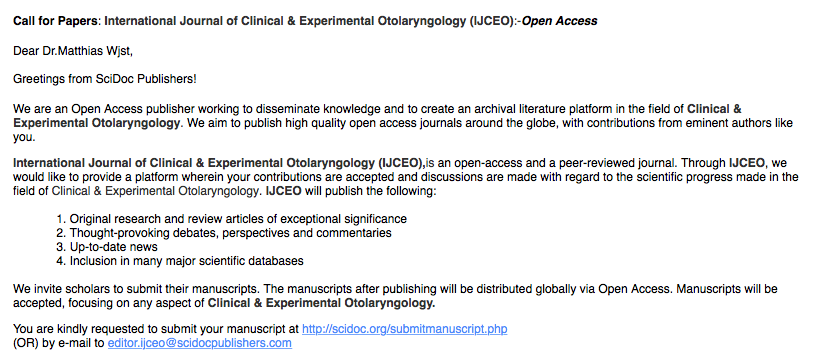
Journal of Clinical and Experimental Otolaryngology (Seoul, Korea)

Bildschirmfoto 2015-04-19 um 09.17.00

  Continue reading Science Spam


CC-BY-NC Science Surf accessed 19.01.2026

Can High Intelligence Be a Burden Rather Than a Boon?

Slashdot occasionally has some interesting science related discussion. The summary of the first response to “Can High Intelligence Be a Burden Rather Than a Boon?”

No amount of sex or expensive liquor or material goods can equate the joys of just proving a theorem. I will forever have this knowledge, that I could have been more, and chose less.


CC-BY-NC Science Surf accessed 19.01.2026

On verification

Most recently, I came across of another euphoric hygiene hypothesis review and wonder how this could ever happen. The evidence here is mixed and largely ambiguous.
Probably it would be best to follow some basic journalistic rules as summarized in the online “Verification Handbook for investigative reporting”

As with the verification of user-generated content in breaking news situations, some fundamentals of verification apply in an investigative context. Some of those fundamentals, which were detailed in the original Handbook, are:

– Develop human sources.
– Contact people, and talk to them.
! Be skeptical when something looks, sounds or seems too good to be true.
! Consult multiple, credible sources.
– Familiarize yourself with search and research methods, and new tools.
– Communicate and work together with other professionals — verification is a team sport.

Journalist Steve Buttry, who wrote the Verification Fundamentals chapter in the original Handbook, said that verification is a mix of three elements:

– A person’s resourcefulness, persistence, skepticism and skill
– Sources’ knowledge, reliability and honesty, and the number, variety and reliability of sources you can find and persuade to talk
– Documentation


CC-BY-NC Science Surf accessed 19.01.2026

No wonder pill

“In the case of religion, we put our faith in gods. And in nutrition, we have vitamins,” writes journalist Catherine Price in Vitamania, in which she traces vitamin crazes from the 1920s to the present.

Harvard Magazine reports about a new cancer vitamin D study. It includes more than 1,000 patients with metastatic colorectal cancer but going into the details it is a phase 3 clinical trial of chemotherapy and NOT a clinical trial of vitamin D. Vitamin D serum levels are used for posthoc stratification only although we know that these kind of studies are always misleading.  At least HM quotes VITAL research Manson with

Clinical enthusiasm for supplemental vitamin D has outpaced available evidence on its effectiveness

I wish the VDAART chairs at  Brigham and Women’s Hospital would have a similar realistic assessment. Their results are overdue with June 2014 ending of data collection for the primary outcome. Is it just the simple fact that vitamin D is not a wonder pill?


CC-BY-NC Science Surf accessed 19.01.2026

How religious is the world today

I received an interesting mail today that will be under embargo until next Monday. It is an Gallup International press release from a poll of 63,898 persons who were interviewed globally. In each country a representative sample of around 1000 men and women was interviewed either face to face or online with poll being conducted during September 2014 – December 2014. And voila, here are the results:

ResultsUnweighted Totals :A religious personNot a religious personA convinced atheist
Total638980,630,220,11
AFGHANISTAN21000,870,090
ALGERIA10000,90,080
ARGENTINA10000,720,160,04
ARMENIA10670,930,030,02
AUSTRALIA10060,340,440,14
AUSTRIA10000,390,440,1
AZERBAIJAN10520,340,540
BANGLADESH10000,930,050
BELGIUM10000,440,30,18
BOSNIA10000,650,290,03
BRAZIL20020,790,160,02
BULGARIA10080,520,360,03
CANADA10110,40,410,12
CHINA11500,070,290,61
COLOMBIA10020,820,140,03
CZECH REPUBLIC10000,230,450,3
DENMARK5050,420,40,12
ECUADOR9730,680,270,01
FIJI10020,920,060,01
FINLAND9930,560,320,1
FRANCE10000,40,350,18
GEORGIA10000,930,060,01
GERMANY10000,340,420,17
GREECE10000,710,150,06
HONG KONG5000,260,360,34
ICELAND10570,510,30,14
INDIA5560,760,210,02
INDONESIA5300,820,150
IRAQ0000
IRELAND10050,450,410,1
ISRAEL5750,30,570,08
ITALY10230,740,180,06
JAPAN12000,130,310,31
KAZAKHSTAN5000,640,190,08
KENYA10150,890,070,02
KOREA15000,440,490,06
KOSOVO11040,830,070,01
LATVIA10050,40,410,09
LEBANON10000,80,160,02
MACEDONIA12040,880,080,02
MALAYSIA5000,720,20,03
MEXICO10010,680,240,04
MOROCCO10000,930,040,01
NETHERLANDS10500,260,510,15
NIGERIA8000,830,140,02
PAKISTAN20000,880,10,01
PALESTINIAN TERR.7530,750,180,01
PANAMA12000,810,120,02
PAPUA NEW GUINEA4860,830,040
PERU12000,820,110,02
PHILIPPINES10000,860,120,01
POLAND10040,860,10,02
PORTUGAL10010,60,280,09
ROMANIA10550,770,160,01
RUSSIA10000,70,180,05
SAUDI ARABIA0000
SERBIA10150,720,180,03
SOUTH AFRICA5000,910,080
SPAIN10440,370,350,2
SWEDEN10030,190,590,17
SWITZERLAND10030,380,460,12
THAILAND6140,940,010,01
TURKEY10080,790,130,02
UK10000,30,530,13
UKRAINE5000,730,170,07
USA10160,560,330,06
VIETNAM5000,340,410,13
ZIMBABWE0000

Like it or not, it’s one of the main driving forces of the world.


CC-BY-NC Science Surf accessed 19.01.2026

Von vertikaler und horizontaler Wissenschaft

Zur Krise der Wissenschaften kann man vieles sagen. Dabei wird das eher selten gemacht, denn eigenartigerweise ist Wissenschaft nur wenig selbst reflexiv. Warum mit immer mehr Wissen und immer mehr Bildung, die eigentliche Wissenschaft – Aufstellen von Hypothesen, Überprüfen von Sachverhalt und logischen Folgerungen – in den letzten Jahren immer weiter abgetreten ist? Continue reading Von vertikaler und horizontaler Wissenschaft


CC-BY-NC Science Surf accessed 19.01.2026

Is this a retraction of the hygiene hypothesis?

There are news about the hygiene hypothesis.

Home cleanliness resulted only in quantitative reduction of floor dust, which mainly indicates removal of superficial dirt with a rather cosmetic effect. Conventional cleaning does not eradicate microorganisms sustainably, because emptied microbial niches are instantly recolonized by ventilation and living carrier.

Sure. Continue reading Is this a retraction of the hygiene hypothesis?


CC-BY-NC Science Surf accessed 19.01.2026

U shape is good and bad

I did not expect that serum vitamin D levels are associated with mortality at both ends of the distribution as now shown by Dorup et al.

Out of 247,574 a total of 16.645 subjects died in the ensuing 0 -7 years. … 25-hydroxyvitamin D level of 70 nmol/L was associated with the lowest cardiovascular disease mortality risk … At the higher extreme (125 nmol/L), the hazard ratio of cardiovascular disease mortality was 1.3 (95% CI 1.2-1.4), with similar risk among men and women.

Following our first paper on U shaped vitamin D effects there are now many more papers show that effect. Vitamin D is not just good or bad, it is both depending on timing, dose, application, whatever.


U


CC-BY-NC Science Surf accessed 19.01.2026