All posts by admin

Genes on the move

–Day 2 of Just Science Week–

Most people think that human genes are static entities inherited from generation to generation. They may be right, there are no jumping genes in humans.

In 2000, when defending my thesis in epidemiology, I even had to answer the question of the faculty: “How can allergy have a genetic cause as most allergy cases date back only 1 or 2 generations?”. I explained the concept of susceptibility genes (that were always there) plus some new environmental risk factor (that came in only recently) and passed the colloquium.

Maybe this concept was not completely wrong. By today, however, I could offer more explanations – human genes are on the move and even within 2 or 3 generations. You may still wonder – are we talking about T cell receptor recombination? Yes, this may be a possibility, but not a really new one. More noteworthy are (1) abolished purifying selection (2) population admixture and (3) increased spike in mutations. These are all are independent paths that may combine freely.

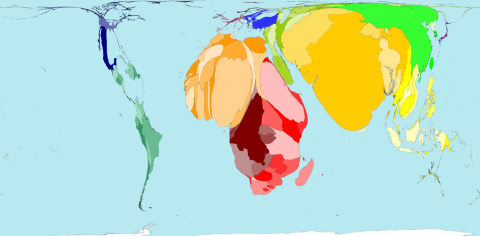
Lets start with “abolished purifying selection”. At the beginning of the last century there were much larger family sizes and a much higher infant mortality. In Europe, mortality under the age of 5 has been about 250/1.000 live born children in 1900. It dropped to 50/1.000 around 1950 and is now about 5/1.000 – the effect of improved sanitary conditions, vaccines and antibiotics. Geneticists would describe it as a reduced selection – giving immediate rise to some variants in the gene pool.

The figure is © Copyright 2006 SASI Group (University of Sheffield) and Mark Newman (University of Michigan). Thanks to John Pritchard from the Worldmapper Team to let me post it here. Territory size shows the proportion of infant deaths during the first year of their life in 2002
261.png

Second, think of population admixture. This usually refers to the composition of a population by descendants of a few founders. Except for major migration periods population composition has been kept rather stable over centuries which can be nicely seen in humans living in isolation and having enriched some diseases – examples from Finland, Hutterities, South Tirol, East Adria or Iceand. With current decrease of admixture also the prevalence of diseases frequently seen in these populations will go done. However, some people even expect that other diseases will rise – as unusual allelic variants will meet other unusual allelic variants (which has not been balanced before). This theory is still vague but has interesting aspects that may be followed up.

A third possibility why human gene variants may change within short time comes with the ever increasing age of fathers at reproduction. I came across this only very recently by a paper of Ellegren. With each additional year of the father the number of pre-meiotic cell divisions increases – leading to a permanent (germline) increase of mutations. Most of these will be irrelevant but some may spike in random genes leading eventually to health effects. Crow asks: “Is this a problem? Surely it will be eventually, but probably not immediately”.

Human genes are therefore on the move, yea, yea.


CC-BY-NC Science Surf accessed 13.01.2026

Human genome variation

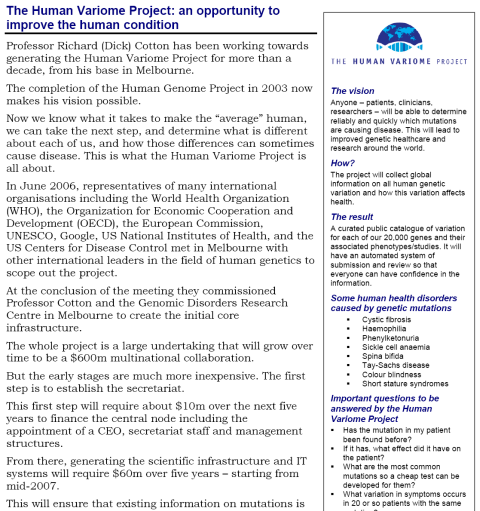
Being a former curator for a genetic disease database, I received a PM that explained why the foundation of the Human Genome Variation Society did not include most of the HUGO Mutation Database Owners — most did not join as they found it difficult to pay for membership. This reflects the overall frustration in obtaining funds for databases projects that are between research and service. Now, a new initiative for the Human Variome Project (HVP) is started to create a focus pulling the whole vision together and to assist in fundraising. Meeting details are at www.humanvariomeproject.org. I strongly support this initiative. All genetic variation databases are sharing a high interest in the community but zero interest at funding bodies (more). I have a dream…

the flyer…
humvariomeproj.png


CC-BY-NC Science Surf accessed 13.01.2026

Curiouser and Curiouser

–Day 1 of Just Science Week–

… said Alice in the Wonderland. Curiouser an couriouser all these gene X – trait Y – value P – association studies that are so often not reproduced. Science magazine now publishes letters of 3 independent groups contributing 6 essentially negative studies. This does not come unexpected – maybe we should look again at the original paper?
The introduction seems to be somewhat misleading — obesity is not primarily associated with another disease but with over-eating — and a heritablity of 70% is hard to believe. BTW I wonder why neither the editors, reviewers, or authors noticed the editorial errors (page 281: the 1775 cases in the text appear as 1835 cases in table 3; table 3 itself is redundant and misses genotype counts as well as the 923 FHS individuals from page 280). However, that does not explain why the association cannot be reproduced by other groups. So what could be the reason that the initial results were not be replicated?
Looking more closely at the case-control definition it seems that obesity is defined in different ways in the different populations – the German sample by cutoff BMI>30, the Polish by 90th to 97th percentile, the Nurses’ trait is never explained and the Africans are split by quartiles. How would a consistently defined look across all these populations? There seems to be also no proof why SNP rs7566605 somewhere 10000 bases away from a gene should have any biological function. Just because it “is an attractive candidate gene … [as it] … inhibits the synthesis of fatty acid” ?
More general, I believe that it is not adequate to make any conclusions about causal interference from a statistical association alone. There are many known fallacies; reasons for non replication may be simple errors during phenotyping or genotyping, inadequate statistical power, a biased analysis, selective reporting, population stratification or population unique effects. My six criteria for a meaningful association are:

  1. sufficient strong association, stable in subgroups and in populations of the same ethnic background
  2. importance of the tagged mutation leading to regulatory or structural protein change while excluding any confounding LD effect
  3. functional importance of the resulting protein with the trait of interest
  4. known genetic background and interaction with other genes and proteins
  5. known time of onset of functional change and interaction with relevant pathway
  6. known interaction with the environment, possibly also in an animal model

Quite simple ;-), yea, yea.


CC-BY-NC Science Surf accessed 13.01.2026

Laptop stolen – phoning home

Scientists are frequent travellers – hopefully you have always your harddisk encrypted. There are many companies that offer to trace your computer like Computrace(R), zTrace(R), LapTrak(R), BoomerangIt(R), LoJack(R) and PC-Guardian(R). Save your $/€ for your next experiment, here is the trick: During the next boot your laptop will send out a http request to any server you like. You simply need to watch the server logfile if your stolen laptop is phoning home…
For installation please download LaptopService.cmd, LaptopService.reg and two small binaries from the windows ressource kit. Adjust path and server name before running LaptopService.cmd. Voilà, that’s it – for a good joke look at Slashdot.

|wj_LaptopService.cmd|


CC-BY-NC Science Surf accessed 13.01.2026

Bionic woman and artifical bladders

I am always fascinated by surgery – the new Lancet shows the re-inervation map for a complete left arm. There is also an excellent lay article. The paralympics photos are always spectacular and I admire all people who manage their life with an amputation. I am, however, also impressed by advances in tissue engineering which may not seem so spectacular on a first view but are quite important for many children.


CC-BY-NC Science Surf accessed 13.01.2026

Asthma – a disease of the gut

When starting in the asthma field in 1989, the textbooks told me that asthma is a disease of the lung. Some years later, asthma turned out to be a disease of the bone marrow cells. More recently, I raised the question if asthma could be even a disease of the gut – our largest immunological organ being frequently exposed to allergen & plenty of immunological active substances. Although on the different track (vitamin A) also other authors now think of an early impaired immune gut response.
Rather unexpected for me was a study in J Steroid Biochem Mol Biol that 1,25(OH)2D3 inhibits in vitro and in vivo intracellular growth of the parasite Toxoplasma gondii. yea, yea.


CC-BY-NC Science Surf accessed 13.01.2026

Genes wanted

The NIH and Jackson ask for nominations of their gene targeting approach (see also A mouse for All Reasons and my previous comment on the 3 R)

KOMP is a trans-NIH initiative to generate a public resource of mouse embryonic stem (ES) cells containing a null mutation in every gene in the mouse genome. Both conditional and null knockouts are being generated. The purpose of this form is to gather input from the scientific community on which genes should have the highest priority for being knocked out.

The Cell paper also explains the hard to understand differences in knockouts

  1. targeted deletion
  2. targeted conditional
  3. trapped conditional

although I still have semantic problems to understand the nomenclature. Anyway my whishlist – you can do me a favor by voting for CYP27B1, VDR, CYP24A1, OPN, IL4, IL5, IL10, IL12, IL13, FLG, CCR5 and CCR9.

Addendum

You can also leave some input at the Environmental Genome Project.


CC-BY-NC Science Surf accessed 13.01.2026

Are science blogs dangerous?

Amnesty International reports that an Egyptian blogger is now facing up to 10 years in prison for criticizing Egypt’s religious authorities. A German blogger writing about constructing buses in China even faced an invitation to a court in Bejing. And everybody knows of Ellen Simonetti becoming famous for being fired by Delta.
A major difference of blogs to accredited journalism is also the limited capacity to respond to any prosecution: I don’t have any money for a lawyer while newspapers and journals can hire dozens.
Sure, science blogs are much less intrusive but there is always a risk that the empire will strike back; 99% of grant and paper reviews are anonymous.
BUT, there are good news – the blog community is large and always alert. As a science blooger writing on bad science you can now even get nice prizes – gratulations to Ben. Don’t forget that all students arriving in your lab have read your weblog first.
Refraining from all activities also involves some risk, yea, yea.


CC-BY-NC Science Surf accessed 13.01.2026

Let vitamin D shine in

said the Denver Post giving a nice overview of vitamin D research. This was just 1 day too early for a fascinating nature immunology paper (scienceblog:doi:10.1038/ni1433:) that links for the first time natural sunlight induced vitamin D action on dendritic cells. Seems that D3 will influence homing of T cells – we are again at “Licht und Leben“, yea, yea.

Addendum


CC-BY-NC Science Surf accessed 13.01.2026

Resilience

Yesterday I heard for the first time of this psychology term. It describes how humans cope with stress, anger or other negative events – even over long time periods. Some people give up but others still grow (“skipjacks”). Seems that this trait can be immedately tested in scientists ;-) there is even a journal Disaster.


CC-BY-NC Science Surf accessed 13.01.2026

Supersize me II

Some of you may remember the fake food hypothesis that relates the obesity epidemic to the introduction of highly processed industrial food. JCI now has a nice review on the satiation signal and the complex system that may be disturbed.
Microbe content might also be important in this context click | click | click, however, even the adoptive transfer might be a secondary effect – everything in biochemistry follows mass equilibrium constants. The poorer resorption in the lean may lead to a different colonialization and vice versa. Will the adoptive transfer really show lasting effects longer than 2 weeks (in the mouse study)? Isn´t colonialization not influenced by diet (in the human study)?

gutsensing.png

Yea, yea.


CC-BY-NC Science Surf accessed 13.01.2026