https://debruine.github.io/talks/RIOT-code-review-2022
CC-BY-NC Science Surf , accessed 20.08.2026
Most recently I had to add forgotten data to a SQL server database that was in use only until 2010. Script language was Cold Fusion at that time creating a visual interface to 96 well plates where proband IDs are assigned to plate positions by drop down fields.
R doesn’t have any good way for formatted data entry. Some shiny apps would be helpful but a bit overkill here. Data export into a javascript framework would be also a more professional solution while I just needed only a quick way to modify my database.
So I came up with some R code producing html code embedding javascript functions that can export the result as SQL code, so a 4 language mixup.

dataentry <- function(plate_id,city) {
# get orig IDs from database first

# position identifier A01, A02...
pos = NULL
for (i in 1:8) {
  pos = c(pos, paste0( rep( LETTERS[i], 12), str_pad( 1:12 ,2,pad="0" ) ) )
}

HTML <- paste('<html>
<script>
function download(filename, text) {
  var element = document.createElement("a");
  element.setAttribute("href", "data:text/plain;charset=utf-8," + encodeURIComponent(text));
  element.setAttribute("download", filename);
  element.style.display = "none";
  document.body.appendChild(element);
  element.click();
  document.body.removeChild(element);
}
function saveValues() {
  var frm = document.getElementById("f");
  var params = "";
  var sample_id = ',sample_id,';
  for( var i=0; i<frm.length; i++ ) {
    sample_id++;
    var fieldId = frm.elements[i].id;
    var fieldValue = frm.elements[i].value;
    if (fieldValue) params += "INSERT INTO samples (plate_id,plate_position,patient_id) VALUES (',plate_id,'," + fieldId + "," + fieldValue + ")\\n";
  }
  download("',plate_id,'.SQL",params);
}
</script>
<body>
<form id="f">')

# dropdowns
sel ='<option value=""></option>'
for (i in 1:dim(patients)[1]) {
  sel <- paste0(sel,'<option value=',patients[i,"patient_id"],'>',patients[i,"Orig_ID"],'</option>\n')
}
for (i in pos) {
  if (substr(i,2,3) == "01") HTML <- paste0(HTML,'<BR>')
  HTML <- paste(HTML,'<select id=',i,'>',sel,'</select>')
}

HTML <- paste(HTML,'</form>
<br><input name="save" type="button" value="SQL" onclick="saveValues(); return false"/>
</body></html>')

sink( paste('plate.html') )
cat(HTML)
sink()
}
dataentry(725,'city')
Ein Frosch sah einen Ochsen gehen.
Une grenouille vit un Bœuf
Wie stattlich war der anzusehen!
Qui lui sembla de belle taille.
Er, der nicht größer als ein Ei, war neidisch drauf,
Elle qui n’était pas grosse en tout comme un œuf,
Er spreizt sich, bläht mit Macht sich auf,
Envieuse s’étend, et s’enfle, et se travaille
Um gleich zu sein dem großen Tier,
Pour égaler l’animal en grosseur,
Und rief: »Ihr Brüder achtet und vergleicht!
Disant : « Regardez bien, ma sœur,
Wie, bin ich nun so weit? Ach, sagt es mir!« -
Est-ce assez ? dites-moi : n’y suis-je point encore ?
»Nein!« - »Aber jetzt?« - »Was denkst du dir!« -
- Nenni. - M’y voici donc ? - Point du tout. - M’y voilà ?
»Und jetzt?« - »Noch lange nicht erreicht!« -
- Vous n’en approchez point. » La chétive pécore »
Das Fröschlein hat sich furchtbar aufgeblasen,
Es platzte und verschied im grünen Rasen.
S’enfla si bien qu’elle creva.
Le monde est plein de gens qui ne sont pas plus sages :
Tout Bourgeois veut bâtir comme les grands Seigneurs,
Tout petit Prince a des Ambassadeurs,
Tout Marquis veut avoir des Pages.
There is a long explanation over at medium
committing code is a small part of what software engineers do. There are many ways in which you can contribute technically without writing much code. In fact, the best senior engineers I know are great at prioritization, delegation, and simplifying. Their pull requests are tiny because they've made the code modular and straightforward. … Writing negative code is a point of pride! If you refactored a complex piece of logic, picked a good library to solve a problem, or eliminated unnecessary features, then you'll have a negative commit history. .. fine-tune configs, research arcane issues, and dive deep into underlying architecture. Working on these jobs can mean days of research just to make a few-line change.
The same applies to amount of funding received by a scientist (although frequently used for calculation of salariy). If I can achieve the same impact at a fraction of the costs, isn’t that much better than producing more costs?
Is there at least one positive advice of all that Musk utterance?
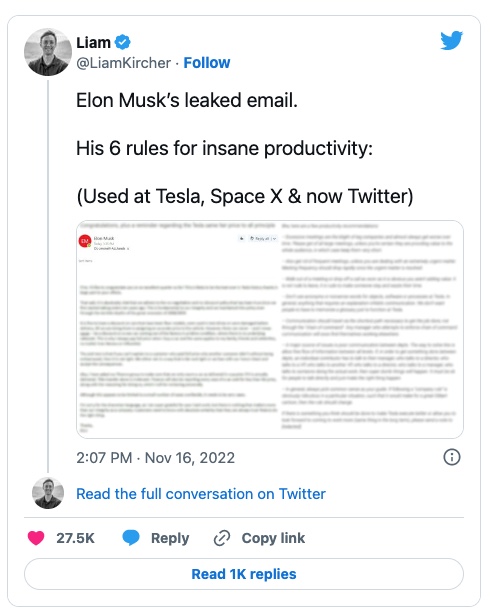
Warning : 2) and even other x) only suitable for slightly autistic, self obsessed and excellent scientists.
AI works well in some areas while results are very mixed or even dangerous in others [1, 2].
But what about AI in generic scientific areas?
I have recently looked at scite.ai, a service that claims to analyze a paper if the references have been supported or contrasted the findings — any references that have been retracted in the meantime or received an expression of concern? While the latter isn’t really a big question, I was not very much impressed by the results as most references could not be classified.
But there are now more companies off the ground. Let’s have a look at some.
One is SciScore

SciScore claims
SciScore generates three reports and a score for every submission. These materials assist researchers, editors, and funders in improving the quality and reliability of scientific research by automatically reporting detected criteria of interest for future review. Researchers signing up with their ORCID get ten free reports. Reports can take as little as 1 minute!
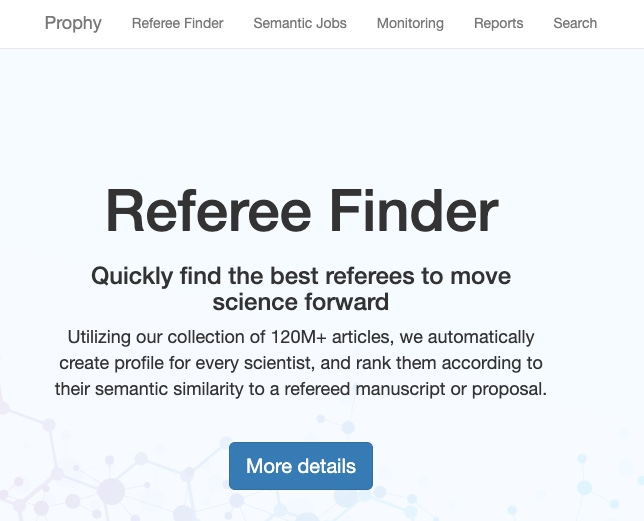
The next one is Prophy, another reference finder.
and there is Galactica.

and well also copy.ai

I have no idea if we really need this kind of stuff – any AI to write my blog even faster?
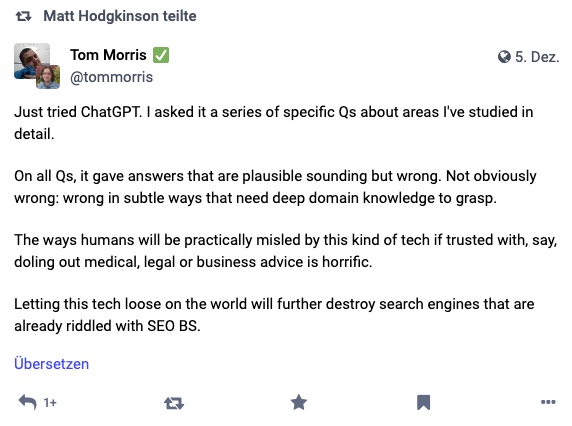
Also others commented earlier this month that it is “not obviously wrong but wrong in subtle ways”.
Fortunately Copyleaks released now even an AI detector just to fight back…
Ronagh & Souder in “The ethics of ironic science”
We adopt the concept of irony from the fields of literary and rhetorical criticism to detect, characterize, and analyze the interpretations in the more than 60 published research papers that cite an instance of ironic science. We find a variety of interpretations: some citing authors interpret the research as valid and accept it, some contradict or reject it, and some acknowledge its ironic nature.
bonus example 61 “Effect on human longevity of added dietary chocolate“
This question has been answered by an earlier study of Avenell et al.
By 2016 the affected trial reports were cited in 1158 publications, including 68 systematic reviews, meta-analyses, narrative reviews, guidelines and clinical trials. We judged that 13 guidelines, systematic or other reviews would likely change their findings if the affected trial reports were removed, and in another eight it was unclear if findings would change. By 2018, only one of the 68 citing publications, a systematic review, appeared to have undertaken a reassessment, which led to a correction.
We found evidence that this group of affected trial reports distorted the evidence base. Correction of these distortions is slow, uncoordinated and inconsistent. Unless there is a rapid, systematic, coordinated approach by bibliographic databases, authors, journals and publishers to mitigate the impact of known cases of research misconduct, patients, other researchers and their funders may continue to be adversely affected.
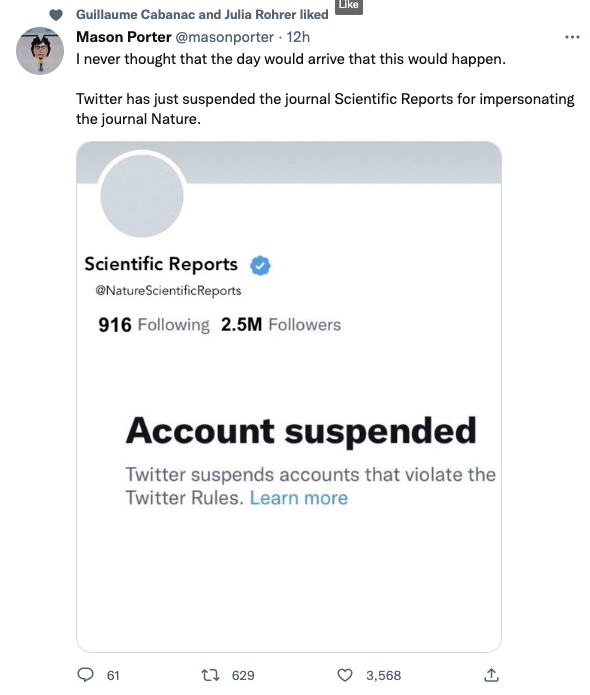
A legendary tale of the dying Twitter imperium
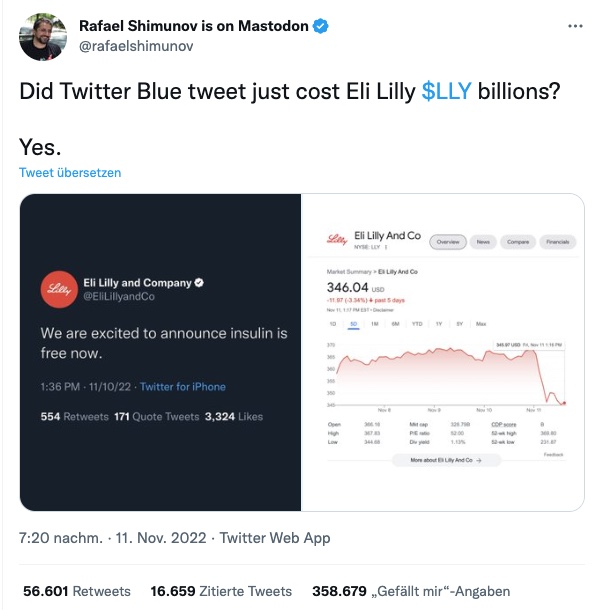
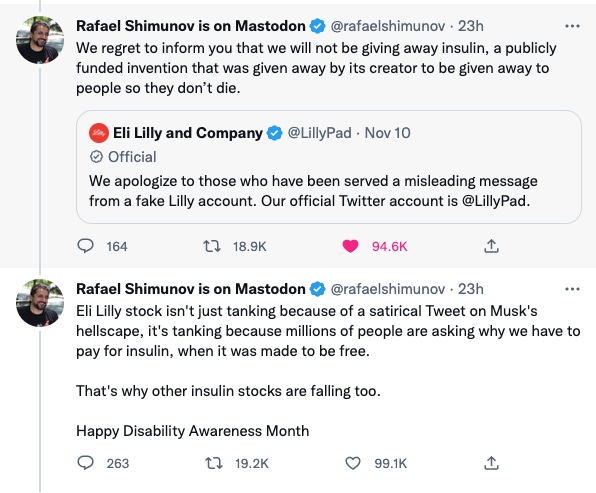
And well, parody everywhere…
(in öffentlich zugänglichen Originaldokumenten)

In Neuherberg stand ein TRIGA Mark III, in Mainz bei Fritz Straßmann, dem Mitentdecker der Kernspaltung, ein TRIGA Mark II.





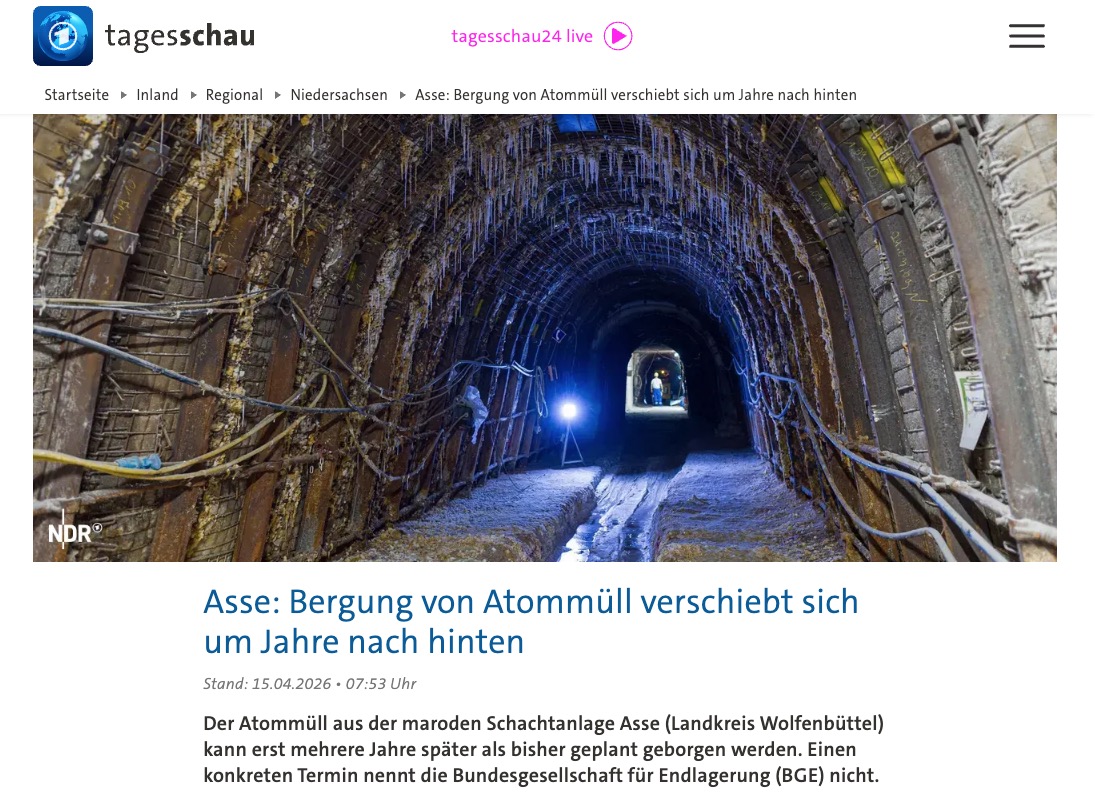
Das Ende der Endlagerung


Even after deleting any account, shadow profiles are still there and linked to your addressbook. Here is a link to delete them (if Meta is not cheating) https://www.facebook.com/contacts/removal


Es gibt bisher wenig gute Erklärungen der Querdenken Bewegung.
Warum verfallen Menschen auf bestimmte Meinungen? Und was unterscheidet sie zum Beispiel von den wahnhaften Störungen in der Psychiatrie oder aber auch von Fehlschlüssen in der Wissenschaft? Irgendwie scheint sich doch alles auf einem Kontinuum zu bewegen?
Bei dem Versuch einer Antwort folge ich dabei mehr oder weniger dem Psychiater Manfred Lütz, der auch nicht viel auf unsere psychiatrischen Diagnosen gibt, da sie nur Hilfskonstruktionen sind die nur einem Zweck dienen, nämlich Menschen medizinisch zu helfen (S.32ff)
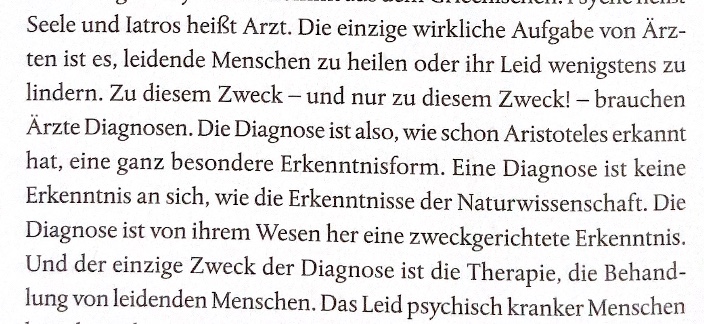
Unbestrittenes Kennzeichen des Wahns ist jedenfalls die Unfähigkeit, die Perspektive zu wechseln. Mit dieser Definition gelingen nun auch die Unterscheidungen: So sind Psychotiker und Querdenker beide unfähig, die Perspektive zu wechseln, während das den meisten Wissenschaftlern aber möglich sein sollte.
Psychotiker leiden unter dieser Unfähigkeit (zumindest im symptomfreien Intervall) während Querdenker darüber in ihrer Gemeinschaftserfahrung Bestätigung erfahren. Die “self enforcing loops” bei der Psychose sind wohl hirnorganisch bedingt, während sie bei Querdenker eher sekundär und erlebnisreaktiv sind. Die Ideenwelt der Psychose ist kreativ, während Querdenker kaum zu neuen oder innovative Ideen in der Lage sind.
Dennoch: Querdenken sollte nicht pathologisiert werden – Labels helfen nicht, sie verstärken nur eher den Zusammenhalt der Gruppe. Mit Wegfall von Youtube und Telegram würde die Bewegung wohl in sich zusammen fallen. Da dies nicht passierte, sucht sie sich neue Ziele etwa Russland.
Im selbst gewählten Asyl ist es dann aber mit dem Gemeinschaftserlebnis vorbei, so auch bei den zwei prominentesten Ärzteaccounts diese Woche zu sehen.