All posts by admin

Is the Nobel prize predictable?

To be a Nobel candidate may be predictable if I am reading correctly a paper on archiv.org. The “traditional” impact factor is largely useless

as it ignores the importance of citing papers: a citation from an obscure paper is given the same weight as a citation from a ground-breaking and highly cited work

It may be, however, that the (PageRank derived) CiteRank is holding some promises – giving weight by whom you are cited. In this case, even a 100 citation paper can lead to a Nobel prize.
But is it predictable to get a Nobel prize candidate? Certainly not. I agree with a news feature about a science manager who

recently read Outliers, a book in which Malcolm Gladwell makes the case that
exceptional people get where they are partly because of the exceptional circumstances in which they find themselves, rather than through exceptional ability or sheer hard work.

Yea, yea.

 

CC-BY-NC Science Surf , accessed 23.03.2026

Peer review – a charade?

quoting from an email this afternoon:

Only 8% members of the Scientific Research Society agreed that “peer review works well as it is.” (Chubin and Hackett, 1990; p.192).
“A recent U.S. Supreme Court decision and an analysis of the peer review system substantiate complaints about this fundamental aspect of scientific research.” (Horrobin, 2001).
Horrobin concludes that peer review “is a non-validated charade whose processes generate results little better than does chance.” (Horrobin, 2001). Continue reading Peer review – a charade?


CC-BY-NC Science Surf , accessed 23.03.2026

John Snow, cure of cholera and foundation of epidemiology

The non-epidemiologist will find the story about John Snow, cholera, and the removed pump handle at Wikipedia or at the UCLA site.
During my visit last week in London, Broadwick (former Broad) Street was under reconstruction – just in line with the old maps of waste water drainage.
dsc_3265 Continue reading John Snow, cure of cholera and foundation of epidemiology


CC-BY-NC Science Surf , accessed 23.03.2026

Darwin and successors

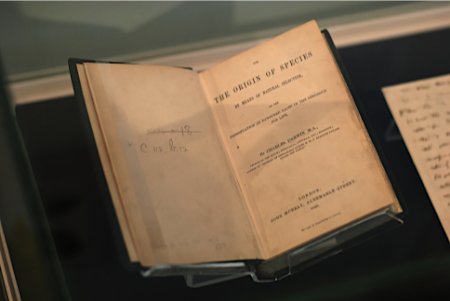
1859 edition of the Origins of Species
Here is a picture the original 1859 edition of the “Origins” while I still wonder if this book is about the origins or about the transitions of species.
That may be understandable as I am currently reading David Berlinski’s 2008 book “The Devil’s Delusion”. His (English) Wikipedia entry is not Continue reading Darwin and successors


CC-BY-NC Science Surf , accessed 23.03.2026

La gaya scienza

Dieter Hattrup pointed me today to Nietzsche

Der tolle Mensch sprang mitten unter sie und durchbohrte sie mit seinen Blicken. Wohin ist Gott? rief er, ich will es euch sagen! Wir haben ihn getödtet, ihr und ich! Wir alle sind sein Mörder! Aber wie haben wir diess gemacht? Wie vermochten wir das Meer auszutrinken? Wer gab uns den Schwamm, um den ganzen Horizint wegzuwischen? Was thaten wir, als wir diese Erde von ihrer Sonne losketteten?

But see also Nietzsche’s account to all Darwin admirers (page 119 of Hattrups book)

Die Behauptungen Darwin’s sind zu überprüfen – durch Versuche! Ebenso die Entstehung höherer Organismen aus den niedersten. Es müssen Verscuhe auf 1000de von Jahren hin geleitet werden! Affen zu Menschen erziehen!

Gaya scienza is close to todays’ synthetic biology, yea, yea.


CC-BY-NC Science Surf , accessed 23.03.2026

Heritability not limited to DNA sequence differences

It has been our gut feeling for many years – first with candidate gene studies, then with the large scale GWAs that show ridiculous low effect sizes.
A new Canadian study now reports DNA methylation at 12 K sites in dizygotic twins. Although they may not have always tested the right spots (see the CpG island shore! paper in the same issue) they were attributing discordances mainly to zygote differences Continue reading Heritability not limited to DNA sequence differences


CC-BY-NC Science Surf , accessed 23.03.2026

Pen scan it

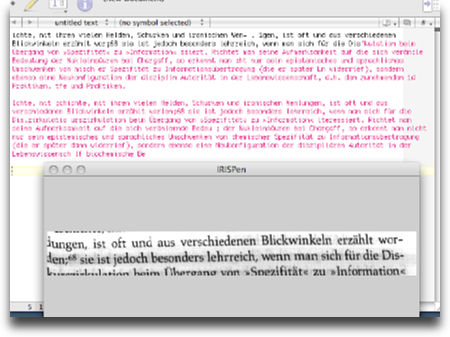
I always wondered why it is not possible to scan just a few sentences from a book. As there are some products on the market, I ordered such an IrisPen. It took only 15 minutes to convince me, that this device is largely useless – a cheap plastic pen with a flimpsy contact but rather rigid USB cable.
screenshot-2
What I even did not consider that syllabicated words at the end of every line can not be recognized by any OCR. So scanned words will require a lot of editing – while it may be better to invest into a typing course using all your fingers, yea, yea.


CC-BY-NC Science Surf , accessed 23.03.2026

Vitamin D as workplace sensitizer

A recent ERJ correspondence letter highlights vitamin D (among other others) as sensitizer at the workplace.

Skin sensitisers are typically more hydrophobic than respiratory sensitisers. Both water-soluble and fat-soluble vitamins are used as additives in the food industry. Exposure at work to both of the above classes of vitamin compounds may occur, resulting in respiratory and skin sensitisation of workers during the manufacturing process.


CC-BY-NC Science Surf , accessed 23.03.2026

Another challenge of the hygiene hypothesis

The hygiene hypothesis usually assumes an “underemployed” system that is directed against self-defined allergen targets – a rather mechanistic view of a half filled barrel. A new Nature paper on memory CD8 T-cells now explains why this view is rather odd Continue reading Another challenge of the hygiene hypothesis


CC-BY-NC Science Surf , accessed 23.03.2026