https://debruine.github.io/talks/RIOT-code-review-2022
CC-BY-NC Science Surf , accessed 19.09.2026
Most recently I had to add forgotten data to a SQL server database that was in use only until 2010. Script language was Cold Fusion at that time creating a visual interface to 96 well plates where proband IDs are assigned to plate positions by drop down fields.
R doesn’t have any good way for formatted data entry. Some shiny apps would be helpful but a bit overkill here. Data export into a javascript framework would be also a more professional solution while I just needed only a quick way to modify my database.
So I came up with some R code producing html code embedding javascript functions that can export the result as SQL code, so a 4 language mixup.

dataentry <- function(plate_id,city) {
# get orig IDs from database first

# position identifier A01, A02...
pos = NULL
for (i in 1:8) {
  pos = c(pos, paste0( rep( LETTERS[i], 12), str_pad( 1:12 ,2,pad="0" ) ) )
}

HTML <- paste('<html>
<script>
function download(filename, text) {
  var element = document.createElement("a");
  element.setAttribute("href", "data:text/plain;charset=utf-8," + encodeURIComponent(text));
  element.setAttribute("download", filename);
  element.style.display = "none";
  document.body.appendChild(element);
  element.click();
  document.body.removeChild(element);
}
function saveValues() {
  var frm = document.getElementById("f");
  var params = "";
  var sample_id = ',sample_id,';
  for( var i=0; i<frm.length; i++ ) {
    sample_id++;
    var fieldId = frm.elements[i].id;
    var fieldValue = frm.elements[i].value;
    if (fieldValue) params += "INSERT INTO samples (plate_id,plate_position,patient_id) VALUES (',plate_id,'," + fieldId + "," + fieldValue + ")\\n";
  }
  download("',plate_id,'.SQL",params);
}
</script>
<body>
<form id="f">')

# dropdowns
sel ='<option value=""></option>'
for (i in 1:dim(patients)[1]) {
  sel <- paste0(sel,'<option value=',patients[i,"patient_id"],'>',patients[i,"Orig_ID"],'</option>\n')
}
for (i in pos) {
  if (substr(i,2,3) == "01") HTML <- paste0(HTML,'<BR>')
  HTML <- paste(HTML,'<select id=',i,'>',sel,'</select>')
}

HTML <- paste(HTML,'</form>
<br><input name="save" type="button" value="SQL" onclick="saveValues(); return false"/>
</body></html>')

sink( paste('plate.html') )
cat(HTML)
sink()
}
dataentry(725,'city')
There is a long explanation over at medium
committing code is a small part of what software engineers do. There are many ways in which you can contribute technically without writing much code. In fact, the best senior engineers I know are great at prioritization, delegation, and simplifying. Their pull requests are tiny because they've made the code modular and straightforward. … Writing negative code is a point of pride! If you refactored a complex piece of logic, picked a good library to solve a problem, or eliminated unnecessary features, then you'll have a negative commit history. .. fine-tune configs, research arcane issues, and dive deep into underlying architecture. Working on these jobs can mean days of research just to make a few-line change.
The same applies to amount of funding received by a scientist (although frequently used for calculation of salariy). If I can achieve the same impact at a fraction of the costs, isn’t that much better than producing more costs?
Is there at least one positive advice of all that Musk utterance?
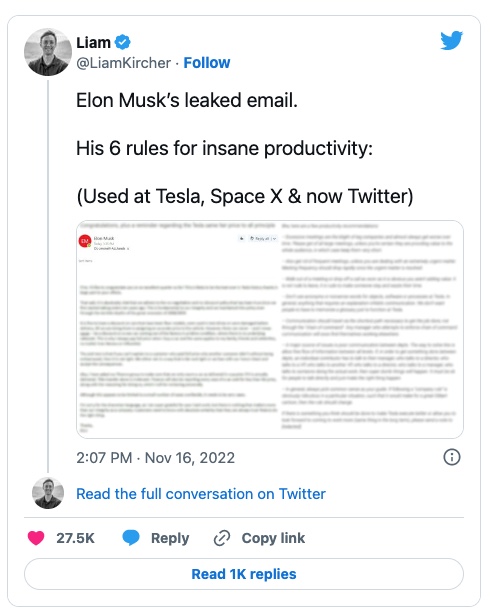
Warning : 2) and even other x) only suitable for slightly autistic, self obsessed and excellent scientists.
AI works well in some areas while results are very mixed or even dangerous in others [1, 2].
But what about AI in generic scientific areas?
I have recently looked at scite.ai, a service that claims to analyze a paper if the references have been supported or contrasted the findings — any references that have been retracted in the meantime or received an expression of concern? While the latter isn’t really a big question, I was not very much impressed by the results as most references could not be classified.
But there are now more companies off the ground. Let’s have a look at some.
One is SciScore

SciScore claims
SciScore generates three reports and a score for every submission. These materials assist researchers, editors, and funders in improving the quality and reliability of scientific research by automatically reporting detected criteria of interest for future review. Researchers signing up with their ORCID get ten free reports. Reports can take as little as 1 minute!
The next one is Prophy, another reference finder.
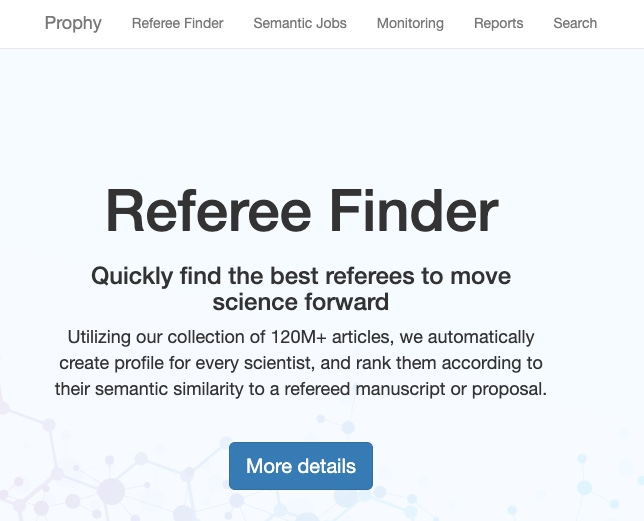
and there is Galactica.
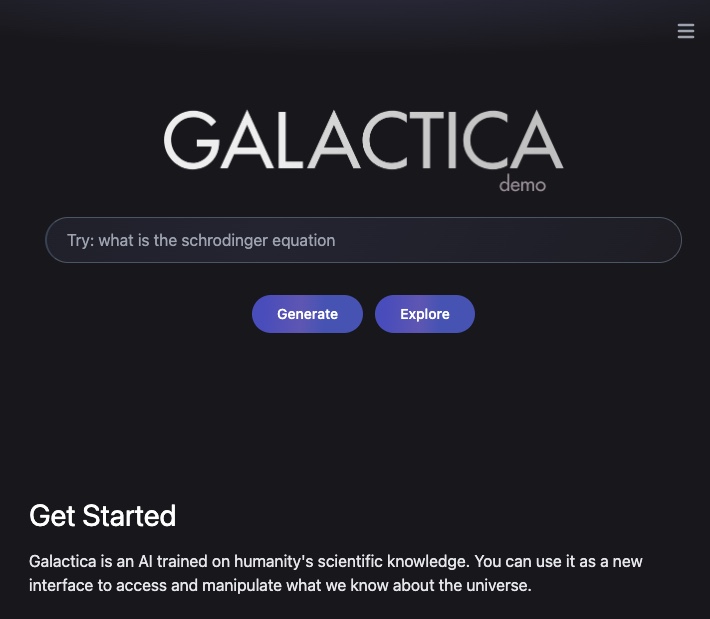
and well also copy.ai

I have no idea if we really need this kind of stuff – any AI to write my blog even faster?
Also others commented earlier this month that it is “not obviously wrong but wrong in subtle ways”.
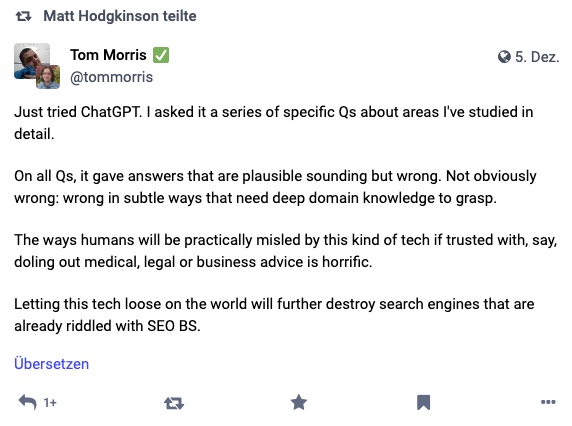
Fortunately Copyleaks released now even an AI detector just to fight back…
Even after deleting any account, shadow profiles are still there and linked to your addressbook. Here is a link to delete them (if Meta is not cheating) https://www.facebook.com/contacts/removal


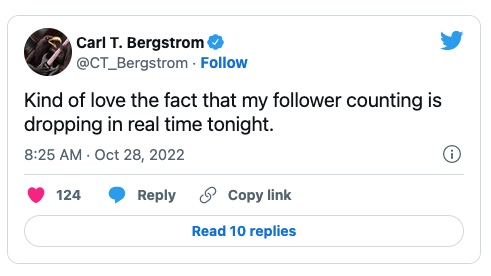
Seltsam, was gerade auf Twitter los ist wenn wir CT Bergstrom glauben, der eine Team Email von Musk geteilt hat.

Es sieht so aus als sei Twitter nun in der Gewalt von einem reichen Mann, der einem pseudoreligiösen Mars Kult angehört – nachzulesen in dem aufschlussreichen Artikel von Dave Troy
This is a reference to "longtermism" the heavily marketed philosophy being promoted by Musk and his friend William MacAskill that asserts the only thing that matters is humanity's future in space, and that the only goal of the living is to maximize the number of future humans alive, as well as the number of artificial intelligence instances that could possibly exist in the future. This mandate is most often used to brush aside calls for improving conditions and alleviating suffering among the living here on Earth now. Because, the theory goes, giving a poor person a blanket isn't likely to be as useful for the future of humanity as building a rocket to Mars. Longtermism is heavily influenced by "Russian Cosmism" and is also directly adjacent to "Effective Altruism." Musk's stated mission, which he intends to fulfill in his lifetime, is to "make humanity a multiplanetary species." The anti-democratic urge in longtermism is rooted in the belief that "mob rule" will lead to nuclear annihilation; we should, Musk thinks, be guided by "wiser" minds.
As I don’t like software subscription models, I never updated 1password 6 until learning yesterday about an open source alternative. And yes, KeePassXC is a perfect replacement.
Capitalized value? Personalized PDFs? DFG warning? User tracking? Forced marriage? It is incredible how scientific publishers are expanding their business. Here is a new paper
This essay develops the idea of surveillance publishing, with special attention to the example of Elsevier. A scholarly publisher can be defined as a surveillance publisher if it derives a substantial proportion of its revenue from prediction products, fueled by data extracted from researcher behavior. … The products' purpose, moreover, is to streamline the top-down assessment and evaluation practices that have taken hold in recent decades. A final concern is that scholars will internalize an analytics mindset, one already encouraged by citation counts and impact factors.
Sure, this already happens as some committees look only at lists of impact factor and grant sums. In the near future, they will switch to Elsevier`s “human ressources” management system Interfolio to compare candidates.
Founded in 1999, Interfolio supports over 400 higher education institutions, research funders and academic organizations in 25 countries, and over 1.7 million academic professionals and scholars. Theo Pillay, General Manager of Research Institutional Products, Elsevier, said: "Interfolio has a proven track record in supporting the academic community, thanks to its deep understanding of faculty needs, institutional workflows, research assessment and academic careers, combined with its agile technology and experienced leadership.
Back to the original article
the publishing giants have long profited off of academics and our university employers-by packaging scholars' unpaid writing-and-editing labor only to sell it back to us as usuriously priced subscriptions or article processing charges (APCs). That's a lucrative business that Elsevier and the others won't give up. But they're layering another business on top of their legacy publishing operations, in the Clarivate mold. The data trove that publishers are sitting on is, if anything, far richer than the citation graph alone.
Data is the new oil, indeed.
Auf Science Twitter ist die Stimmung am Tiefpunkt nachdem Wissenschaftler scharenweise den Dienst verlassen.
obwohl doch klar ist, daß Continue reading Katzenjammer I
How to save hundreds of $$$ paying a predatory publisher: Use the preprint form at Github and create your own PDF that can be uploaded to OSF or any other preprint server for free.
brew install --cask vscodium
brew install --cask mactex
and continue with the instructions here…
I also wrote about X without knowing why. Here is the answer.
Ein mathematischer Gottesbeweis geht zurück auf Guido Grandi und wurde vor kurzem wieder mal ausgegraben von u/Prunestand bzw Cliff Pickover.
0 = 0 + 0 + 0 + ...
  = (1-1) + (1-1) + (1-1) + ...
  = 1 - 1 + 1 - 1 + 1 - 1 + ...
  = 1 + (-1 + 1) + (-1 + 1) + (-1 + 1) + ...
  = 1 + 0 + 0 + 0 + ...
  = 1
was letztendlich einer Schöpfung aus dem Nichts entspricht wo doch eigentlich “nihilo ex nihilum” gilt.
Die Grandi-Reihe hat nur leider keinen Summenwert, weil sie nicht konvergent ist. Anders gesagt
0 + 0 + 0 + ...                          # N Elemente
(1-1) + (1-1) + (1-1) + ...              # 2N Elemente
1 - 1 + 1 - 1 + 1 - 1 + ...              # 2N Elemente
1 + (-1 + 1) + (-1 + 1) + (-1 + 1) + ... # 2N + 1 Elemente
1 + 0 + 0 + 0 + ...                      # N + 1 Elemente
dh die 4. Zeile enthält eine falsche Aussage.
Frustriert oder erleichtert? Auf arXiv geht es weiter mit Gödels Gottesbeweis.
Another famous article from the past: P. W. Anderson “More is different” 50 years ago
… the next stage could be hierarchy or specialization of function, or both. At some point we have to stop talking about decreasing symmetry and start calling it increasing complication. Thus, with increasing complication at each stage, we go up on the hierarchy of the sciences. We expect to encounter fascinating and, I believe, very fundamental questions at each stage in fitting together less complicated pieces into a more complicated system and understanding the basically new types of behavior which can result.