Category Archives: Noteworthy

Programmers, Professors, and Parasites

This is the title of a 2009 Stanford academic paper by Justin Solomon that analyzes the history of credit and co-authorship in computer science. The paper argues for a more consistent publishing standard in the field by addressing issues of inconsistent co-authorship, where some contributors may receive credit for minimal work, leading to potential accountability problems.

in fact, the 1993 Ig Nobel prize for “improbable research” in literature was awarded to “E. Topol, R. Califf, F. Van de Werf, P.W. Armstrong, and their 972 coauthors, for publishing a medical research paper which has one hundred times as many authors as pages

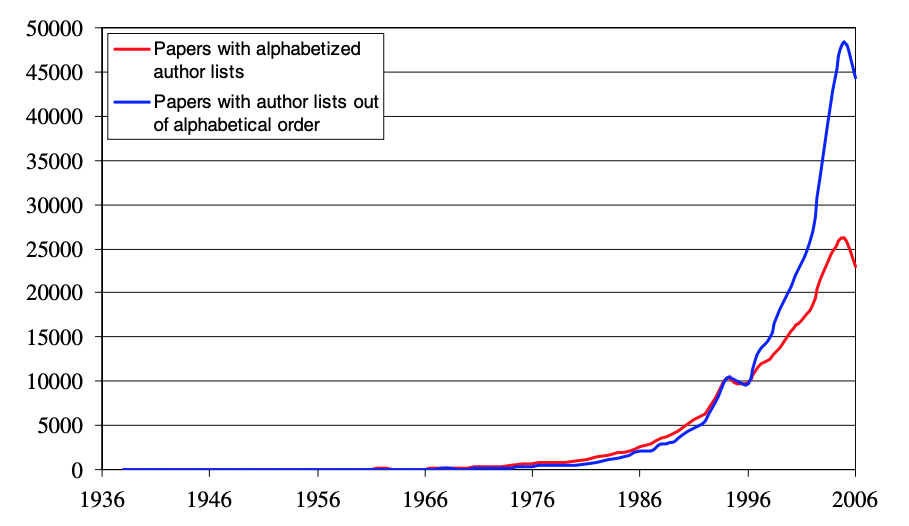
Well, and their Fig 4 was only the beginning of the “gaming the system” enterprise…

Fig. 4 Trends in author list alphabetization in computer science papers (data gathered from the DBLP Computer Science Bibliography) by Solomon 2009


CC-BY-NC Science Surf accessed 15.12.2025

Why are editors at even highranked scientific journals no more experienced scientists but rather young PhD?

Editors at even highly ranked scientific journals are now often young staff rather than experienced scientists for several structural reasons.

The business model of modern scientific publishing has changed. High-impact journals have become commercial enterprises rather than academic institutions. Their goals are efficiency, market reach, and brand control. Experienced scientists are expensive and often unwilling to take full-time editorial jobs that pay less than senior academic roles. Hiring younger PhDs, often fresh from postdocs, keeps costs low and allows publishers to maintain centralized editorial teams.

Second, professional editors are easier to train and manage. Publishers prefer editors who can follow company policy and editorial strategy. Senior scientists would bring strong opinions and disciplinary biases and may resist marketing or strategic directives. Younger editors are more adaptable, less attached to specific disciplines, and focused on efficient handling of manuscripts and reviewers.

The prestige gap between academia and editorial work has widened. Decades ago, senior scientists sometimes served as editors between research posts. Today, the reputation and influence of active research far outweigh editorial work, which is now more about managing flow and impact metrics than shaping science. Most experienced scientists therefore stay in academia, while early-career researchers see editing as an alternative career path.

Fourth, publishing houses are driven by profit and high throughput. Companies like Elsevier, Springer Nature, or Wiley operate with constant publication pressure. They depend on rapid editorial decisions to sustain citation rates and subscription value. Young editors working within standardized procedures are faster and cheaper to employ.

Finally, this shift has consequences. It leads to a focus on novelty and newsworthiness over technical soundness, and to reduced capacity for deep scientific evaluation. Editors rely heavily on external reviewers and internal performance indicators such as citation forecasts or altmetrics. The result is a system driven by marketing and efficiency rather than scientific judgment.

In short, modern journal editing has become a professionalized and industrialized process. It is now a job rather than a calling, and youthful, efficient gatekeepers have replaced experienced, skeptical scientists.

(with chatGPT 5 Support)


CC-BY-NC Science Surf accessed 15.12.2025

Christlicher Realismus

Jan Lucas Dietrich in der Eule mit “Christlicher Realismus statt evangelikaler Faschismus”

Niebuhr attestiert Amerika einen Exzeptionalismus, in dem auf paradoxe Art und Weise Macht immer wieder mit größter moralischer Schwachheit zusammenkommt. Dass dieser Exzeptionalismus derzeit vor allem von ultra-rechten, fundamentalistischen Christen bespielt wird, zeigte zuletzt die Gedenkfeier für Charlie Kirk. In ihrem Selbstverständnis findet sich auch jenes Muster, das Niebuhr bei faschistischen Gruppierungen seiner Zeit entdeckte: Eine kollektive Hybris, in der die grundlegende Illusion menschlicher Perfektion gepaart mit der Persistenz der Sünde in kruden Selbsterlösungsphantasien gipfelt.


CC-BY-NC Science Surf accessed 15.12.2025

The Science Publishing Industry as Turbo-Capitalism. A manifesto.

The modern science publishing industry operates much like turbo-capitalism — a system driven by profit maximization, consolidation of power, and resistance to regulation. What once served as a collective effort to disseminate knowledge has turned into a multibillion-dollar business controlled by a few dominant publishers such as Elsevier, Springer Nature, and Wiley. These companies have commercialized access to knowledge itself, transforming the public good of science into a high-priced commodity.

The evolution of the publishing system followed the classic pattern of enshittification. At first, science served the peers, then the  users — offering access, visibility, and academic communication. Then publishers as peripheral service provider began to exploit those users to favor their paying institutional customers, tightening control over access and pricing. Finally, they turn on those very customers, extracting maximum profit while degrading service, fairness, and trust, until the entire ecosystem becomes a hollow structure of metrics and monetization.

Just as financial elites resisted government oversight, major publishers oppose reforms that would curb their profits. They lobby against open-access mandates, hide profit structures behind opaque pricing, and maintain control through prestige and impact metrics that entrench their market dominance. Their profits — often higher than those of Apple or Google — depend on free academic labor: scientists write, review, and edit for free, while universities must then pay to read their own work back.

Equity and fairness are collateral damage in this system. Article processing charges reaching thousands of dollars exclude poorer institutions and researchers from full participation. The ideal of open, global science is replaced by a tiered system where access and influence depend on wealth and affiliation.

Equally revealing is the industry’s attitude toward corrections and retractions. In a healthy scientific ecosystem, acknowledging and correcting errors is vital. But in the turbo-capitalist logic of publishing, retractions resemble market regulations — they threaten reputation, weaken brand value, and risk financial loss. Publishers therefore often delay or resist corrections, preferring to protect the façade of flawless output over the integrity of the scientific record.

This distorted environment also shapes scientific behavior itself. Way too many self-assigned researchers, under immense pressure to build careers in a metric-driven system, quickly learn how to “game the system”. Even without proper training or deep experience, they chase citation counts, impact factors, and quantity over quality — optimizing for visibility rather than understanding. The system rewards the appearance of productivity, not the slow and  rather uncertain process of genuine discovery.

Thus, the science publishing industry reproduces the same pathologies seen in unregulated capitalism: profit before accountability, personality show before truth, and career before fairness. In this turbo-capitalist model, we have learned the price of everything — but the value of nothing. To restore science to its purpose — the open pursuit of truth — it is not enough to call for open access. The entire system must be rebalanced away from speculative prestige and back toward collective responsibility, transparency, and genuine public knowledge.

(with chatGPT 5 support)


CC-BY-NC Science Surf accessed 15.12.2025

Why we should abandon the Nobel prize

Here is  comes a concise overview of common arguments for abandoning or radically reforming the Nobel Prize system.
The myth of the lone genius
Modern science and culture are highly collaborative. The Nobel rules limit the prize to at most three individuals and exclude institutions or teams, which distorts how major discoveries are actually achieved and reinforces a hero-focused narrative rather than recognizing collective effort.
Distorting scientific incentives
The prestige and financial reward attached to the Nobel can encourage unhealthy competition, secrecy, and risk-averse behavior. Researchers may pursue topics perceived as “Nobel-worthy” instead of socially urgent or less glamorous problems, skewing funding and public attention.
Outdated and elitist structure
Created in the late 19th century, many Nobel rules no longer fit current realities: some fields are excluded, posthumous awards are disallowed, and selection processes are often opaque and dominated by narrow demographics. This can lead to Eurocentric and gender-biased outcomes.
Legitimizing controversial work
Some laureates have been associated with ethically problematic activities. Awarding individuals without thorough ethical scrutiny risks whitewashing responsibility and giving prestige to work that may have harmful implications.
Oversimplifying and politicizing knowledge
Prizes in fields like peace, literature, and economics can be deeply political. The Nobel can function as a soft-power instrument, promoting specific ideological views while marginalizing alternative perspectives or non-Western traditions.
Mismatch with how value is created today
The Nobel model treats discoveries as singular moments, but progress increasingly emerges from iterative processes, large teams, shared infrastructure, and interdisciplinary networks. The current system fails to acknowledge those modes of creation and contribution.
Alternatives and reforms
Possible changes include recognizing teams or institutions, creating rotating and more transparent juries with global representation, adding new categories for areas like environmental or data science, and shifting recognition from single results to ethical process and collaborative impact.

(with chatGPT 5 support)


CC-BY-NC Science Surf accessed 15.12.2025

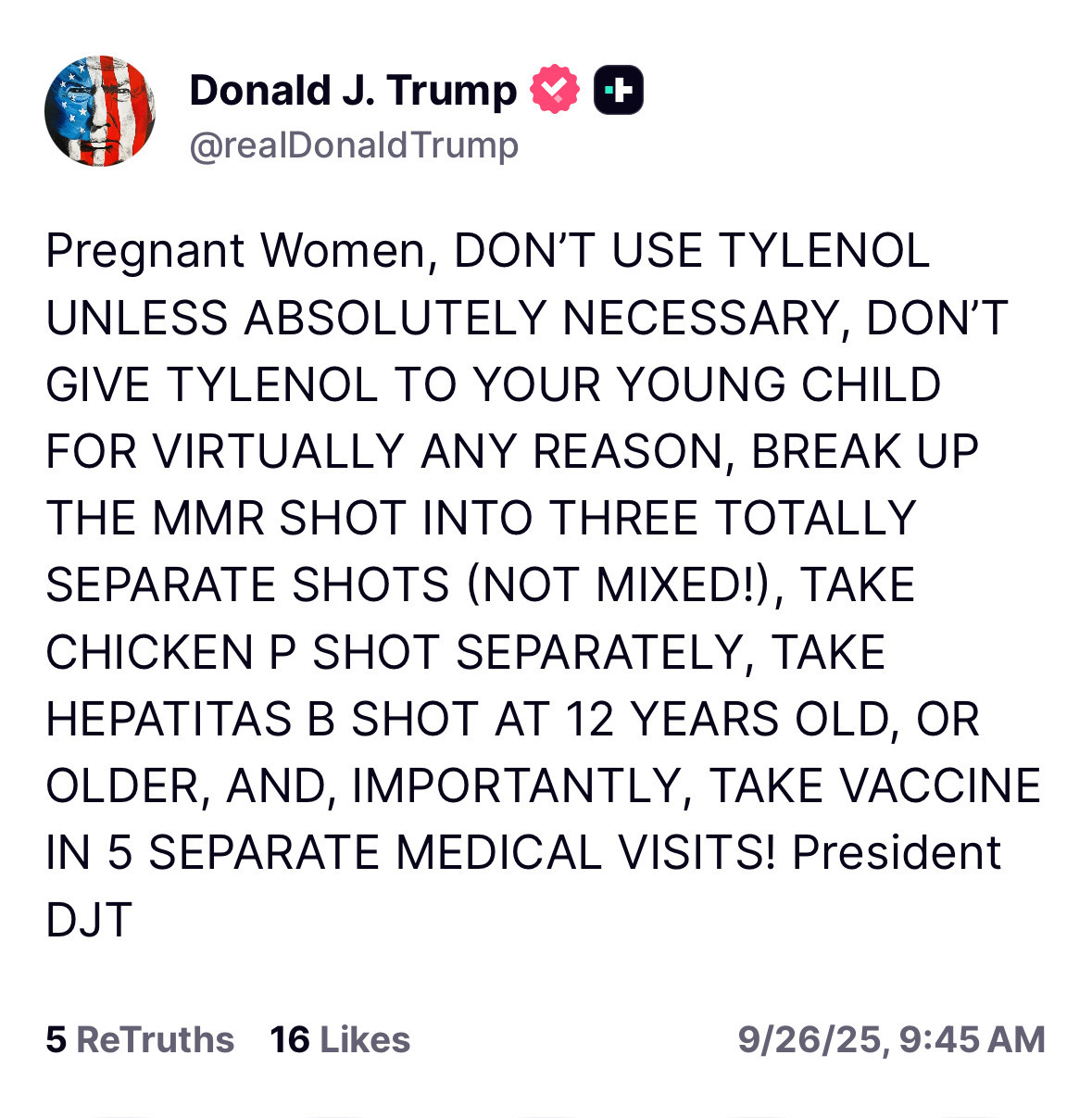
Paracetamol and autism in “Environmental Health”: A dubious paper that made politics

If paracetamol use in pregnancy may cause later autism spectrum disorder has received public interest recently.

https://cdn.bsky.app/img/feed_fullsize/plain/did:plc:nuqrjelqx4a2ewqzvwekhuro/bafkreifud4kyiacufg6wrt7hld5babfttrwnpg6mg5fgyrcmr466j734ou@jpeg

Robert J Lifton wrote in “Losing reality”

Trump is different. His solipsism is sui generis. He is psychologically remarkable in his capacity to manufacture and continuously assert falsehood in the apparent absence of psychosis.

Not unexpected the advice was rejected by basically all medical professionals. Commentaries are raging in Nature, BMJThe Lancet, JAMA and even the WHO. Continue reading Paracetamol and autism in “Environmental Health”: A dubious paper that made politics


CC-BY-NC Science Surf accessed 15.12.2025

We did not learn the COVID19 lesson

me 2020

The epidemic started with a few cases during the winter holidays, increased exponentially afterwards including significant more cases by beer festivals and another significant excess of cases following the election that occurred in Bavaria only. Compared to other German countries, Bavaria reached the highest prevalence which could not be reversed by even the most restrictive containment measurements. To be effective, NPIs need to applied early, if possible even before the beginning of the exponential phase.

Jeremy Farrar 2022

When you look back, what was the most momentous mistake in the pandemic response?
Farrar: The biggest mistake was that we didn’t take it seriously enough in the first six weeks of 2020. It was the time when a pandemic could still have been prevented. From the beginning of January, it was clear what was happening in Wuhan. By the end of January, it was clear how dangerous the situation was. And even though this information was  available, the rest of the world didn’t act until March – two critical months passed in which the virus was spreading. Instead, we had a U.S. President Donald Trump, who dismissed what was happening as “kung flu,” and in Europe, at least in the UK, there was a sense that this was all happening in faraway China, and northern Italy was also somehow different – it won’t be so bad here. It was a kind of complacency, the arrogance of exceptionalism.


CC-BY-NC Science Surf accessed 15.12.2025

“Ecce Homo” by Caravaggio

An interesting documentary at Isabella/München

It has some unexpected turns while at the end basically everybody seems to be happy — although we neither know the buyer, the price and  the courtage. And just 9 months display at Prado is a bit disapppointing, isn’t it?

Doubts remain also about the authorship as the work is not signed by Caravaggio as nearly all of his paintings. There was  a large number of “follower” as many artists were influenced by Caravaggio’s style and techniques. And well, there is an exceptional high value included where all people involved have a significant financial incentive: seller, auction house, trader, experts, museums …

I am not very much impressed by the hands and also the documentation raises questions

Most of the scholars who have examined the painting date its execution between 1606 and 1607, either during the artist’s last months in Rome or after his escape to Naples after impaling the local gang boss Ranuccio Tommasoni with his rapier during a game of tennis.

So did Caravaggio leave an unfinished painting? Did another painter complete it?

Camillo Manzitti, writing in Finestre sull’Arte (May 2024), contends that after restoration, the painting reveals a moderate chiaroscuro and lack of the dramatic tension characteristic of Caravaggio. He specifically highlights weakened emotional expression. Pilate appears only vaguely sad, not deeply troubled, and the young man behind Christ lacks the hallucinatory horror typical of Caravaggio’s depictions. The poor anatomical modeling, which he argues is incompatible with Caravaggio’s known skill. Christ’s face is asymmetrically deformed, with misaligned eyes and an ear inserted at an unnatural angle. Pilate’s face also shows modeling weaknesses. Kolja Thurner, an art historian based in Berlin, voiced his doubts via X as “a good painting by a talented Caravaggio follower, stylistically imitating the master to a high degree.”

BTW – the Guardian has the best reproductions IMHO.


CC-BY-NC Science Surf accessed 15.12.2025

COVID19 und Politik

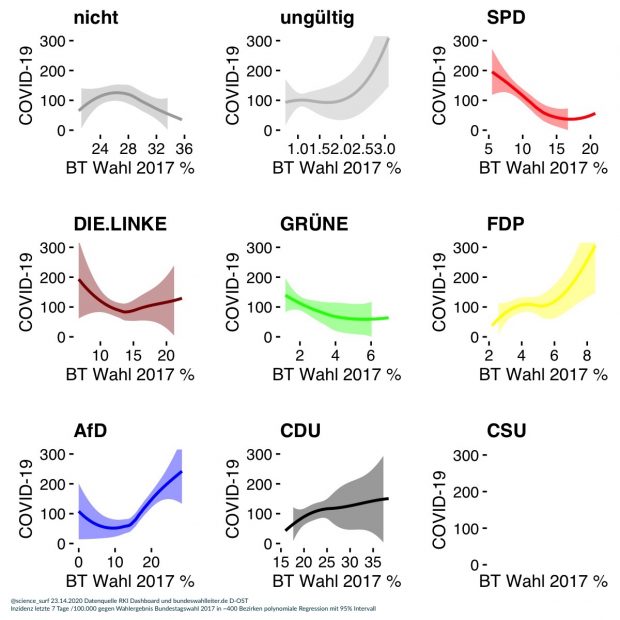
Ich habe den Plot  hier schon 2020 gebracht, wie im Osten Deutschlands die Inzidenz vor allem von Landkreisen mit primär AfD, FDP und CDU Wählern nach oben getrieben wurde.

https://www.wjst.de/blog/sciencesurf/2020/12/eine-politische-frage/

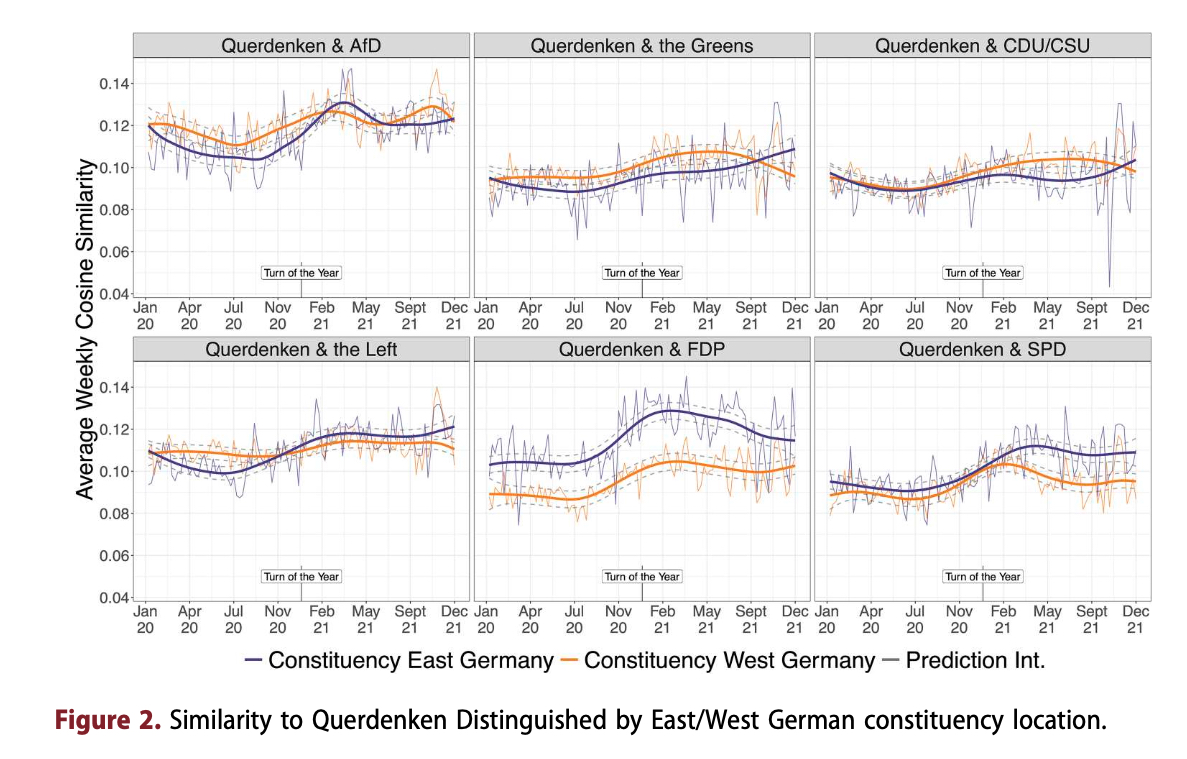
Zum Teil stand das auch in unserem Artikel von2021 wobei ich jetzt über den Citation Alert auf eine weitere interessante Arbeit von Zehring und Domahidi  aufmerksam wurde “The language similarity between corona protest  mobilizers on Telegram and German politicians on Twitter“. Sie zeigen

Protestbewegungen gegen Maßnahmen zur Eindämmung der COVID-19-Pandemie, wie beispielsweise die deutsche Bewegung Querdenken, verfolgen das Ziel, ihre Positionen auf die politische Agenda zu setzen. Während die rechtsgerichtete Partei Alternative für Deutschland (AfD) im Deutschen Bundestag als parlamentarischer Arm von Querdenken agierte, bleibt die Rolle anderer Parteien bislang unzureichend erforscht. … Grundlage [der Studie] bilden n = 934.432 Telegram-Nachrichten von Querdenken sowie n = 445.690 Tweets der sechs im Bundestag vertretenen Parteien in den Jahren 2020–2021. Methodisch kamen eine Kombination aus Sentence-Transformer-Modellen, Zeitreihenanalysen sowie einer ergänzenden manuellen Bewertung zum Einsatz. Die Ergebnisse zeigen, dass sich nach Herbst/Winter 2020 sämtliche untersuchten Parteien – wenn auch aus unterschiedlichen Gründen – semantisch zunehmend an die Diskurse von Querdenken angenähert haben. Während die Kommunikationsmuster der AfD die größte inhaltliche Nähe aufweisen, lassen sich auch bei Teilen der Freien Demokratischen Partei (FDP) sowie der Christlich Demokratischen Union/Christlich-Sozialen Union (CDU/CSU) Übereinstimmungen feststellen, etwa hinsichtlich der Abwertung linker und grüner Politik sowie der Ablehnung pandemiebedingter Eindämmungsmaßnahmen….

https://doi.org/10.1080/1369118X.2025.2536160

Aus Worten werden Taten, Ubi sermo, ibi actio.


CC-BY-NC Science Surf accessed 15.12.2025

Aus den Schlagzeilen verschwunden, aber noch längst nicht erledigt

„Freiheit ist die Freiheit zu sagen, dass zwei plus zwei vier ist.”
George Orwell, 1984.

Hier das Manifest Pro Realität

Wir verstehen uns als liberale, progressive, weltoffene, linke und feministische Stimmen, die für Pluralität und Toleranz einstehen. Alle Menschen müssen leben dürfen “nach dem Gesetz, nach dem sie angetreten”. Gerade deswegen aber sehen wir mit Sorge, wie fatal die Debatte um Sex und Gender derzeit läuft. Bestürzt müssen wir zur Kenntnis nehmen, dass falsche und zum Teil regelrecht aberwitzige Verdrehungen (“weiblicher Penis”, “die Biologie ist längst weiter”, “es gibt mehr als zwei Geschlechter”) gerade denen in die Hände spielen, die unsere demokratische Vielfalt mit dumpfen Parolen bedrohen…
Der funktionale Begriff “Geschlecht” ist in der naturwissenschaftlichen Community unstrittig: Biologisch gibt es bei allen Arten, die sich über das Verschmelzen ungleich großer Keimzellen vermehren (Anisogamie), nur zwei Arten von Keimzellen – und daraus abgeleitet zwei Geschlechter, die als männlich und weiblich bezeichnet werden…
Auf dieser biologischen Grundlage der Zweigeschlechtlichkeit gibt es kulturelle und soziale Erwartungen und Geschlechterrollen. Es ist ein Kennzeichen liberaler Gesellschaften und eine große Errungenschaft der Emanzipationsbewegung des neunzehnten und zwanzigsten Jahrhunderts, dass Geschlechterrollen keinen zwingenden Charakter mehr haben und dem Individuum alle gesellschaftlichen Rollen unabhängig vom Geschlecht offen stehen.


CC-BY-NC Science Surf accessed 15.12.2025

The decline of science is now official

Coming from an official announcement

https://www.whitehouse.gov/presidential-actions/2025/08/improving-oversight-of-federal-grantmaking/

Every tax dollar the Government spends should improve American lives or advance American interests.  This often does not happen.  Federal grants have funded drag shows in Ecuador, trained doctoral candidates in critical race theory, and developed transgender-sexual-education programs.  In 2024, one study claimed that more than one-quarter of new National Science Foundation (NSF) grants went to diversity, equity, and inclusion and other far-left initiatives.  These NSF grants included those to educators that promoted Marxism, class warfare propaganda, and other anti-American ideologies in the classroom, masked as rigorous and thoughtful investigation.

While I once believed that funding should primarily support the advancement of core scientific methods and studies rather than numerous DEI initiatives, this view is a grotesque distortion of reality, especially when we consider the so-called “study” the White House is citing. Many DEI projects are, in fact, valuable educational efforts or have an environmental focus, often addressing critical research needs that receive little to no funding from other sources.

Here is  a brief overview how these numbers were produced, and key problems that I have with the methods. The statement comes from the October 9, 2024 Senate Republican staff report Division. Extremism. Ideology: How the Biden-Harris NSF Politicized Science from the U.S. Senate Committee on Commerce, Science & Transportation, then led by Sen. Ted Cruz (PDF, the original is no more available on Aug 12, 2025).  The underlying dataset was released on February 11, 2025 (press release and database).

https://www.commerce.senate.gov/services/files/FA4D5565-5056-4916-AF87-64C96EAB8FEA

Staff analyzed 32,198 NSF prime awards with start dates between January 2021 and April 4, 2024. Using a keyword-based tagging process, they identified 3,483 awards they labeled as “DEI/neo-Marxist,” totaling more than $2.05 billion. The report says that for 2024 (measured only up to April 4), 27% of new grants fell into this category. Appendix A of the report explains the method. Staff pulled all NSF awards from USAspending.gov with start dates in the 2021–2024 window. They ran an n-gram/keyword search using glossaries from sources like NACo and the University of Washington, expanding the list to more than 800,000 variants. Awards with zero or only one keyword match were removed, and additional filtering plus manual checks produced the final set of 3,483. Grants were grouped into five thematic categories (Status, Social Justice, Gender, Race, Environment). The “27% in 2024” figure came from the share of awards in that subset with start dates in the first quarter of 2024.

Faults and shortcomings in the method

  • The keyword approach equates the presence of certain words with being a DEI-focused grant, and the keyword list is very broad (including terms like “equity,” “privilege,” “climate change,” “systemic,” “historic*,” and “intersectional”), which can capture unrelated research.
  • The 27% figure comes from only part of the year (January–April 2024), not a full year.
  • There is ambiguity between counts and dollar amounts; the 27% refers to counts, not necessarily to total funding share.
  • Removing all single-keyword matches and applying manual pruning introduces subjectivity and potential bias.
  • Categories like “Social Justice” or “Race” are based purely on word presence, not actual research aims, conflating standard NSF education/broader impacts work with political advocacy.
  • Reliance on abstracts and spending descriptions means the screen often catches standard boilerplate language that NSF requires by law.
  • A House Science Committee Democratic staff review in April 2025 found numerous false positives in the Cruz dataset, such as biodiversity studies flagged for the word “diversity” or wildlife grants flagged for the word “female.” That review also notes that NSF is required by statute to consider “broader impacts” in all awards.
  • The Senate report is a partisan staff product, not peer-reviewed, and uses normative framing (“neo-Marxist,” “extremist”) rather than neutral description.

Restoring „gold standard“ of science by non-scientists?
An US health secretary who wants to retract an Annals paper for personal opinion?


CC-BY-NC Science Surf accessed 15.12.2025

Sagan Standard

This is not about the extraordinary cyclist Peter Sagan but about the astronomer Carl Sagan who postulated  in his 1979 book  “Broca’s brain” that “extraordinary claims require extraordinary evidence”

A major part of the book is devoted to debunking “paradoxers” who either live at the edge of science or are outright charlatans.


CC-BY-NC Science Surf accessed 15.12.2025

A forensic analysis of the Prince Andrew/Giuffre/Maxwell image

There are only a few photographs that made headlines recently. One is Man Ray’s Le Violon d’Ingres for its price tag of $12,400,000.  Or the authorship discussion around the  “Napalm Girl” Phan Thị Kim Phúc.  And there is a third photograph – a snapshot from a London house two decades ago – that has a similar price tag attached like Le Violon d’Ingres.


My most recent paper at https://arxiv.org/abs/2507.1223 examines this infamous photograph using the latest image analysis techniques.

This study offers a forensic assessment of a widely circulated photograph featuring Prince Andrew, Virginia Giuffre, and Ghislaine Maxwell – an image that has played a pivotal role in public discourse and legal narratives. Through analysis of multiple published versions, several inconsistencies are identified, including irregularities in lighting, posture, and physical interaction, which are more consistent with digital compositing than with an unaltered snapshot. While the absence of the original negative and a verifiable audit trail precludes definitive conclusions, the technical and contextual anomalies suggest that the image may have been deliberately constructed. Nevertheless, without additional evidence, the photograph remains an unresolved but symbolically charged fragment within a complex story of abuse, memory, and contested truth.


I provide also a 3D reconstruction of the scene in the preprint although some people  may find it easier to watch a video instead.


Even after completion of the analysis there are  many open questions – where is the original headshot? There are numerous similar images at various image archives while I haven’t found the original so far. Any pointer would be greatly appreciated.


Even as there are now reasonable doubts on the image, Prince Andrew could have have met Virginia Giuffre. Maybe like an artist is painting a scene from memory, this photograph could be showing a real scene although not in a physical sense.

So, to repeat my last sentence in the paper – this photograph remains an unresolved but symbolically charged fragment within a complex story of abuse, memory, and contested truth.

Bonus Link


CC-BY-NC Science Surf accessed 15.12.2025