Category Archives: Philosophy

How to push the impact of 2,299 scientists with 8,000 citations each?

Answer: Be co-author of an autophagy guideline

this is another episode of guidelines paper. More participants listed here – Affiliations listed stopped at 2299 – this means that there are 2299 authors in the manuscript. Unbelievable – how did they manage to get a consensus on what is written. May the first author explain, how the authorship on this guidelines is decided?


CC-BY-NC Science Surf accessed 16.12.2025

Face à Gaïa


Bruno Latour (* 22. Juni 1947 in Beaune; † 9. Oktober 2022 in Paris)

Jonas Salk in the foreword of “Laboratory Life – the Construction of Scientific Facts” 1986:

Scientists often have an aversion to what nonscientists say about science. Scientific criticism by nonscientists is not practiced in the same way as literary criticism by those who are not novelists or poets …  A love-hate relationship exists toward scientists in some segments of society. This is evident in accounts that deal with facets ranging from tremendously high expectations of scientific studies to their cost and their dangers—all of which ignore the content and process of scientific work itself …  For myself, it was interesting to have Bruno Latour in our institute, which allowed him to carry out the first investigation of this kind of which I am aware…

“Laboratory Life” focuses on the question how the objects of scientific study are socially constructed within the laboratory where they enter a “cycle of credibility” by accumulating recognition, honors, funding and prestige. But is there any truth or is this just a scientific culture remains an open question.


CC-BY-NC Science Surf accessed 16.12.2025

Das gemeinsame wissenschaftliche Ethos

Lesenswert!

https://www.bpb.de/system/files/dokument_pdf/APuZ_2021-46_online_0.pdf
[Es ist … ] unbestreitbar, dass ein gemeinsames wissenschaftliches Ethos und eine geteilte akademische Kultur die Grundlage für die Möglichkeit und den Bestand von epistemischen Freiräumen bilden. Diese Freiräume, auf die Wissenschaft angewiesen ist und die durch die Rechtsordnung allein nicht garantiert werden können, sind Räume der Gründe. Hier sind die rationalen Gütekriterien hoch, die Vorwegnahme der Gegenposition zur eigenen und deren ernsthafte Reflexion der wissenschaftliche Idealfall. Der Rede folgen gemeinhin Kritik und Gegenrede; eine sachbezogene Beharrlichkeit (statt Ablenkung, Themenwechsel, bullshitting) ist der diskursive Standard. Daher ist die „große Gereiztheit“, die Teile der aktuellen Debatte um Wissenschaftsfreiheit charakterisiert, der Wissenschaft wesensfremd, ebenso wie antagonistische Selbstverortungen (links vs. rechts, wokevs. boomer, Freunde vs. Feinde der Wissenschaft).


CC-BY-NC Science Surf accessed 16.12.2025

The slow abandonment of the academic mindset

Mittelman  on the  “The World-Class University and Repurposing Higher Education” 2018:

… the central academic purposes of the university are imperiled. While not universally adopted, they began to take root in the nineteenth century, developed gradually in the nineteenth and twentieth, and encounter novel tensions in the twenty-first. In this century, the triad of core educational missions in nonauthoritarian societies—cultivating democratic citizenship, fostering critical thinking, and protecting academic freedom — is losing footing. A new form of utilitarianism is gaining ground. It prioritizes useful knowledge and problem-solving skills at the expense of basic inquiry…

A few pages later Mittelman notices that universities

… have become preoccupied with strategic planning, benchmarking, branding, visibility, rankings, productivity indices, quality assurance systems, students as customers, and measurable outcomes. Before the 1980s, members of the higher education community rarely expressed themselves in these terms.

And it is true – we have been struggling even after 1980 with the mysteries of nature, by designing experiments and studies, trying to make new discoveries and teaching them to our students.

Fast rewind to the “idea of  a university” and the “cultivated intellect” by John Henry Newman (p15) and the usefulness of useless knowledge  of Abraham Flexner. In the last century clearly a need for unanticipated outcome was felt while today basically every research program starts with  a lengthy introduction that this is the most important research because disease D is so frequent or technology T is so important for the environment. Mittelman quotes Daniel Zajfman, 10th president of Israel’s Weizmann Institute, when talking about university rankings

When we look at the values of knowledge for the sake of knowledge, we realise 100 years later what we can do with this. If you look at the history of science, you will find that most of the discoveries were never made by trying to solve a problem, rather by trying to understand how nature works, so our focus is on understanding.


CC-BY-NC Science Surf accessed 16.12.2025

increasing complication

Another famous article from the past: P. W. Anderson “More is different” 50 years ago

… the next stage could be hierarchy or specialization of function, or both. At some point we have to stop talking about decreasing symmetry and start calling it increasing complication. Thus, with increasing complication at each stage, we go up on the hierarchy of the sciences. We expect to encounter fascinating and, I believe, very fundamental questions at each stage in fitting together less complicated pieces into a more complicated system and understanding the basically new types of behavior which can result.


CC-BY-NC Science Surf accessed 16.12.2025

More humility needed

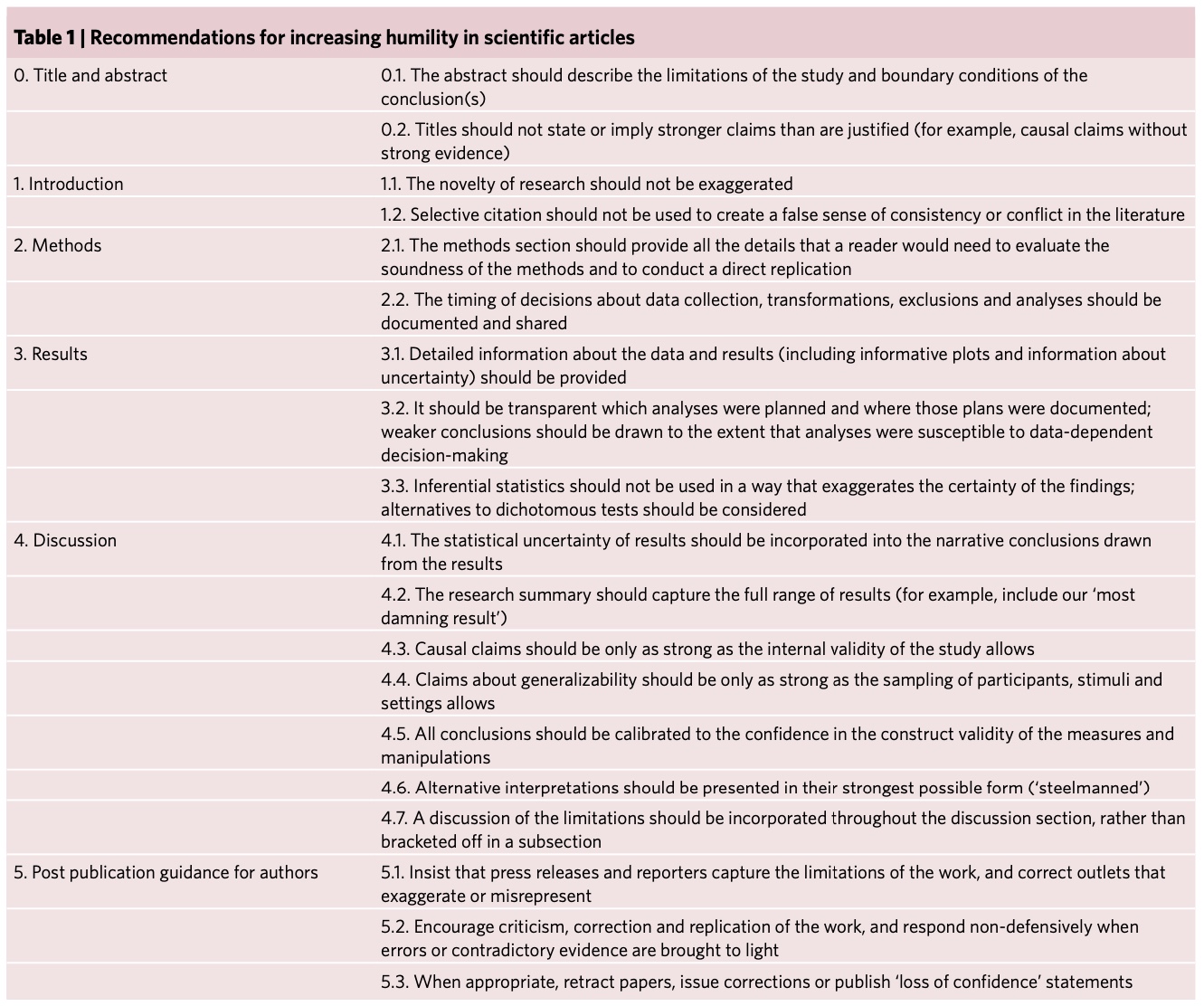
Hoekstra and Vazire on “Aspiring to greater intellectual humility in science

Although intellectual humility is presented as a widely accepted scientific norm, we argue that current research practice does not incentivize intellectual humility. We provide a set of recommendations on how to increase intellectual humility in research articles

Indeed – many recommendations are counterproductive for a science career…

https://www.nature.com/articles/s41562-021-01203-8

and well, a divergent view at PubPeer.


CC-BY-NC Science Surf accessed 16.12.2025

The currency of the New Economy won’t be money, but attention

Time to revisit the groundbreaking 1997 @mgoldh  paper in Wired “Attention Shoppers! The currency of the New Economy won’t be money, but attention”

As is now obvious, the economies of the industrialized nations – and especially that of the US – have shifted dramatically. We’ve turned a corner toward an economy where an increasing number of workers are no longer involved directly in the production, transportation, and distribution of material goods, but instead earn their living managing or dealing with information in some form. Most call this an “information economy.”


CC-BY-NC Science Surf accessed 16.12.2025

Disagree without being disagreeable?

The NIH director on communication with the NIH

We are committed to ensuring a safe and respectful workplace wherever NIH-supported research occurs. Be it at a recipient institution, at a conference where scientific ideas are exchanged, or in our own intramural labs, everybody deserves to work in an environment that is free of harassment, bullying, intimidation, threats, or other disruptive and inappropriate behaviors. Likewise, this goes for NIH program officers, scientific review officers (SROs), grants management specialists, and other extramural staff.


CC-BY-NC Science Surf accessed 16.12.2025

Endlich neue CV Formulare bei der DFG

Quelle DFG 1.9.22 https://www.dfg.de/en/research_funding

Publication details in proposals and CVs
Performance assessment based on content-related qualitative criteria also explicitly includes ensuring that the entire spectrum of academic publication types are equally displayed and acknowledged in funding proposals and CVs. In addition to a maximum of ten publications in the more common publication formats, the CV can therefore now list up to ten further sets of research outcomes and findings that have been publicised in a variety of other ways, including articles on preprint servers, data sets or software packages, for example. In DFG proposals, the project-specific list of publications will be included in the general bibliography. The intention here is to shift the focus of the review and the evaluation of a proposal away from the list of publications and towards the substance of the applicant’s accomplishments. In order to document their own published preliminary work, applicants can typographically highlight (e.g. in bold) a maximum of ten of their own publications in the bibliography that are important for the project. No information on quantitative metrics such as impact factors and h-indices is required in the CV or the proposal, and such information is not to be considered in the review. The relevant details are included in DFG forms and review instructions.


CC-BY-NC Science Surf accessed 16.12.2025

Klimaschutz

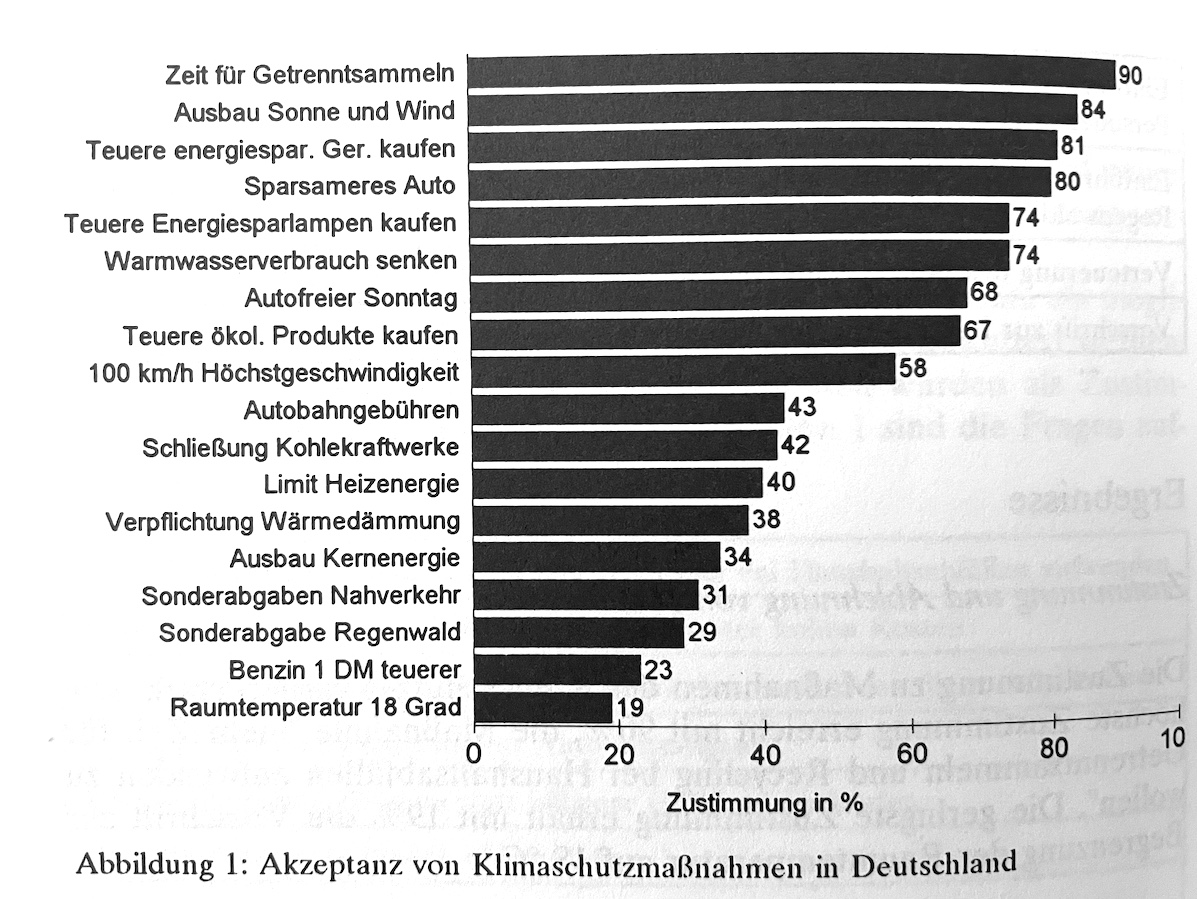
Bereits 1991 gab es eine Mehrheit in der Bundesrepublik für 100 km/h Höchstgeschwindigkeit und gegen Ausbau der Kernenergie.

Scan Umschlag – Die Informationszentrale der Elektrizitätswirtschaft IZE war eine Einrichtung der deutschen Elektrizitätswirtschaft mit Sitz in Frankfurt wurde im  Jahr 2000 aufgelöst und ging im Verband der Elektrizitätswirtschaft auf. Diese Art von Studien waren schliesslich auch kontraproduktiv zu den Zielen des VDEW. Der VDEW ging dann 2007 im Bundesverband der Energie- und Wasserwirtschaft auf.
Scan S. 202

Bonuslink Earth for All das heute erscheint.


CC-BY-NC Science Surf accessed 16.12.2025

Please do not try to tell a story but report your results

When I prepared a lecture last year on scientific paper writing I have found countless advices how to tell a story – it made it even into elife.

Don’t do that – there are lies and damned lies (Disraeli) while you are easily running into a trap when trying to “tell a story”.  Preregister your study plan, tell the world what you did right from the beginning, what did not work, why you repeated an experiment or why changed your opinion.

Writing a story from the backend distorts the proportions and misdirects attention. Ulrich Dirnagl highlighted this problem in an earlier talk here in March using the following two slides.

How we present results in a basically linear way – story telling. By NIH QUEST/Dirnagl.
How it would be fair to tell the story with numerous inputs, non working assay (primer, antibody, other samples), new literature and conference talks, where we constantly change our opinion that could have led to alternate papers. By NIH QUEST/Dirnagl


CC-BY-NC Science Surf accessed 16.12.2025

So many asthma papers under fire

As an avid PubPeer reader, I found a  new  entry  by Elisabeth Bik recently about Andreas Pahl of Heidelberg Pharma who has already one retracted and several more papers under scrutiny.

Unfortunately there are now also many asthma trash papers from paper mills. Another example was identified by @gcabanac, distributed by @deevybee and published at Pubpeer.

In total there are 386 asthma entries at PubPeer. What is  really happening in this field? When I started the field there was just one misconduct case – Ranjit Kumar Chandra. That’s an increase from 1 to 386…

What makes it even more complicated that there is no border anymore to predatory journals if also respected scientists drop their names at predatory journals.  Only recently I received an email addressed to one of my former technical assistants as “professor” inviting her to send a paper…


CC-BY-NC Science Surf accessed 16.12.2025