New species alignment

The UCSC Genome Bioinformatics Group ( who is running one of my favorite websites ) just announced

After 15.4 years of CPU run-time in 9,905,594 individual ‘jobs’ and 99 cluster runs for lastz pair-wise alignment…we are excited to announce the release of a 100 species alignment on the hg19/GRCh37 human Genome Browser.
This new Conservation track shows multiple alignments of 100 species and measurements of evolutionary conservation using two methods (phastCons and phyloP) from the PHAST package. This adds 40 more species to the existing 60 species track on the mm10 mouse browser. For more information about the 100 species Conservation track, please see its description page.


CC-BY-NC Science Surf , accessed 20.04.2026
Finally! 23 and the FDA warning

Quite some time passed already since my last post (to be exact, more than 5 years) but now there are good news. The FDA issued a warning letter on the 22nd

… The Food and Drug Administration (FDA) is sending you this letter because you are marketing the 23andMe Saliva Collection Kit and Personal Genome Service (PGS) without marketing clearance or approval in violation of the Federal Food, Drug and Cosmetic Act (the FD&C Act) … However, even after these many interactions with 23andMe, we still do not have any assurance that the firm has analytically or clinically validated the PGS for its intended uses … Therefore, 23andMe must immediately discontinue marketing the PGS until such time as it receives FDA marketing authorization for the device …

The response is quite flimsy. Yes, there may be negative side effects of genetic testing and of course tests need to validated first. Slate may be correct that the FDA’s battle with 23andMe won’t mean anything in the long run but now at least, we are set back to science, yea, yea.


CC-BY-NC Science Surf , accessed 20.04.2026
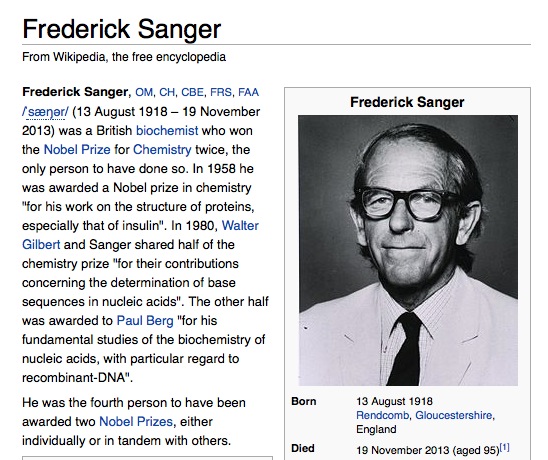
Frederick Sanger R.I.P.

Bildschirmfoto 2013-11-20 um 15.45.26

There has been so much written about Frederick Sanger (see nobelprize.org or Sanger Centre itself) while I like most what he wrote himself in Annual Reviews 1988:

These prefatory chapters are usually accounts of biochemists’ experiences in research, teaching, and administration. In my case the last two are easily dealt with as I have done hardly any and have indeed actively tried to avoid both teaching and administrative work. This was partly because I thought I would be no good at them, but also out of selfishness. I do not enjoy them, whereas I find research most enjoyable and rewarding.

Sydney Brenner, another British nobel laureate (2002) thinks:

A Fred Sanger would not survive today’s world of science. With continuous reporting and appraisals, some committee would note that he published little of import between insulin in 1952 and his first paper on RNA sequencing in 1967 with another long gap until DNA sequencing in 1977. He would be labeled as unproductive, and his modest personal support would be denied. We no longer have a culture that allows individuals to embark on long-term—and what would be considered today extremely risky—projects.

Sanger remains one of my heroes – the only scientist from whom I possess an autograph, bought a decade ago on Ebay.


CC-BY-NC Science Surf , accessed 20.04.2026

Single cell genomics update

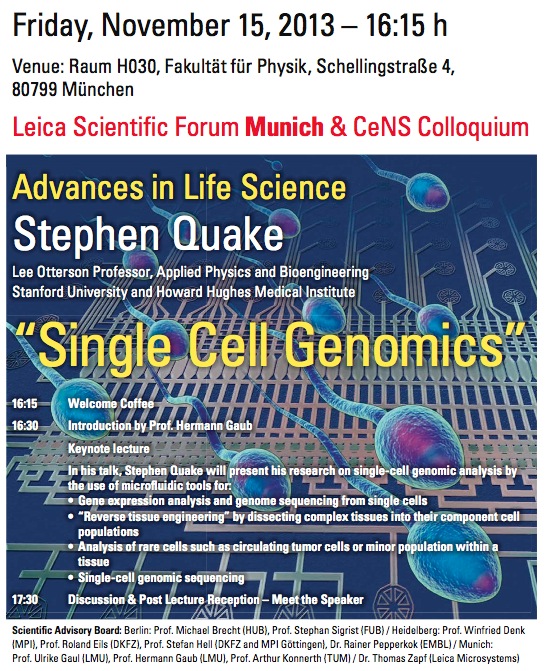
talk I have been attending yesterday an interesting talk of Stephen Quake. Yes, this was a Leica sponsored event, but not about photography, it was about single cell genomics. I was always interested in that field and quite impressed by the Quake approach. These biology-baptized mathematicians and physicists can easily compete with whole research centers and a 100fold head count.

The commercial spin-off is fluidigm.com while his main research is not only sequencing of the fastest moving bacterium but also an estimate of mutations in his own haploid (sperm) genomes, single cell expression along with single cell methylation patterns.

One of the really exciting questions is the mismatch of single cell RNA and protein content where I need to go for some papers that I wasn’t aware off. Another excellent idea is the clustering of single cell expression profiles. This is already leading to new classes of cells and a probably much more valid approach than using random? surface markers as immunologists usually do, yea, yea.


CC-BY-NC Science Surf , accessed 20.04.2026
bp;dr

Do you know what bp;dr means? Here is the solution:

behind paywall; didn’t read

The very first use is being quoted to @NeuroPolarbear. I am using it in emails too but maybe it should be added also to bibliographic references of printed papers, yes, yea.


CC-BY-NC Science Surf , accessed 20.04.2026
Negative metrics is not such a bad idea

Nature recently raised an extremely important point

Research metrics are ambiguous — a paper may be cited for positive or negative reasons. Funding agencies and universities focus on positive impact in evaluating research, which increasingly includes alternative metrics. We think that researchers can generate a more complete account of their impact by including seemingly negative indicators — such as confrontations with important people or legal action — as well as those that seem positive.

Yea, yea.


CC-BY-NC Science Surf , accessed 20.04.2026

No te amo como se aman ciertas cosas oscuras, secretamente, entre la sombra y el alma

Was Wissenschaft nie beschreiben kann sondern nur die Kunst:

Ich liebe dich nicht, wie ich eine Rose aus Salz lieben würde,
einen Topas, einen Nelkenpfeil, der das Feuer entfacht:
ich liebe dich, wie man die dunklen Dinge liebt,
heimlich, zwischen Seele und Schatten.
Ich liebe dich wie die Pflanze, die nicht blüht und die in ihrem Innern anderer Blumen Licht versteckt,
und dank deiner Liebe lebt in meinem Leibe dunkel das dichte Aroma, das aufstieg aus der Erde.
Ich liebe dich und weiß nicht, wie noch wann noch wo,
ich liebe dich geradezu ohne Fragen noch Übermut,
so lieb ich dich, weil anders ich nicht lieben kann,
vielmehr auf diese Weise, in der ich und du nicht sind,
so nah, dass deine Hand auf meiner Brust ganz mir gehört,
so nah, daß ich in meinem Schlaf deine Augen schließe.

(Übersetzer unbekannt, Neruda Sonnet XVII)


CC-BY-NC Science Surf , accessed 20.04.2026

Something you cannot google

Most people think that you can google for everything you want to know. What an overestimate!! There are so many relationships that will probably never turn out in any graph search ( at least I believe so ). And here is a nice example as I recently heard of a patient with an allergy AGAINST dimethindene maleate ( Fenistil (R), an antihistmaine used TO TREAT allergy. So whenever you enter “fenistil allergy” you get 119.000 hits. Although you get that result in 0,23s it will take you 23y to wade through the results. Hint: You could google for “leroy dimethindene” and you will find that there are only 2 patients so far in the literature plus the one that I know.


CC-BY-NC Science Surf , accessed 20.04.2026

Scientist lost their way

LA Times’ Michael Hiltzik reports yesterday

Researchers are rewarded for splashy findings, not for double-checking accuracy. So many scientists looking for cures to diseases have been building on ideas that aren’t even true.

A few years ago, scientists at the Thousand Oaks biotech firm Amgen set out to double-check the results of 53 landmark papers in their fields of cancer research and blood biology.
The idea was to make sure that research on which Amgen was spending millions of development dollars still held up. They figured that a few of the studies would fail the test — that the original results couldn’t be reproduced because the findings were especially novel or described fresh therapeutic approaches.
But what they found was startling: Of the 53 landmark papers, only six could be proved valid.

I can confirm that finding.


CC-BY-NC Science Surf , accessed 20.04.2026

Nämlich wenn Sie erfinden

Wann Wissenschaftler kreativ sind? Vasari schreibt über die Entstehung Leonardo da Vinci’s Abendmahl (letzte Woche war ich in Mailand und natürlich auch in der Santa Maria della Grazie)

Leonardo kannte den klaren Verstand und den Takt des Fürsten, und deshalb entschloss er sich, mit ihm über die Sache ausführlich zu reden, was er mit dem Prior nie getan hatte. Er äußerte sich weitläufig über die Kunst und machte anschaulich, daß erhabene Geister bisweilen am meisten schaffen, wenn sie am wenigsten arbeiten, nämlich wenn sie erfinden und vollkommene Ideen ausbilden.

Nach der Meinung eines Universalgenies ist also etwas wichtig, das im lieben langen Wissenschaftstag nicht vor kommt?


CC-BY-NC Science Surf , accessed 20.04.2026

The first proven risk factor for allergy

After more than a century of research, the first successful clinical trial of an allergy risk factor has been performed. It looks like the authors even did not anticipate such an effect (known as triple blind design). But read what the Pubmed article about the Norizoe et al. paper says

To elucidate whether maternal vitamin D supplementation during lactation improves infantile eczema and other subsequent allergic disorders, a randomized, double-blind, placebo-controlled trial was performed.
Mothers (n=164) of infants with facial eczema at one-month checkup were randomly assigned to receive vitamin D3 supplements (n=82; 800 IU/day) or placebo (n=82) for 6 weeks from May 2009 to January 2011. The primary outcome was infantile eczema quantified by Scoring Atopic Dermatitis (SCORAD) index at the three-month checkup, and the secondary outcomes were atopic dermatitis, food allergy, and wheeze diagnosed by doctors up to 2 years of age.
There was no significant difference in SCORAD at 3-month checkup between two comparative groups. Doctor-diagnosed food allergy was significantly more common up to age 2 years in vitamin D group (10/39: 25.7%) than in placebo group (3/40: 7.5%; RR=3.42, 95%CI=1.02 to 11.77, P=0.030). Moreover, at least one secondary outcome was also significantly more common in vitamin D group (17/39: 43.6%) than in placebo group (7/40: 17.5%; RR=2.49, 95%CI=1.16 to 5.34, P=0.012).
These results suggest that vitamin D supplementation may not decrease the severity of infantile eczema at three months of age, but may rather increase the risk of later food allergy up to two years of age. Because a large number of subjects was lost to follow-up, further study is needed to confirm the findings.

Of course, there may be some weakness in the study design, a large loss to follow-up and the way how food allergy was diagnosed will be critized. I think, however, that this is a major breakthrough that raises the hope that we will finally understand how allergy develops.

Addendum Dec 23th, 2013

I should have added “true” risk factor, as there are positive trials on probiotics and atopic dermatitis. The meta-analysis by Lee immediately lead to a rebuttal

Their review fails to meet published standards for the quality of systematic reviews on several criteria, and this has led to inappropriate conclusions. […] These defects in methodologic rigor have led to an exaggeration of the clinical benefits of probiotics for eczema prevention.

The Cochrane Summaries are also negativ

There is not enough evidence to recommend using probiotics for the treatment of eczema.

Same situation with asthma

We found no evidence to support a protective association between perinatal use of probiotics and doctor diagnosed asthma or childhood wheeze


CC-BY-NC Science Surf , accessed 20.04.2026