All posts by admin

Less than one mistake in every 6 million deliveries

I have seen recently a TV documentation about the Dabbawalas in Mumbai who deliver freshly cooked food to the workplaces and return the empty boxes back to the customer’s home. According to Wikiedia.

In 2002, Forbes Magazine found its reliability to be that of a six sigma standard. More than 175,000 or 200,000 lunch boxes get moved every day by an estimated 4,500 to 5,000 dabbawalas, all with an extremely small nominal fee and with utmost punctuality Continue reading Less than one mistake in every 6 million deliveries


CC-BY-NC Science Surf , accessed 24.03.2026

A Mac OSX journalling error can inhibit the boot disk to be mounted

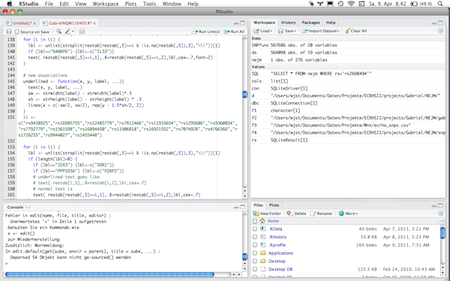
The screenshot below shows my desperate search why my Macbook wouldn’t boot again (following a cold reset writing a large Photoshop CS5 file for more than 15 minutes).

The verbose boot mode (APPLE+S) showed some error with the journalling system, basically an error as described at the currently non functioning Apple Support Board

jnl: replay_journal: bad block list header @ 0x4bra50 (checksum 0xega0fee1 != 0x927a5993)
jnl: journal_open: Error replaying the journal!
hfs: early jnl init: failed to open/create the journal (retval 0).

Unfortunately nothing helped. Booting from an external disk just showed a normal, error-free HD in disk utility. Continue reading A Mac OSX journalling error can inhibit the boot disk to be mounted


CC-BY-NC Science Surf , accessed 24.03.2026
Will the bacterial flora protect you from you allergies?

Here is another post as the field seems to progress so fast with a new study on enterotypes of the human gut microbiome from

22 newly sequenced faecal metagenomes of individuals from four countries with previously published data sets, here we identify three robust clusters (referred to as enterotypes hereafter) that are not nation or continent specific.

The 3 clusters are Bacteroides (enterotype 1), Prevotella (enterotype 2) and Ruminococcus (enterotype 3) – no idea if these are under selective pressure from the host (genes!), from enviroment (antibiotics!) or from microbial competitors. When we look, however, at another study published also last week at Science magazine, it seems that at least one cluster has it’s own trick to get the right of residence by synthesizing a symbiosis factor. Continue reading Will the bacterial flora protect you from you allergies?


CC-BY-NC Science Surf , accessed 24.03.2026
LIMIT TO 5! What about a maximum of 5 papers per year per scientist?

Undoubtly, there is an avalanche of poor research – as the Chronicle wrote last June, “we must stop the avalanche of low-quality research

the amount of redundant, inconsequential, and outright poor research has swelled in recent decades, filling countless pages in journals and monographs. Consider this tally from Science two decades ago: Only 45 percent of the articles published in the 4,500 top scientific journals were cited within the first five years after publication. In recent years, the figure seems to have dropped further

Also Genomeweb writes

Pedro Beltrao at the Public Rambling blog says there never seems to be enough time to keep up with all the literature researchers keep churning out. In 2009, 848,865 papers were added to PubMed, he says — that’s something like 1.6 papers per minute.

Continuing a discussion Continue reading LIMIT TO 5! What about a maximum of 5 papers per year per scientist?


CC-BY-NC Science Surf , accessed 24.03.2026

Gambling with the planet

Found at project-syndicate.org, a piece by Joseph E. Stiglitz (Professor at Columbia University and a Nobel laureate in Economics):

In the end, those gambling in Las Vegas lose more than they gain. As a society, we are gambling – with our big banks, with our nuclear power facilities, with our planet. As in Las Vegas, the lucky few – the bankers that put our economy at risk and the owners of energy companies that put our planet at risk – may walk off with a mint. But on average and almost certainly, we as a society, like all gamblers, will lose.
That, unfortunately, is a lesson of Japan’s disaster that we continue to ignore at our peril.


CC-BY-NC Science Surf , accessed 24.03.2026

The DNA window at the King’s College Chapel at the Strand

Here is another take home item of the recent EMGS 2011 meeting at the King’s College. Located in the apse there are 5 topics as originally conceived by Gilbert Scott: Christ in the carpenter’s shop, Christ and the lawyers, Christ healing the sick, Christ teaching the people and The Cruxification. While that may all be appropriate for today’s Sunday Continue reading The DNA window at the King’s College Chapel at the Strand


CC-BY-NC Science Surf , accessed 24.03.2026

Optimized SSD under OSX

Having now a SSD in use for more than one year, here are my accumulated tweaks. The first one is Smart Sleep which greatly enhances sleeping/wakening time. Disabling the motion sensor (“sudo pmset -a sms 0”) doesn’t hurt but is isn’t really necessary. Mounting the SSD noatime , however, gives a measurable performance gain. And at the end, I dropped that RAM thingy as it breaks with every system update.


CC-BY-NC Science Surf , accessed 24.03.2026

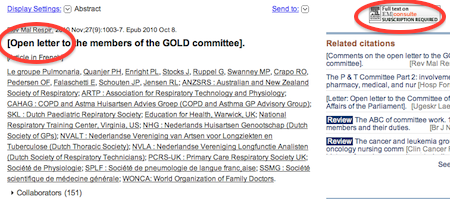
Open letter

a screenshot from Pubmed without words

probably as good as an email that I received recently:

This is the final reminder of your registration.
THE ABOVE BARCODE CONTAINS YOUR BADGE AND TICKET INFORMATION!
Please be sure to PRINT out this e-mail and BRING it with you to the meeting. The barcode included on this reminder will speed you through the registration and materials pick-up area.

Please consider the environment before printing this email.


CC-BY-NC Science Surf , accessed 24.03.2026

4 tons of CO2

I flew this night to San Francisco, having a chance to read some magazines in flight, including an interview of Stefan Klein with Peter Singer in ZEIT MAGAZIN yesterday. The interview has been done by Skype as Singer says “it is immoral to travel without serious reasons” – a classical Utilitarian perspective that does however not even stop him arguing Continue reading 4 tons of CO2


CC-BY-NC Science Surf , accessed 24.03.2026

Papers 2 – disappointing

I have long been waiting for upgrading Papers 1.9 as it is getting so slow with 10,000+ PDFs; there are notorious bugs that were never fixed (just delete an entry and see what happens). With the big hype around Papers 2, I hoped that all these problems would be cured while I also urgently need OCR, annotation and citation management.
When reading at the new support forum at http://support.mekentosj.com/discussions/problems/3118-papers-2-going-back-to-papers-1 of all the glitches introduced instead, it is probably time to say good bye now to Mekentosj.


CC-BY-NC Science Surf , accessed 24.03.2026

50% of all disease genes found, really?

I have been reading now many times in nature genetics that a few newly found SNPs explain about half of the attributable risk by genes while I fear that this probably mixes up different epidemiological concepts.
The population attributable risk is usually defined as the reduction in incidence that would be observed if the population were entirely unexposed. This cannot be meant as I don’t know of any genetic study examining incidence so far. Continue reading 50% of all disease genes found, really?


CC-BY-NC Science Surf , accessed 24.03.2026

R cloud computing

A recent article on WPA hacking using the Amzon EC2 cloud computing facility let me wonder whether there couldn’t be more useful projects. For example gene-gene interaction testing would be nice – indeed somebody has already setup a possibility to use R: Robert Grossman, director at the Informatics at the Institute for Genomics and Systems Biology. Great, many thanks!
What’s even better, a

… 60 Genomes dataset can be found here, as part of the public data that Bionimbus makes available to researchers. With the Bionimbus Community Cloud, the data is available via both the commodity Internet, as well as via high performance research networks, such as the National LambdaRail and Internet2 … If you are a member of the Bionimbus Community Cloud, then you don’t need to download the data but can compute over the data directly with Bionimbus. Currently, we are not making the Bionimbus Cloud generally available, but expect to do so beginning in approximately June, 2011.


CC-BY-NC Science Surf , accessed 24.03.2026

God is in the house

Last Sunday night, I heard an interesting broadcast at Ö1 on the way back from St. Moritz “Nach dem Willen Gottes. Religion, Erziehung und Gewalt. Gestaltung: Sebastian Fleischer” while couldn’t find the song played during the last 30 seconds.

Finally, here is it, although the Nick Cave version on youtube is still another one than at the Ö1 broadcast. An email clarified it:
Continue reading God is in the house


CC-BY-NC Science Surf , accessed 24.03.2026