CC-BY-NC Science Surf , accessed 22.08.2026
from referee3
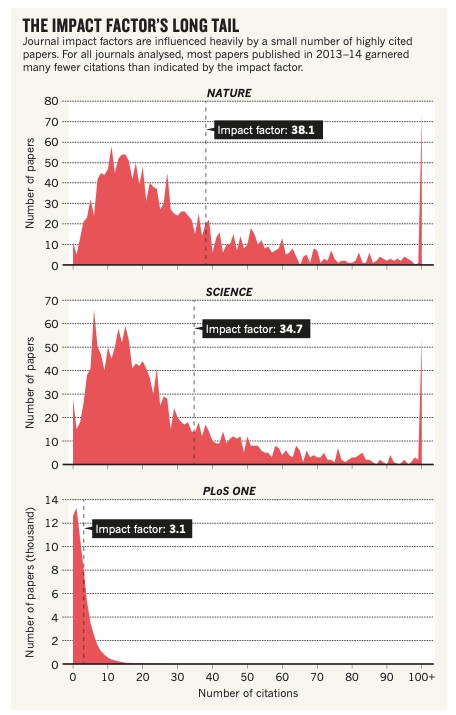
Even citation counts, the supposed gold standard, are close to worthless: only a tiny fraction of citations represent serious evaluation or validation, whereas the great majority represent nothing more than lazy copying and fashion-following. Two anecdotes demonstrate just how worthless citation counts can be:Some of the most highly-cited researchers in the world have been exposed as gaming the citation system and as charlatans. Papers with thousands of citations turn out to be false; obviously not one of those citations represented a serious validation.
credit for the link goes to J Metzger
Here is an interesting study published already some years ago “We Made History: Citizens of 35 Countries Overestimate Their Nation's Role in World History“. Continue reading We Made History
Take care – category joke here.
This article won’t change your mind
I remember looking at her and thinking, 'She's totally lying.' At the same time, I remember something in my mind saying, 'And that doesn't matter.'
Don’t miss Werner Herzog…
I find it increasingly difficult to get the haplotype structure of a given gene. While the are patches to the human genome at UCSC, this isn’t the same like good old hapmap.org by the HapMap consortium that has been retired back in 2016.
A recent computer security audit has revealed security flaws in the legacy HapMap site that require NCBI to take it down immediately. We regret the inconvenience, but we are required to do this. That said, NCBI was planning to decommission this site in the near future anyway (although not quite so suddenly), as the 1,000 genomes (1KG) project has established itself as a research standard for population genetics and genomics. NCBI has observed a decline in usage of the HapMap dataset and website with its available resources over the past five years and it has come to the end of its useful life.
It seems that also its successor, the 1000 genomes, will be retired during the next month. Unfortunately, the phasing server in Michigan does not allow any logon for whatever reason, UK biobank is too expensive so haplotypes basically vanished in the nirvana.

Es gibt zwar viele Fallgeschichten von out of body experience und Nahtoderfahrung. Angeblich soll der Körper auch 21 Gramm leichter werden aber verlässliche Daten gibt es keine. Eine neue Arbeit beschreibt aber nun die Hirnaktivität eines 87jährigen der einen Herzstillstand unter laufendem EEG erleidet.
Cross-frequency coupling revealed modulation of left-hemispheric gamma activity by alpha and theta rhythms across all windows, even after cessation of cerebral blood flow. The strongest coupling is observed for narrow- and broad-band gamma activity by the alpha waves during left-sided suppression and after cardiac arrest.
Die Vorerkrankung schränkt die Aussagekraft zwar ein, aber die Autoren schreiben
The alpha band is thought to critically interfere in cognitive processes by inhibiting networks that are irrelevant or disruptive … Given that cross-coupling between alpha and gamma activity is involved in cognitive processes and memory recall in healthy subjects, it is intriguing to speculate that such activity could support a last "recall of life" that may take place in the near-death state.
I think most active researchers are against the permanent rating of their work by research administrators like
as nobody can reliable measure the true relevance of their work.
https://twitter.com/MathiasLeroy_/status/1487446565438562310
Continue reading Best data visualizations
Lockdown effects can be clearly calculated

But why does the British Hart Group deny all lockdown effects?
Es gab schon immer Lehrbücher der Blickdiagnose. Dazu gibt es auch schon länger AI basierte Programme, die automatisiert Röntgen-, CT- oder PET Bilder erkennen und Diagnosen zuordnen können. Aber ein neuer Beitrag in nature genetics zeigt eine neue faszinierende Methode der schwierigen Diagnose genetischer Syndrome per Bildanalyse. Nach längerer Vorbereitung wurden hier 17.560 Patienten mit 1.115 Krankheiten in einem Datensatz erfasst. Die Zuordnung sollte damit auch für weniger erfahrene Experten leichter möglich sein. Das alles erinnert mich an ein mehrtägiges Frauenradrennen, das ich einmal fotografiert habe. Mit den täglichen Bildern auf der Siegertribüne liess sich auch ganz ohne KI die Zyklusschwankungen erkennen, allerdings nicht bei allen Teilnehmerinnen (V.a. funktionelle Amenorrhoe)
Den Gasverbrauch zu reduzieren wäre nun auch aus aktuellen politischen Gründen sinnvoll. Allerdings müsste man dafür den Verbrauch verstehen und nicht nur einmal im Jahr ablesen…
Nachdem es mit etwas Computerkenntnissen möglich ist, einen Stromzähler mit einem Raspberry PI auszulesen, müsste die Methode auch beim Gaszähler funktionieren. Die “Gasuhr” funktioniert dabei so, dass zwei Balgen wechselseitig gefüllt werden und die Füllung einer Kammer über eine Kurbelmechanik ein Zählrad antreibt. Continue reading Apropos Gasboykott – wie hoch ist eigentlich mein Gasverbrauch?
Not sure if it is really the biggest but certainly one of the most pressing problems: Out-of-distribution generalization. It is explained as
Imagine, for example, an AI that's trained to identify cows in images. Ideally, we'd want it to learn to detect cows based on their shape and colour. But what if the cow pictures we put in the training dataset always show cows standing on grass? In that case, we have a spurious correlation between grass and cows, and if we're not careful, our AI might learn to become a grass detector rather than a cow detector.
As an epidemiologist I would have simply said, it is colliding or confounding, so every new field is rediscovering the same problems over and over again.
Not unexpected AI just running randomly over pixels is leading to spurious association. Once shape and colour of cows has been detected, surrounding environment, like grass or stable is irrelevant. That means that after getting initial results we have to step back, simulate different lighting conditions from sunlight to lightbulb and environmental conditions from grass to slatted floor (invariance principle). Also shape and size matters – cow spots will keep to some extent size and form irrespective if it is a real animal or children toy (scaling principle). I am a bit more sceptical about including also multimodal data (eg smacking sound) as the absence of these features is no proof of non-existence while this sound can also be imitated by other animals.
And yes, less is more.
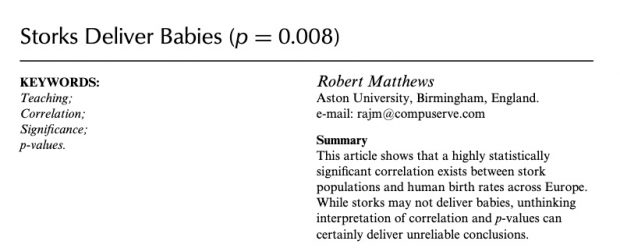
It cannot be said loud enough – storks deliver babies.