All posts by admin

Der Tanz auf dem Vulkan

Virologie und Epidemiologie sind der Eindämmung der Pandemie verpflichtet (Viren und ihre Ausbreitung kann man wissenschaftlich untersuchen).

Politik in der Demokratie ist der Mehrheitsfindung verpflichtet (mit Viren selbst kann man ja nicht verhandeln).

Juristen bedienen sich der Hermeneutik bestehender Gesetzestexte (auch wenn da eher wenig zu Viren steht).

Der “dance” wurde damit in den westlichen Demokratien zum großen Tanz auf dem Vulkan. Auch wenn die Zahlen langsam sinken, der Abstieg ist nun genauso mühsam und gefährlich wie der Aufstieg.
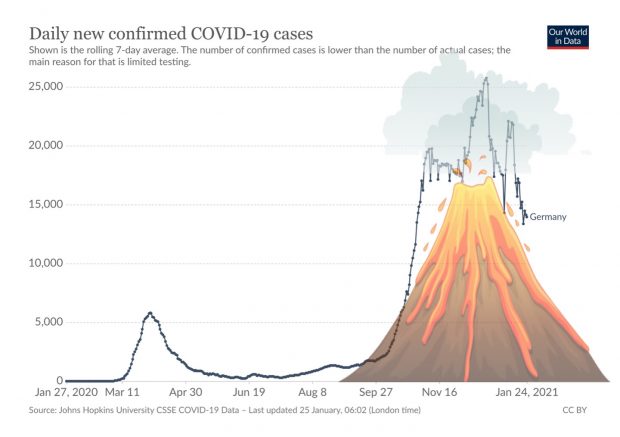
Quelle: https://www.pngegg.com/de/png-ddgel/download und https://ourworldindata.org/coronavirus/country/germany?country=~DEU

Den für mich unerwarteten zweiten großen Absturz in der Corona Pandemie hat Heribert Prantl vor 2 Tagen im Hangar-7 hingelegt. Bei Artikel 2 GG hat Prantl offensichtlich nur den ersten Halbsatz von (1) gelesen:

(1) Jeder hat das Recht auf die freie Entfaltung seiner Persönlichkeit, soweit er nicht die Rechte anderer verletzt und nicht gegen die verfassungsmäßige Ordnung oder das Sittengesetz verstößt.

(2) Jeder hat das Recht auf Leben und körperliche Unversehrtheit. Die Freiheit der Person ist unverletzlich. In diese Rechte darf nur auf Grund eines Gesetzes eingegriffen werden.
 

CC-BY-NC Science Surf , accessed 21.03.2026

COVID-19 Mortalität V: Vergleich Schweiz/Österreich

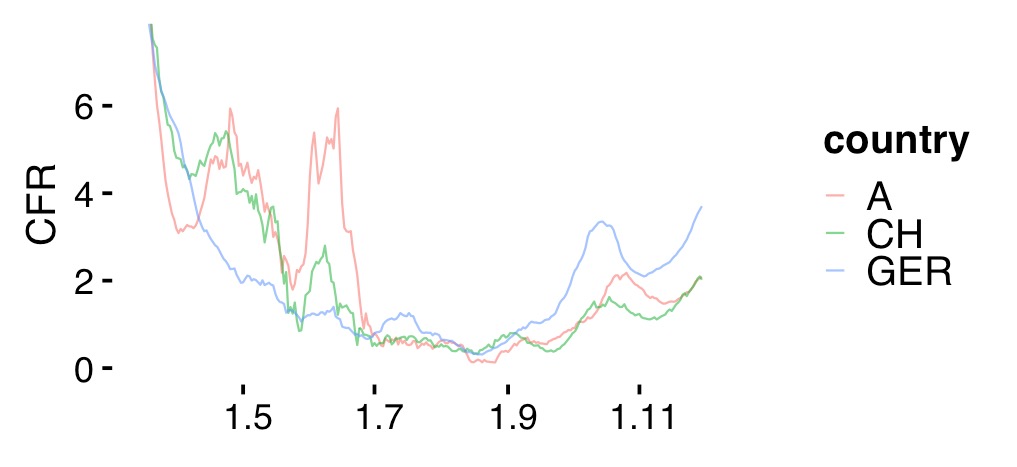
Hier noch ein Vergleich der Case Fatality Rate in Deutschland mit Österreich und der Schweiz.

Beide Länder haben in der ersten Phase offensichtlich dazu gelernt, wie man besser (nicht) beatmet, Deutschland hat eher nichts dazugelernt.


Quellen: RKI (Deutschland) https://experience.arcgis.com/experience/478220a4c454480e823b17327b2bf1d4 AGES (Österreich) https://covid19-dashboard.ages.at/dashboard.html sowie Dashboard (Schweiz) https://www.covid19.admin.ch/de/overview Download am 24.1.2021. CFR im gleitenden Mittel aus Fällen 14 Tage vor und Todesfällen 14 Tage nach dem Indextag. Letzter berichteter Wert 15.12.2020
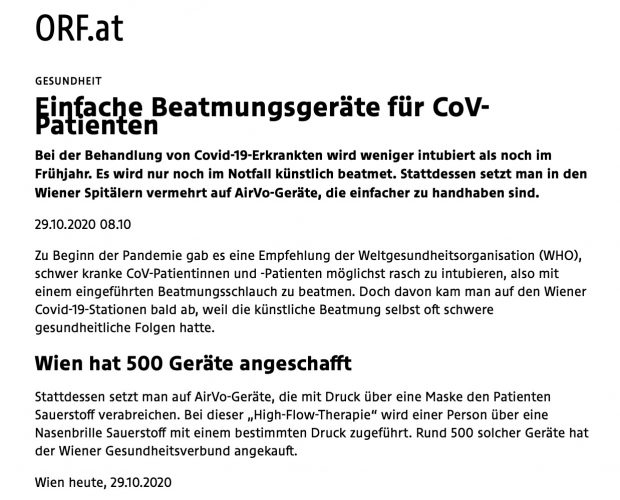
Zeitungsausriss 29.10.2021, überprüft am 24.1.2021, Quelle https://wien.orf.at/stories/3073495/


CC-BY-NC Science Surf , accessed 21.03.2026

Uri Geller in Nature

Alle Nature Artikel in meinem engeren Arbeitsgebiet lagen daneben. Warum es  aber trotzdem als höchste Auszeichnung gilt, einen Artikel dort veröffentlicht zu haben? Wo doch die allermeisten Artikel nicht einmal besonders häufig zitiert werden?
Und das mit Kosten für den deutschen Steuerzahler in Höhe von 9,500€?

Vielleicht sollte man doch mal an einen der legendärsten Artikel in Nature erinnern – die Studie zu Uri Geller (James Randi der den Geller Betrug aufgeklärt hat ist gerade erst verstorben).

The establishment of ESP [extrasensory perception] could conceivable require a paradigm shift (in Kuhn’s sense) of the most fundamental kind and our concepts of mind-brain relationships and cobsciousness would need radical alteration.

Es ist dabei nicht so sehr ein einzelner Artikel (den man natürlich hätte veröffentlichen können) sondern der monatelange Hype, der hier befeuert wurde.

Doch zurück zu den 9,500€ von den kein Reviewer einen Cent sieht. Undark hat eine vernichtende Analyse des Geschäftsmodells

But Springer Nature’s announcement also exposes a deep structural problem in scientific publishing. The proposed author fee, known as an article processing charge, or APC, is several times higher than what other publishers charge; it will likely be out of reach for researchers working outside of the world’s top institutions. Viewed in that light, Springer Nature’s move to open access seems less like a step toward equity and more like a corporation taking advantage of an uneven scientific funding landscape to increase its profits.


CC-BY-NC Science Surf , accessed 21.03.2026

Wissenschaftsjournalismus in Deutschland

Die Defizite des Wissenschaftsjournalismus in Deutschland sind ja offensichtlich von vielen Kommentaren hier etwa zur NO2 Berichterstattung,
zu den Crispr Cas Zwillingen oder auch zu COVID-19.

Aber gibt es eine mehr systematische Exploration?

Die folgenden Literaturhinweise verdanke ich Carsten Reinmann

Die Qualität der Berichterstattung über Wissenschaft

Zu dem Thema auch

Senja Post (2015) http://doi.org/10.1177/1464884914541067
Summ/Volpers (2016) http://doi.org/10.1177/0963662515583419
Guenther et al. (2019) https://doi.org/10.1080/1461670X.2017.1353432

Völlig unbeirrt hagelt es nun Preise.

Mai Thi Nguyen-Kim ist „medium magazin“ Journalistin des Jahres 2020.

Dazu die Recherchekooperation „Pillenkick“ von Correctiv und ARD-Dopingredaktion: Jonathan Sachse, Arne Steinberg (Correctiv) und Hajo Seppelt, Wigbert Löer, Josef Opfermann, Patricia Corniciuc, Jörg Mebus, Shea Westhoff (ARD).

Und Volker Stollorz, Science Media Center.


CC-BY-NC Science Surf , accessed 21.03.2026

Overloading reviewer

There is an interesting paper at bioRxiv on the never ending stream of review requests

… overburdening of reviewers to be caused by (i) an increase in manuscript submissions; (ii) insufficient editorial triage; (iii) a lack of reviewing instructions; (iv) difficulties in recruiting reviewers; (v) inefficiencies in manuscript handling and (vi) a lack of institutionalisation of peer review.

What makes it even more worse, that with the limited capacity of pre-publication review also the capacity of post-publication review is dropping…

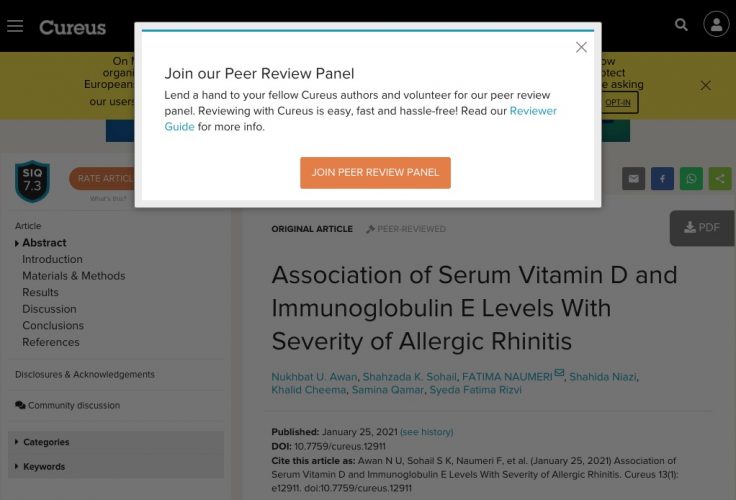
Want to be a predatory reviewer? Just click on “yes” at the Cureus website (but read up the gossip at researchgate first)


CC-BY-NC Science Surf , accessed 21.03.2026

Voll daneben

Christoph Lütge ist ja spätestens seit dem BILD Auftritt im Dezember nun auch deutschlandweit bekannt. Die menschenverachtende sozialdarwinistische Aussage “die Alten wären doch sowieso gestorben” steht in direkter Linie seines Credos “dass der Wettbewerb in vielen gesellschaftlichen Bereichen stärker als bisher … Problemlösungsmechanismus eingesetzt werden sollte“.


Archiv-Version.

Zum Glück blieb der Kollege gelassen.


CC-BY-NC Science Surf , accessed 21.03.2026

Bad apple or bad system?

A new piece in the Journal of Academic Ethics raises the important question if and why the earlier “bad apple” explanation of scientific misconduct has been largely abandoned by referencing to ‘institutional failure’ (bad barrels), and ‘structural crisis (bad system).

Dutch scientists in 2011 explained Diederik Stapel’s grand-scale data fabrication largely in systemic terms, whereas only fifteen years earlier, in the René Diekstra affair (1996) such explanations had been close to absent…


CC-BY-NC Science Surf , accessed 21.03.2026

Citation is not Confirmation

this is basically reframing a recent Twitter thread

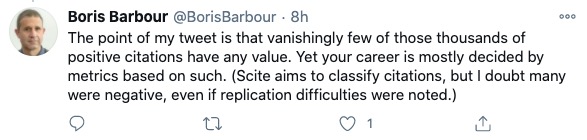
Excellence depends on citation. Citation depends on  popularity. Popularity depends on fanciness. Fanciness on newsworthiness. Newsworthiness on excellence. Excellence depends on citation …


CC-BY-NC Science Surf , accessed 21.03.2026

Fair enough

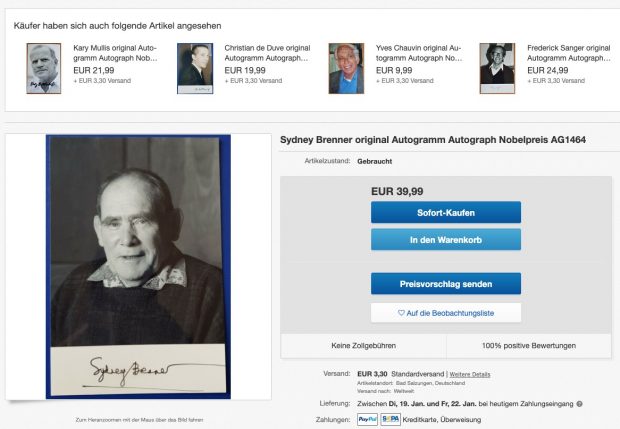
Wouldn’t pay 20 bucks for Mullis while 40 for Brenner is ok

My Life in Science
Sydney Brenner
BioMed Central: 2001. 191 pp. £14.99
“In April and May of 1994, Sydney Brenner sat down in front of a video camera and talked to Lewis Wolpert, recording enough to fill 15 videotapes. Errol Friedberg and Eleanor Lawrence have taken sections from the transcript of the interviews and woven them, with linking and explanatory passages added by Friedberg, into My Life in Science, an ‘autobiography’ of Brenner’s more than 50 years of research.”


CC-BY-NC Science Surf , accessed 21.03.2026

How to save a Twitter thread

This is not a trivial task as most browser produce garbage when printing to pdf. Also screenshots do not help so much with multipage threads. “Unroll” also doesn’t work reliable.

So I have been using the archive.today plugin before producing the pdf,  but this method is time consuming  as it needs a captcha.

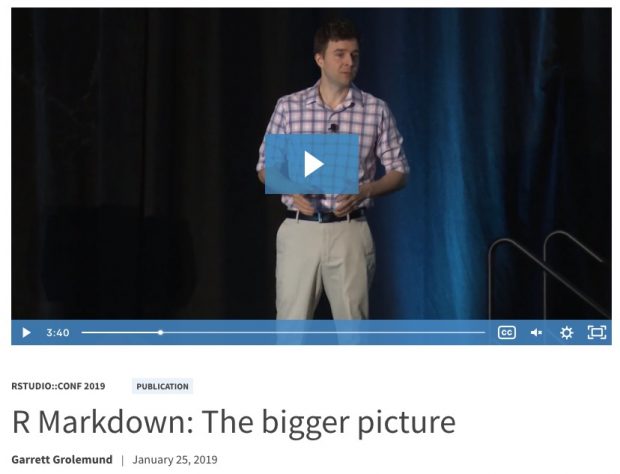
Having now Selenium running in a docker container, there is a more convenient solution where  just two lines of R are sufficient

remDr$navigate("https://twitter.com/SZ_Muenchen/status/1346425350394236930")
remDr$screenshot(file = 'screen.png')

Login is also possible as explained at github

username <- remDr$findElement(using = "name", value = "session[username_or_email]")
username$sendKeysToElement(list("XXX"))
passwd <- remDr$findElement(using = "name", value = "session[password]")
passwd$sendKeysToElement(list("XXX", "\uE007"))


CC-BY-NC Science Surf , accessed 21.03.2026

Give us our daily bias

When working today about COVID-19 mortality, I was falling back to the survivorship bias that is nice illustrated at Wikipedia and which is just another type of selection bias that I explained in my last talk.

During World War II, the statistician Abraham Wald took survivorship bias into his calculations when considering how to minimize bomber losses to enemy fire.The Statistical Research Group (SRG) at Columbia University, which Wald was a part of, examined the damage done to aircraft that had returned from missions and recommended adding armor to the areas that showed the least damage, based on his reasoning. This contradicted the US military’s conclusions that the most-hit areas of the plane needed additional armor.


CC-BY-NC Science Surf , accessed 21.03.2026