Category Archives: Allergy

The asthma and glaucoma island

Dr. Zamel, one of the PIs of the Tristan da Cunha study pointed me today to the interesting 30 min BBC documentation online at Allergy Canada

Allergy Island is an exclusive documentary on the history of asthma in Tristan da Cunha and the discovery of the gene related to asthma in that highly inbred community by the expedition that I did in 1993. I went in May 2008 to Tristan da Cunha with the BBC crew to film both parts for the entire month.


CC-BY-NC Science Surf accessed 19.02.2026

Ghost in your genes

was an earlier title of a BBC documentation about gene methylation. While running today an analysis of segregating methylation marks, I have major difficulties to find out the status of the human epigenome map. The Sanger site seems to be down for a long time, there aren’t any updates of the AHEAD consortium, the site of the Epigenetics Society is largely uniformative, methDB gives me “information about the research situation in France and why French scientists are in conflict with the current government”, an EU network excellence has only a fashionable website while another EU project is even not fashionable. Or do I miss something??


CC-BY-NC Science Surf accessed 19.02.2026

Forget about genes III

Here is another opinion from a widely read German magazine (Spiegel online, 25. Mai 2009, Jörg Blech, Wahrsager im Labor) about our too great expectations in genetics:

Während die einen noch mehr und noch größere Vergleichsstudien fordern, halten Skeptiker wie Goldstein dies für reine Zeitverschwendung: “Wenn man 30.000 Patienten mit Diabetes Typ 2 untersucht hat, dann halte ich es für sinnlos, die Zahl auf 60.000 oder 100.000 zu erhöhen.”

good bye to the “common variant hypothesis”!


CC-BY-NC Science Surf accessed 19.02.2026

IL17- Jekyll and Hide

We will probably submit our IL-17 paper next week – so it was of interest to read a new paper in NJ that

demonstrate a protective function for IL-17 and identify T cells as not only the source but also a target of IL-17 in vivo

for inflammatory bowel disease. Asthma may, however, present a different situation.


CC-BY-NC Science Surf accessed 19.02.2026

(1S,3Z)-3-[(2E)-2-[(1R,3aR,7aR)-7a-methyl-1-[(2R)-6-methylheptan-2-yl]-2,3,3a,5,6,7-hexahydro-1H-inden-4-ylidene]ethylidene]-4-methylidene-cyclohexan-1-ol

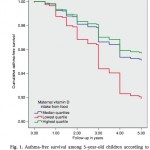
or briefly vitamin D3. There seems to be another vitamin D /allergy abstract at the forthcoming EAACI congress from the KOALA study. The authors find

Risk for AD was highest for children in the fourth quintile of maternal 25(OH)D level [adjusted odds ratio (aOR) 2.08; 95%CI 1.07-4.03] compared to those in the third quintile; P for trend over the quintiles 0.03]. Continue reading (1S,3Z)-3-[(2E)-2-[(1R,3aR,7aR)-7a-methyl-1-[(2R)-6-methylheptan-2-yl]-2,3,3a,5,6,7-hexahydro-1H-inden-4-ylidene]ethylidene]-4-methylidene-cyclohexan-1-ol


CC-BY-NC Science Surf accessed 19.02.2026

T_S_L_P

SPQR (is not necessary to be remembered) but certainly TSLP – at least if you are interested in allergy research (see the discussion here 2 years ago) when we knew from a PNAS paper that topical vitamin D3 induces thymic stromal lymphopoietin and triggers atopic dermatitis (in mice). Now there is an update – TSLP even mediates the progression to experimental asthma

vitamin D3 … not only triggers AD as we previously reported but also aggravates experimental allergic asthma induced by ovalbumin sensitization and challenge. Our study, which provides a mouse model to study human “atopic march

will be continued after Continue reading T_S_L_P


CC-BY-NC Science Surf accessed 19.02.2026

A fancy new category for a GWA result: same direction

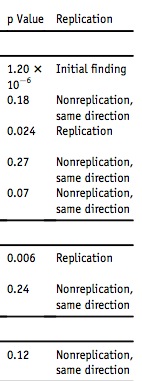
screenshot7 Isn’t that a funny new category as reported in the last asthma genome scan – “same direction”? Should that provide evidence that isn’t there?
Of 10 samples only one replicates (FHS) and one shows borderline (COP) association to PDE4D / rs 1588265.

… in the absence of biological evidence we cannot exclude the possibility that the associations we measured were due to chance only

yea, yea.
BTW Also here – magically, previously associated genes disappear


CC-BY-NC Science Surf accessed 19.02.2026

Shift happens

The current issue of the blue journal has more stuff on the vitamin D hypothesis (that has been shifted recently into the opposite direction). I agree with the editorial that

Intervention studies of vitamin D in the primary prevention and treatment of asthma raise a number of difficult scientific, ethical, and regulatory issues.

That may be true while the editorial includes the widely quoted myth that immunological effects occur only at high doses Continue reading Shift happens


CC-BY-NC Science Surf accessed 19.02.2026